| |
 |
 |
| |
|
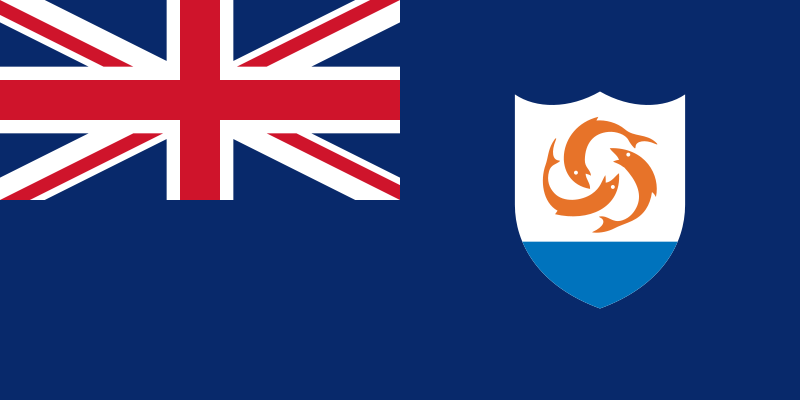
Anguilla |
| |
 |
 |
| |
c.1500 Discovered and named Isla de Anguila.
02 Jul 1627 Granted to James, Earl of Carlisle by King Charles I
of England (as part of the Islands of Carlisle
Province, also called Carliola); no settlement.
c.1631 Dutch fort, founded earlier, is abandoned.
1650 Anguilla settled by unauthorized settlers from
St. Christopher.
1670 - 1816
Part of Leeward Islands colony (under Antigua).
21 - 22 Dec 1688
Spanish attempted invasion.
1689 - 1689
Population briefly evacuated to Antigua.
1724 Anguilla formally made part of St. Christopher.
21 May 1745 French invasion attempt.
Nov 1796 French invasion attempt.
1816 - 1871
Part of St. Christopher, Nevis, Anguilla, and the
British Virgin Islands colon (under Saint Kitts and Nevis).
19 Dec 1832 - 01 Jul 1956 Part of the Leeward Islands (see Antigua).
1856 - 1867
U.S. claims Sombrero Island.
1882 Part of colony of Saint
Christopher-Nevis-
Anguilla (under Saint Kitts and Nevis).
01 May 1956 Sombrero Island transferred from the British Virgin
Islands to Saint Christopher-Nevis-Anguilla.
27 Feb 1967 Associated state of Saint Christopher-Nevis-
Anguilla (under Saint Kitts and Nevis).
30 May 1967 St. Christopher-Nevis police officials evicted.
11 Jul 1967 Referendum supports separation from St. Christopher
-Nevis, 99.7% to 0.28% (1,813 votes to 5).
12 Jul 1967 Independence proclaimed (not recognized by U.K.)
17 Oct 1967 Elections in Anguilla, Anguilla Council created.
06 Feb 1969 Referendum supports independence, 99.7%-0.29%
(1,739 votes to 4).
06 Feb 1969 Republic of Anguilla proclaimed (not recognized).
19 Mar 1969 British rule restored under emergency powers.
27 Jul 1971 Anguilla formally detached from St. Kitts-Nevis.
04 Aug 1971 Anguilla (Administrative) Order passed by U.K.
10 Feb 1976 Anguilla (Constitution) Order comes into operation.
19 Dec 1980 Anguilla becomes a separate dependency under
the Anguilla Bill by U.K. |
Nov 1493 Discovered by Columbus named Isla de Anguila.
c.1631 Dutch fort erected, later destroyed by the Spanish.
1650 English colony, ruled from St. Christopher.
1696 - 1816
Part of Leeward Islands colony (under Antigua).
1666 - 1667
French occupation.
21 May 1745 French invasion attempt.
Nov 1796 French invasion attempt.
1816 - 1871
Part of St. Christopher, Nevis, Anguilla, and the British
Virgin Islands colony. (Now Saint Christopher is known as
Saint Kitts).
1832 - 1871
Part of Leeward Islands colony (under Antigua).
1871 - 01 Jul 1956 Part of the
Federal Colony of the Leeward Islands (under
Antigua).
1882 Part of colony of Saint
Christopher-Nevis-Anguilla.
27 Feb 1967 Associated state of Saint Christopher-Nevis-Anguilla.
09 Mar/30 May 1967 St.
Christopher-Nevis officials evicted.
16 Jun 1967 Anguilla unilaterally withdraws from Saint Christopher-Nevis
11 Jul 1967 Referendum supports separation from St. Kitts.
12 Jul 1967 Independence proclaimed (not recognized by U.K.)
06 Feb 1969 Republic of Anguilla proclaimed (not recognized).
19 Mar 1969 British rule restored.
15 Sep 1969 Reunited with St. Kitts-Nevis de jure, de facto direct
British administration.
10 Feb 1976 Autonomy
19 Dec 1980 Anguilla becomes a separate dependency de jure. |
|
|
|
|
 |
The British dependency of
Anguilla, a self-governing British territory situated in the east Caribbean
Sea about 60 miles (100 km.) northwest of St. Kitts, has an area of 35 sq.
mi. (91 sq. km.) and an approximate population of 12,000.
Capital: The Valley. In
recent years, tourism has replaced the traditional fishing, stock raising
and salt production as the main industry. Anguilla was discovered by
Columbus in 1493 and became a British colony in 1650. As the other British
areas in the West Indies did, Anguilla officially adapted to Pound Sterling
beginning in 1825. From 1950 to 1965, Anguilla was a member of the British
Caribbean Territories (Eastern Group) Currency Board, whose coinage it used.
In March 1967, Anguilla was joined politically with St. Christopher (St.
Kitts), as it had been for much of its colonial history, and Nevis to form a
British associated state. On June 16, 1967, the Provisional Government of
Anguilla unilaterally declared its independence and seceded from the
Federation. |
| Later, on July 11, 1967, a vote of confidence was taken and
the results favored independence. Britain refused to accept the
declaration (nor did any other country recognize it) and appointed
a British administrator whom Anguilla accepted. However, in Feb.
1969 Anguilla ousted the British emissary, voted to sever all ties
with Britain, and established the Republic of Anguilla. The following
month Britain landed a force of paratroopers and policemen.
This bloodless counteraction ended the self-proclaimed
republic and resulted in the installation of a governing commissioner.
The troops were withdrawn in Sept. 1969, and the Anguilla
Act of July 1971 placed Anguilla directly under British control. A
new constitution in 1976 established Anguilla as a self-governing
British dependant territory. Britain retains power over defense,
police and civil service, and foreign affairs. Since 1981, Anguilla
has employed the coinage of the East Caribbean States.
Motto: "Strength and Endurance. |
| |
|
|
- Chairman of the Peace-keeping
Committee
- Walter G.
Hodge.................................31 May 1967 - 12 Jul 1967 d. 1989
- Chief
Executives (and from 21 Oct 1967, Chairman of the Anguilla Council)
- Peter
Adams.....................................12 Jul 1967 - 04 Aug 1967
- Independence was declared
on 11 Jul 1967, but not recognized by UK. Peter Adams also served as Warden
(magistrate) from Jul 1967 to 23 May 1968.
- Ronald
Webster (1st time).......................04 Aug 1967 -
08 Jan 1968
- Commissioner
- Anthony "Tony" Lee
(1st time)...................08 Jan 1968 -
09 Jan 1969
- He also became Commissioner
under British rule from 19 Mar to 20 Apr 1969.
- Chief Executive
and Chairman of the Anguilla Council
- Ronald Webster (2nd
time).......................09
Jan 1969 - 21 Feb 1969
- President
- Ronald Webster (continued)......................21
Feb 1969 - 19 Mar 1969
- He served as the Chairman
of Anguilla Council from 09 Jan 1969 to 10 Feb 1976 and twice Chief Minister
from 10 February 1976 to 02 February 1977 and again from 28 May 1980 to 12
March 1984. He died on 09 December 2016.
- Great Britain...................................19
Mar 1969 -
date
- After two rebellions in
1967 and 1969 and a brief period as a self-declared independent republic
headed by Ronald Webster, British rule was fully restored in July 1971.
Anguilla became a separate British dependency (now termed a British overseas
territory) in 1980.
|
| |
- Commissioners
- Anthony "Tony" Lee
(2nd time)...................19
Mar 1969 - 20 Apr 1969
- John Alfred
Cumber..............................20 Apr 1969 - 1969
- Willoughby Harry
Thompson..........................Jul 1969 - 1971
- Arthur Christopher
Watson..............................1971 - 1973
- He was a British Civil
Servant. Watson served as Commissioner of Anguilla from 1971 to 1974. He
was then the Governor of the Turks and Caicos from May 1975 until July
1978. He then served as Governor of Montserrat from 1985 until 1987.
Watson was also the last British High Commissioner to Brunei before
independence, serving from 1978 until independence on 1 January 1984.
- David Le
Breton........................................1974 - 1978
- Charles Harry
Godden...................................1978 - 01 Apr 1982
- Governors
- Charles Harry
Godden (continued)................01
Apr 1982 - 1983
- Alastair Turner
Baillie.........................30 Nov 1983 - 07 Apr 1987
- Geoffrey Owen
Whittaker.........................17 May 1987 - 1989
- Brian George John
Canty.........................25 Nov 1989 - 1992
- Alan William
Shave..............................14 Aug 1992 - 31 Oct 1995
- Alan Norman Hoole...............................03
Nov 1995 - Dec 1996
- Robert Harris (acting
to 29 May 1997)..............Dec
1996 - 27 Jan 2000
- Roger Cousins (acting)
.........................27 Jan 2000 - 04 Feb 2000
- Peter
Johnston..................................04 Feb 2000 - 29 Apr 2004
- Mark Andrew Capes
(1st time -
acting)...........29
Apr 2004 - 28 May 2004
- Alan Edden Huckle...............................28
May 2004 - 02 Jun 2006
- Mark Andrew Capes
(2nd time -
acting)...........02
Jun 2006 - 10 Jul 2006
- Andrew
Neil George..............................10 Jul 2006 - 12 Mar 2009
- Stanley E. Reid (1st
time - acting).............12
Mar 2009 - 21 Apr 2009
- William Alistair
Harrison.......................21 Apr 2009 - 18 Jul 2013
- Stanley E. Reid (2nd
time - acting).............18
Jul 2013 - 23 Jul 2013
- Christina Martha
Elena Scott (female)...........23
Jul 2013 - 17 Aug 2017
- Perin Bradley (acting)..........................17
Aug 2017 - 21 Aug 2017
Timothy "Tim" John Foy..........................21 Aug 2017 - date
|
| |
| Currency:
Since 1981, East Caribbean Dollar is used on this Island. There is no evidence that the issues of the self-proclaimed
Provisional Government ever actually circulated. The c/s
series most likely served as souvenirs of the “revolution”, dated 1968 to
1970. By action taken by the council on the 30th
December 1968. |
| |
|
ND (1968) |
| |
|
 |
KM#26 25 Dollars. Year:
ND (1968).
Weight: 31.00g.
Metal:
0.999 Silver. Diameter:
43.00 mm. Edge:
Reeded.
Alignment:
Medal.
Mint:
N/A.
Obverse: Three intertwined dolphins
form circle, text: "Issued by Authority of the Government of
Anguilla W.I.". Reverse:
President Ronald Webster bust facing left.
Text: "Commemorating the First Year of Independence 11th July 1968.
Ronald Webster, First President of the Council".
Subject: 1st Year of
Independence. |
| Some coin collectors believe
that this coin was probably produced in 1974. |
|
| |
|
1970 |
| |
|
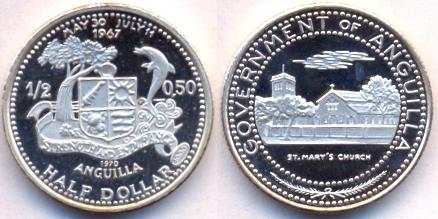 |
KM#15 1/2 Dollar. Year:
1970.
Weight: 3.61g.
Metal:
0.999 Silver. Diameter:
18.50 mm. Edge:
Reeded.
Alignment:
Coin.
Mint:
Italcambio Mint, Arezzo, Italy. |
|
Obverse: Coat of Arms of Anguilla with motto: "Strength
and Endurance" on ribbon below, in center, MAY 30 JULY 11 / 1967 /
1970 / ANGUILLA / HALF DOLLAR and 1000 hallmark around below, within
outer circle of pearls around 4 o'clock.
Reverse:
St. Mary’s Church picture and written within inner circle of pearls,
"Government of Anguilla", around above, small partial wreath tied
with ribbon below, within outer circle of pearls.
Mintage: 4,200 (including 1969).
Minted Years:
1969 and 1970 (Krause publication also indicates coins
produced without date). |
|
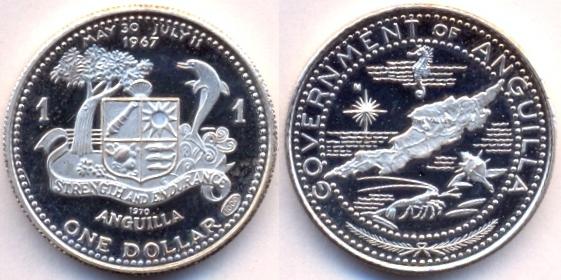 |
KM#16 Dollar. Year:
1970.
Weight: 7.18g.
Metal:
0.999 Silver. Diameter:
24.00 mm. Edge:
Reeded.
Alignment:
Coin.
Mint:
Italcambio Mint, Arezzo, Italy.
Obverse: Coat of Arms of Anguilla with motto: "Strength
and Endurance" on ribbon below, in center, MAY 30 JULY 11 / 1967 /
1970 / ANGUILLA / ONE DOLLAR and 1000 hallmark around below, within
outer circle of pearls around 4 o'clock. |
|
Reverse:
Anguilla Map, Seahorse and Caribbean Silver Lobster within inner
circle of pearls, "Government of Anguilla", around above, small
partial wreath tied with ribbon below, within outer circle of
pearls.
Mintage: 4,450 (including 1969).
Minted Years:
1969 and 1970 (Krause publication also indicates coins
produced without date). |
|
 |
KM#17 2 Dollars. Year:
1970.
Weight: 14.14g.
Metal:
0.999 Silver. Diameter:
31.50 mm. Edge:
Reeded.
Alignment:
Coin.
Mint:
Italcambio Mint, Arezzo, Italy.
Obverse: Coat of Arms of Anguilla with motto: "Strength
and Endurance" on ribbon below, in center, MAY 30 JULY 11 / 1967 /
1970 / ANGUILLA / TWO DOLLAR and 1000 hallmark around below, within
outer circle of pearls around 4 o'clock. |
|
Reverse:
Anguilla Map with independence Flag within inner circle of pearls,
"Government of Anguilla", around above, small partial wreath tied
with ribbon below, within outer circle of pearls.
Mintage: 4,150 (including 1969).
Minted Years:
1969 and 1970 (Krause publication also indicates coins
produced without date). |
|
 |
KM#18.1 4 Dollars. Year:
1970.
Weight: 28.48g.
Metal:
0.999 Silver. Diameter:
42.00 mm. Edge:
Reeded.
Alignment:
Coin.
Mint:
Italcambio Mint, Arezzo, Italy.
Obverse:
Coat of Arms of Anguilla with motto: "Strength
and Endurance" on ribbon below, in center, MAY 30 JULY 11 / 1967 /
1970 / ANGUILLA / FOUR DOLLAR and 1000 hallmark around below, within
outer circle of pearls around 4 o'clock. |
|
Reverse:
Atlantic Star picture and written within inner circle of pearls,
"Government of Anguilla", around above, small partial wreath tied
with ribbon below, within outer circle of pearls.
Mintage: 5,100 (including 1969).
Minted Years:
1969 and 1970 (Krause publication also indicates coins
produced without date).
KM#18.2 also exists with two hallmarks at 4
o'clock on the reverse side. |
|
| |
| |
|
|
| Countries
/ Territories |
| |
|
Chiefa Coins | |
|