|
 |
 |
| |
 |
 |
|
|
10 Nov 1493
Antigua discovered and claimed by Spain by Christopher
Columbus, named Isla de Santa Maria de la Antigua
11 Nov
1493 Barbuda and Redonda discovered by Christopher Colombus
as Isla Dulcina and Santa Maria la Redonda (Saint Mary
the round)
respectively
1628 English
colony of Barbuda
1632 English colony of
Antigua, Barbuda becomes a
dependency of Antigua
1663
English crown colony of Antigua
1666 The village of
Codrington established in Barbuda
03 Nov 1666 - May 1667 French occupation of Antigua
Jan 1671 - 16 Oct 1816 part
of Leeward Islands colony (Antigua, Barbuda,
Montserrat, Saint Christopher, Nevis, Anguilla and
Dominica [to 1770]
1678
Barbuda an English colony
09 Jan 1685 - 1870 Barbuda
leased to Codrington family by the crown
1816 - 1832
Part of Antigua-Barbuda-Montserrat colony
1833 - 01 Jan 1960 part of
Leeward Islands (Antigua, British Virgin
Islands, Dominica [to 1940], Montserrat, Saint
Christopher-Nevis-Anguilla
01 Aug 1860
Barbuda united with Antigua
Jun 1865 Kingdom of Redonda proclaimed by Matthew Dowdy Shiel,
not recognized by UK.
Jun 1871 Antigua part
of Federal Colony of Leewards Islands
26 Mar
1872 Redonda annexed by Britain; incorporated with Antigua
01 Jul 1956 Antigua part of Territory of Leewards Islands
30
Jun 1956 Antigua becomes a separate colony
03 Jan 1958 - 31 May 1962 Antigua becomes part of Federation of the
West Indies
under Trinidad and Tobago
27
Feb 1967 associated state. Redonda as dependency of Antigua
23 Dec
1976 Barbuda Local Government Act grants limited autonomy
01 Oct
1980 Barbuda attempts secession from Antigua but fails
01 Nov 1981 Independence as Antigua and Barbuda. Redonda as
dependency
|
| |
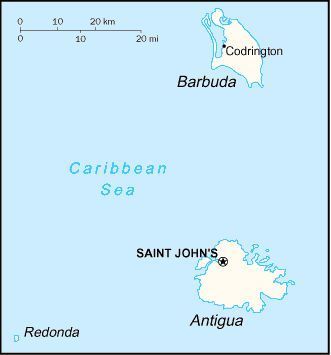 |
Antigua and Barbuda has an
area of 170 sq. mi. (440 sq. km.) with capital: Saint John's. Prior to 1967,
Antigua and its dependencies Barbuda and Redonda, comprised a presidency of
the Leeward Islands. The mountainous island produces sugar, molasses, rum,
cotton and fruits. Antigua was discovered by
Columbus in 1493, settled by British colonists from Saint Kitts in 1632. It
was occupied by the French in 1666, and ceded to Britain in 1667. It became
an associate state with internal self-government on February 27, 1967. On
November 1, 1981 it became independent as Antigua and Barbuda. As a
constitutional monarchy, Elizabeth II is Queen of Antigua and Barbuda and
Head of State. Antigua and Barbuda is a member of the commonwealth of
Nations. |
| |
-
Claimed by Spain.................................10 Nov 1493 - 1632
- Great Britain...........................................1632 -
03 Nov 1666
-
France...........................................03 Nov 1666 - May 1667
- Great Britain (Barbuda
occupied 1678)...............May
1667 - 1973
- Self-governing
dependency...............................1973 - 01 Nov 1981
- Governor of Antigua
- Sir Wilfred Ebenezer Jacobs......................27
Feb 1967 - 01 Nov 1981
- Governor-General of Antigua and Barbuda
-
representing the British monarch as head of
state
- Sir Wilfred Ebenezer Jacobs (continued)..........01
Nov 1981 - 10 Jun 1993
- James Beethoven Carlisle.........................10
Jun 1993 - 17 Jul 2007
- from 09 Nov 1993, Sir James Beethoven Carlisle.
- Louise Agnetha Lake-Tack (female)................17
Jul 2007 - 13 Aug 2014
- from 17 Oct 2007, Dame Louise Agnetha Lake-Tack.
- Rodney
Williams..................................14 Aug 2014 - date
|
|
|
|
Monetary standard:
East Caribbean Dollar = 100 cents
Spanish silver coinage and French colonial "Black
Dogs" were used throughout the island's early history; however, late in
the seventeenth century in the introduction of British tin farthings was
attempted with complete lack of success. In 1822, British colonial
Anchor Money was introduced. From 1825 to 1955, Antigua was on the
sterling standard and used British coins. Coins of the British Caribbean
Territories (Eastern Group) and East Caribbean States circulated from
1955. East Caribbean Currency Authority banknotes are now used on the
island. The early coinage was augmented by that of the East Caribbean
States in 1981. |
|
The East Caribbean dollar (sign: $; code: XCD) is
the currency of eight of the nine members of the Organisation of Eastern
Caribbean States (the one exception being the British Virgin Islands).
It has existed since 1965, being the successor to the British West
Indies dollar, and it is normally abbreviated with the dollar sign $ or,
alternatively, EC$ to distinguish it from other dollar-denominated
currencies. The EC$ is subdivided into 100 cents. It has been pegged to
the United States dollar since July 07, 1976 and the exchange rate is
US$1 = EC$2.70. Six of the states using the EC$ are independent states:
Antigua and Barbuda, Dominica, Grenada, Saint Kitts and Nevis, Saint
Lucia, and Saint Vincent and the Grenadines. The other two are British
overseas territories: Anguilla and Montserrat.
Commemorative coins were produced by Antigua
and Barbuda in
1970, 1982, 1985 and 1988. |
|
|
|
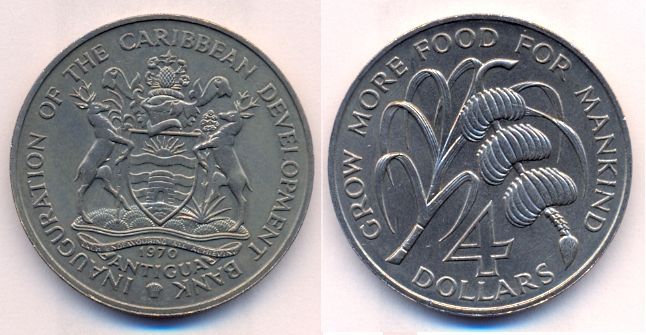 |
| KM#1 4
Dollars. Year:
1970. Weight:
28.30 grams.
Metal:
Copper-Nickel. Edge:
Reeded. Diameter:
38.50 mm.
Alignment:
Medal. Mint:
British Royal Mint.
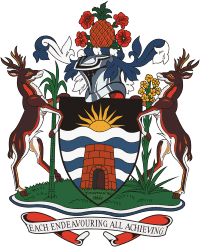
Obverse: Antigua Coat and Arms with Motto: "Each Endeavouring All Achieving".
Date and "ANTIGUA" below it. "INAUGURATION OF THE CARIBBEAN DEVELOPMENT
BANK" around.
Reverse:
Sugar cane and Banana tree branches in the center.
"GROW MORE FOOD FOR MANKIND" on the
top part and value "4 DOLLARS" at the bottom. F.A.O issue.
Mintage:
16,000 (including 2,000 proof pieces).
Minted Years: One year
type. British Antigua Governor:
Sir Wilfred Ebenzer Jacobs (27
Feb 1967 - 01 Nov 1981) under
British monarch:
Elizabeth II [Elizabeth Alexandra Mary Windsor].
|
|
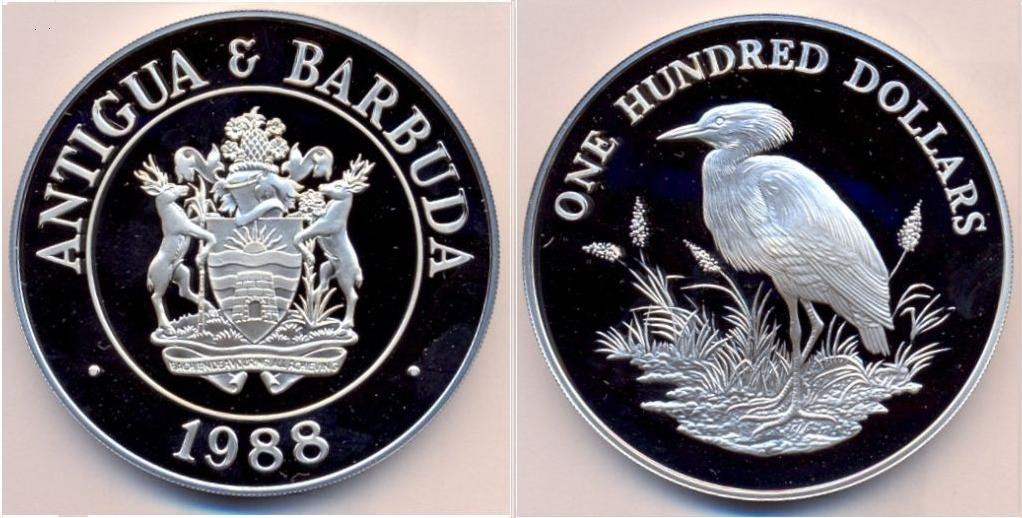 |
| KM#6 100
Dollars. Year:
1988. Weight:
129.59 grams.
Metal: .925 Silver.
Diameter:
63.00 mm. Edge:
Reeded. Alignment:
Medal. Mint:
British Royal Mint.
Obverse: Coat and Arms in circle - with Motto:
"Each Endeavouring All Achieving" within the center
circle. "ANTIGUA & BARBUDA" above the
center circle and date at the bottom.
Reverse: Tropical Bird: Cattle Egret. "ONE
HUNDRED DOLLARS" written at the top.
Mintage:
10,000 (estimated).
Minted Years: One year
type. Governor-General:
Sir Wilfred Ebenzer Jacobs (01 Nov 1981
- 10 Jun 1993) representing British monarch:
Elizabeth II [Elizabeth Alexandra Mary Windsor].
|
|
| |
| |
|
|
|
Countries
/ Territories |
| |
|
Chiefa Coins |
|
|