|
 |
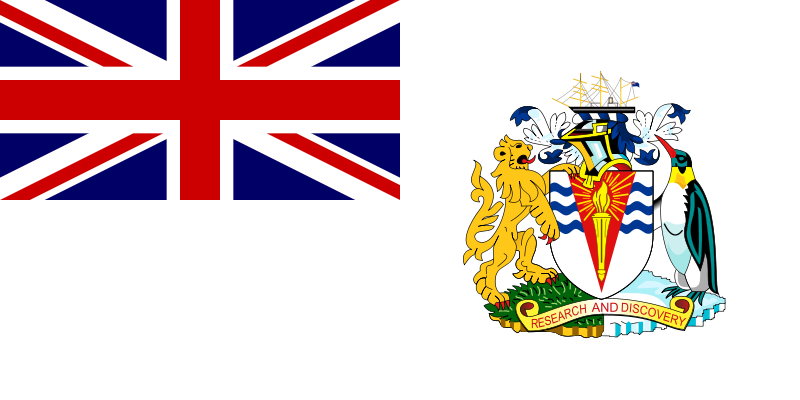
| British Antarctic Territory | |||||
 |
|
||||
|
16 Oct 1819 South Shetland Islands claimed for Britain. 16 Nov 1820 Palmer Land discovered by American Capt. Nathaniel Palmer. 06 Dec 1821 South Orkney Islands claimed for Britain, named Powell's Group (renamed the South Orkney Islands Feb 1822). 21 Feb 1832 Graham Land in Antarctica annexed for Britain by Capt. John Biscoe. 01 Apr 1903 - 22 Feb 1904 First permanent scientific station established in the Antarctic, at Laurie Island, South Orkneys by the Scottish National Antarctic expedition under William Speirs Bruce, then sold to Argentina. 21 Jul 1908 Antarctica south of 50° between 20° W and 80°W longitude, South Shetland Islands, and South Orkney Islands officially annexed by Britain as the Falkland Islands Dependencies. 06 Nov 1940 South Shetland Islands claimed by Chile. 08 Feb 1942 South Shetland Islands claimed by Argentina. 1943 - 1945 British dispatch naval missions to Antarctica "Operation Tabarin" which established the first permanent British scientific bases. Oct 1948 Falkland Islands Dependencies Survey created in Stanley, Falkland Islands. Jun 1950 Falkland Islands Dependencies Scientific Bureau organized in London. 01 Jan 1962 British Antarctic Survey headquarters in London. 03 Mar 1962 British Antarctic Territory (South Shetland Islands, South Orkney Islands, and Graham Land) made a separate dependency. |
|||||
|
|
|||||
|
The British Antarctic Territory
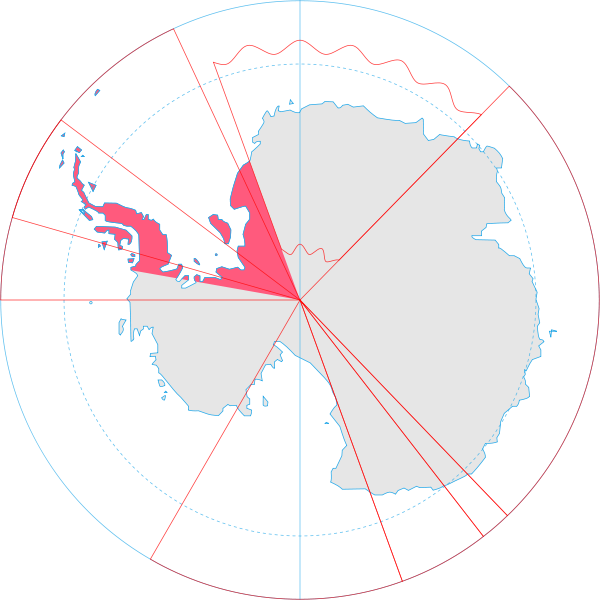
(BAT) is a sector of Antarctica claimed by the United Kingdom as one of its 14
British Overseas Territories. It comprises the region south of 60°S latitude and
between longitudes 20°W and 80°W, forming a wedge shape that extends to the
South Pole. The Territory was formed on 3 March 1962, although the UK's claim to
this portion of the Antarctic dates back to Letters Patent of 1908 and 1917. The
area now covered by the Territory includes three regions which, before 1962,
were administered by the British as separate dependencies of the Falkland
Islands: Graham Land, the South Orkney Islands, and the South Shetland Islands.
The Territory overlaps the Antarctic claims of Argentina (Argentine Antarctica)
and Chile (Antártica Chilena Province) is not been recognized by the United
Nations, U.S., Russia or by most other countries (other than Australia and New
Zealand). It is inhabited by the staff of research and support stations operated
and maintained by the British Antarctic Survey and other organisations, and
stations of Argentina, Chile and other countries. There are no native
inhabitants. Capital:
Rothera
(Main base). Chief
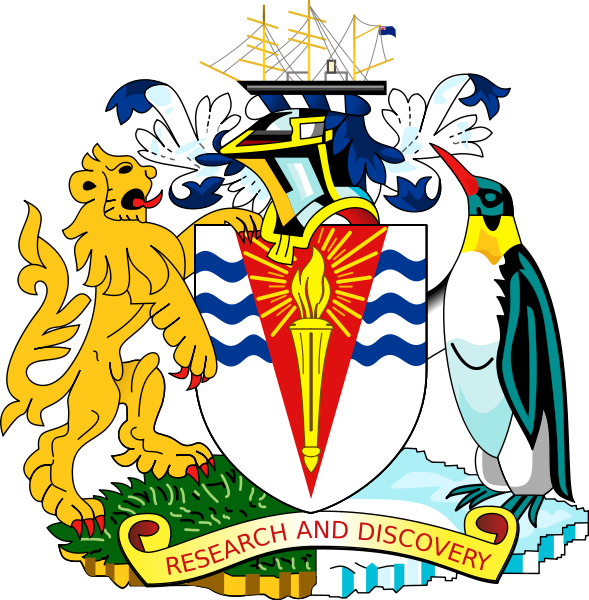
Stations: Halley V, Rothera and Signy. Motto: "Research
and discovery". The British Antarctic Survey has two permanently staffed research stations in the Territory: Halley and Rothera. Signy was operated from 1947 until 1996 and now is only staffed in the summer. There are also two summer-only forward operating stations, at Fossil Bluff and Sky Blu. Faraday was maintained until 1996, when it was sold to Ukraine and renamed Akademik Vernadsky Station. Since 1996, the historic base at Port Lockroy on Goudier Island has been staffed by the UK Antarctic Heritage Trust during the Antarctic summer. Receiving about 10,000 visitors a year, it is one of the most visited sites on the continent. Visitors can tour the museum, buy souvenirs, post mail, and view the large gentoo penguin colony. Argentine presence in the territory dates to the foundation of the Orcadas Base, South Orkney Islands in 1903. A number of other nations maintain bases in the territory, many in the South Shetland Islands. The South Orkney Islands were discovered in 1821 by two sealers, Nathaniel Brown Palmer and George Powell. The Islands were originally named Powell's Group, with the main island named Coronation Island as it was the year of the coronation of King George IV. In 1823, James Weddell visited the Islands, gave the archipelago its present name (after the Orkney Islands, Scotland) and also renamed some of the islands. The South Orkney Islands are located at roughly the same latitude south as the Orkney Islands are north (60°S vs 59°N), although it is not known if this was a factor behind the naming of the islands. Territorial Disputes: Mauritius claims the Chagos Archipelago including Diego Garcia; in 2001, the former inhabitants of the Chagos Archipelago, evicted in 1967 and 1973 and now residing chiefly in Mauritius, were granted UK citizenship and the right to repatriation; in May 2007, the UK Court of Appeals upheld the May 2006 High Court of London judgment reversing the UK government's 2004 Orders of Council that banned habitation on the islands, but the ban was upheld 22 Oct 2008 by the British House of Lords; a small group of Chagossians visited Diego Garcia in Apr 2006; repatriation is complicated by the exclusive US military lease of Diego Garcia that restricts access to the largest viable island in the chain, the US lease on Diego Garcia expires in 2016. |
|||||
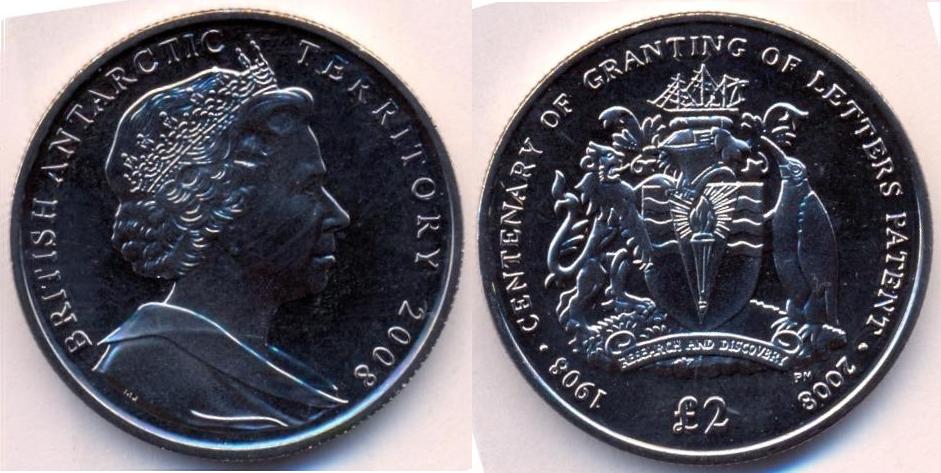
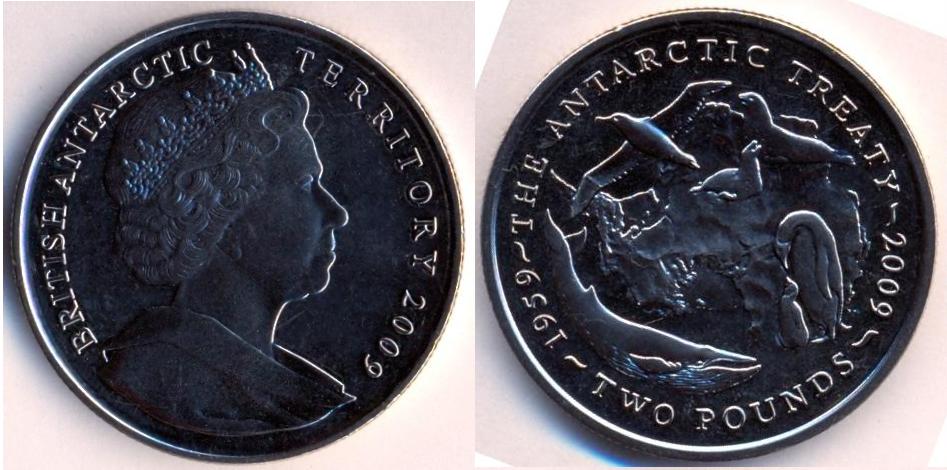
| Currency: Despite the lack of permanent inhabitants, the British Antarctic Territory issues its own postage stamps. While some are actually used by visiting tourists and resident scientists, the bulk are sold overseas to collectors. The first issue came in 1963, an engraved set with 15 values ranging from ½d to one pound, featuring a portrait of Queen Elizabeth overlooking various scenes of human activity in Antarctica. Several additional issues in the 1960s were followed by a decimalisation issue in 1971 produced by overprinting the 1963 stamps. Although nominally British, the British Antarctic Territory is subject to international agreements which limit British authority there and allow other countries to maintain scientific research bases there. The official currency is the Pound sterling. Legal notices have appeared in the London Gazette in relation to the currency of the British Antarctic Territory, for example when the farthing, halfpenny, and half crown were demonetised in the late 1960s and early 1970s. The dates for demonetisation did not correspond to the equivalent dates in the United Kingdom, and were often about a year behind. The official currency in these territories is either sterling or a local currency that evolved from sterling and is at a fixed one-to-one parity with sterling. In 2008/2009, as part of the celebrations of the centenary of the 1908 British territorial claim and 1959 Antarctic Treaty, the British Antarctic Territory issued its first ever legal-tender coins. | |||||
|
|||||
| Countries / Territories | |||||
| Chiefa Coins | |||||