| |
 |
 |
| |
|
Tuvalu |
| |
 |
 |
| |
|
16 Jan 1568 Spanish Capt. Álvaro de Mendaña y Neyra discovers
Nui Island
which he names Isla de Jesus.
29 Aug 1595 Álvaro de Mendaña y Neyra discovers Niulakita
Island which he
names La Solitaria.
1764 Discovered by British Capt. John Byron, named Lagoon Islands.
05 May 1781 Spanish Capt. Francisco Maurelle discovers
Nanumanga Island
which he names Isla de Cocal.
May 1819 American Capt. Arent de Peyster on a British ship
names
Nukefetau as de Peyster's Group and
names the Funafuti as
Ellice's Group.
06 Nov 1821 U.S. Capt. George Barrett discovers Nukulaelae
Island and
rediscovers Niulakita.
1841 U.S. Exploring Expedition commanded by Charles
Wilkes visited
three of Tuvalu's islands.
16 Oct 1892 Part of the British colony of the Gilbert and Ellice Islands
01 Oct 1975 Separate dependency as Ellice Islands.
01 Oct 1975 - 02 Jan 1976 Part of the British Western Pacific Territories.
01 Oct 1978 Independence from Britain as Tuvalu.
07 Feb 1979 U.S. recognizes Funafuti, Nukefetau, Nukulaelae,
and Nurakita
(Niulakita) atolls as part of
Tuvalu (effective 23 Sep 1983).
Feb 1986 Referendum votes against becoming a republic.
30 Apr 2008 Referendum again votes against becoming a republic. |
|
|
 |
Tuvalu (formerly the Ellice or Lagoon Islands of the Gilbert and Ellice
Islands), located in the South Pacific north of the Fiji Islands, has an
area of 10 sq. mi. (26 sq.km.) and a population of around 9,000.
Capital: Funafuti
(administrative offices are located in Vaiaku Village on Fongafale
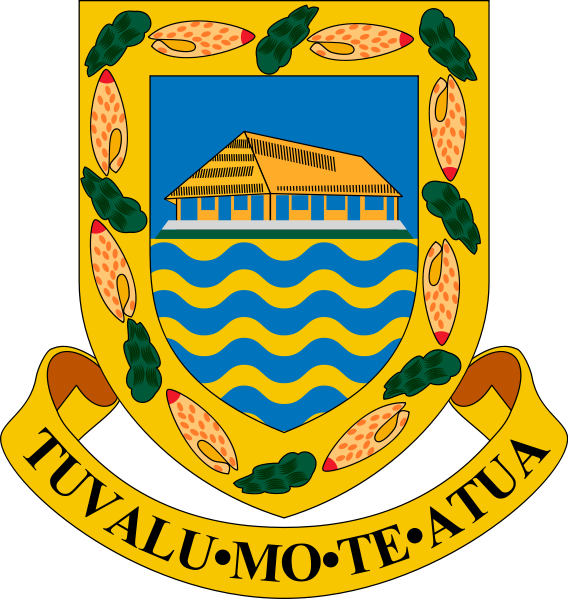
Islet). Motto: "Tuvalu mo te Atua"
(Tuvalu for the Almighty).
The independent state includes the islands of Nanumanga, Nanumea, Nui,
Niutao, Viatupa, Funafuti, Nukufetau, Nukulailai and Nurakita. The latter
four islands were claimed by the United States until relinquished by the
Feb. 07, 1979, Treaty of Friendship signed by the United States and Tuvalu.
The principal industries are copra production and phosphate mining. The
islands were discovered in 1764 by John Byron, a British navigator, and
annexed by Britain in 1892. In 1915 they became part of the crown colony of
the Gilbert and Ellice Islands. In 1974 the islanders voted to separate from
the Gilberts, becoming on Jan. 01, 1976, the separate constitutional
dependency of Tuvalu. Full independence was attained on Oct. 01, 1978.
Tuvalu is a member of
the Commonwealth of Nations. Elizabeth II is Head of State as Queen of
Tuvalu. |
| |
| Currency:
Tuvaluan
Dollar
(TVD)
= 100 cents were introduced since 1976. Australian Dollar (AUD) are also
used. Both currencies are pegged one to one. |
| |
|
1976 |
| |
|
 |
KM#5 20 cents. Year:
1976.
Weight: 11.28g [11.25g].
Metal:
Copper-Nickel. Diameter:
28.45 mm. Edge:
Reeded.
Alignment: Medal.
Mint: N/A.
Obverse:
Flying fish in the center. "TUVALU" written at the top. Value "20c" written on
the lower right side. Date at the bottom.
Reverse:
Young
portrait of Elizabeth II facing right.
"QUEEN ELIZABETH THE SECOND" written clockwise around her.
Mintage: 36,000 + 20,000 Proof.
Minted Years:
1976, 1981 and 1985. Ruler:
Elizabeth II [Elizabeth Alexandra Mary Windsor]. |
| Engravers: John
Donald (date side) and Arnold Machin (Elizabeth II
portrait side). |
|
| |
|
1985 |
| |
|
 |
KM#1 1 cent. Year:
1985.
Weight: 2.56g [2.60g].
Metal:
Bronze. Diameter:
17.50 mm. Edge:
Plain.
Alignment: Medal.
Mint: N/A.
Obverse: Lambis shell in the center.
"TUVALU" written at the top. Value "1c" written on the lower right
side. Date at the bottom. Reverse:
Young
portrait of Elizabeth II facing right.
"QUEEN ELIZABETH THE SECOND" written clockwise around her.
Mintage: N/A.
Minted Years:
1976, 1981 and 1985. Ruler:
Elizabeth II [Elizabeth Alexandra Mary Windsor]. |
|
Engravers: John Donald (date
side) and Arnold Machin (Elizabeth II
portrait side). |
|
 |
KM#5 20 cents. Year:
1985.
Weight: 11.26g [11.25g].
Metal:
Copper-Nickel. Diameter:
28.45 mm. Edge:
Reeded.
Alignment: Medal.
Mint: N/A.
Obverse:
Flying fish in the center. "TUVALU" written at the top. Value "20c" written on
the lower right side. Date at the bottom.
Reverse:
Young
portrait of Elizabeth II facing right.
"QUEEN ELIZABETH THE SECOND" written clockwise around her.
Mintage: N/A.
Minted Years:
1976, 1981 and 1985. Ruler:
Elizabeth II [Elizabeth Alexandra Mary Windsor]. |
|
Engravers: John Donald (date
side) and Arnold Machin (Elizabeth II
portrait side). |
|
 |
|
KM#16 1 Dollar. Year:
1985.
Weight: 16.00g.
Metal:
Copper-Nickel. Diameter:
33.00 mm; Nonagonal (9 sided). Edge:
Plain.
Alignment: Medal.
Mint: N/A.
Obverse:
Sea turtle in the center. "TUVALU" written at the top with Date.
Value "ONE DOLLAR" written at the bottom. Reverse:
Young
portrait of Elizabeth II facing right.
"QUEEN ELIZABETH THE SECOND" written clockwise around her.
Mintage: N/A.
Minted Years:
1976, 1981 and 1985. Ruler:
Elizabeth II [Elizabeth Alexandra Mary Windsor].
Engravers: John Donald (date
side) and Arnold Machin (Elizabeth II
portrait side). |
|
| |
|
1994 |
| |
|
 |
KM#32 10 cents. Year:
1994.
Weight: 5.59g [5.60g].
Metal:
Copper-Nickel. Diameter:
23.50 mm. Edge:
Reeded.
Alignment: Medal.
Mint: N/A.
Obverse: Crab in the center. "TUVALU" written at the top. Value "10c" written on
the lower right side. Date at the bottom.
Reverse:
Elizabeth II facing right.
"QUEEN ELIZABETH THE SECOND" written clockwise around her.
Mintage: N/A.
Minted Years: One
year type. Ruler:
Elizabeth II [Elizabeth Alexandra Mary Windsor]. |
|
Engravers: John Donald (date
side) and Raphael David Maklouf (Elizabeth II
portrait side). |
|
 |
KM#33 20 cents. Year:
1994.
Weight: 11.24g [11.25g].
Metal:
Copper-Nickel. Diameter:
28.45 mm. Edge:
Reeded.
Alignment: Medal.
Mint: N/A.
Obverse:
Flying fish in the center. "TUVALU" written at the top. Value "20c" written on
the lower right side. Date at the bottom.
Reverse:
Elizabeth II facing right.
"QUEEN ELIZABETH THE SECOND" written clockwise around her.
Mintage: N/A.
Minted Years: One
year type. Ruler:
Elizabeth II [Elizabeth Alexandra Mary Windsor]. |
|
Engravers: John Donald (date
side) and Raphael David Maklouf (Elizabeth II
portrait side). |
|
 |
|
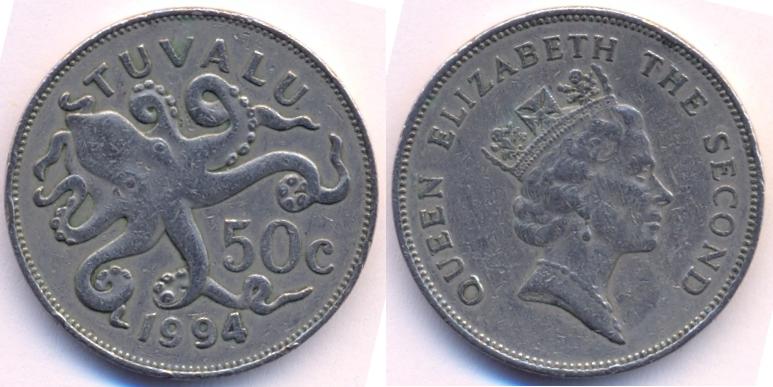
KM#34 50 cents. Year:
1994.
Weight: 15.45g [15.50g].
Metal:
Copper-Nickel. Diameter:
31.65 mm. Edge:
Plain.
Alignment: Medal.
Mint: N/A.
Obverse:
Octopus in the center. "TUVALU" written at the top. Value "50c" written on
the lower right side. Date at the bottom.
Reverse:
Elizabeth II facing right.
"QUEEN ELIZABETH THE SECOND" written clockwise around her.
Mintage: N/A.
Minted Years: One
year type. Ruler:
Elizabeth II [Elizabeth Alexandra Mary Windsor].
Engravers: John Donald (date
side) and Raphael David Maklouf (Elizabeth II
portrait side). |
|
|
 |
|
KM#27 20 Dollars. Year:
1994.
Weight: 31.70g.
Metal:
0.925 Silver. Diameter:
41.00 mm. Edge:
Reeded.
Alignment: Medal.
Mint: N/A.
Obverse: Elizabeth II facing right.
"QUEEN ELIZABETH II . TUVALU" written clockwise around her.
Date at the bottom. Reverse:
Blue Coral seascape in the center. "PROTECT
OUR WORLD" written at the top. Value "$20" written at the lower left
side. "BLUE CORAL" written the the bottom right side.
Mintage: N/A.
Minted Years: One
year type.
Subject:
Protect Our World. Ruler:
Elizabeth II [Elizabeth Alexandra Mary Windsor]. |
|
| |
|
1997 |
| |
|
 |
| 50 cents. Year:
2007.
Weight: 20.00g.
Metal:
Aluminum-Bronze. Diameter:
38.74 mm. Edge:
Reeded.
Alignment: Medal.
Mint: The Perth
Mint.
Obverse: Crowned head right. Reverse:
"GRAND SUMO TOURNAMENT" on the top. A
large wrestler with the Japanese and Hawaiian flags. "2007 IN
HAWAII" written below.
Reverse:
"QUEEN ELIZABETH II" on the top. Queen
Elizabeth's picture in the center facing right. "50 CENTS TUVALU"
written below.
Mintage: N/A.
Minted Years: One
year type.
Ruler:
Elizabeth II [Elizabeth Alexandra Mary Windsor].
Note: Though
professional Sumo tournaments have been going on in Japan for over
300 years, this Tuvalu 50 cent coin is the first coin that I know of
to honor the traditional Japanese sport. The coin commemorates the
Grand Sumo Tournament held in Hawaii in 2007. The object of the
sport is to force an opponent outside of the ring or to have him
touch the ground with some part of his body other than his feet. As
might be expected, Sumo wrestlers tend to be very large. The coin,
struck by the Perth Mint, features an unusual reverse frosting, so
that the devices are bright and the fields are frosted. The Grand
Sumo Tournament in Hawaii 2007 was held on Saturday 09th June to
Sunday 10th June. |
|
| |
| |
|
Queen Elizabeth II is the head of the state, 01 Oct 1978 - 01 Oct 1986: "By
the Grace of God, of the United Kingdom of Great Britain and Northern
Ireland and of Her other Realms and Territories Queen, Head of the
Commonwealth, Defender of the Faith"; from 1 Oct 1986: "By the Grace of God,
Queen of Tuvalu and of Her other Realms and Territories, Head of the
Commonwealth."
|
| |
- Chiefs of Funafuti (title Aliki tupu)
- Local chieftaincies, increasingly in contact with
Europeans from the 18th century on, particularly whalers.
-
Telematua
-
Kaitosuga
-
Tailoa I
-
Tailoa II
-
Tepaolo
-
Salaika
-
Polau
-
Tauasa
-
Silimaiau
-
Tila
-
Sokomani
-
Talafou
-
Featule
-
Teleke
-
Matavai
-
Iakopo
-
Manu
-
Protectorate of Great Britain...........................1892 - 1916
-
Elia..............................................1892? - 1902
-
Great Britain...........................................1916 - 1941
-
Japan...................................................1941 - 1943
-
Great Britain...........................................1943 - 01 Oct 1975
-
Self-governing colony of Great Britain...........01 Oct 1975 - 01 Oct 1978
-
Commissioner
-
Thomas H. Layng..................................01 Oct 1975 - 01 Oct 1978
-
Independent within the British Commonwealth since 01 Oct 1978.
-
Governor-Generals (representing the British monarch as head of state)
-
Fiatau Penitala Teo..............................01 Oct 1978 - 01 Mar 1986
-
He is known from 02 Jun 1979 as Sir Fiatau Penitala Teo.
-
Sir Tupua Leupena................................01 Mar 1986 - 01 Oct 1990
-
Sir Toaripi Lauti................................01 Oct 1990 - 01 Dec 1993
- He
served as Chief
Minister from 02 Oct 1975 to 01 Oct 1978 and then Prime Minister from 01 Oct
1978 to 08 Sep 1981.
-
Tomu Sione.......................................01 Dec 1993 - 21 Jun 1994
-
Tulaga Manuella..................................21 Jun 1994 - 26 Jun 1998
-
He is known from 15 Feb 1996 as Sir Tulaga Manuella.
-
Sir Tomasi Puapua................................26 Jun 1998 - 09 Sep 2003
-
He served as Prime Minister from 08 Sep 1981 to 16 Oct 1989.
-
Faimalaga Luka...................................09 Sep 2003 - 15 Apr 2005
-
He served as Prime Minister from 24 Feb 2001 to 14 Dec 2001.
-
Filoimea Telito..................................15 Apr 2005 - 19 Mar 2010
-
He is known from 12 Jan 2007 as Sir Filoimea Telito.
-
Sir Kamuta Latasi (acting).......................19 Mar 2010 - 16 Apr 2010
-
Iakoba Taeia Italeli.............................16 Apr 2010 - Aug 2019
-
He is known from 21 Jun 2010 as Sir Iakoba Taeia Italeli.
-
Teniku Talesi (female - acting).....................Aug 2019 - date
|
| |
|
|
| |
|
|
| Countries
/ Territories |
| |
|
Chiefa Coins | |
|