| |
 |
 |
|
|
|
Gakhar
and later Khanpur (Jagir) |
|
|
|
The ancestor of the present Raja, was Kaid of
Isfahan, said to be a son of Bahram V, the Sassanid ruler of Persia,
his descendants controlled a sizeable area of the Hazara and
Rawalpindi districts prior to the coming of the Muslim invaders from
the North/North West around the 10th-11th centuries. Gakhar legends
say that they were converted to Islam before joining with Sabuktigin,
founder of the Ghaznavid Empire, and father of Mahmud of Ghazni, in
his invasions of India. The clan later joined forces with the Mahmud
of Ghazni in his invasion of 1008 and were rewarded with the kingdom
of Potohar, which has since been their territory. The Gakhars
converted to Islam en masse around 1205 during the rule of Muhammed
Ghori. Thereafter it is a continual series of conflicts with their
Mughal overlords. |
|
The best primary source comes from the Baburnama (The Memoirs of
Babur). In his chapter "Recent History of Bhera", in 1519 Babur
noted: "There were the Jats, the Gujjars, and many other peoples
living in the mountains between the Nilab and Bhera (in Jhelum
district), which are connected to the mountains of Kashmir. Their
rulers and chieftains belong to the Gakhar clan whose chieftainship
is like that of the Jud and Janjua." |
|
Khanpur is one of the 44 Union Councils, administrative
subdivisions, of Haripur District in the North-West Frontier
Province of Pakistan. It is located to the south of the district
capital Haripur and about 30 km from
Islamabad in a beautiful green hilly town. It is famous throughout
Pakistan for its oranges and is also known for Khanpur Dam.
The history of Khanpur is dominated by the Gakhars Chiefs who played
an important role in shaping the history of the region. The Khanpur
Estate was established by the Gakhar Chief Sultan Fateh Khan in
early 18th Century. Khanpur jagir that consists of 84 villages of
comprises of an area of 1,554 km2.
Gakhar (also Gakkhar or Ghakhar or Ghakkar) are an
ancient aristocratic and warlike clan now located in Rawalpindi,
Islamabad, Jhelum, Kashmir, Gilgit, Baltistan (Tibet), Chitral, and
Khanpur (NWFP) regions in modern day Pakistan. Over the years Ghakhar has grown and now its area is about
7 kilometres (10 miles). Ghakhar Mandi is in Gujranwala District,
tehsil Wazirabad. |
|
|
- GAKHAR
(an ancient aristocratic clan in modern
Pakistan and they also exists in some part of India as well)
- The Gakhar (also Gakkhar or Ghakhar or
Ghakkar) were a fiercely independent and warlike clan now
located in Rawalpindi, Islamabad, Jhelum, Kashmir, Gilgit,
Baltistan, Chitral, Khanpur (NWFP) and Mirpur regions in modern
day Pakistan. They formed a feudal aristocracy over the
territories they controlled. This tribe settled in the Potohar
region, between the river Indus and Jhelum. Some claim the
confusion of origin to be caused by different Rajput/Jat tribes
which are geographically related, such as the Kukhran/Khokharan
and the Gakhar/kakar/khakhar tribes. This ambiguity can be
illustrated by well documented historical figures such as
Sheikha and Jasrat being regarded as Khokhar by some but Gakhar
by others, or in some works by H.
A. Rose who even states that he is assuming the Gakhar and
Khokhar to be the same. The Gakhar arrived
in the Potohar region as Persian settlers after the invasion of
Sasanians in 565 CE or they arrived with the fleeing Sasanians
after the Arab invasion in 651 CE. In 682 CE some disputes
arising between the Gakhar and the Raja of Lahore, caused this
race to make a treaty of alliance... with the Afghans, who
compelled the Raja of Lahore to submit to terms from the Gakhars,
to whom he could otherwise himself have dictated conditions.
This treaty included the cession of certain territories in
perpetuity to the Gakhars. When Mahmud of Ghazni
(979-1030), the first Muslim attacked Peshawar in 399 AH
(1008 CE) to avenge the collaboration and assistance provided by
Anand Pal of Lahore to Abu'l Fateh Daud bin Nasir, the Qarmatid
ruler of Multan. The Gakhars has joined other warlike tribes of
the region to obstruct the invader. A narrative reported of the
battle reports the presence of 30,000 bare-headed and
bare-footed Gakhars. The battle resulted in total victory for
Mahmud and the annihilation of the allied army of Indians.
- Kai Gohar......................................................fl.
1030
- The Ghaznavid Empire ended in 1149
with the capture of Ghanza by Ghorid sultan, Muiz al-Din
Muhammad bin Sam. Ghaznavid power continued in northern India
until the conquest of Lahore in 1187. Ferishta describes the
Gakhars as wild barbarian involved in infanticide and indulging
in polyandry before the conversion to Islam.
- Unknown rulers
- In 1204 to 1205
they (Gakhars) rose up against the rule of Muhammad Ghori (Sultan
Muiz al-Din Muhammad bin Sam), who took strong measures against
them and quelled the rebellion with an iron hand. After this
crushing defeat they were so demoralized that their Chief,
simply because of a Muslim captive had initiated him into the
tenants of Islam, willingly became a convert, followed by his
tribe en masse. Gakhars murdered Sultan Muiz al-Din Muhammad bin
Sam on 14th Mar 1206 at Dhamik near Jhelum, while he was passing
through their territory. Later on they collaborated with the
Mongols when they proceeded towards Lahore in November 1241 (639
AH). After the Mongols had withdrawn, Sultan Nasir al-Din Mahmud
of Delhi inflicted severe punishment upon the Gakhars for their
cooperation with the Mongols.
- Malik
Haider...................................................fl.
1342
- In 743 AH
(1342), during the reign of Sultan Muhammad bin Tughlug (725 -
752 AH), Malik Haider, a Gakhar chief, invaded Punjab, and slew
Tartar Khan, the viceroy of Lahore. Khwaja Jehan was sent to
Lahore and he reduced the enemy.
- Sultan
Gella
- Sultan
Meer
- Sheikha
(or Shuja) Khokhar..........................fl. 1393 - 1398
- Sheikha
occupied Lahore in 1393 (AH 796). This was during the reign of
Sultan Mahmud Shah bin Muhammad (795 - 815 AH). Sarang
Khan, governor of Deepalpur, confronted the Khokhars at Ajudhan
(modern name: Pakpattan). Sarang Khan obtained the victory and
Sheikha Khokhar went into Lahore. In the night, however, he
collected his wives and children, and fled to the Jud mountains.
On the following day, Sarang Khan obtained possession of the
fort of Lahore, and giving his brother Malik Kandhu the title of
Adil Khan, he left him there, and himself returned to Dibalpur.
In 1397 came Tamerlane (Timur) himself, whose troops occupied
Uch and Multan , sacked Tulamba, raided the Khokhars of the Ravi
Valley and passed on across the Bias to Pakpattan and Delhi. In
1398, from Dehli, Tímur returned by the skirts of the hills, and
made prisoners of those people who had remained in the hills.
When he arrived at Lahore, he plundered the city, and he made
Sheikha Khokhar prisoner, with his wives and children, and all
those who had taken refuge with him. This Sheikha Khokhar,
through enmity to Sarang Khan, had early joined Timur, and had
acted as his guide, in return for which he had received mercy
and favour. Timur granted the fiefs of Multan and Dibalpur to
Khizr Khan, and sent him thither. Then he marched through Kabul
to his own territories, and arrived at his capital, Samarkand.
On the death of Taimur in 1405, Jasrat (or Dashrath Khokhar, son
of Shaikha Khokhar) escaped from prison, returned home and
assumed the leadership of his tribe and set himself up at
Sialkot. He involved in the selection of a new ruler and
intervened in the civil war in Kashmir between the two brothers
Ali Shah and Shahi Khan. He favoured Shahi Khan (later known as
Sultan Zain al-Abidin ibn Sikandar 1420-1470 CE in Kashmir) and
due to this gained immensely by his victory. Gakhars power gradually increased due to
the absence of a strong and central government at Delhi at that
time.
- Jhanda
Khan....................................................fl. 1493
- Mahmud of Ghazna, gave the
ruined city to a Gakhar Chief, Kai Gohar. The town, however, being
on an invasion route, could not prosper and remained deserted until
Jhanda Khan, another Gakhar Chief, restored it and named it
Rawalpindi after the village Rawal in 1493. Rawalpindi remained
under the rule of the Gakhars until Muqarrab Khan, which became the last Gakhar
ruler.
- Tatar Khan
- Hathi
Khan..........................................fl. 1519 - 1526
- Concerning the Gakhar clan, Babur goes on to say: "At that time
(1519), the chieftains of the peoples on the mountainsides were two
cousins, Tatar Khan and Hathi "Elephant" Gakhar. Their strongholds
were the ravines and cliffs. Tatar's seat was Pharwala, which is way
below the snow-covered mountains. Hati, whose territory was adjacent
to the mountains, had gained dominance over Kalinjar, which belonged
to Babu Khan of Bisut. Tatar Khan had seen Dawlat Khan and owed him
total allegiance; Hati, however, had not seen him and maintained a
rebellious attitude towards him. With the advice and agreement of
the Hindustan Begs, Tatar had gone and camped at a distance as
though to lay siege to Hathi. While we were in Bhera, Hati seized
upon some pretext to make a surprise attack on Tatar, kill him, and
lay hands on his territory, his wives, and everything he had."
In the case of both the Janjua and the Gakhar clans in the Medieval
period, Babur paints a clear picture of heavily armed warrior elites
living off the tribute of many acquiescent villages and in turn
paying reluctant homage to their Turko-Mongol overlords. The Battle of Pharwala in 1519 is Babur's vivid account of his attack on Hathi Gakhar
at the fortress of Pharwala. The battle took place as Janjua, who were old enemies of the
Gakhar, reported that Hathi Gakhar had recently turned outlaw. He was
engaging in highway robbery and bringing ruination upon the
people. It was necessary to do something to drive him from the
area or else to teach him a good lesson. Hathi escaped and
later, letters of appeasement were send by Muhammad Ali Jang’s
servant.
At the end of 1526 (933 AH), Hathi Khan waited on the emperor during his
return to the Punjab (after the First battle of Panipat in which Babar
defeated Ibrahim Lodhi). Whence
Hathi Khan was defeated by Babur (who recruited the local Janjua
Rajputs for this battle), he was later assasinated by an aged
Sarang through poison. Sarang, now claimed leadership of the
turbulent Gakhar tribe.
- Sultan Sarang Khan,
Chief of
Gakhars....................1526
- 1546
- He was born in Pharwala fort and his
father was a Gakhar chief Tatar Khan.
He greatly
assisted in procuring supplies for the Mughal army. Mughal Emperor Babar fully recognised his services, making him a handsome present and
conferring on him the title of Sultan. Gakhars became so strong that they ruled the area
from Attock to Jehlum, struck their own currency and had the chiefs
name in Khutba. He had two known sons Kamal and Said.
In order to further cement his relations with the Gakhars and use
them as an ally against the tubulent Afghans, Akbar in accordance
with his well-known policy, contracted matrimonial alliances with
them. Akbar's son Prince Salim was married to a daughter of Said Khan. Said Khan had fought under the Mughal General Zain
Khan against the Afghans in Swat and Bajaur at Hashtnagar. Gakhars
refused to accept Sher Shah Suri after their defeat and exile of
Humayun in 1540. The headquarter of Gakhars was a fort in
Sultanpur situated eight kilometers from Mangla. According to
the Akbarnama, Sher Shah Suri
personally led an expedition and started a genocidal war against the Gakhars.
Sultan Sarang Khan Gakhar who remained loyal to Humayun,
building the massive Rohtas Fort in 1541-43 (designated a UNESCO
World Heritage Site in 1997) in an effort to crush the Gakhars,
to whom the fort was finally surrendered ten years after Sher
Suri's death. Sultan Sarang was later captured by Emperor Sher
Shah and flayed alive. Sultan Sarang died in 1546 CE and is
buried in tomb in Rawat Fort with many of his sons. His brother
Adam Khan assumed leadership of the tribe upon his demise.
- Sultan Adam Khan,
brother of
Sarang Khan................1546
- 1555
- Adam Khan was brother of Sarang Khan
and had several skirmishes with
the troops of Islam Shah. In 1552, the Mughal Prince Kamran
sought shelter with the Gakhar chief, who gave him up to Humayun.
Humayun
rewarded Adam Khan with robes of honour, kettle drums and other insignia of
nobility. Later Humayun blinded his brother Kamran.
Adam Khan issued his own coins
with mint name: Pharwala, which are published in Stan Goran and
JP Goenka book
"The coins of the Indian Sultanate" (Copper coinage:
SG1: Falus 12g and SG2: half Falus 6g at page 491).
From that time Pharwala
fort was the headquarters of the turbulent Gakhars of the
Potohar plateau.
He got married and had a known son Raja Lashkar Khan. According
to Ansari: "Sultan Adam was imprisoned at Pharwala Fort by his nephew Kamal
Khan, one of Sultan Sarang's sons. Adam died in captivity. Kamal
Khan also hanged Adam's son Lashkar Khan who had been found guilty
of an illicit love affair with the wife of Kamal Khan's brother. Abul
Fazl in his Akbarnama gives a different version omitting all
reference to the love-affair and asserting that on a petition from
Kamal Khan, Akbar ordered the division of the Gakhar territory
between him and his uncle Adam; this resulted in a pitched battle in
which Adam was utterly defeated and captured. This was clearly a
stratagem which Akbar employed to punish the rebellious chief by
pitting his own kinsman against him and to implant his overlordship
firmly in the territory of the Gakhars."
- Sultan
Kamal Khan,
son of Sarang
Khan
- Sultan Said Khan,
son of
Sarang Khan...........................fl.
1597
- Sher Shah Suri built the Rohtas Fort
in 1605 near the Jhelum River to stop the opposition of Gakhars against his rule.
After his death, the Mughal emperor Humayun reorganised his army and
made an agreement with Gakhars. The agreement was that if Humayun is
victorious and occupies Delhi, he would grant them the region ten
miles south of Chenab River.
Therefore, after his success, Gakhars established their state called
Ghakhar. Borders of this state were recognized by building a post
which can still be seen near Ghakhar Grid Station. Saidpur Village,
Islamabad, is a little quaint village, famous for its pottery,
is part of Islamabad today. It is located off the Hill Road to
the east of Daman-e-Koh. Sultan Said Khan son of Sultan Sarang
Khan founded Saidpur. He gave his daughter in marriage to Mughal
Prince Saleem who later became Emperor Jehangir. Saidpur was
considered a garden resort and a perpetual spring provided water
for drinking and for watering gardens around during the Mughal
period.
- Allah Kuli Khan.........................................1681 - 1705
- Aurangzeb also
honoured the Gakhar chief Allah Kuli Khan by marrying
one of his daughters to his son prince Muhammad Akbar.
- Sultan
Muqarrab Khan................................fl. 1719 - 1769
- Muqarrab was a local chieftain of a
marauding tribe. The territory under his control was barren and
unproductive. Agriculture was dependent upon rain and even that
was only possible where ground level was available. There was
not much trade or commerce either. Rock salt and small
quantities of coal were mined and exported. Akbar's policy of pacification and reconciliation had its desired
effect and we find the Gakhars leading a peaceful and uneventful
life during the major part of the Mughal rule. They seem to have
have only reluctantly accepted the Timurids as their overlords
however as a celebrated Gakhar warrior-chief, Muqarrab Khan, sided
with Nadir Shah Afshar and took part in the battle of Karnal in 1152
AH (1739),
which showed up the crumbling fabric of the Mughal empire. As a
reward for his services, he was confirmed in his possession of the
fort of Pharwala and on his return to Kabul, Nadir Shah conferred
upon him, as a mark of further favor, the title of Nawab, this
seems to have been a personal title as no later Gakhar chief ever
used it. In his days the Gakhar power was greater than it had
perhaps ever been before. He defeated the Yusafzai Afghans and Jang
Kuli Khan of Khattak, and captured Gujrat, overrunning the Chib
country as far north as Bhimber. He was finally defeated by the
Sikhs (Gujar Singh) under Sardar Milka
Singh at Gujrat in 1765 and had to surrender the whole of his
possessions up to the Jehlum. Four year later in 1769 (1183 AH), he
was treacherously captured and put to death by a rival chief,
Himmat Khan. Muqarrab's son succeeded to his dominions, until 1810, when he fell before the
irresistible power of Ranjit Singh's thrice attacks.
|
|
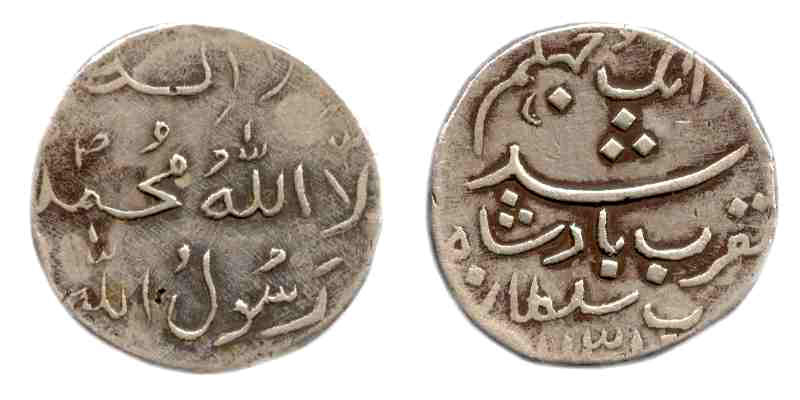 |
Rupee.
1131 AH [1719 CE]
10.92g.
Mint:
Sultanpur
[Sultanpur fort located about 8 kilometers
from Mangla].
Metal: Silver.
Obverse:
(Darmiyan) Attock wa Jehlum shud (M)uqarrab Badshah
- (Zar)b Sultan(pur)
[words in brackets are off flan].
[Translation: Between
Attock (River Indus) and Jehlum (River Jehlum) only Muqarrab is
King, Mint: Sultanpur].
Reverse: Kalma written in a
script similar to Naskh without any outline or border:
La Ilaha Ila Allah Muhammad Rasul Allah. Ruler:
Nawab
Sultan Muqarrab Khan Gakhar. |
|
Here a comment is irresistible:
The significance of year 1131 AH (1719) is
great in the history of India. Sind was recently lost by Mughal
Empire to a local dynasty: Kalhora in 1718. Mughal Empre was not
stable as was declining rapidly. It suffered from severe internecine
conflicts and four Mughal Kings occupied the throne of Delhi in
succession. Farrukhsiyar 1124-1131AH (1713-1719), Rafi al-Darajat
(Mar-Jun 1719), Shah Jahan II (Jun-Sep 1719) and Muhammad Shah (Sep
1719 to Apr 1748). A rebel, Muhammad Shah Nikusiyar also ruled some
parts of Mughal Empire during
Mar-Aug 1719. The central authority at Delhi was, therefore, in the
state of disarray and control over the provinces and other
peripheral regions, was diminishing. Against this backdrop, several subedars became independent of the central authority at Delhi while
new powers like the Sikhs consolidated their gains and emerged as
independent states. |
|
|
 |
Falus.
1168 AH [1755 CE]
5.58g.
Mint:
Pharwala. (Near Islamabad).
Metal: Copper.
Obverse:
Darmiyan Attock wa Jehlum shud Muqarrab Badshah [Between
Attock (River Indus) and Jehlum (River Jehlum) only Muqarrab is King].
Reverse: Bey
hamdey' hee Zarb Pharwala [By his
(God's) grace, struck at Pharwala].
Ruler: Nawab Sultan Muqarrab Khan
Gakhar. |
|
The probability that the coinage under Muqarrab
was not issued regularly but only sporadically is because, mostly coinage of
neighboring kingdoms were used. It is obvious that a few silver and
copper coins were minted to support Muqarrab's claim to the throne,
independent of Mughal supremacy. Pharwala Fort (Urdu: قلعہ
پھروالہ) is a 15th century fort located about 40 km from Rawalpindi
in Punjab, Pakistan. The fort is naturally defended by one side by a
small Himalayan range and the other by the Swaan River. Coordinates:
33.61944°N 73.29917°E.
The fort was built by the Gakhars in the 15th century. The Mughal
Emperor Babur conquered the fort in 1519, however after the Mughals
reconciled with the Gakhars the fort was returned to the Gakhars.
Under British rule, the Pharwala Gakhars were disbanded and their
Jagir grants taken away after 1857.
The fort is in a bad shape. Being situated in the Kahuta area, is
only open for Pakistani visitors. Foreigners need a No Objection
Certificate to enter the area. A small community of Gakhars still
lives inside the fort these days (around 50 people). An old and huge
Banyan tree is also found inside the fort. There is no road to the
fort. The Fort is not so easily accessible: there is no bridge, you
have to cross the river on foot. |
|
|
- KHANPUR (Jagir)
- Dewan Fateh
Khan, founder of Khanpur Estate
and son
of Sultan Said Khan.
- Sultan Sarang gifted the estate to his
grandson Fateh Khan. At that time the estate compromised of 225
villages including Dhund and Karral Hills.
- Shahid
Baig Khan
- Sultan
Ajmair Khan
- Sultan Bisharat Khan
- Sultan Namdar Khan
- Sultan
Jalal [or Jaleel/Jehlum] Khan
- Sultan Nawazish Ali Khan
- Nur
Khan......................................................fl.
1825
- In 1825, the Sikh forces of Gurmukh
Singh Lamba conquered the Rohtas fort from the Gakhar chieftain
Nur Khan. The fort was also thereafter used for administrative
purposes by the Sikh Empire until its collapse by the British in
1849.
- Sultan Mehdi
[or Mehnd]
Ali Khan..............................fl. 1835
- Raja Najaf
Khan...............................................fl. 1836
- Raja
Haider Bakhsh Khan S/o Najaf Khan........................fl.
1857
- confirmed in his jagir (84 villages)
with area of 600 miles after defeating the Sikhs with the
British in 1858, following loyal services in the Indian Mutiny.
- Khan
Bahadur Raja Jehandad Khan...........................? - 1930
- He was born in
1870. Became Chief of Gakhars, C.I.E. (Companion of
the Most Eminent Order of the Indian Empire), Kaiser-i-Hind, was
the descendant of Sultan Sarang. Raja Jahandad was conferred the
title of Khan Bahadur on 24th May 1881 and was bestowed Order of
the Indian Empire on 1st Jan, 1904. He remained Assistant
Commissioner, Punjab and was sent as ambassador of British
Government to Afghanistan to congratulate Amir Habibullah Khan
on his accession. He married into
the Royal Family of Amir Sher Ali Khan of Kabul. He had two sons; Capt. Raja Haidar Zaman Khan and
Sardar Bahadur Risaldar Maj. Raja
Abdulaziz Khan. Khan Bahadur Raja Jahandad Khan, who has made a most
painstaking study of the original authorities and gave the
following statement: "All
the historians before the time of Ferishta agree that the
Khokhars, not the Gakhars, killed Shahab-ud-din Ghori. Ferishta
certainly confused these two tribes, in other cases: thus he
frequently refers to Sheikha and Jasrat as Gakhar Chiefs; there
are no such names in the Gakhar tree, whereas Sheikha and Jasrat
appear as father and son in the genealogy of the Khokhars".
- Capt. Raja
Haidar Zaman Khan...........................1930 - 1938
- Son of Raja Jahandad Khan, born in 1892, educated at MAO
College, Aligarh; Imperial Cadet Corps, Dehra Dun in 1912, was awarded the
Delhi Durbar Medal 1911, King George Silver Jubilee Medal 1935 and Coronation Durbar
Medal 1937, M.B.E. [cr.1938]. He married and had a son Raja Rukan Zaman Khan.
- Raja
[Safdar ?] Rukan Zaman Khan.......................1938 - 1963
- Son of Raja Haider Zaman, born in 1921
and married to Malka Meher Afroz daughter of Khan of Makhad Sher
Mohammad Khan and Zaibunnisa Kureishi - a prominent estate in Attock. He was
educated at Cambridge School, Dehra Dun and Aitchison College,
Lahore. He remained memeber of West Pakistan Legislative Assembly from
Hazara district (1956-1958). He had two children: Raja Eraj
Zaman Khan (Son) and Anjuman Ara (daughter). Other prominent member of this
family are Raja George Sikandar Zaman (younger brother of Raja
Rukan Zaman), Raja Shahjahan (b. 1920 - d.
1988), Raja Basharat and Raja Amir Zaman.
- Sultan
Raja Eraj Zaman Khan........................Oct 1963 - date
- He was born in 1940 and Raja Sahib of Khanpur and the present Chief of Gakhars. He is
the great grandson of prominent Gakhar Chief Khan Bahadur Raja
Jahandad Khan and son of Sultan Raja Rukan Zaman. He was educated at
Army Burn Hall College, Abbottabad. He was crowned SULTAN by Field Marshall Ayub Khan in a
grand ceremony also attended by Zulfiqar Ali Bhutto. The Sultan is
the grandson (maternal) of Khan of Makhad - a prominent estate in
Attock. His nephew Raja Sikander Zaman (son of Raja Haider Zaman
Khan) is a former acting Chief
Minister of North West Frontier Province from
12 November 1996 to 12 February 1997. Raja Eraj remained Member
Majlis-e-Shoora during General Muhammad Zia-ul-Haq's military
regime. He was also Member of Provincial Assembly (MPA) from Khanpur, NWFP. He got married
to (late) Ruby Imtiaz and has three sons and one daughter.
- Raja Sheraz Haider
Zaman Khan
(son)
- Rani
Amber Eraj (daughter) - is
currently married to Safdar Mummunka on 23rd Oct 2010. The couple have a daughter named Ayeza Safdar Mummunka.
Safdar's maternal grand mother was Qamar Sultan; daughter of
Khan of Makhad.
- Raja Sheharyar Haider Khan
(son)
- Raja Faraz Haider Khan
(son)
|
|
|
|
Sources of Information:
|
|
|
|
|
|
|
|
|
|
Pakistan's province of Punjab. |
|
Countries
/ Territories |
|
|
|
Chiefa Coins |
|
|