| |
 |
 |
| |
|
Sindh |
| |
|
This is the land adjacent to the Indus River
and the Thar Desert. It is, in fact, one of the oldest inhabited
regions on earth, and hosted one of the worlds great pre-classical
civilizations. Alexander the Great (326 BCE), Chandragupta Maurya
(ca. 305 BCE), Asoka (274-232 BCE) and many others ruled this place
until the first Muslim inroads into Sind in 712 CE. For almost the
next three hundred years, Sind was subject to Arab caliphs, after
which it was conquered by Sultan Mahmud of Ghazni, who conducted
annual raids into India after 1000 CE. Even then it remained
semi-independent under local dynasties until Akbar (who himself born
at Umerkot in Sind), Sind became part of the Mughal Empire. |
|
|
- The Indus Valley civilization
- Not much is known about this people, who
developed an urbanized culture in the late 3rd millennium BCE.
Primary known sites include Mohenjo-daro, Amri, and Kot Diji.
This culture, which was an important commercial partner to
Dilmun and early Mesopotamia, seems to have been active c. 2300
- c. 1700 BCE.
- A blank time, no knowledge of people
living here remains...
-
Persia................................................c. 520 -
326 BCE
-
Macedon..................................................326 -
310
- The
Seleucid Empire......................................310 - 306
-
The
Mauryan Empire.......................................306 - c.
250
-
Bactria...............................................c.
250 - c. 100
-
The
Bactrian Sakae....................................c. 100 - c. 20
-
The
Kushanid Empire................................c. 20 BCE - c.
230 CE
-
The
Kushanshahs.......................................c. 230 - c.
410
- The
White Huns (Hephthalites)............................410 - 565
- Gold dinar
coins issued in Sindh of Varhran V type and Ranaditya Satya are known from the
White Huns.
- Sahasi I ?
- Unknown rulers
?
- Siharu.........................................................early
600's
- He extended his
kingdom to Panjgur and Kech (Makran division).
- Sahasi
II..................................................? - 632
- Prachandendra............................................632
- 671
- Yashaditya...............................................679
- 712
- Silver Damma
coins are known for Prachandendra and Yashaditya.
|
|
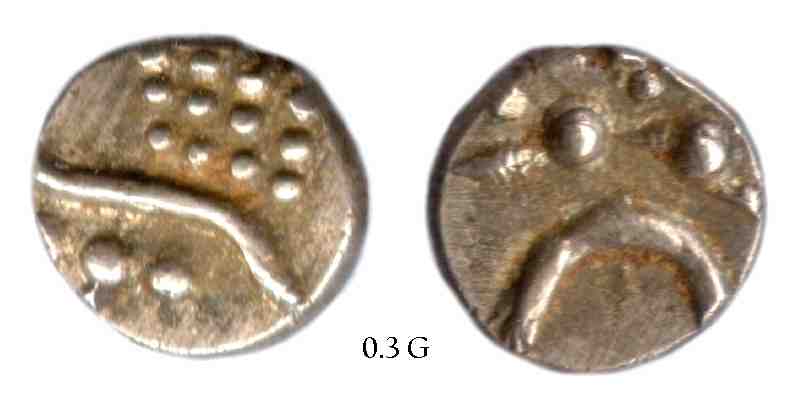 |
This coin is of
0.3g in
silver is known to be of
Later Gupta Dynasty in Sind and Multan around c. 570 to c.600 CE. |
|
|
|
- CHACH of ALOR
(see also Chach
dynasty rulers at Multan)
- Chach (c.
631-711 CE) (Sindhi: چچ) was a Brahmin who reigned as king of
Sindh region of modern-day Pakistan in the mid-7th century CE.
Chach expanded the kingdom of Sindh, and his successful efforts
to subjugate surrounding monarchies and ethnic groups into an
empire covering the entire Indus valley and beyond were recorded
in the Chach Nama.
Chach was a Brahmin who rose to a position of influence under
Rai Sahiras II, king of Sindh and a member of the Rai dynasty.
Chach was given the appointments prime minister to the King, and
retained influence after Rai Sahasi's death. He became the lover
of Rai Sahasi's widow (queen Rani Suhanadi), and their marriage
enabled him to receive the kingship the date of which is
normally put at 632 CE. It is believed that Chach conspired with
Rani Suhanadi and killed Raja Sahasi II and his brothers were
sent to prison. Chach was married with the queen and became
ruler of Sindh ending the rule of the Rai Dynasty and starting a
line of Brahmin ruler-ship. Chach enlisted his brother Chandar
(also known as Chandra) to help him administer the kingdom. He
then launched a campaign against a succession of autonomous
regions; he defeated his opponents along the south bank of the
River Beas, at Iskandah, and at Sikkah. He sacked Sikkah,
killing 5,000 men and taking the remainder of its inhabitants
prisoners. A significant number of these captives were enslaved,
and much booty was taken. After this victory, which he appointed
a thakur to govern from Multan, and used his army to settle
boundary disputes with Kashmir. Chach also conquered Siwistan,
but allowed its chief, Matta, to remain as his feudatory.
Later, he expanded his rule into Buddhist regions across the
Indus River. These efforts culminated in a battle at Brahmanabad,
in which the region's governor, Agham Lohana, was killed. Chach
remained in Brahmanabad for a year to cement his authority
there, and appointed Agham's son Sarhand as his governor;
Sarhand was also wed to Chach's niece. Chach took Agham's widow
as his wife, as well.
From Brahmanabad, he invaded Sassanid territory through the town
of Armanbelah, marching from Turan to Kandahar. He exacted
tribute from the latter before returning.
- Chach.................................................c.
643 - c. 671
- Upon his death,
Chach was succeeded by his brother Chandar; Chandar is stated to
have ruled for eight years, whereupon Dahir, Chach's eldest son,
inherited the throne.
- Chandar...............................................c.
671 - c. 679
- After Chach's
death, Matta, the ruler of Sehwan Sharif, began to conspire
against Chandar. Matta had formerly been the autonomous chief of
Siwistan; however, he had been subjugated during one of Chach's
campaigns, and intended to regain independence. He sent an
emissary to Siharas, ruler of Kannauj, noting that Chandar was a
monk who allegedly spent his entire day at prayer, and who would
thus be a weak foe. He asked Siharas to invade Sindh, and to
cede a portion of these lands to Siwistan. Siharas refused, but
conceded to Matta's request for a governorship if he succeeded
in conquering Sindh. Matta agreed to pay tribute to Siharas in
exchange for this post. Aligned with Chach's grandson, Siharas
entered Sindh and besieged Chandar in Alor. During a parley with
Sindhi forces, Siharas was seized; he agreed to end the war,
sending hostages with robes of honor to Chandar. Chandar
eventually formed an alliance with Siharas.
- Raja Dahir
Sen S/o
Chach..............................c.
679 - 711
- Raja Dahar Sen
(Sanskrit: राजा दाहिर सेन) (Sindhi: راجا ڏاھر); 663 – 712 CE)
was the last Hindu Sindhi ruler of the Brahmin Dynasty of Sindh,
ruling Sindh and parts of Punjab (present-day Pakistan).
He was a a Brahmin king and son of Chach of Alor, who ascended the throne upon the death of his
uncle Chandar. In 711 CE, his kingdom was conquered by the
Ummayad Caliphate led by General Muhammad bin Qasim. He was
killed at the Battle of Aror at the banks of the Indus River,
near modern-day Rohri, Sukkur. Earlier, Dahir's kingdom was also
invaded by King Ramal of Kannauj.
- Hullishah................................................712
- c. 724
- Sisah..........................................................fl.
c. 724
- Jaisimha
S/o Dahir
- A pre-Islamic
governor in Sindh.
-
Umayyad
Caliphate........................................724 - 750
- Amirs of Sindh under the
Umayyad Caliphate
- Muhammad bin Qasim..................................712 -
715
- al-Hadjadj
ibn Yusuf (Governor of Iraq at Basra 694 to 714 CE during
Ummayad Caliph Al-Walid I ) send his 17 years old nephew [Imad-uddin
Muhammad bin Qasim Al-Thaqafi bin Yusuf Sakifi (born on 31
Dec 695), a Syrian general], to Sind to
help some poor and innocent people of Serendib (modern Sri
Lanka) as well as the female pilgrims from the hands Raja
Dahir. Qasim landed on the shores of Debal to
rescue the innocent people and also to take revenge of the
defeat, which was led by Badil bin Tuhfa and by the governor
of Makran:
Abdullah bin Nahban, landed at Nerun
Kot (modern Hyderabad) against Raja Dahir. On the other hand
Ummayad was looking for an opportunity to have a firm foot
in Sindh. The
army which departed from Shiraz in 710 CE.
When Muhammad bin Qasim passed through Makran while raising
forces, he had to re-subdue the restive Umayyad towns of
Fannazbur and Arman Belah (Lasbela).
In 711, the first town
assaulted was Debal and upon the orders of Al-Hajjaj, he
exacted a bloody retribution on Debal by giving no quarter
to its residents or priests and destroying its great temple
in the process of freeing the kidnapped women. From Debal
the Arab army then marched north taking towns such as Nerun
and Sadusan (Sehwan) peacefully. A mosque was built to
replace the main temples. At Raor
(Nawabshah) he was met by Dahir's forces and the eastern
Jats in battle. Muhammad bin Qasim defeated Dahir and captured his eastern territories
for the Umayyad Caliphate. Raja Dahir then attempted to
prevent Qasim from crossing the Indus river and so moved his
forces to its eastern banks in an attempt prevent Qasim from
furthering the campaign. Eventually however, Qasim
successfully completed the crossing and defeated an attempt
to repel them at Jitor led by Jaisiah, the son of Dahir. Qasim was triumphant in this battle and
Dahir died in 712 in this battle leaving Muhammad bin Qasim
in control of Sind. In the wake of the battle enemy soldiers
were put to death - but not artisans, merchants or farmers -
and Dahir and his chiefs, the "daughters of princes" and the
usual fifth of the booty and slaves was sent on to Hajjaj
and the Caliph.
Soon the capitals of the other provinces, Brahmanabad, Alor
(Aror) and Multan, were captured alongside other in-between
towns with only light Muslim casualties. Muhammad bin Qasim
had begun preparations for further expansions when Hajjaj
died, as did Caliph Al-Walid I, who was succeeded by
Sulayman ibn Abd al-Malik. After Hajjaj's death, the new
governor took revenge against all who were close to Hajjaj
and Muhammad bin Qasim was torture to death on 18 July 715. People were impressed by his bravely and justice,
started to accept Islam in the region. Later Islam was
spread throughout the South Asia (Indian sub-continent).
Therefore Sindh province of Pakistan is also named Bab-e-Islam
(The Gateway of Islam).
- Habib
ibn Muhalab...................................715 - ?
- Amr
ibn Muslim al-Bahili
- Bilal
ibn Ahwaz
- Junaid
ibn Abd ar-Rahman
- Tamim
ibn Zaid al-'Utbi..........................c. 728 - c. 730
- Tamim
ibn Zayd was the first Muslim governor to issue silver Dammas in
Sind. His damma weight around 0.35g with Reference:
A-O1493.
Obverse: "Allah ahad Allah al-samad".
Reverse" "mâ amara bihi tamim bin zayd", with just mâ instead of
the full word mimmâ.
Extremely rare
coin. The full Umayyad dirham of 3.0 grams was struck about 14 years earlier
at al-Daybul, the coastal city of Sind, dated only AH 95
(Klat-377 / AGS1) without the name of a governor during the time
of Caliph al-Walid I (AH 86-96 / 705-715 CE).
- al-Hakam
ibn Awanah al-Qalbi.....................c. 730 - c. 740
- Al-Hakam ibn
Awana is one of the earliest Muslim governors of Al-Sind
(Pakistan) and served under the Umayyad caliphate during the
reign of Hisham Ibn Abd Al-Malik. After the death of ill-starred
Tamim ibn Zayd al-Qayni, al-Hakam ibn Awana al-Kabli, a Syrian
Commander, was appointed governor of Sind. Al-Hakam was known
for his successes in conquering parts of India. His
reference is found mostly by late 9th century Arab historian al-Baladhuri:
www.ibiblio.org/britishraj/Jackson5/chapter01.html. The
people of India had returned to idolatry, excepting those of
Kassa, and the Mussulmans had no place of security in which they
could take refuge, so he built a town on the other side of the
lake facing India, and called it al-Mahfuzah, "the secure," and
this he made a place of refuge and security for them, and their
chief town. He asked the elders of the tribe of Kalb, who were
of Syrian descent, what name he should give the town. Some said
Dimashk (Damascus), others, Hims (Emessa), and others Tadmur
(Palmyra), whereupon Hakim chose the latter name for his
garrison-city, to which he gave the epithet of al-Mahfuzah, near Brahmanabad,
and dwelt there. He became the second native city of Sind after al-Rawr.
Amr ibn Mohammad ibn Kasim was with Hakim, and the latter
advised with him, trusted him with many important matters, and
sent him out of al-Mahfuzah on a warlike expedition. He was
victorious in his commission, and was made an amir. He founded a
city on this side of the lake, which he called Mansura, in which
the governors now dwell. Hakim recovered from the enemy those
places which they had subjugated, and gave satisfaction to the
people in his country, so that Khalid said: "It is very
surprising – I gave the charge of the country to the most
generous of Arabs, that is, to Tamim, and they were disgusted; I
gave it to the most niggardly of men, and they were satisfied."
Hakim was killed there. The governors who succeeded him
continued to kill the enemy, taking whatever they could acquire
and subduing the people who rebelled. When the dynasty of the
Abbasids was established, Abu Muslim appointed Abd-ar-Rahman ibn
Abu Muslim Mughallis-al-Abdi to the frontier of Sind. He is also very briefly mentioned in al-Tabari who mentions that al-Hakam
ibn Awana al-Kabli was appointed Governor of Khorasan in Ramadan
AH109. Prior to coming to Sind, he was the Umayyad Governor of
Khorasan. Only 10-15 pieces of his silver Dammas minted at Sind
are known today and therefore his coins are considered extremely very rare.
- Amr ibn
Muhammad ibn al-Qasim al-Taqafi..........c. 740 - c. 744
- Silver damma of
weight around 0.43g is known for this ruler. Reference: A-Q1493.
Obverse: "la ilah illa Allah" written in three lines. Reverse:
Three line legend "(….) / amrw bin / muhammad". Extremely rare
coin.
- Sulayman ibn Salim
al-Qalbi......................c. 745 - c. 747
- al-Mansur
ibn Jamhur al-Qalbi....................c. 748 - c. 751
- Mansur ibn
Jumhur, who served in Sistan until AH 751 or slightly later, and
probably somewhat later in Sind, is tentative. He is cited, with
his patronymic, on an undated Umayyad fals of the Zaranj mint in
Sistan.
-
Abbasid
Caliphate........................................750 - 855
- Amirs of Sindh under the
Abbasid Caliphate
- Yazid
ibn Arrar
- Hisham ibn Amru
- Abu Jafar Umar ibn
Hafs
- Hasan
- Jafar
- Umar
ibn Musa
- Muhammad
II ibn Azi(z)...................................c. fl. 800
- Daud ibn Yazid al-Muhallabi.....................c.
800 - c. 820
- One of his silver damma
is referred as Fishman & Todd CS12.10 with Star.
- Bashar
ibn Daud al-Muhallabi....................c. 820 - c. 826
- Hajjib ibn Salih................................c.
826 - c. 828
- Yahya....................................................ca.
fl. 830
- He was possibly a son or other
relative of Musa al-Barmaki.
- Musa
al-Barmaki.................................c. 831 - c. 836
- On his coins, he cite Imam Abi Ishaq,
which must refer to the caliph al-Mu’tasim, who ruled 833-842.
- al-Marhal?
al-Barmaki....................................ca. fl. 830s
- This name on few coins at obverse side
resembles “al-marhal”, but that is just a wild guess as the
calligraphy is not clear.
- Jabir ibn
al-Ash’ath.....................................c. 850s
- Jabir was likely related to Muhammad
ibn al-Ash’ath, who was governor in Sistan circa 812-815, and
may have fled eastward around the end of that time. We have
found no direct reference to Jabir, but the style of a fals coin
is coherent with this period. The only example previously known
sold by Stephen Album Auction 31, Lot 2219, was assigned to
Muhammad, but now that the full name is clear, it is Jabir, not
Muhammad.
- Yazid ibn
Umar
- The stylistic similarity between this
type and the Dammas of Amr ibn Muhammad (ca. AH 116-126)
suggests that the issuer might have been Yazid ibn Umar al-Fazari,
who had served as governor of Iraq circa AH 127, but later it
was found to have no evidence that he might been assigned to
Sind either before or after his service in Iraq.
- HIBARI
(or HABBARID) - Amirs of Sindh
- Sindh became semi-independent under
the Arab ruler Aziz al-Habbari in 841 CE, though nominally
remaining part of Abbasid Caliphate. The Habbari ruled Sindh,
Makran, Turan, Khuzdar and Multan from their capital city of
Mansura. The Hibari clan ruled most of Sindh until its
conquest by the Ghaznavids in 1005, but the names of below subsequent
rulers are not in sequence.
- Umar I ibn Abd al-Aziz al-Habbari.......................854
- 874
- He was the founder of the Habbadid
dynasty, in effect, declaring his independence from the Abbasid
caliphate during the reign of the caliph al-Mutawakkil
(847-861).
- Abdallah ibn Umar.............................................after
900
- Umar II ibn Abdallah al-Hibbari.........................912
- 913
- His extremely rare silver damma coin
is referred as
Fishman & Todd
HS1.1. He was ruling when the famous Arab
historian Al-Masudi visited Sindh.
- Abd al-Rahman
- Ali
- Isa
- Hatim
- Ahmad...............................................c.
1010 - c. 1040
- al-Muzaffar.........................................c.
1040 - c. 1050
- al-Mansur...........................................c.
1040 - c. 1050
- al-Mu'tazz....................................................ca.
1030s/1040s ?
- His silver damma of weight around
0.44g, clearly shows the governor's name, and the 2nd letter is
'ayn, not qaf, so al-Mu'tazz is indeed the correct reading of
the name, not al-Muqtazz. His silver damma is very rare.
- Unknown ruler: ca. 1030s - 1050s.
- A silver damma of weight around 0.77g,
stylistically similar to the dammas of Ya'qub Beg but either
anonymous or with uncertain name, struck as usual from dies much
broader than the coin. This coin is extremely rare.
|
|
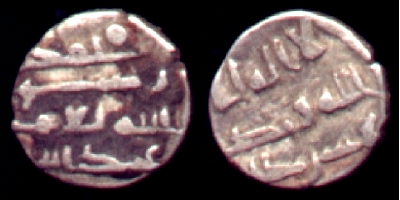 |
SA#1495 / SA# AS2 / R# 3250 / D# 11. Damma. Year:
865-893 CE or later 900 CE. Weight:
0.46 g. Metal:
Silver.
Diameter: 9.00 mm. Edge:
Plain. Alignment:
Coin.
Ruler:
Abdallah ibn Umar. Shahada
legend type. |
|
|
|
|
The sequence of rulers and their dates have
not yet been reconstructed. The coinage consists of tiny fractional
dirhams, (called damma, which were identified by Robert Tye) and
poorly struck coppers, struck at either Multan or Mansura (the mint
is not indicated on the coins). Damma is equal in weight of 0.5g,
traditional used by the Gurjuras, Pratiharas and other medieval
Hindu kingdoms. Note that the damma seems to correspond to one sixth
of a traditional Islamic dirham. Some numismatics believe that the
Habbarid dynasty lasted from 257 to 400 AH (871 to 1010 CE). |
|
|
- The Ghaznavid
Empire..................................1005 - 1058
- Fateh Daud was the Ismaili Shi'a ruler of
Multan, deposed by Mahmud Ghazni, who also massacared the Ismailis of
Multan in the course of his conquest. A
fractional Dirham (known as Damma) coin from ruler Farrukhzad (1053-1059)
was issued for Sindh and it can be seen under
Ghaznavid.
|
|
|
- SUMRA or SOOMRA
- Historically, Soomras are the first to wrest
Sindh from the Arab rule. They substituted the Arab Habari government of
al-Mansurah (875-1025) after the episode of Sultan Mahmud Ghaznavi's
sack of al-Mansurah and unsuccessful hold over Sindh. The Soomras
originally were a local Hindu tribe. Some influential members of it had
accepted Islam soon after the Arab conquest of Sindh. Even after
conversion they retained their old Hindu names and customs. The most prominent historical tradition of Soomras was their ability to unite all Sindhi tribes to create a power
of resistance against any foreign occupation and rule. There were many devoted Islamic
missionaries in Sindh during the Soomra rule, who were patronized and
provided security. Thus Islam spread by leaps and bounds during this
period, to make Sindh a Muslim majority land.
- Sardar Khafif
I..................................1011 - c. 1026
- Founder of the Soomra
Dynasty who ruled for 15 years (1011-1026 AD) from his new capital at
Tharri in Matli Taluka (presently in Badin district).
- Sardar Sumra (Soomar).........................c. 1026 - c. 1053
- Bhungar I (Bhoongar I)
S/o Soomar..................c. 1053 - c. 1068
- In 1053, state of as-Sind secedes from Ghaznavid
Empire. Despite the hostilities of the Ghaznavids and their successors ,
Ismailism survived in Sindh and later received the protection of the
Sumras, who ruled independently from Thatta, for almost three centuries.
Soomar, Bhoongar and Dodo I, established their rule from the shores of
the Arabian Sea to Multan, Bahawalpur, Sadiqabad and Uch in the north
and in the east to Rajistan and in the west to Balochistan.
- Asamuddin
Daula Dodo I (Duda I) S/o Bhungar I......c. 1068 - 1092
- Zenab Tari (female)
D/o Dodo I........................1092 - 1098
- She ruled on behalf of
her minor brother Sanghar. Reforms were made in promoting Sindhi
language for good governance. Fast progress was made in Arts and Crafts,
Architecture, Agriculture and music, both instrumental and vocal.
- Shahabuddin
Sanghar...................................1098 - c. 1107
- He died without any
child.
- Hamun (female)...............................................fl.
c. 1107 with...
- Sanghar's wife Hamun occupied the throne but
the Soomra nobles crushed the conspiracy.
- Khafif II..........................................c.
1107 - c. 1142
- Brother-in-law of
Sanghar. He annexed a part of Kutch territory with Sindh.
- Umar I.............................................c.
1142 - c. 1181
- Brother of Khafif II.
During and after his rule Ghorid invasion
of Sindh occurred. Pahtu Soomro, the ruler of Nagarparkar got the
opportunity to occupied the entire Kutch territory in 1178. But his
occupation was short lived as it was retrieved by the Samas of Kutch.
- Pahtu (at
Nagarparkar).......................................c.
1178
- Dodo
II............................................c. 1181 - c. 1195
- He contended with
Ghorid occupation of Debal and also attached the Samas of Kutch. The
Ghorid rule was made impossible. Jam Lakho Samo submitted and was
pardoned for his attacks on Thatta.
- Bhungar
II.........................................c. 1195 - 1222
- A descendent of Dodo I
and not from Dodo II. During his rule Sultan Jalaluddin Khwarizm Shah
wrought destruction in Sindh. He occupied Debal where Chanesar I Soomro
was ruling. Chanesar fled and later returned to re-occupy Debal.
- Chanesar I (1st
time)................................1222 - 1228
- Gunero I [Ganhwar I] (1st
time)......................1228 -
c. 1236
- Chanesar I (2nd
time).............................c.
1236 - ?
- Gunero I [Ganhwar I] (2nd
time)........................
? - c. 1241
- Muhammad (Mahatam) Tur S/o Gunero
I...............c. 1242 - 1256
- Gunero
II [Ganhwar II]...............................1256 - 1259
- Dodo III S/o
Gunero II...............................1259 - c. 1273
- Tai S/o Dodo
III..................................c. 1274 - c. 1283
- Chanesar
II.......................................c. 1284 - c. 1300
- The great historical dramatic romances that
took place in the reign of the last few Soomra kings were Lila
Chanesar, Umar Marvi and Momal Rano. Earlier than this, the love
tales of Sassi Punnun, Sohni Mahiwal and Sorath-Raidiach
were narrated in melodious poetry by minstrels and bards in public
musical evenings patronized by the Soomra Kings.
- Bhungar
III.......................................c. 1301 - 1315
- Khafif
III...........................................1315 - c. 1333
- Dodo IV S/o Khafif
III............................c. 1333 - 1350 with...
-
The Khaljis not
only wanted to replace Dodo by Chanesar; they also wanted Bhagi,
Bhungar Rao's daughter by a third (regular) wife, for Alauddin.
However, the Soomras would not agree to either demand. Rejecting
the idea of a matrimonial alliance, they said: "Tu Turk asee
Soomra, ahri jor na jugai" (You are a Turk and we are Soomras; such a union will not be right). In the fight that
ensued, both sides suffered heavily. Dodo's son Bhungar Jr. and
even Chanesar's son Nangar Nehro, fought heroically for Dodo and
fell. Sabar Abro, a Samma chief on the Soomra side, killed
Alauddin's son Syed Ghazi Salar. When Dodo was speared and
raised high, he told Chanesar standing by: "Even now I am
above you!" Meanwhile the Khalji attack on his own land and
people had induced second thoughts in Chanesar. Chanesar now
began to hate Alauddin for his excesses against Sindh. He is
believed to have died fighting Alauddin. The most important
aspect of this episode is that in Sindh it became a people's
war. Even peasants, shepherds, cowherds, bards, faqirs,
fishermen, potters and weavers joined the fray. They all said: "The sword is our plough.
About the same period, Dodo at the castle of Dahkah,
considering the opportunity
very favorable, collected his kinsmen and caste-fellows, invaded the
country of Hímu’s brothers, and defeated and killed them. But soon
afterwards, Dadu Phattu, of the descendants of Dodo collected a
large number of men and made himself the master of his forefather’s
country. After a quiet reign of some years he died and was succeeded by
a chief named Khaira. After Khaira, Armel became the ruler of the
place. Some people revolted against him and killed him in conspiracy
with his ministers. The head of Armel was hung on the top of the gate of
the fort and Unar was proclaimed their ruler. This occurred in 752 A.H
(1351 A.D.). Thus the Government of Sind passed away from the hands of
Sumras to those of Sammas.
- Umar II Sumra.....................................c.
1332 - 1350 and ...
- Bhungar
IV........................................c. 1332 - 1350 and ...
- Dadu Phathu
- Khaira
- Armel
- Hamir S/o Dodo
IV....................................1332 - c. 1352
- Hamir fled to Dragul hills in Punjab in 1352.
He continued to rule in Thar. He was later killed by Sammas between
1360-1365. His son Umar ruled at Umerkot
from 1355 to 1390. His descendants in Layyah, Punjab became big
zamindars (agricultural land owners). Some of the descendants of this
dynasty also settled in Gujarat. Hammu is known to found Fatah mosque in
Parentej, Gujarat in 1382.
|
|
"Soomra National Council - Pakistan" was
founded by Umer Soomro at Karachi on 14th July 1999. He has done a
painstaking study on his own dynasty and highlighted the hidden
facts and information from various books and resources. This council
also provides a social welfare to the poor people as well. |
|
|
The following rulers, according to
numismatics, are considered Sultans of Sind and Punjab. They were
most probably ruling in the Southern parts of Punjab and Northern
upper parts of Sind.
- SULTANS OF SIND AND PUNJAB
- Nasir al-Din Qubacha
(Sind
and Multan)...............1206
– 1228 and...
- He had been
appointed governor of Uch in 1205 by the Ghurid ruler: Muhammad
bin Sam and had married the daughter of Qutb al-Din Aibak who
was shortly to succeed Muhammad in India as Sultan of Delhi.
Qubacha kept on good terms with Aibak, the latter helping him to
flight off an invasion by the army of Taj al-Din Yildiz,
Governor of Kirman, who had design on the Ghaznavid succession
and territories. When Aibak died in 1210, Qubacha threw off his
allegiance to Delhi and declared his independence. He captured
Multan, proceeded into Sind where he took all the cities and
fortresses and incorporated those lands into his domains. He
also made several attemps to capture Lahore from Yildiz's
governor there but was not successful for any length of time,
until Yildiz, himself, was defeated by Iltutmish of Delhi. In
1217 Qubacha was expelled from Lahore by Iltutmish. Nonetheless,
it is reported that Qubacha's court was adorned by the
presence of various nobles and great men, who had fled the
Mongol invasions. Multan was an important center of Muslim
learning and eminent scholars ere to be found there. A couple of
years later Iltutmish decided that it was time to extend his
territories in the west and do deal with Qubacha. In 1228 he
besieged and captured Uch and send an army after Qubacha
himself. Qubacha fled southwards and in due course ensconced
himself in the island-fortress of Bhakkar in the River Indus.
The fortress was besieged and Qubacha drowned in the river
either seeking to flee or by committing suicide. His domains
were then incorporated into those of the Delhi Sultanate.
- Jalal al-Din Mangubarni
.............................1221 - 1224
- Ruler of
Khwarizm (Northern Iran, Uzbekistan and Turkestan) from 1221 to
1231. He was the last ruler of Anushtiginid dynasty before
Mongol came. He ruled only in the Southern part of his realm. In
1221, the Mongol invasions began to make themselves felt in
India. The powerful Khwarizm Shah, Ala al-Din Muhammad had been
driven from his throne and his son Jalal al-Din Mangubarni took
refuge in Lahore. From there he sent an envoy to Iltutmish in
Delhi requesting asylum, but Iltutmish was not willing to have
such a guest in his frontier city and offered him a place near
Delhi. This, Mangubarni refused. He then withdrew from Lahore
and made his way towards the Salt Range where he first attacked
and defeated the Khokars and then found it better to enter into
an alliance with them against Qubacha.
Multan, Uch, Bakhar, Sehwan and Debal saw major upheaval between
1222 to 1228 when Jalaluddin Khawarizm Shah looted and burnt
many towns, exhorted heavy tribute from Qabacha weakening his
power. This was followed by the invasion of Torbae Toqshin, the
Mongol, who laid a siege on Multan and Uktae, devastated the
whole Sindh and finally by Altatmash who eliminated Qabacha and
took Chanesar with him to Delhi in 1228 AD. Since 1228, Uch and
Multan were annexed to Delhi Sultanate and Sindh of Soomras
became a tributary, but Bakhar was included in Soomras' Sindh,
as, due to Mongol raids, Delhi Sultanate had no control over the
southern Punjab.
Qubacha was attacked and
forced to pay a heavy tribute. Enriched with this, and with
other booty obtained in Sind, Mangubarni fled Persia in 1224.
- Khalif
Beg..................................................1224
- It is believed
that he was one of Mangubarni's general or officer, who stayed
behind after Mangubarni fled to Persia, and who ruled over a
small, ephemeral principality. His personage is known only from
a rare issue of billion jitals similar in style to those of
Mangubarni. (Reference: SA# 1812 / SG# SS8 / R# 3280 / Tye# 322/
D# 355).
|
|
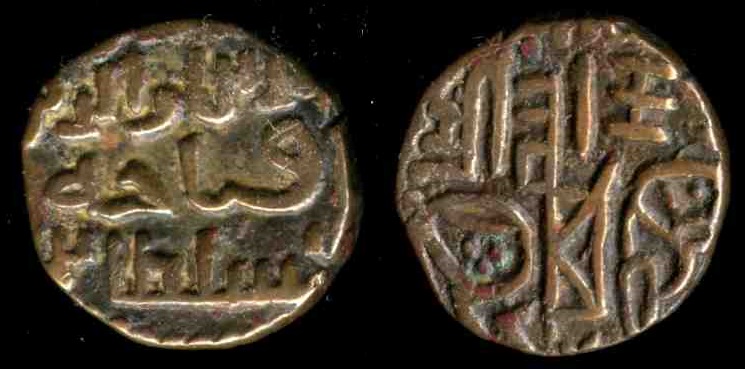 |
SA# 1811 / SG# SS1 / R# 3270 / Tye# 205.1 / D# 341. AE Jital.
Date:
ND (1203-1228).
Weight:
3.4g. Edge:
Plain. Mint:
probably Multan. Obverse:
"nasir al-dunya wa'l din qubachah al-sultani".
Reverse:
Horseman to the right. Star below horse.
Ruler: Nasiruddin Qubacha
(600-626 AH). This Tye type
has Star below horse. Common type. |
|
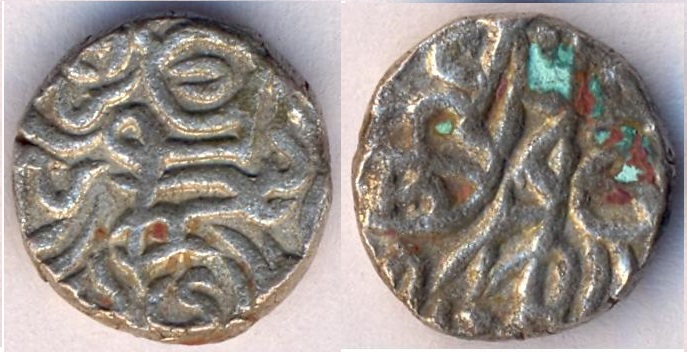 |
SA# 1750 / SG# SS7 / R# 3278 / Tye# 318 / D# 349-354. AE Jital.
Date:
ND (1221-1224). Weight:
3.4g. Edge:
Plain.
Mint: Nandana (Sind
Issue). Obverse: Bull to left:
"sa jalaladina"
in cursive Nagari around. Reverse:
horseman to the right: "sri hamirah" above.
Ruler: Jalal al-dunya wa'l din
Mangubarni al-sultan (Jelal ad-Din
Mingburnu) [AH 617-621 / 1220-1224]. Scarce type. |
|
|
- QARLUKHID
- Saif al-Din al-Hasan Qarlugh
(in
Ghazna from 1224)...1239
- 1249
- He ruled over
Ghazna and the surrounding area of the first part of his reign
from 1224 (621 AH) and then moved into Sind for the last decade
of his reign. His silver Tankas were made on the same standard
as the contemporary Sultans of Delhi and billion jitals. Some of
the Tankas might have been struck in Ghazna, like the one in the
name of the Caliph, al-Zahir (1225-1226; 622-623 AH), while the
others, in the name of the Caliph al-Mustansir, are of Sind
style. Some of these coins are dated 633 AH, Probably these
coins were issued on the death of the powerful Delhi sultan,
Iltutmish and were struck to celebrate the fact.
- Nasir al-Din Muhammad Qarlugh
S/o Hasan Qarlugh......1249
– 1259
|
|
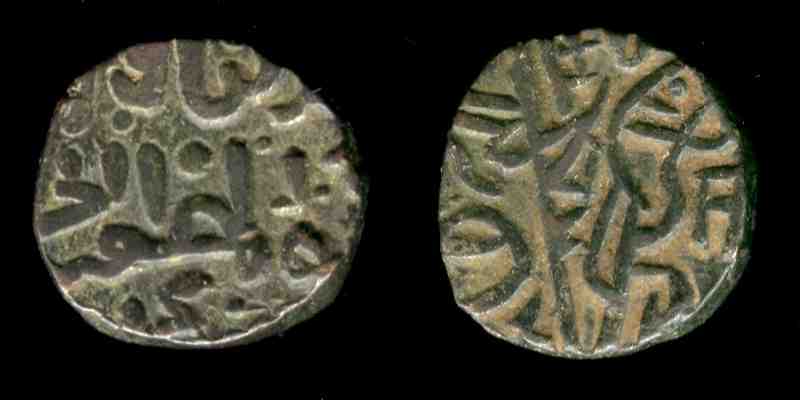 |
SA# 1815 / SG# SS12 / R# 3283 / Tye# 345 /
D# 337. AE Jital.
Dated: ND (1239-1249).
Weight:
3.4g. Edge:
Plain. Obverse:
"saif al-dunya wa'l din abu'l muzaffar al-hasan
qarlugh". Reverse:
horseman to
right. Ruler: Saif
al-Din al-Hasan Qarlugh. Scarce
type. |
|
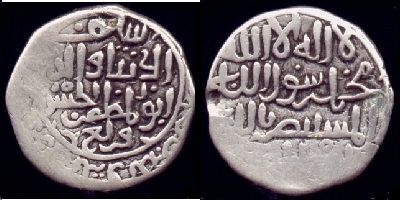 |
|
SA# 1813.2 / SG# SS10 / R# 3284 / D# 356. Tanka
Dated:
AH 633 (1236).
Weight: 10.80g.
Metal:
Silver.
Diameter: 26.00 mm.
Edge:
Plain. Obverse legends:
"saif al-dunya wa'l din abu'l muzaffar
al-hasan qarlugh" (within center circle).
"bismillah darb hada dirham sanah thalath wa thalathin wo
sitma'iah" (written in outer circle).
Reverse legends:
Shahada in top two lines: "la ilaha illa-llah
muhammadun rasulu-llah" (There is no deity but God.
Muhammad is the messenger of God) and last two lines
"al-mustansir billah amir al-mu'minin".
Ruler:
Saif al-Din al-Hasan Qarlugh [citing
caliph: al-Mustansir AH 623-640]. Scarce
type. |
|
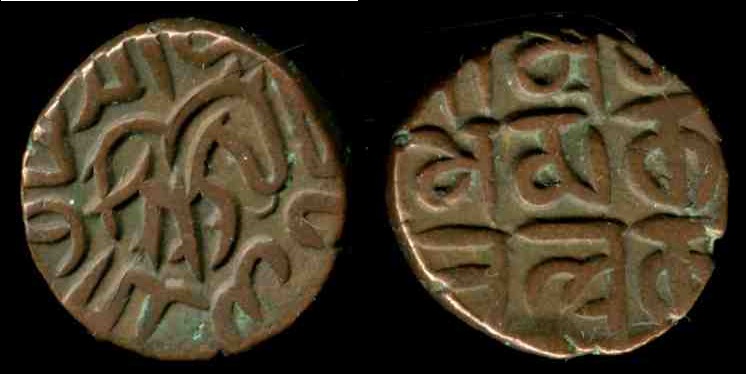 |
SA# 1819 / SG# SS14 / R# 3290 / Tye# 347 /
D# 361. AE Jital.
Dated:
ND (1249-1259).
Metal: Copper.
Edge:
Plain. Obverse:
Outline of horse facing right in the center.
"nasir al-dunya wa'l din" written around the horse. Reverse
Nagari inscription / Sharada letters: "sri maha / mada ka /
raluka".
Ruler: Nasir al-dunya wa'l din al-malik al-muazzam
Muhammad bin Hassan Qarlugh
[Nasir al-Din Muhammad Qarlugh]. Common
type. |
|
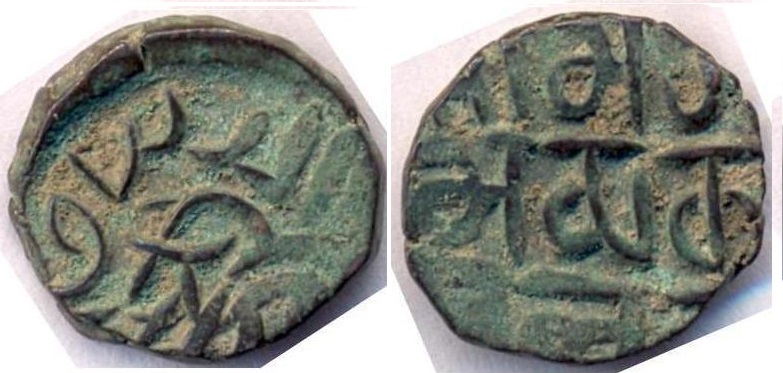 |
Same as below, but corrode
and having large characters on both sides.
|
|
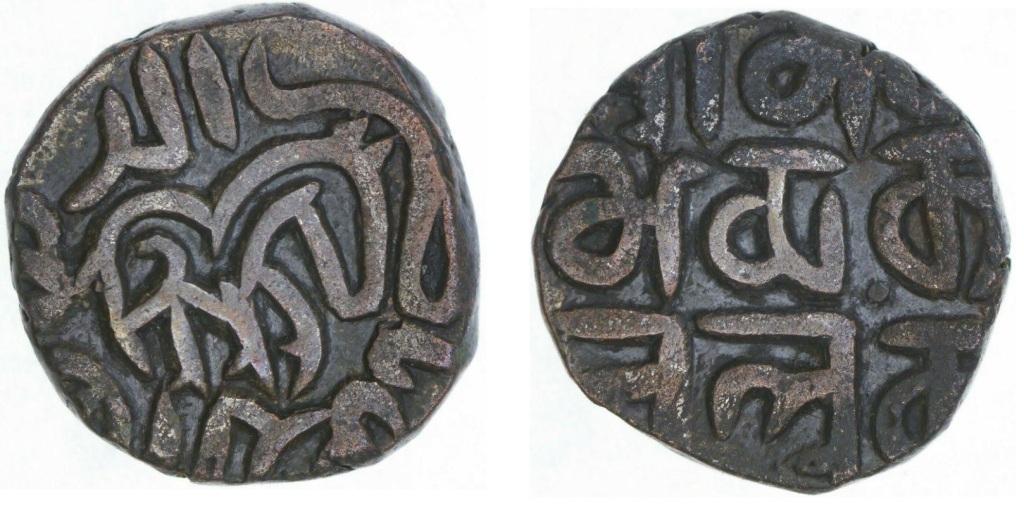 |
Another variety of the above coin.
Weight:
3.66 g.
Diameter: 15.50
mm.
Alignment:
Rotated (3 o' clock). |
|
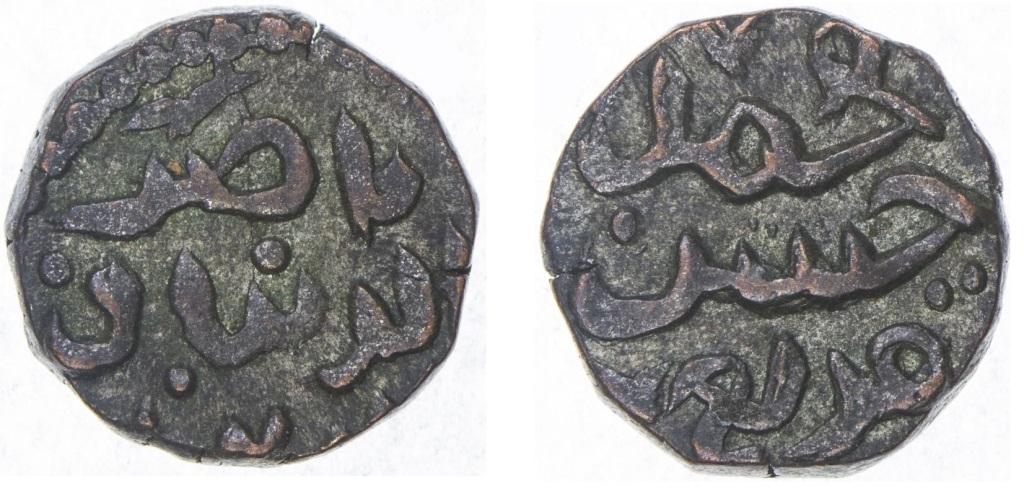 |
SG# SS15 / R# 3291 / Tye# 349 /
D# 360. AE Jital.
Dated:
ND (1249-1259).
Weight:
3.74 g. Metal: Copper.
Diameter:
15.00 mm.
Alignment:
Medal; slightly rotated. Edge:
Plain. Obverse:
"nasir al-dunya wa'l din". Reverse: "muhammad bin
hassan qarlugh".
Ruler: Nasir al-dunya wa'l din al-malik al-muazzam
Muhammad bin Hassan Qarlugh
[Nasir al-Din Muhammad Qarlugh]. Rare
type. |
|
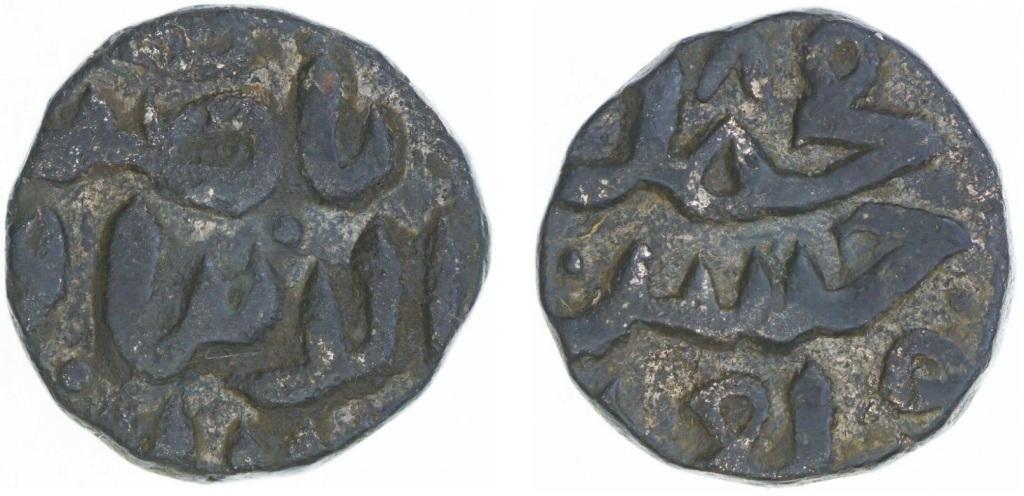 |
Another variety of the above coin with thick
legends on both sides.
Weight:
3.49 g.
Diameter: 15.00
mm.
Alignment:
Rotated (9 o' clock). |
|
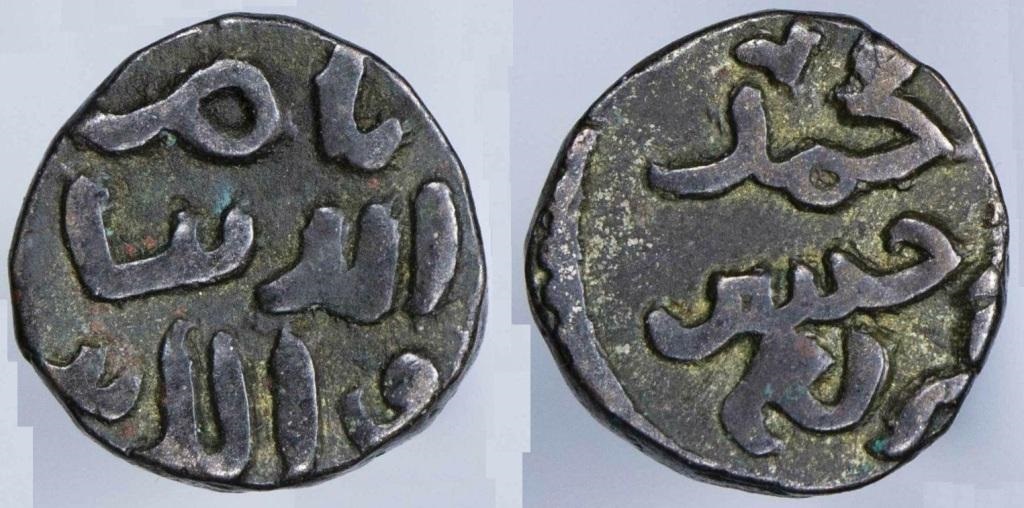 |
Another variety of the above coin. "hassan qarlugh"
on Reverse side are joined together.
Weight:
3.71 g.
Diameter: 13.50
mm.
Alignment:
Rotated (3 o' clock). |
|
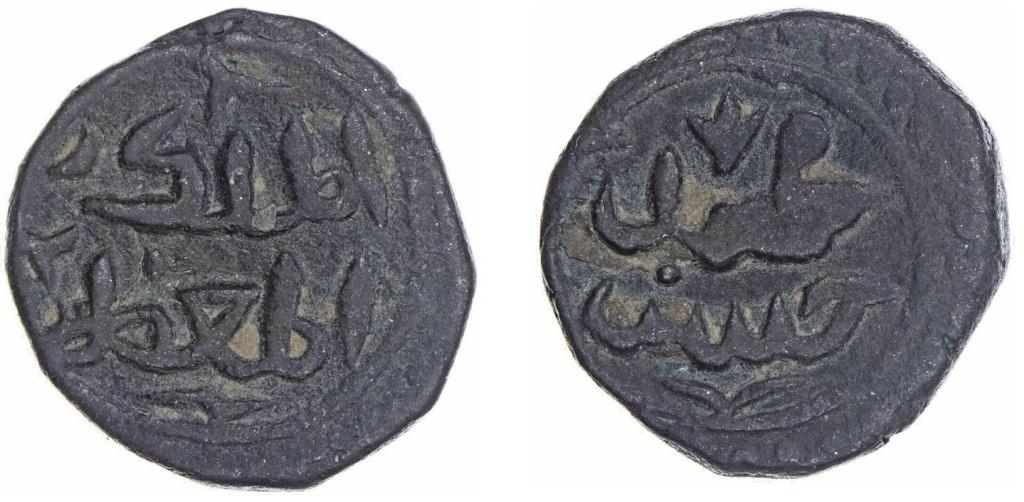 |
SG# SS16 / R# 3293 / Tye# 350 / D# 359. AE Jital.
Dated:
ND (1249-1259).
Weight:
2.43 g. Metal: Copper.
Diameter:
13.50 mm.
Alignment:
Coin. Edge:
Plain. Obverse:
"al-malik al-mu'azzam". Reverse: "muhammad bin
hassan".
Ruler: Nasir al-dunya wa'l din al-malik al-muazzam
Muhammad bin Hassan Qarlugh
[Nasir al-Din Muhammad Qarlugh]. Rare
type. Reduced weight Jital. |
|
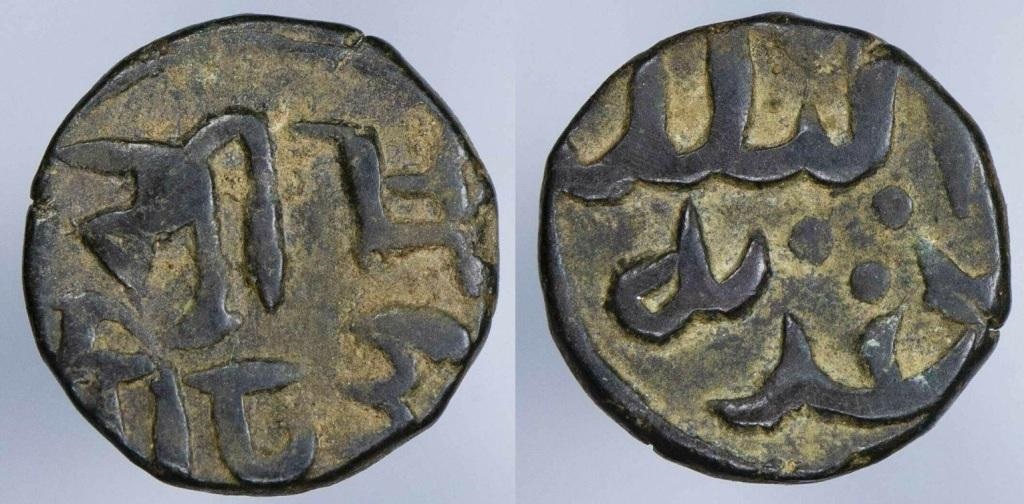 |
Tye# 352.1 AE Jital.
Dated:
ND (1249-1259).
Weight:
3.61 g. Metal: Copper.
Diameter:
14.50 mm.
Alignment:
Rotated (7 o' clock). Edge:
Plain.
Mint:
probably Kurraman. Obverse:
"Sri Sha / LiPhaTi" in two lines for the Sharada text. Reverse:
"في البلد غزنة" (Fi Al-balad Ghazna = At the city Ghazna) in
two lines.
Ruler: Nasir al-dunya wa'l din al-malik al-muazzam
Muhammad bin Hassan Qarlugh
[Nasir al-Din Muhammad Qarlugh]. Rare
type. |
|
Note: These types of Jitals are
recently recovered and discussed in July 2018 at:
WorldofCoins. |
|
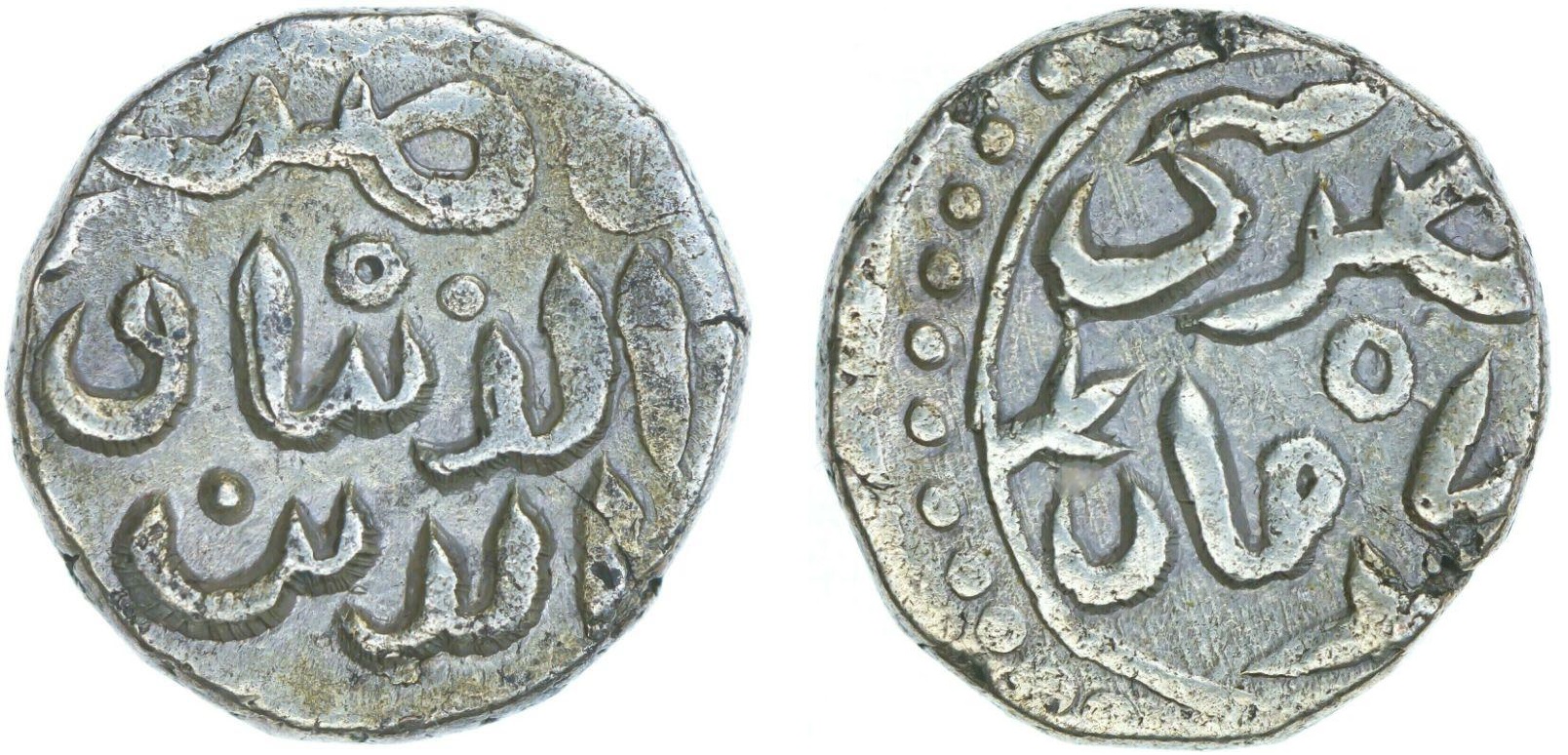 |
SA-1818K AR Jital.
Dated:
ND (1249-1259).
Weight:
3.67 g. Metal:
Silver.
Diameter:
15.50 mm.
Alignment:
Rotated (4 o' Clock). Edge:
Plain. Mint:
Kurraman. Obverse:
"nasir al-dunya wa'l din". Reverse: "zarb
Kurraman" written within center circle; surrounded by
circular dots.
Ruler: Nasir al-dunya wa'l din al-malik al-muazzam
Muhammad bin Hassan Qarlugh
[Nasir al-Din Muhammad Qarlugh]. Very Rare
type. |
|
Note:
Newly discovered type from Ghazna Hoard (2015 Ghazni Hoard.
The find contained around 150 copper jitals; together with
Möngke Khan jitals). Not published in Tye. However this coin
was listed in 2016 at Zeno as
Z-167713. |
|
|
|
- SAMMA
(Jams of Sind)
- Little is known about the history of Sind for
the next century, though, nominally at least, it seems to have been a
part of Delhi Sultanate. During the reign of Muhammad bin Tughluq,
Multan was seized and temporarity occupied by Malik Shahu Lodi, an
Afghan noble. From around 1236, Sind, or at least lower Sind, was in the
hands of the Sammas, a Rajput tribe, who had adopted Islam, and whose
rulers used the title Jam. Their chronology is very uncertain, but the
first three princes of this dynasty paid tribute to Muhammad bin Tuqhluq
and thus acknowledged the supremacy of the Delhi Sultanate. But then in
1350, the Jam gave shelter to the rebel Taghi, which caused Muhammad to
lead his army into Sind. Before he could reach Tattah, the capital, he
died and his army withdrew with difficulty. To avenge this humiliating
retreat, Muhammad's successor Firuz Tughluq invaded Sind in 1362 and
reached Tattah, where the ruler the Jam resolutely defended his city. A
serious disease braking out in the Delhi army, Firuz again had to
retreat, losing a large number of soldiers in the process. A year or two
later, however, Firuz made another expedition into Sind, this time
catching the inhabitants unprepared. The Jam was besieged and had to sue
foe peace. His submission was accepted and not only had he to pay an
annual tribute to Delhi but also accompany the army to Delhi under mild
restraint. The weakening of the Delhi Sultanate after the death of Firuz
Tughluq and the invasion of Timur, enabled the Jams to throw off their
allegiance to Delhi and to rule as independent sovereigns until the
reign of Jam Nizam al-Din, also known as Nanda. During his lengthy reign
the Arghun clan began to make their influence felt in lower Sind and the
Jams attempted to strengthen their position by making marriage alliances
with the Sultans of Gujarat. In 1521, however, Shah Beg Arghun,
conquered Sind and expelled the last Jam, Firuz. Their capital was at
Thatta before being replaced by the Arghun Dynasty. The Samma dynasty
has left its mark in Sindh with magnificent structures including the
necropolis of kings and royalties in Thatta and many more ruins.
- Saman Sultanan Jo
Shajro Babinho I
- Firuz al-Din Shah Unar
I S/o Babinho I...............1336 - 1340
- Jam Unar was the
founder of Samma Dynasty mentioned by Ibn Battuta, the famous traveller
from North Africa, Ibn Battuta visited Sindh in 1333 AD, and saw Samma’s
rebellion against Delhi government.
- Ala al-Din Junan (Juto) I S/o Babinho I..............1340 - 1353
- Sadr al-Din Shah Babinho II
(Banhatiya) S/o Unar I...1353 - 1376
- Rukn al-Din Shah Timaji S/o Unar I...................1376 - 1379
- Sultan Salah al-Din Shah Unar II S/o Tamachi.........1379 - 1391
- He put down revolts in some parts of the
country, by sending forces in those directions and punished the
ringleaders.
- Nizam al-Din I S/o Salah al-Din......................1391 - 1393
- After Jam Salah al-din’s death, the nobles of
the state put his son Jam Nizam al-din I on the throne. Jam Nizam al-din
ruled for a few months. His first act of kindness was the release of his
cousins Sikandar, Karn and Bahauddín and Amar, who had been placed in
captivity by the advice of the ministers. He appointed every one of them
as an officer to discharge administrative duties in different places,
while he himself remained in the capital, superintending the work done
by them and other officials in different quarters of the country. Before
long, however, his cousins, very ungratefully made a conspiracy among
themselves and stealthily coming to the capital attempted to seize him.
Learning their intention in time, Nizam al-Din left the place at the
dead of night with a handful of men and made his escape to Gujrat. In
the morning, men were sent after him, but got no information. The people
therefore summoned Ali Sher, son of Jam Tamachí, who was living in
obscurity, raised him to the throne. Meanwhile Nizam al-Dín also died in
his flight and his cousins too being disappointed in every thing, lived
roving lives.
- Ali Sher S/o Tamachi.................................1393 - 1408
- He was a wise man and a brave soldier. He
ruled the country very discreetly and in his time the people were all at
ease in their minds. He was killed by the planning of some member of his
dynasty including Karan S/o Tugaji, Sadr al-Din Sikandar S/o Tugaji and
Fateh Khan S/o Sadr al-Din Sikandar.
- Karan S/o Khair
al-Din Tugaji S/o Junan (Juto) I............1408
- Fateh Khan S/o Sadr
al-Din Sikandar I S/o
Tugaji.....1408 - 1422
- About this time, Mirza Pir Muhammad one of
Amir Timur’s grandsons came to Multan and conquered that town and Uch.
As he made a long stay there, his presence was felt. Mirza Pír Muhammad
soon went to Delhi and was crowned as king. Multan remained in the hands
of Langahs, and Sind in those of the Sammah rulers as before.
- Tughluq Shah Juto II S/o Sikandar I S/o
Tugaji.......1423 - 1449
- Jam Tughluq [Taghlak] was fond of hunting and
left his brothers to administer the affairs of state at Sehwán and
Bakhar. In his reign some Baloch raised the standard of revolt in the
outskirts of Bakhar, but Jam Taghlak marched in the direction and
punished their ring-leaders and appointed an outpost in each parganah to
prevent any future rebellion of the kind.
- Mubarak [Tughluq Jo Aziz-a-Darbar] (usurper)................1449
- At Nasarpur, a man by the name Mubarak, who
during the last Jam’s reign had made himself celebrated for acts of
bravery, proclaimed himself king under the name of Jam Mubarak. But as
the people were not in league with him, he was driven away.
- Sikandar Shah II Muhammad (Unar) S/o Fateh Khan......1449 - 1452
- Sadr al-Din Shah Sanjar (Raidhan)....................1452 - 1460
- Jam Sanjar ruled the country very wisely.
Under no ruler before this had the people of Sind enjoyed such ease of
mind. He was very fond of the company of the learned and the pious.
- Sultan Nizam al-Din II Nando.........................1460 - 1492
- He was the most famous Sultan of the Samma or
Jamot dynasty. The Samma Sultanate reached the height of its power
during the reign of Jam Nizam al-Din II, who is still recalled as a
hero, and his rule as a golden age. During his last period, a Mughul
army under Shah Beg Arghun came from Kandahar and fell upon many
villages of Chundooha and Sideejuh, invading the town of Agrí, Ohandukah,
Sibi Sindichah and Kot Machián. Jam Nando sent a large army under his
Vazier Darya Khan and defeated the Mughuls in a pitched battle. Shah Beg
Arghun’s brother Abu Muhammad Mirza was killed in the battle. Mughuls
fled back to Kandahar, never to return during the reign of Jam Nizam al-Dín.
Jam Nizam al-Din's death was followed by a war of succession between the
two cousins Jam Firuz and Jam Salah ad-din (a grandson of Jam Sanjar).
- Nasir al-Din Abu Al-Fateh Sultan Firuz S/o Nando.....1492 - 1521
and again in
1528
- Shahbeg Arghun was induced to invade and
conquer Sind in 926 AH (1519 AD) at the Battle of Fatehpur (1519), which
resulted in the displacement of the Sammah dynasty of rulers by that of
Arghun. The Battle of Fatehpur was a key episode in the dissolution of
the Samma Dynasty of Sindh and its replacement by the Arghun Dynasty.
Some Mughals had come to Sind in the reign of Jam Feroz and settled
there with the authorization of the Jam. Among them were Kabak Arghun
who had left Shahhbeg`s party due to a murder. It was at the information
and invitation of Mír Kasim Kíbakí, that Shahbeg marched against Tatta
with a large army about the close of 914 AH (1508 AD). It was on the
15th of Muharram 926 AH (1519 AD) that Shahbeg rode into the river and
led his whole force across, having left a party of soldiers to protect
the camp at the river. Darya Khan, the adopted son of Jam Nando, left
his master Jam Feroz at the capital city and himself advanced with a
large army and gave battle to the Mughuls. A severe battle was fought,
which ended in the victory of Shahbeg. Jam Feroz hearing of the defeat
of his army, fled across the river. Darya Khan was killed in the battle.
Up to the 20th of the same month the Mughuls plundered the city. Several
women and children of respectable families were captured. Even those of
Jam Feroz remained in the city. It was at the intercession of Kazí Kazan,
the most learned man of the time at Tatta, whose family members also had
been taken prisoners, that Shahbeg stopped the plunder by giving an
arrow to the Kazí to show it round to the plundering Mughuls. A
proclamation was also issued to that effect, and once more there was
order and quiet in the city. Jam Feroz was obliged to send messengers to
Sháhbeg recognizing him as his superior and asking for mercy. In the
next month, Saffar, Shahbeg encamped outside the city, where Jam Feroz
came to pay homage to him in person. Shahbeg received him well and gave
him the rich robe of honour that his own father Amír Zunnún had received
from king Muzaffar Husain. Shahbeg was kind enough to give the
governorship of Tattá to the Jam. But after some consultation with the
chief men of the place it was resolved that as Sind was a spacious
country, half of it might be given to Jam Feroz and the other half
retained and left in charge of agents appointed by the Mughul prince. At
Taltí Shahbeg received the homage of certain Sahtah and Sodha chiefs. He
then came to Sehwan. He left Mír Alíkah Arghún, Sultan Mukímbeg Lar,
Kíbak Arghun and Ahmad Tarkhan in charge of the place, and sent Sultan
Mahmud Khan Kokaltash to take charge of Bakhar and himself proceeded to
Shal to bring his family. At the same time he deputed Kazí Kazan to
bring Mahmud son of Darya Khan to his senses and advise him to
surrender, but the Kazí did not succeed in his mission. Shahbeg, was
therefore obliged to come to Taltí, where Darya Khan’s sons Mahmud and
Motan Khan, and Jam Sarang and Rinmal Sodho had mustered their forces
and prepared to defend the place at the instigation of Makhdum Bilal, a
learned man of the place, as the latter had been ill-treated by the
Mughuls after Shahbeg’s victory in Sind and compelled to give certain
taxes. Within three days, Shahbeg secured some boats and crossed the
river, with Mír Fazil Kokaltash and the Arghun and Tarkhan forces. As
Rinmal with his brother Jodho advanced to meet them Mír Fazil attacked
them and defeated them. The fort of Taltí was taken. Most of the Sammah
troops were cut down, some drowned themselves in the river and a few
fled to Sehwan. Rinmal Sodho’s brother Jodho was also among the slain.
After spending three days at Taltí, Shahbeg returned to Shal and Siwí,
and Jam Feroz began to rule quietly at Tatta as before. But it was not
long before Jam Salahuddín, who had some time ago revolted against Jam
Feroz and driven him away from his capital, and had subsequently been
himself driven away by Darya Khan to Gujrat, once more invaded Tatta
with an army of 10,000 men, consisting chiefly of Jarejas and Sodha
Khangars. Jam Feroz, without losing time, hastened to Shahbeg’s agents
at Sehwan and through them sent some fleet messengers to Shahbeg for
help. Shahbeg dispatched his son Mírza Shah Hasan with a column of
Mughuls for the purpose, and sent some more forces after him, by
successive installments. On the 14th of Muharram 927 AH (1520 AD) Mirza
Shah Hasan left Shal for Sind, and after 20 days journey arrived in the
vicinity of Tatta. Salahuddín hearing of the Mughul’s approach left
Tatta, recrossed the river and betook himself to the village of Jun. Jam
Feroz received Mírza Shah Hasan gratefully and in return received marks
of distinction and friendship from him. Salahuddín was soon pursued and
overtaken. A fight ensued between the advance columns of the two
parties, one led by Haibat Alí Khan, Salahuddín’s son, who was
son-in-law to Sultan Muzaffar of Gujrat, and another by Mírza Isa
Tarkhán, Sultan-kulíbeg and Mír Alíkah. Salahuddín’s son was killed and
his army routed. Mad with rage at his son’s death, Salahuddín
precipitated himself upon the Mughuls. But soon he too was slain and his
army fled to Gujrat. After spending three days at the scene of the
battle Jam Feroz went back to Tatta to settle affairs there and Mírza
Shah Hasan returned to Baghban to pay his respects to his father, who
had come to that place. Here during their stay, the Machhí tribes, who
had become rather turbulent and refractory, were punished, their cattle
and property plundered and their villages razed to the grounds. Later
Feroz was exiled to Sultanate of Gujarat during Sultan Qutb ud-Din
Bahadur reign. When the Mughal Empire and Sultanate of Gujarat collide
under Emperor Humayun, Feroz was killed at Khambhat in a
misunderstanding.
- Salah
al-Din................................................1512 and 1520
|
|
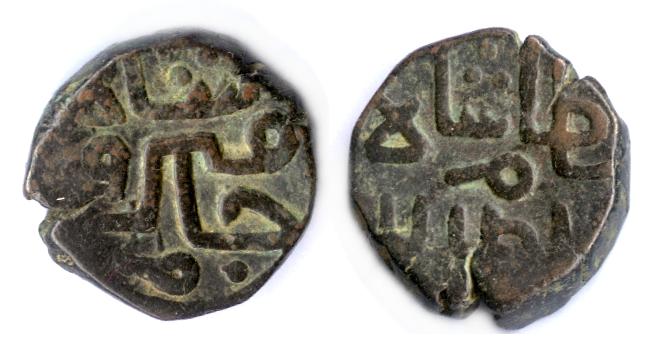 |
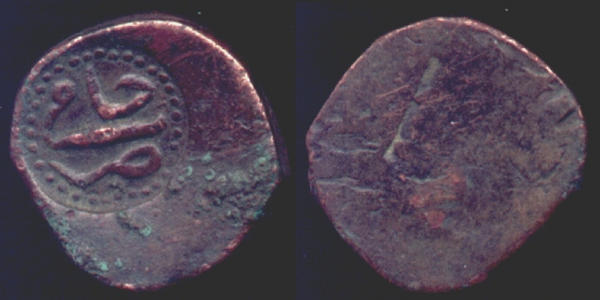
SG# SJ4 AE Falus. Year:
ND (1508-1523). Weight:
14.91g.
Metal: Copper.
Diameter: 22.00 mm. Edge:
Plain. Alignment:
Rotated. Obverse:
"jam firuz shah".
Reverse: "bin
nizam shah sultan".
Ruler: Jam Firuz Salah al-Din Shah Bin
Jam Nizam al-Din II Nando (1492-1521). Rare
type. |
|
 |
AE Falus.
Dated:
ND (probably in 1528).
Metal: Copper.
Weight:
8.49g.
Diameter: 21.00 mm. Edge:
Plain. Alignment:
Medal. Obverse:
"Zarb-i-Jam".
Ruler: Jam Firuz
Salah al-Din Shah Bin Jam Nizam al-Din II Nando (1492-1521). Rare
type. This is a unique coin discovered recently
in Sindh. Jam of Sind - countermarked "Zarb-i-Jam" upon
a Timurid host copper (Dangi) coin. |
|
Note: As per Tareekh Ferishta by Abul Qasim Muhammad
Ferishta, Mirza Shah Beg Arghun of Qandhar was a contemporary of (Sitamgan
dynasty) Jam Nanda of Sindh and Sultan Hussain Shah Langah of Multan.
He (Shah Beg) had made inroads into Sindh and occcupied the fort of
"Sulee" from the Jams and appointed his own brother Sultan Muhammad
as governor or custodian of that fort. Once Shah Beg had retuned to
Qandhar, Jam Nanda re-took that fort and executed Sultan Muhammad.
Most of the time Mirza Shah Beg Arghun had defeated Sindh's local
chieftains including Jams, the aforementioned defeat of Timurid
being an only instance of Jam's victory. Ultimately the Arghuns
assimilated Sindh into an Arghun state with its capital at Thatta.
The overstrike is indicative of the fact that this coin pertains to
the era of short-lived victory over Arghuns because the Jam lers
otherwise mostly on the run were unlikely to have countermarked
Arghun's coins. |
|
|
- ARGHUNS
- Dynasty suppressed by Mughal emperor Akbar
after conquest of Thatta. Hussain Shah Arghun was an independent sultan
of Thatta. He was not a feudatory to any other ruler. He was of Timurid
descent and was the son of Shuja’a Beg alias Shah Beg Arghun son of Amir
Zu’alnun. (Amir Zu’alnun was a commander of Hussain Shah Timurid (Ruled
862 to 911 AH) and a tutor to his son Badi’uzzaman (Ruled 905 to 908 and
911 to 914 AH). He was made the administrator of Dawar, Sagar, Tobuk and
Karah in 884 AH}. During the turmoil period Amir Zu’alnun became
quasi-independent and appointed his son Shah Beg as ruler of Qandhar
(please see entries number K2467 and L2467 of Mr. Album’s ‘A Checklist
of Islamic coins’ [second edition]). After the death in 930 AH of Shah
Beg Arghun, who had occupied parts of Sindh, his son Hussain Shah Arghun
was ousted from Qandhar by the Mughals under Babar. Hussain Shah
established a Timurid sultanate in upper and central Sindh extending
into the present day Rajasthan on the east and Baluchistan on the West.
His capital was at Thatta. According to one account he was induced by
Babar to attack Multan as the Langah rulers of Multan were feudatories
to the Lodhi Sultanate and Babar did not wish to encounter any
significant opposition before meeting the Delhi forces. Hussain Shah
Arghun attacked Multan in 1526 CE [932-33 AH] and after a prolonged
siege Hussain Shah-II Langah capitulated and Multan was annexed to the
kingdom of Thatta. The early Mughals, Babar and Humayun did not bother
the Arghun Sultanate but when Sher Shah Suri defeated Humayun in 945 AH
[1538 CE], Humayun fled westwards and sought refuge in the sultanate of
Thatta. Except for initial superficial goodwill, Hussain Shah Arghun
withheld all material help from Humayun, and made all possible efforts
to prevent the westwards escape of Humayun by denying him boats (to
cross the Indus) and provisions and transport for the royal entourage.
He attempted to create rift between the fugitive emperor and his uncle
Mirza Yadgar Nasir Beg by minting coins at Bhakkar in the name of latter
{No such coin has been reported in any numismatic reference so far but
we might stumble upon one of those coins some day}. Reverting to our
subject, we find that Humayun managed to escape to Iran in a most
wretched condition. Mirza Yadgar Nasir too was subsequently expelled in
an unceremonious manner. In the meantime Hussain Shah Arghun had married
his daughter Mahe-Chuchak to Mirza Kamran, the younger brother of
Humayun and ruler (after the death of Babar) of Kabul, Qandhar and the
Punjab. (Kamran at a later stage sought refuge with Arghun after Humayun
returned with Persian assistance but was ultimately captured & blinded
by Humayun). Hussain Shah Arghun died in 964 AH [1556 CE] and was
succeeded by his son Sultan Mahmood at Bhakkar (Northern Sind), whereas
Mirza Isa Beg Tarkhan, a former commander of Shah Beg Arghun, occupied
Thatta (South). Both the Sultanates lasted for a while, the former for
another 18 years before its annexation by Akbar and the latter for 36
years up to 1000 AH when it was conquered by Khan-e-Khanan. Both of
these small Sultanates minted coins albeit only of copper. A reference
to Tarkhan coins is available in ONS Newsletter number 129 (June-July
1991). The coins indicate mint of Thatta and the year as 983 AH [1585
CE] and some as 984 AH [1586 CE]. The obverse side depicts a crudely
designed bird, probably peacock. Isa Beg was succeeded by his son Baqi
Beg in 983 AH [1587 CE].
- Mirza Shah Beg Arghun (in Qandahar 1507-1522)........1522 - 1524
- Mirza Shah Husain S/o Shah Beg Arghun................1524 - 1556
- Shah Husain was suffering from ill
health and was deposed by his nobles in favor of Mirza Muhammad Isa
Tarkhan after some internal conflicts.
- ARGHUN TARKHANS
- Makli Necropolis (Urdu: مکلی کا شہرِ خموشاں;
Sindhi: مڪلي جو مقام) is one of the largest funerary sites in the
world, spread over an area of 10 square kilometres near the city of
Thatta, in the Pakistani province of Sindh. Makli Necropolis is located
in the town of Makli, which is located on a plateau approximately 6
kilometers from the city of Thatta, the capital of lower Sindh until the
17th century. It lies approximately 98 km east of Karachi, near the apex
of the Indus River Delta in southeastern Sindh. The southernmost point
of the site is approximately 5 miles north of the ruins of the medieval
Kallankot Fort. The site houses approximately 500,000 to 1 million tombs
built over the course of a 400 year period. Makli Necropolis features
several large funerary monuments belonging to royalty including Arghun
Tarkhans rulers, various Sufi saints, and esteemed scholars. The site
was inscribed as a UNESCO World Heritage Site in 1981 as an "outstanding
testament" to Sindhi civilization between the 14th and 18th centuries.
- Mirza Mohammed Isa Tarkhan I..........................1556 - 1567
- He was a member of the elder branch of the
Arghun clan. During the civil war between Shah Husain and his nobles
under Muhammad Isa
Tarkhan, Muhammad Isa Tarkhan sent a request for the help to the
Portuguese at Bassein. A 700 man force under the command of Pedro
Barreto Rolim sailed up to Thatta in 1555, only to find that Muhammad
Isa Tarkhan had already won the conflict and there was no need for their
assistance. Furious at the governor of Thatta's refusal to pay them, the
Portuguese sacked the defenseless city and killed several thousand
people.
Muhammad Isa Tarkhan was soon forced to deal with a rival claimant,
Sultan Mahmud Gokaldash. He was eventually compelled to make peace with
Sultan Mahmud; the two agreed that Muhammad Isa Tarkhan would keep lower
Sindh, with his capital at Thatta, while Sultan Mahmud would rule upper
Sindh from Bakhar. In 1567 Muhammad Isa Tarkhan died and was succeeded
by his son Muhammad Baqi.
- Mirza Mohammed Baqi Tarkhan S/o Mohammad
Isa.........1567 - 1585
- During his reign in 1568 Debal a Sindhi port
city near Thatta was attacked by the Portuguese Admiral Fernão Mendes
Pinto in an attempt to capture or destroy the Ottoman vessels anchored
there, the port was heavy damaged and a large Mughal force armed with
muskets was deployed on the shores to avoid such attacks and landings by
the Portuguese. Upper Sindh was annexed by
the Mughal Emperor Akbar in 1573. Muhammad Baqi committed suicide in
1585, and was succeeded by his son Jani Beg.
- Mirza Jani Beg Tarkhan...............................1585 - 1591
- Sind was invaded by Mughals. In 1591 Akbar
sent an army to conquer lower Sindh under general Abdul-Rahim Khan
better known as Khan-e-Khanan (Khan of Khans). Jani Beg put up a resistance but
was defeated by the Mughal forces and his principality was annexed. In
1599, Jani Beg died of delirium tremens.
|
|
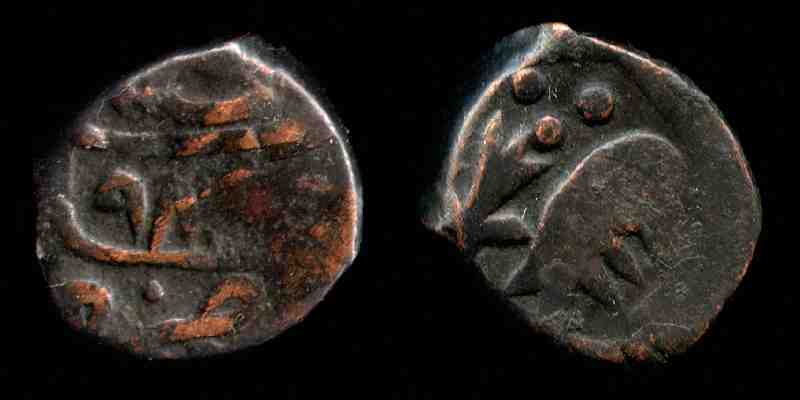 |
SG#
ST1. Falus.
Dated: AH 984 (1576).
Weight:
2.40g. [2.30 - 2.90g]. Metal:
Copper.
Diameter: 14.50 mm.
Edge:
Plain. Alignment:
Coin. Mint: Thatta.
Metal: Bronze.
Obverse: "darb
falus balda tattah" / AH 984. Reverse Cursive
floral ornaments and bird (possibly peacock) at right. Mintage Years:
AH 979 (1571), AH 981-985 (1573-1577) and AH
987-988 (1579-1580). Ruler:
Mirza Muhammad Baqi Beg ibn Mirza
Muhammad Isa Khan Tarkhan (AH 975-993 /
1567-1585). Rare
type. |
|
|
|
-
Mughal
Empire........................................1591 - 1718
- Mirza Jani Beg Tarkhan (continued)..............1591
- 1599
- Ghazi Beg Tarkhan...............................1599
- 1612
- Mirza Ghazi Beg Tarkhan (Persian: میرزا غازى
بیگ ترخان) of the Tarkhan dynasty in Sindh ruled from the capital city
of Thatta. He was the most powerful Mughal governor who administered
Sindh, during whose rule the region had become fiercely loyal to the
Mughals. In Sindh a network of small and large forts manned by cavalry
and musketeers further extended Mughal power during the reign of Mughal
Emperor Shah Jahan. He was a descendant of the powerful Mirza clan which
had arrived in the region with the Mughal Emperor Mirza Babur Beg who
had conquered South Asia in 1526. Mirza Ghazi Beg spoke nearly three
languages which include Sindhi (his native-tongue), Persian (the
official language of the Mughal Empire) and some Turkic. He is
remembered for the completion of the monumental Shah Jahan Mosque built
in 1647-1649 at Thatta, he is also credited for introducing the Sindhi
Abjad (new Sindhi alphabets alongside the original Arabic Alphabets). He
was a charismatic leader who had a deep passion for Horse-back Archery
and Sufi teachings. Mirza Ghazi Beg took action against the rebellious
Hindu Brahmans.
- Abul-Qasim Sultan Tarkhan..............................1612
- Mohammed Isa Tarkhan II S/o Jan
Baba............1612 - 1644
- Jan Baba was the son of Isa Tarkhan I and
father of Isa Tarkhan II.
- MIR BEJAR
- The Mir Bejar dynasty began to gain influence
as a dynasty of feudal lords in lower Sindh, they were of Sisodia clan
of Mewar, where they ruled since the middle 17th century. They were
merchant rulers who flourished Sindh during mughal period eventually
brought Thatta under their control in 1638 - after which they became
hereditary rulers of Thatta; before eventually moving to near by
Cutch (Kutch) State in 1750.
-
KALHORA
- The Kalhora dynasty began to gain influence as
a dynasty of feudal lords in upper Sindh, where they ruled since the
middle 16th century. They eventually brought Thatta under their control
in 1736 - after which they moved their capital to Thatta before
eventually moving it to Hyderabad in 1789. Thatta continued to decline
in the mid 18th century in importance as a trading centre throughout the
18th century, as much of the city's trading classes shifted to Shikarpur
in northern Sindh, or to Gujarat.
-
Yar Mohammed
Khan...............................1701 - 1719
- Nur Mohammed.........................................1719 - 1752 d. 1754
- During his reign, Shah Abdul Latif Bhittai
(1689–1752) was a Sufi scholar and saint, and is considered one of the
greatest poets of the Sindhi language. Bhittai settled in the town of
Bhit Shah in Matiari, Pakistan where his shrine is located. Shah Abdul
Latif Bhittai's most famous written work is the Shah Jo Risalo,
which is a masterpiece of Sindhi literature as well.
- Afghanistan (Ahmad Shah Durrani).....................1752 - c. 1760
-
Ahmad Shah ruled Afghanistan from 1747 until 1773 and
captured Sind for approximately eight years.
- KALHORA (restored)
- Mohammed Murad Yar Khan...........................c. 1760 - c. 1765
- Ghulam Shah.......................................c. 1765 - 1770's
- Haiderabad city in Sind was founded by Ghulam
Shah Kalhora in 1768 and it became the capital of Talpur Mirs in 1786,
both being feudatories of Taimur Shah Durrani.
- 3 unknown rulers
- Sarfaraz
- Mahmud......................................................10 months in the 1770's
- Ghulam Nabi
- Abdul Nabi (1st
time)
- Sadiq Ali
- Abdul Nabi (2nd
time)...................................? - 1783
- Kalhora forces under Abdul Nabi Kalhora
were defeated by the Talpurs in the battle
of Halani in 1783 under the command of Mir Fateh Ali Khan bin Sobhdar.
Later Mir Fateh Ali made Hyderabad the seat of rule.
- TALPUR (Khairpur State)
- In 1739, however,
following the Battle of Karnal, the Mughal province of Sindh was fully
ceded to Nadir Shah of the Persian Empire, after which Thatta fell into
neglect, as the Indus river also began to silt. The city then came under
the rule of the Talpurs, who seized Thatta from the Kalhoras. A second
British comptoir was established during the Kalhora period in 1758,
which operated until 1775.
The Talpur arranged a dispersed system of local co-Princes, with the
Hyderabad succession as senior and chief among them. Talpur clan of Sohrabani lineage
founds the state of Khayrpur in 1775 with ruler title as Mir. Mirpur state
was also founded by branch of the Talpur clan of Manikani lineage in 1801 with ruler title known as Mir. All had a certain
measure of influence over the polity as a whole. Title of rulers at
Hyderabad were Khan. Sindh was repetitively attacked by Balochistan,
Afghanistan, Rajputs and finally the Sikhs as well. The Sikhs snatched
the area north of Kashmore till Mithankot from Khairpur and the southern
part of the Sikh empire faced constant Baloch insurrection and battle.
However, their is a real possibility that had Talpurs were united under
Mir Ali Murad of Khairpur, the strongest of them all whom the the
British Governor general had termed a "mortal" threat to the British
army, they would have fared better. It became a British protectorate on 29 Nov 1834,
while Khairpur on 25 Dec 1838. Abdul Majeed
Jokhia, an eminent historian of that period says that Sindh was divided
into seven districts, three were under Mir Fateh Ali and his brothers,
(sons of Mir Sobhdar), two were under Mir Sohrab, one under Mir Thara of
Mirpur and one under Mir Mahmood, (their uncle) and sons of Mir
Abdullah.
- Sohrab Khan (Khairpur)...............................1775 - 1811
and...
- Fath Ali Khan bin Sobhdar (Hyderabad: Chief).........1783 - 1801
with...
- Mir Fateh Ali Khan and his three brothers
ruled at Hyderabad. This was known as "The Chauyari," the rule of four
friends. Fateh Ali was the Principal Amir and held the most important
position. The other brothers also had some responsibilities.
- Thara Khan (Keti
Mir Tharo)..........................1784
- 1801
- Mir Thara Khan, Sitara-i-Jang, was the founder of Mankani Talpurs state in
southeastern Sindh. Talpurs defeated Kalhora rulers and founded their
rule over Sindh. Mir Thara Khan Talpur participated in the Battle of
Halani against Kalhoras. However, when Mir Fateh Ali Talpur started rule
from Hyderabad (Sindh), Mir Thara Khan Talpur went to southeastern Sindh
and founded his own state at Keti Mir Tharo in 1784.
- Ghulam Ali Khan bin Sobhdar (Hyderabad: Chief).......1801 - 1811
and...
- Karim Ali Khan bin Sobhdar (Hyderabad: Chief 1811-28)1801 - 1828
and...
- British were eyeing Sindh for its wealth and
strategic position and were making inroads with new agreements aimed at
increasing their influence. When Mir Murad Ali the youngest of all
brothers fell gravely ill, Mir Karim Ali requested the Governor in
Bombay to send an able doctor. Dr. James Burnes came and cured him of
the disease. Dr Burnes book "A Visit to the Court of Sinde" tells a lot
about the state of the Court in 1827. The book dispels a lot of
misconceptions regarding the Talpurs and their rule.
- Murad Ali bin Sobhdar (Hyderabad: Chief
1828-32).....1801 - 1832
and...
- Rustam Ali Khan bin Sohrab Khan (Khairpur)...........1811 -
20 Dec 1842
and...
- Ali Murad bin Thara Khan (Mirpur Khas)...............1801 - 1829
and...
- Mir Ali Murad Talpur, known as the Aadil-i-Jang, was the second ruler of the Mankani Talpurs state of
Mirpurkhas. He founded Mirpurkhas town in 1806 and made it the capital
of his state which was founded by his father, Mir Thara Khan Talpur at
Keti Mir Tharo. His state included territories of the present day
southeastern Sindh. His son was Mir Sher Muhammad Talpur.
- Sher Muhammad bin Ali Murad (Mirpur
Khas)............1829 -
12 Feb 1843
and...
- Mir Sher Muhammad Talpur, popularly known as
“The Lion of Sindh” (Sher-i-Sindh) belonged to the Mirpurkhas House of
Royal Talpurs. He was born in 1810 and was the last ruler of Talpurs who
fought British General Charles Napier on 24 March 1843 at the
battleground of Dubbo to liberate Sindh from British domination. He died
on 24 August 1874.
- Mubarak Ali Khan (Khairpur)..........................1829 - 1839
and...
- Sahib (Hyderabad: Chief).............................1832 - 1833
and...
- Nur Muhammad Khan bin Murad Ali (Hyderabad: Chief)...1833 - 1841
and...
- Muhammed Naseer Khan bin Murad Ali (Hyder.: Chief
1841-1843).1833 - 12 Feb 1843 and
- Sobhdar Khan (Hyderabad).............................1833 -
12 Feb 1843
and..
- Mohammad Khan (Hyderabad)............................1833 -
12 Feb 1843
and...
- Sobhdar Khan and Mohmmad Khan were cousins of
Nur Muhmmad Khan.
- Nasir Muhammad Khan (Khairpur).......................1839 -
1842 and...
- Shahdad bin Nur Muhammad Khan (Hyderabad)............1841 -
12 Feb 1843
and...
- Husain Ali bin Nur Muhammad Khan (Hyderabad).........1841 -
12 Feb 1843
-
The rule was passed to Mir
Mohammad Naseer Khan in 1841 as mentioned above. In the
same year Sir Charles Napier was sent to Sindh to
achieve the ultimate goal of annexation of Sindh to the
British Empire. Differences between the Talpurs began to
crop up anew and the old grievances came to fore. There
were differences between the sons of Mir Nur Mohammad.
Mir Sobhdar Khan in Hyderabad and Mir Ali Murad in
Khairpur failed to realize that the English would
eventually not be their friends either. The British
presented new terms for a treaty and Mir Naser Khan was
an unwilling signatory as there were many unjust
demands. The British wanted Karachi, Thatta and Bakhaar
permanently. They wanted the Mint to be closed and no
taxation for their traders. They wanted to replace Mir
Rustam with his brother Mir Ali Murad and kept making
unjust demands on him. Eastwick says that at one point
Mir Rustam was so fed up with their demands that he said
he couldn't accept them. After all, he was a Baluch. "A
Glance at Sindh Before Napier " by Eastwick presents the
true picture of those times. Napier forced Mir Rustam to
go to Hyderabad. Mirsahib was old and ailing at that
time. The Talpurs and other Baluchs were infuriated at
this. To make the matters worse, Napier started his
incursion towards Hyderabad to provoke the Baluchs. He
confiscated Mir Rustam's possessions on flimsy pretexts
in December 1842. Napier continued his provocations by
words and deeds. The Baluchs knew for certain that
Napier would use the logic of the wolf that is bent upon
devouring the sheep and not relent even if all his
demands were met. They decided to meet force with force.
On the 05th of February Major Outram's post near Kotri
was attacked but he embarked on the steamer and escaped.
Napier had camped near Miani and the Baluchs assembled
there to fight it out. On 17 February the opposing
forces met. The Baluchs surpassed all in valor and
bravery. Mir Jan Mohammad Talpur charged into the
English camp and attacked Outram who narrowly escaped
his chance by jumping off his horse. Mir Jan Mohammad's
grave is in Miani. One Baluch, bayoneted by a British
soldier and unable to reach the opponent with his sword,
pushed the bayonet and the rifle through his own body
and killed the opponent. The British say their
casualties were 62 killed and 194 wounded. The
casualties on the Baluch side are estimated to be six
times higher. The Baluchs were defeated and had to
retreat. Valor alone has never been and can never on its
own be the determining factor in the outcome of any
battle.
Discipline and planning played a
much more important role and on February 17th 1843, won
the day for the British. Had the outcome of the Battle at Miani
been different it would have changed the history of the
sub-continent.
It could have been different if
only the Talpurs had realized that the British would never abide
by the agreements they were making. The next day Mir
Naseer Khan Talpur surrendered to Charles Napier. He and others
were then arrested and sent in exile to Calcutta and
other places in India. The houses were looted even the
ladies were not spared. Finally, the English had gotten Sindh.
Mir Sher Mohammad of Mirpur Khas,
popularly known as “The Lion of Sindh” (Sher-i-Sindh) tried to rally
his forces. He fought against the English at Dabbo near
Hyderabad on March 24, 1843 but his forces too were
defeated and no change could be brought to the state of
things. The British had wormed their way into Sindh
through deceit and intrigues but conquered it through
force of arms and that was the only recourse for them in
sustaining their illegal rule here. Thus
British extinguishes
the state on 12 Feb 1843 and makes Sindh as a part of Bombay Presidency,
British India. A comment here is irresistible: Sir Charles James Napier,
was a British general and Commander-in-Chief of India, who conquered Sindh in 1843, sent to
London on the completion of his mission what is perhaps the most
succinct dispatch in the annals of military history, and one which also
provides an extremely rare multi-lingual triple pun: he scrawled the
single word "Peccavi", which is Latin for "I have sinned".
- Great
Britain........................................1843 - 1948
- British Resident in Lower Sind and later Upper Sind
- James Outram....................................1839 - 1843
- TALPUR
- Further Emirs of Khairpur under British
authority. Capital: Khayrpur (Khairpur). It was a princely state on
the Indus River. The state was originally founded as the kingdom of
Upper Sindh 1783 by Sohrab Khan who was a member of the junior
branch of the ruling Talpur clan of the state of Sindh. The capital
city was developed in 1786. When the British took over
responsibility for foreign affairs in 1838, the status was reduced
to that of a Princely State. The gun salute was reduced from 19 to
17 and then to 15, as the area of the state diminished to 15,670
km². Khairpur closed its mint and currency in 1903 and gave legal
tender to the British imperial currency in order to utilize the
benefit of the economic market of the empire. After almost two
centuries of varying degrees of independence, the state became part
of Pakistan in 1947. Sindhi or Saraiki are spoken in this area.
-
![[Khairpur c.1860/70]](Khairpur-Flag1.gif) ![[Khairpur to 1955]](Khairpur-Flag2.gif)
- Ali Murad
Khan...........................20 Dec 1842 - 02 Apr 1894
- Faiz Mohammad Khan
I.....................02 Apr 1894 - 06 Mar 1909
- Imam Bakhsh
Khan.........................06 Mar 1909 - 08 Feb 1921
- Ali Nawaz
Khan...........................25 Jun 1921 - 25 Dec 1935
- Faiz Mohammad Khan
II....................26 Dec 1935 - 19 Jul 1947
- Pakistan.............................................1948 - date
- George Ali Murad
Khan....................19 Jul 1947 - 14 Oct 1955
- He was born in 1933 and ruled under a unknown
regent from 19 Jul 1957 to 16 Sep 1951.
|
| |
|
.jpg) |
KM#17
Rupee. Year:
ND [1812-1848]. Weight:
7.58g [7.50 - 7.80g].
Metal: Silver.
Diameter: 17.50 mm.
Edge:
Plain. Alignment:
Rotated (3 o' clock). Mint:
Hyderabad.
Obverse Persian Legend: "Zarb
Haidarabad Sind julus maimanat manus"
(Struck at Haidarabad Sind
associated with tranquil prosperity). Mint mark: Sprig with
three berries.
Reverse: "Sikka
Taimur Shah" (Coin of Taimur Shah) within design in the center. Legends near the border in circular form. Mintage:
N/A. Mintage Years:
One year type. Ruler:
Amirs of Hyderabad
(1812-1848) citing: Taimur Shah
Durrani of Afghanistan. |
|
.jpg) |
KM#20.4
Rupee. Year:
ND [1812-1848]. Weight:
7.63g [7.50 - 7.80g].
Metal: Silver.
Diameter: 17.00 mm.
Edge:
Plain. Alignment:
Rotated (3 o' clock). Mint:
Hyderabad.
Obverse Persian Legend: "Zarb
Haidarabad Sind julus maimanat manus"
(Struck at Haidarabad Sind
associated with tranquil prosperity). Mint mark: Sprig with three
berries.
Reverse: "Sikka
Taimur Shah" (Coin of Taimur Shah) within design in the center. Legends
near the border in circular form. Mintage:
N/A. Mintage Years:
One year type. Ruler:
Amirs of Hyderabad
(1812-1848) citing: Taimur Shah
Durrani of Afghanistan. |
|
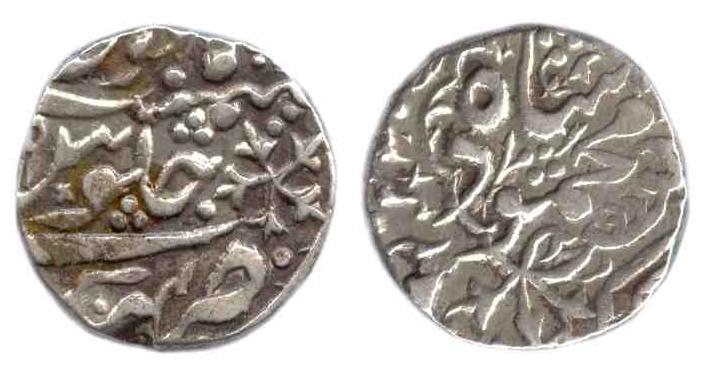 |
C#10.9
Rupee. Year:
AH xxx5 (AH
1225 error for 1252)
[1836]. Weight:
9.78g.
Metal: Silver.
Diameter: 20.00 mm. Edge:
Plain. Alignment:
Medal. Mint: Bhakhar.
Obverse Persian Legend: "Zarb
Bhakhar (xxx5) julus maimanat manus"
(Struck at Bhakhar in the year xxx5 of the accession
associated with tranquil prosperity). Branch mintmark.
Reverse: "Mahmud Shah". Star
mintmark. Mintage:
N/A. Mintage Years:
One year type. Ruler:
Amirs of Khairpur
(1812-1845) citing:
Mahmud Shah
Barakzai of Afghanistan. |
|
According to Krause and Mishler, this coin is considered to be of Amir
of Khairpur of Talpur Dynasty, Nasir al-Din Muhammad [AH 1239-1260
(1823-1842)]. Khairpur was officially recognized as an independent state from
AH 1248 (1832) to AH 1259 (1843). |
|
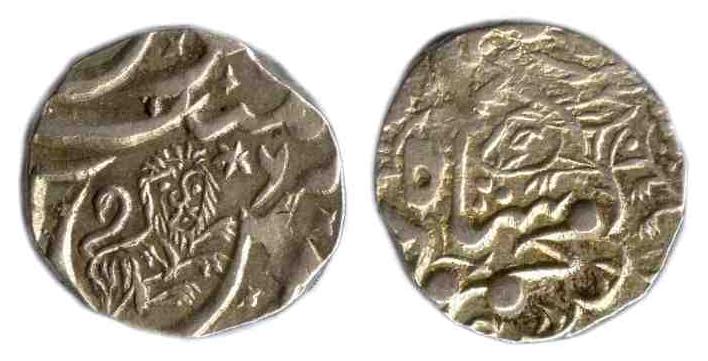 |
C#11
Rupee. Year:
AH
xx6x = 1261 (1845). Weight:
9.91g.
Metal: Silver.
Diameter: 20.00 mm. Edge:
Plain. Alignment:
Rotated. Mint: Bhakhar.
Obverse:
"Mahmud Shah". Outline of Hare head facing left. Reverse:
"Zarb Bhakhar (xx6x) julus maimanat manus"
(Struck at Bhakhar in the year xx6x of the accession
associated with tranquil prosperity). Outline of British Lion
walking right. Mintage:
N/A.
Mintage Years:
AH 1259 (1843) and AH 1261 (1845). Ruler:
British occupation of Sindh during Ali Murad's rule (coinage: AH 1259-1269 /
1843-1853) citing:
Mahmud Shah
Barakzai of Afghanistan. |
|
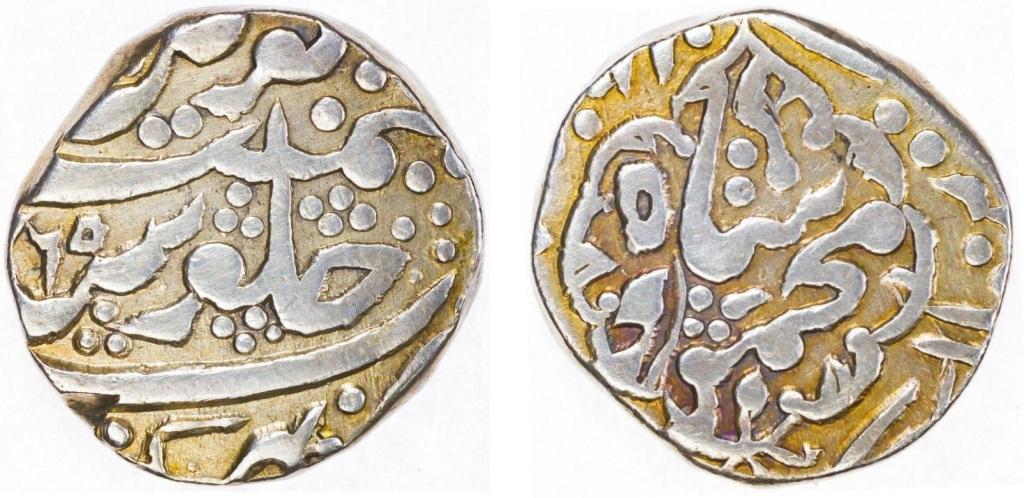 |
C#12
Rupee. Year:
AH
xx65 = 1265 (1849). Weight:
9.73g.
Metal: Silver.
Diameter: 19.00 mm.
Edge:
Plain. Alignment:
Coin. Mint: Bhakhar.
Obverse:
"Zarb Bhakhar (xx65) julus maimanat manus"
(Struck at Bhakhar in the year xx65 of the accession
associated with tranquil prosperity). Floral mint marks of various
kinds. Reverse:
"Mahmud Shah" within design in the center.
Legends near the border in circular form.
Mintage: N/A.
Mintage Years:
AH 1262-1269 (1846-1853). Ruler:
British occupation of Sindh
during Ali Murad's rule (coinage: AH 1259-1269 /
1843-1853) citing:
Mahmud Shah
Barakzai of Afghanistan. |
| |
| |
|
Below is a Hindus Jagir in Sind, known as |
|
|
| |
|
Sind -
Province of British India |
| |
21 Feb 1843 Sind occupied by Britain.
Jun 1843 Annexed by Britain; subordinated to
Bombay.
01 Apr 1936 Sind a separate province.
14 Aug 1947 Part of
Pakistan. |
| |
- Chief commissioners
-
Charles James
Napier.....................................1843 - 1847
-
Richard Keith
Pringle....................................1847 - 1851
-
Henry Edward Bartle Frere................................1851
- 1859
-
Jonathan Duncan Inverarity...............................1859 - 1862
-
Samuel
Mansfield.........................................1862 - 1867
-
William Henry
Havelock...................................1867 - 1868
-
William Lockyer
Merewether...............................1868 - 1877
-
Francis Dawes
Melville...................................1877 - 1879
-
Henry Napier Bruce Erskine...............................1879
- 1887
- Charles
Bradley Pritchard...............................1887 - 1889
-
Arthur Charles
Trevor....................................1889 - 1891
-
Henry Evan Murchison
James...............................1891 - 1900
-
Robert
Giles.............................................1900 - 1902
-
Alexander Cumie..........................................1902
- 1903
- Horace
Charles Mules.....................................1903 - 1904
-
John Williams Pitt
Muir-Mackenzie........................1904 - 1905
-
Arthur Delaval Youngshound...............................1905
- 1912
- William
Henry Lucas......................................1912 - 1916
-
Henry Staveley
Lawrence..................................1916 - 1920
-
Jean Louis Rieu..........................................1920
- 1925
- Patrick
Robert Cadell....................................1925 - 1926
-
Walter Frank
Hudson......................................1926 - 1929
-
George Arthur
Thomas.....................................1929 - 1931
-
Raymond Evelyn
Gibson....................................1931 - 1935
-
Godfrey Ferdinando
Stratford Collins.....................1935 - 1936
-
Governors
-
Sir Lancelot Graham (1st
time)....................01
Apr 1936 - 01 Aug 1938
-
Joseph Garret (acting)............................01
Aug 1938 - 01 Dec 1938
-
Sir Lancelot Graham (2nd
time)....................01
Dec 1938 - 01 Apr 1941
- Sir Hugh
Dow......................................01 Apr 1941 - 15 Jan 1946
-
Sir Robert Francis Mudie..........................15
Jan 1946 - 14 Aug 1947
|
- Prime Ministers
- Sir Ghulam Hussain
Hidayatullah Khan Bahadur Shaykh (1st)..24
Apr 1937 - 23 Mar 1938
- Khan Bahadur
Shaheed Allah
Bakhsh Soomro (1st
time)........23
Mar 1938 - 18 Mar 1940
- Mir Bandeh Ali
Khan Talpur.................................18 Mar 1940 - 07 Mar 1941
- Khan Bahadur
Shaheed Allah
Bakhsh Soomro (2nd
time)........07
Mar 1938 - 14 Feb 1942
- Sir Ghulam Hussain
Hidayatullah Khan Bahadur Shaykh (2nd)..14
Oct 1942 - 14 Aug 1947
- Continued as Governor
of Sind for Independent Pakistan.
|
|
|
|
|
| |
|
|
|
Pakistan or refer to Pakistan's Sindh
Governors and Chief Ministers. |
|
Countries
/ Territories |
| |
|
Chiefa Coins | |
|