| |
 |
 |
| |
|
Libya |
| |
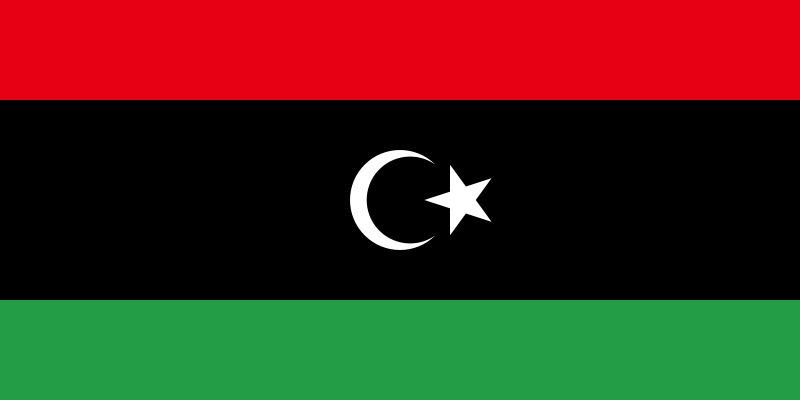 |
|
|
|
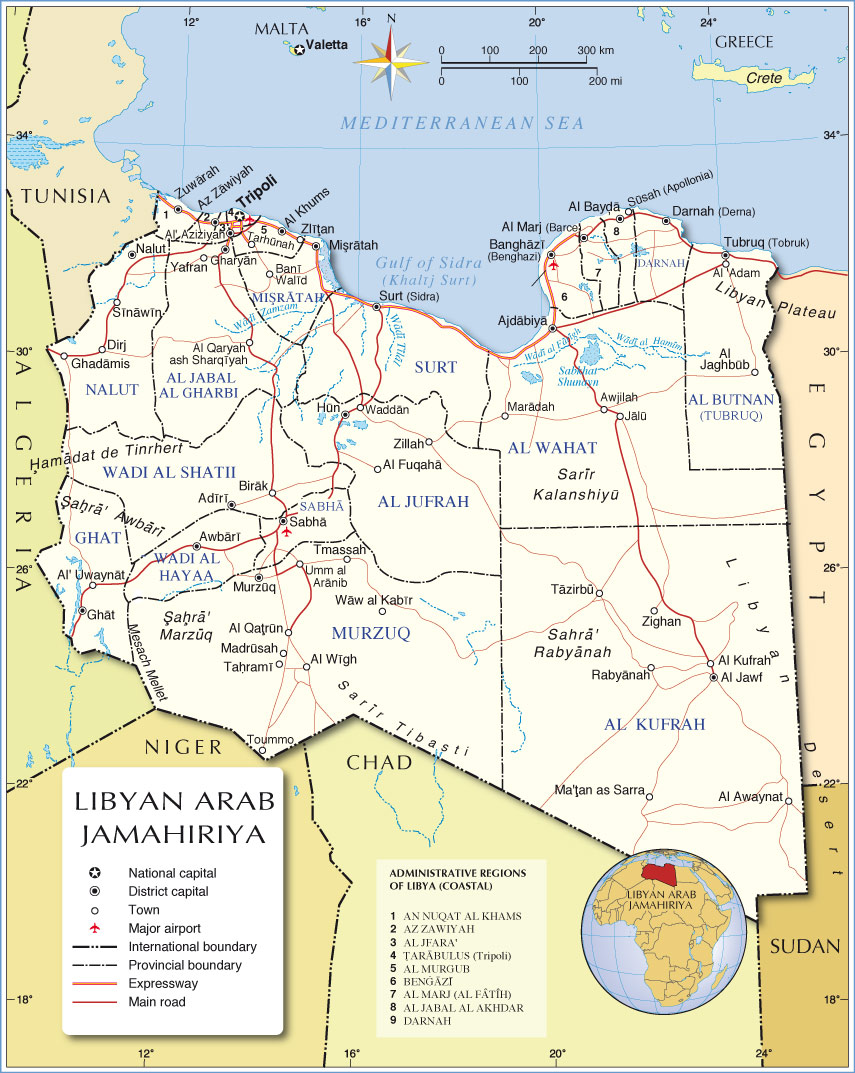
| Libya is a
country in North Africa bordered by the Mediterranean Sea to the north,
Egypt to the east, Sudan to the southeast, Chad and Niger to the south, and
Algeria and Tunisia to the west. With an area of almost 1.8 million square
kilometres (700,000 sq mi), Libya is the third largest country in Africa by
area, and the 17th largest in the world. The largest city and capital is
Tripoli. The three traditional parts of the country are Cyrenaica, Fezzan
and Tripolitania. |
| Territorial
Disputes: Libya has claimed more than 32,000 sq
km in southeastern Algeria and about 25,000 sq km in the Tommo region of
Niger in a currently dormant dispute; various Chadian rebels from the Aozou
region reside in southern Libya. |
| |
1521 Cyrenaica part of the Ottoman Empire.
14 Aug 1551 Tripolitania part of the Ottoman Empire.
29 Jul 1711 Tripoli Regency under de facto hereditary Qaramanli
dynasty.
26 May 1835 Direct Ottoman rule restored.
1911 Independent government in Tripolitania
(in rebellion against Ottoman sovereignty).
03 Oct 1911 Italian occupation.
18 Oct 1912 Ceded to Italy by the Ottoman Empire.
16 Nov 1918 - 1923
Tripolitanian Republic (in revolt against Italy).
12 Nov 1922 Annexed to Italy (nominally 18 May 1919).
01 Jan 1934 Tripolitania, Cyrenaica, Fezzan united as Colony of Libya.
1941/1942 Tripolitania and Cyrenaica occupied by Britain,
Fezzan occupied by France.
13 May 1943 End of Italian rule.
15 Feb 1947 Italy formally cedes Libya to the Allies.
21 Nov 1949 United Nations supervision, under British and French.
24 Dec 1951 Independence as United Libyan Kingdom.
25 Apr 1963 Libyan Kingdom (federal arrangement abolished).
01 Sep 1969 Libyan Arab Republic
01 Jan 1972 - 19 Nov 1977 Part of Federation of Arab Republics
(Egypt, Libya and Syria).
28 Nov 1972 - 30 May 1994 Libya occupies (and 1975 annexes) the
Aozou (Aouzou) Strip
region in Chad.
02 Mar 1977 Socialist People's Libyan Arab Jamahiriya.
Apr 1986 Great Socialist People's Libyan Arab Jamahiriya.
23 Aug 2011 Libya (proclaimed on 10 Aug 2011).
Provisional parliamentary Republic. |
| |
|
|
|
CYRENAICA |
| |
1521 Cyrenaica part of the
Ottoman Empire (under Tripolitania).
1843 Sanusiya Order founded.
15 Oct 1912 Italian protectorate declared Cirenaica (Cyrenaica).
18 Oct 1912 Ceded to Italy by the Ottoman Empire.
17 May 1919 Italian Cirenaica colony.
25 Oct 1920 Italian government recognizes Sheikh Sidi Idriss as the
leader of the Sanusiya (Sensussi); with authority only in
regions of Koufrah, Djarabouh, Audjila and Djalo, with
Adjedabia (Agedabia) as capital.
1920 Italy claims
sovereignty.
1929 Italy derecognizes the
Order.
01 Jan 1934 Tripolitania, Cirenaica, and Fezzan united as Libya.
Dec 1940 - Mar 1941 British forces
occupy Bardia (5 Jan 1941), Tobruk (22 Jan
1941), Derna (Feb 1941), El Agheila and Benghazi (Feb 1941).
Feb 1941 British administration (Cyrenaica
district).
Mar 1941 - Nov 1941 Axis forces
retake El Agheila (24 Mar 1941), Benghazi (3 Apr),
Derna (Apr 1941), and Tobruk 30 (Apr 1941).
18 Nov 1941 - 31 Dec 1941 British forces retake Benghazi (24 Dec
1941), Derna
(Dec 1941), Tobruk (4 Dec 1941) and Gazala (15 Dec 1941).
21 Jan 1942 - 07 Jul 1942 Axis forces retake Benghazi (29 Jan 1942),
Derna (Dec 1941),
Tobruk (21 Jun 1942), and Bardia (June 1942).
11 Nov 1942 British forces occupy Bardia, Tobruk (13 Nov 1942),
Derna (15 Nov 1942) and Benghazi (20 Nov 1942).
Oct 1946 Sanusi emir recognized by Britain.
01 Mar 1949 Independence proclaimed (Emirate of Cyrenaica).
01 Jun 1949 Independence (Emirate of Cyrenaica) recognized by Britain.
21 Nov 1949 Cyrenaica autonomous.
24 Dec 1951 Incorporated into Libya.
25 Apr 1963 Autonomy abolished.
06 Mar 2012 Autonomy declared (not recognized by Libya) by Ahmed al-Zubair
al-Senussi (Head of Cyrenaica Transitional Council) |
| |
- On the coast of eastern Libya, a Greek
Colony-Kingdom founded from Thera in the 7th century BCE. The interior
just behind the coastal settlements was the scene of intense fighting
during WWII between FM. Montgomery and FM Rommel. Capital: Benghazi (Barce
1942-1943).
- Libya-Egypt, to
c. 635/630.
-
BATTIAD
- Battus
I..............................................c. 632 - c. 600
- Arcesilaus
I..........................................c. 600 - c. 583
- Battus II Eudaemon....................................c.
583 - c. 554
- Arcesilaus II the
Cruel...............................c. 554 - c. 550
- Learchus the
Usurper...........................................c. 550
- Battus III the
Lame...................................c. 550 - c. 525
- Vassals of Persia
525-440
- Arcesilaus
III...................................c. 530 - 515
- Battus IV the
Handsome..............................515 - 465
- Arcesilaus
IV.......................................465 - 460
- Republic of
Cyrene.......................................460 - 331
-
Macedon..................................................331 - 322
-
Egypt....................................................323 - 308
- Thibron of
Sparta...................................323 - 322
- Ptolemy Soter (Pharaoh
323-305).....................322 - 313
- Ophellas............................................313
- 308
- Magas....................................................308
- 258
- Demetrius the
Handsome...................................258 - 257
- Republic of
Cyrene.......................................257 - 246
-
Egypt....................................................246 - 240
- Ecdelos........................................................240
- Demophanes.....................................................240
-
Egypt....................................................240 - 205
-
Philemon.................................................205 - 204
- Egypt ?
.................................................204 - 200
-
Numidia..................................................200 - 149
-
Egypt....................................................149 - 116
- Ptolemy Aspion (1st
time)................................116
- 110
- Nikostratos the
Tyrant.........................................110
- Ptolemy Aspion (2nd
time)................................110
- 96
- Republic (Free
port under Roman influence)................96 - 75/4
- Roman
Republic..........................................75/4 - 37/6
-
Egypt...................................................37/6 - 30
- Cleopatra Selene (dau.
Cleop. VII; also Libya)............34 - 30
- Roman
Republic............................................30 - 27
- Roman
Empire..........................................27 BCE - 395 CE
- Byzantine
Empire.........................................395 - 670
- The Prophet
Muhammad's elected successors................647 - 661
- Oqba ibn Nafi'i al-Fihri (1st
time).................647 -
654
- unknown ruler
- Oqba ibn Nafi'i al-Fihri (2nd
time).................658 -
666
-
Umayyad
Caliphate........................................661 - 750
- Ruwaifi' ibn Thabit al-Ansari.......................666
- 667
- Zoheïr ibn Kaïs al-Balawi...........................667
- ?
- Ibrahim ibn an-Nasrani................................?
- c. 697
- Talid al-Fata (the
Slave)........................c. 697 - c. 718
- Fehd ibn Kathir..................................c.
718 - 752
-
Abbasid
Caliphate........................................750 - 879
- Abu 'Awn 'Abd al-Malik ibn
Yezid....................752 - 753
- unknown ruler
- Ibn Dabbes..........................................757
- 765
- 'Abd as-Salem as-Sabaï..............................765
- ?
- unknown ruler
- Isa ibn
Mansur......................................830 - 842
- Muhammed ibn 'Abdaweïh al-Jili......................842
- 871
- Muhammed ibn Harthama ibn
A'yun.....................871 - 875
- Ahmed ibn Issa as-Sa'di.............................875
- 876
- Muhammed ibn Farrukh al-Farghani..........................876
- Shu'ba ibn Kharriken................................876
- 879
- al-Abbas ibn Ahmed
ibn Tulun (revolt)....................879
- 881
- Tulunid
(Egypt) gov. appointed by Capt. Tabargi.....881 - ?
- Fatimids.................................................910
- 1004
- Abu an-Nasr Ahmed ibn Salih...............................910
- Kheïr al-Mansuri....................................910
- 916
- Abu Medyen ibn Farrukh al-Lahissi...................916
- 918
- Aflah an-Nashib al-Kutami...........................918
- ?
- unknown rulers
- Yanus as-Siqilli..........................................1000
- unknown ruler
- Sandal al-Aswad (the
Black)...............................1004
- Abu Rakwa (revolt)......................................1004
- 1007
- Unknown ruler
- Mukhtar ibn al-Kassim......................................?
- 1029
- Mukarreb ibn Mafi....................................c.
1029 - c. 1048
- Jabara ibn Mukhtar...................................c.
1048 - c. 1049
- Madhi ibn Mukarreb.............................................c.
1049
- Banu Suleïm
tribe.......................................1049 - 1172
- Sharaf al-Din
Karakush al-Mudhaffari an-Nassiri.........1172 - 1182
- Banu Suleïm
tribe.......................................1182 - c. 1359
- Sayf ad-Din
Ata Allah ibn Azzaz....................1264 - ?
- unknown ruler
- Jafar ibn Umar
al-Jafari
- Arif ibn Amru......................................2nd
half of 14th cent.
- Amru ibn Arif......................................2nd
half of 14th cent.
- Egypt................................................c. 1359 - 1517
-
Ottoman
Empire..........................................1517 - 1911
- Awlad
Sayyidi Abd Allah dynasty
- Sheikhs of al-Khattabi al-Mujahiri
al-Hasani al-Idrisi lineage
- Sayyid
Muhammad ibn Ali as-Sanusi.............................1843 - 07 Sep
1859
- Sayyid
Muhammad ibn Sayyid Muhammad al-Mahdi as-Sanusi.07 Sep 1859 - 02 Jun
1902
- Sayyid Ahmad
ibn Sayyid Muhammad ash-Sharif as-Sanusi..02 Jun 1902 - 21 Aug 1918
- Sayyid
Muhammad Idris as-Sanusi........................21 Aug 1918 - 25 Oct
1920
- Emir
- Sayyid
Muhammad Idris as-Sanusi (continued
- 1st time).25
Oct 1920 - 1929
- exile in Egypt from 1923.
- Sayyid
Muhammad ar-Rida (acting)..............................1923
- 1928
- Umar Muhtar (acting)..........................................1928
- 1929
- Italy...................................................1911 - 1941
- Governors
- Ottavio
Briccola...................................1911 - Oct 1913
- Giovanni
Battista Ameglio......................Oct 1913 - 05 Aug 1918
- Vincenzo
Garioni............................05 Aug 1918 - 05 Aug 1919
- Giacomo De
Martino..........................05 Aug 1919 - 23 Nov 1921
- Luigi Pintor................................23
Nov 1921 - Oct 1922
- Eduardo
Baccari................................Oct 1922 - Dec 1922
- Luigi
Bongiovanni...........................07 Jan 1923 - May 1924
- Ernesto
Mombelli............................04 May 1924 - 02 Nov 1926
- Attilio
Teruzzi.............................08 Nov 1926 - 31 Dec 1928
- Vice-Governors
- Domenico
Siciliani.............................Jan 1929 - Mar 1930
- Rodolfo
Graziani, marchese di Neghelli.........Mar 1930 - May 1934
- Guglielmo Nasi.................................Jun
1934 - Apr 1935
- Occupied by
Great Britain...........................Jan 1941 - Apr 1941
- Military
Governors
- Sir Henry
Maitland Wilson......................Dec 1940 - 1941
- Philip Neame................................28
Feb 1941 - 08 Apr 1941
- Sir John
Dudley Lavarack..................................1941
- Germany (Afrika
Korps under Rommel).................Apr 1941 - Nov 1941
- Occupied by
Great Britain...........................Nov 1941 - June 1942
- Germany (Afrika
Korps under Rommel).................Jun 1942 - Dec 1942
- Occupied by
Great Britain...............................1942 - 1945
- Military
Governors
- Anthony
Sillery...........................................1943
- Angus Lyell
Collier.......................................1943
- H.R.
Hall...................................19 Dec 1943 - 1944
- Administrators
- Duncan Cameron
Cumming......................21 Dec 1942 - 30 Oct 1945
- He was military administrator to 10 Mar
1943.
- Anglo-French
authority..................................1945 - 1951
- Administrators
- Peter Bevil
Edward Acland...................30 Oct 1945 - 1946
- James William
Norris Haugh.........................1946 - 1948
- Eric Armar
Vully de Candole........................1948 - 1951
- He was resident from 17 Sep 1949.
- Emir
- Sayyid
Muhammad Idris as-Sanusi (2nd
time).....Oct
1946 - 24 Dec 1951
- Prime
Ministers
- Umar
Mansur Kikhia.....................09 Nov 1949 - 18 Mar 1950
- Muhammad
Sakizli.......................18 Mar 1950 - 24 Dec 1951
- Under Libya thereafter...
|
| |
| |
|
FEZZAN |
|
|
918 Sultanate of
Fezzan founded.
1190 - 12..
Annexed by Egypt.
1212 Annexed by Borno (Kanem).
13.. Independence recovered.
1580 - 1582
Incorporated into Ottoman Empire.
1612 - 1614
Incorporated into Ottoman Empire.
1623 - 1626
Incorporated into Ottoman Empire.
1689 - 1690
Incorporated into Ottoman Empire.
1843 Incorporated into
Ottoman Empire (Fezzan Paskalik).
1909 - 1914
Sanusi rule.
15 Oct 1912 - 11 Jan 1943 Annexed by Italy.
Aug 1914 - Jan 1915 Italian
occupation.
1915 - 1923
Sanusi rule (restored).
1923 - 1930
Anarchy, ruled by Arab nomads.
01 Jan 1934 Fezzan, Tripolitania, and Cyrencia united as Libya.
08 Jan 1943 Fezzan occupied by Free French, forces enter Sebha.
1946 UN administration
10 Jan 1947 Fezzan Territory, under French administration.
01 Jan 1948 Fezzan-Ghadamès Territory, under French administration.
24 Dec 1951 Incorporated into Libya, with autonomy.
25 Apr 1963 Autonomy abolished. |
| |
- Fezzan is the arid interior of western Libya.
Capital: Sebha 1943-1951 (Murzuq c.1566-1912).
- Garamantes
dynasty
- Roman
Empire..........................................19 BCE - 395 CE
- Western Roman
Empire.....................................395 - 428
- Kingdom of
Phazana - dynasty current in the 6th and 7th centuries,
the Berauna.
-
Umayyad
Caliphate........................................667 - 750
-
Abbasid
Caliphate........................................750 - 918
- Banu Khattab
dynasty
- al-GHUZZI
- Sharaf al-Din
Karakush..................................1190 - 1195 d. 1212
- Yahya ibn Ghaniya.......................................1195
- 1209 d. 1209 >
- Borno
(Kanem)...........................................1209 - 1578
- NESUR
- The Nesur were a local clan who claimed a
connection to the old Berauna dynasts. They governed Fezzan on
behalf of the Kanem-Bornu (Chad) Empire.
- KHORMAN
- The Khorman were an Arab tribe who
overthrew the Nesur and reduced the local population to that chattal
slaves.
- Beni MUHAMMAD (Awlad Muhammad
dynasty)
- The Beni Muhammad were derived from a Moroccan
Sharif who broke the power of the Khorman in the mid-16th century and
established a Sultanate in Fezzan. His descendants were at times
tributary to the Pasha of Tripoli, (the Ottoman Governor of Libya), but
just as often at war with the Ottomans. Even in times of obedience,
their power within their own borders was effectively absolute.
-
Ottoman
Empire..........................................1578 - 1831
- al-Mustansir ibn
Muhammad..........................1566 - 1580
- an-Nasir...........................................1580 - 1599
- al-Mansur..........................................1599 - 1612
- Governed from Tripoli 1612-1614.
- Tahir
I............................................1614 - 1623
- Governed from Tripoli 1623-1626.
- Muhammad
I.........................................1626 - 1658
- Nagib..............................................1658
- 1682
- Muhammad II an-Nasir (1st
time)....................1682 - 1689
- Muhammad al-Mukni (Tripoli
Governor)......................1689
- Temmam....................................................1689
- Muhammad
III.......................................1689 - 1690
- Ali al-Mukni (Tripoli
Governor)...........................1690
- Muhammad Ii an-Nasir (2nd
time)....................1690 - 1709/18
- Ahmad
I.........................................1709/18 - 1767
- Tahir
II...........................................1767 - 1776
- Ahmad II al-Munsur.................................1776
- 1789
- Sharif Muhammad ibn al-Mansur
al-Hakim.............1789 - 1804
- Sharif Muhammad ibn al-Mansur
al-Muntasr...........1804 - 1811
- Yusuf al-Mukkani
(usurper)..............................1811
- 1831
- BERBER (Banu Sulayman dynasty)
- Sayf an-Nasr Abd
al-Jalil ibn Rad.......................1831 - 1842 opposed by...
- ibn KHALIFA
- Jumah ibn Khalifa
(1st time
in rebellion)...............1835
- 1842 d. 1856
-
Ottoman
Empire..........................................1842 - 1854
- Walis (Viceroys)
- Bekir
Pasha........................................1842 - 1846
- Hasan Pasha al-Bal`azi.............................1846
- 1855
- ibn KHALIFA
- Jumah ibn Khalifa
(2nd time
in rebellion)...............1854
- 1856
-
Ottoman
Empire..........................................1856 - 1914
- Walis (Viceroys)
- Halim Pasha (1st
time).............................1859 - 1865
- Hamid Bey
(acting)........................................1865
- Halim Pasha (2nd
time).............................1865 - 1870
- unknown ruler
- Mustafa Faik
Pasha...............................1870's - 1882
- unknown ruler
- Mahmud Bey.........................................1900
- c. 1906
- Samih Bey.......................................c.
1906 - 1909
- unknown ruler
- Sanusi Governor
- Sayyid Muhammad
al-Abid (1st
time)......................1909
- 15 Oct 1912
- Italy...............................................Aug 1914 - Jan 1915
- Anarchic times
punctuated by Berber raids...............1915 - 1929
- Sayyid Muhammad
al-Abid (2nd
time)......................1915
- 1923
- Italy...................................................1929 - 1943
- Allied Military
Occupation..............................1943 - 1945
- French Military Governor
-
René Delange................................08
Jan 1943 - c. Jan 1944
-
R. Thiriet..................................c.
Jan 1944 - 1940s
-
Terri.....................................................1940s
- Anglo-French
authority..................................1945 - 24 Dec 1951
- French Military Governor
-
Maurice Sarazac................................Mar
1947 - 1950
- French Resident
-
Maurice
Sarazac (continued)........................1950
- 24 Dec 1951
-
Auguste
Cauneille (acting for Sarazac)....................1951
- Hakim (from 12 Feb 1950, Wali [Chef du
territoire])
- Ahmad Sayf
an-Nasr.................................1946 - 24 Dec 1951
- Later he became Governor of Fezzan: 24 Dec
1951 - 12 Jun 1954.
- Under Libya thereafter...
|
| |
| |
|
TRIPOLI
(Tripolitania) |
| |
26
Mar 909 - 977
Incorporated into Egypt.
977 Part of Zirid
Kingdom.
1146 - 22 Jan 1160 Tripoli
under Norman rule (subordinated to Kingdom of Sicily).
1160 - 1248
Incorporated into Morocco (Almohad Empire).
1172 - 1190
Egyptian rule.
.... - 1202
Egyptian rule.
1248 - 1327
Incorporated into Tunis.
1327 Sultanate
1401 - 1482
Incorporated into Tunis.
1412 - 1421
Egyptian rule.
24 Jul 1510 Spanish rule in Tripoli (subordinated to Sicily).
23 Mar 1530 Spanish transfer Tripoli to the Knights of St. John
Hospitaller (Knights take possession 25 Jul 1530).
14 Aug 1551 Province of the Ottoman Empire.
29 Jul 1711 Tripoli Regency under de facto hereditary Qaramanli
dynasty.
26 May 1835 Tripoli Ottoman province (direct Ottoman rule).
1911 Independent government (in rebellion against Ottoman
sovereignty).
03 Oct 1911 Italian occupation.
05 Nov 1911 Italian Tripolitania protectorate.
18 Oct 1912 Ceded to Italy by the Ottoman Empire.
16 Nov 1918 Tripolitanian Republic
12 Nov 1922 Annexed to Italy (Italian Tripolitania colony)
(nominally from 18 May 1919).
01 Jan 1934 Cyrenaica, Tripolitania, Fezzan united as Libya.
23 Oct 1942 British administration (Tripolitania district).
20 Nov 1942 British forces occupy Benghazi, Sirte (25 Dec 1942) and
Tripoli (23 Jan 1943).
1946 UN administration.
24 Dec 1951 Incorporated into Libya, with autonomy.
25 Apr 1963 Autonomy abolished. |
| |
-
A port in
western Libya, it is the country's largest city. Capital: Tripoli
(Republic: Aziziyah 1918-1923).
- Phoenician colony of Oea
- It was founded as a Carthaginian trading post.
- "Tripoli" is named as such because Oea formed
one settlement within an extended tri-cities district. The other
settlements were Sabratha (now al-Khums) and Leptis Magna (sometimes
transcribed as Lepcis; the nearest modern town of any size is Misratah).
Leptis Magna city had been in a downward spiral since the 360's,
suffering much from Barbarian attacks, disastrous Winter flooding, and
encroaching sand dunes; by the time of the Arab conquest in 642, there
was essentially nothing left of the community. By the end of the 7th
century, references to Misratah, a caravanserai way-station, begin to
occur. Leptis Magna remains one of the best-preserved Roman cities,
owing to it being more-or-less buried under the shifting sands until
quite recently.
-
Carthage..............................................c. 500 - 146
- Leptis Magna
taken by Numidia............................202 - 111
- Roman
Republic...........................................146 - 27
- Roman
Empire..........................................27 BCE - 442 CE
- Vandals..................................................442 - 534
- Leptis Magna under Vandals in c. 455 and
Sabratha c. 450.
- Byzantine
Empire.........................................534 - 647
- The Prophet
Muhammad's elected successors................647 - 649
- Byzantine
Empire.........................................649 - 667
-
Umayyad
Caliphate........................................667 - 697
- Byzantine
Empire.........................................697 - 703
-
Umayyad
Caliphate........................................703 - 750
-
Abbasid
Caliphate........................................750 - 800
- In this era, the governors of Tripoli were
appointed by those of Ifriqiyya and not by the Caliphs directly.
- Oqba ibn Nafi'i al-Fihri (1st
time).................643 - 666
- Ruwaifi' ibn Thabit al-Ansari.......................666
- 669
- Oqba ibn Nafi'i al-Fihri (2nd
time).................669 - 683
- Zoheïr ibn Kaïs al-Balawi...........................683
- 695
- Atiya ibn Yurbu' am-Madhhidgi.......................695
- 696
- Hassene ibn al-Nu'man al-Ghassani...................696
- 705
- Bakr ibn Issa al-Kaïsi............................713/4
- ?
- Without walis until 728.
- Yezid ibn Abi Muslim al-Kindi.......................728
- 741
- Safwan ibn Abi Malik................................741
- 742
- Revolt of
Ukasha ibn Ayyub al-Fazari...........................741
- Muawiya ibn Safawan.................................742
- 747
- Ilyas ibn Habib al-Fihri............................747
- 755
- Hamid ibn Abdallah al-'Aqqi.........................755
- ?
- Yezid ibn Safwan al-Ma'afiri..........................?
- 759
- Revolt of
Ismaïl ibn Zied an-Nafusi............................759
- Amr ibn Suwayd al-Muradi............................759
- 761
- Abdallah ibn Rahima.................................758
- 761
- al-Mukhariq ibn Ghifar at-Taii......................761
- 768
- al-Junayd ibn Bashar al-Assedi......................768
- ?
- Saïd ibn Shadded......................................?
- 793
- Yahya ibn
Musa......................................793 - 795
- Sofiene ibn Abi-l Muhadjir..........................795
- 805
- Ibadhite Imams
- Djebel Nefusah is a hill
country in the interior of western Libya, south of Tripoli. The
district was in the hands of a group of Kharijite Imams of the
Ibadhiyah sect during the 8th through 10th centuries CE. The
Kharijites ("Withdrawers", "Seceders") are Muslims who rejected both
Sunni and Shi'ite interpretations of Caliphate succession and
developed an idealist and deed-oriented version of Islam. The
Ibadhiyah are the moderate wing of the Kharijtes, as opposed to the
radical Azariqah movement of Basra, in Iraq.
- Abu-l-Khattab
Abd al-A'la ibn Assamh al-Ma'afiri....758 - 761
- Umar................................................761
- 771
- Abu Hatim al-Malzuzi................................771
- 777
- Occupied by
Tahert..................................777 - 880
- as-Samh ibn
Abi-l Khattab al-Ma'afiri...............777 - 812
- Khlaf ibn as-Samh
al-Ma'afiri.......................812 - ?
- Abu-l Hassan
Ayyub
- Abu Oubeïda
Abd al-Hamid al-Janawni
- Revolt of Khalaf.
- al-Abbas ibn
Ayyub
- Abu Dharr Aben..............................(for
7 months, latter 9th c.)
- Abu Mansur
Ilyas......................................? - 880
- al-Abbas ibn
Ahmed Tulun............................880 - ?
- al-Aflah ibn
al-Abbas (1st
time)......................?
- 896
- Revolt in 896.
- al-Aflah ibn
al-Abbas (2nd
time)....................896
- ?
- Abu Zakariyah
Yahya al-Urjani.........................? - 923
- Fatamid conquest of Djebel
Nefusah in 923 and below sequence afterwards...
- Aghlabids
(Tunisia)......................................800 - 909
- Ibrahim ibn Sofiene at-Tamimi.......................805
- 811
- Abdallah ibn Ibrahim at-Tamimi
(E. Ifriqiyya).............811
- Sofiene ibn Abi-l Muhadjir
(restored)...............811 - 838
- unknown ruler
- Abdallah ibn Muhammed at-Tamimi
(E. Ifriqiyya)......859 - ?
- Muhammed ibn Qahrub.................................868
- 888
- vacant
- Shukr as-Siqilli....................................891
- ?
- Ahmed ibn Abdallah al-Aghlabi.......................903
- 909
- Fatamids.................................................909
- 976
- Makanun ibn Dhubara al-Lihiani......................909
- 912
- Revolt of
Muhammed ibn Ishaq al-Qurash, Ibn al-Qirlin..........912
- Abu-l Futuh Zayyen as-Siqilli
- Bassil as-Siqilli...................................953
- 973
- Abdallah ibn Yakhluf al-Kutami......................973
- 977
- Tunisia (Zirids).........................................977
- 1001
- Ousla ibn Bakkar....................................977
- 1000
- Yanus as-Siqilli (appointed
by Fatamids)..................1000
- Fattuh ibn
Ali.....................................1000 - 1001
- Banu KHAZRUN
- Fulful ibn Saïd (1st
time)..............................1001
- 1002
- Fatamids................................................1002
- 1003
- Yahya ibn Hamdun al-Andalusi.......................1002
- 1003
- Fulful ibn Saïd (2nd
time)..............................1003
- 1009
- Warru ibn Saïd..........................................1009
- 1012
- Tunisia.................................................1012 - 1023
- Muhammad ibn
al-Hassan.............................1012 - 1014
- Abu Abdallah ibn
al-Hassan.........................1014 - 1022
- Khalifa ibn Warru.......................................1022
- 1028
- Saïd ibn Khazrun........................................1028
- 1037
- Abu'l Hasan
Ali.........................................1037 - 1038
- Khazrun ibn
Khalifa.....................................1038 - ?
- Muhammad...................................................? - 1053
- Abu Muhammad
Abdallah...................................1053 - 1058
- al-Muntasir ibn
Khazrun.................................1058 - 1068
- Khalifa ibn
Khazrun.....................................1068 - 1078
- Muqallab................................................1078
- ?
- Shah Malik at-Turki............................................fl.
c. 1095
- Muhammad ibn
Khazrun....................................1095 - 1146
- Sheikh Abu Yahya........................................1146
- 1148
- Sicily..................................................1148 - 22 Jan 1160
- Norman Kings
- Roger II of
Sicily.................................1146 - 26 Feb 1154
- William I of
Sicily.........................26 Feb 1154 - 22 Jan 1160
- Norman Governor
- Abu Yahya Rafi ibn Matruh..........................1148
- 1172
- He continued to
rule under Morocco (Almohad) till 1172.
- Morocco (Almohad).......................................1160
- 1172
- Egypt (Ayyubid).........................................1172
- 1190
- Sharaf al-Din Qaraqush (1st
time)..................1172 - 1190
- Morocco (Almohad).......................................1190
- ?
- Yakut al-Iftikhar.........................................fl.
1190's
- Egypt (Ayyubid).............................
? -1202
- Sharaf al-Din Qaraqush (2nd
time).........................fl. c. 1200
- Morocco (Almohad).......................................1202
- c. 1247
- Yahya al-Miruki....................................1204
- 1207
- Abu Muhammad Abd
al-Wahid..........................1207 - 1221
- Abu Saïd Abd ar-Rahman.........................Mar
1221 - Jun 1221
- Saïd Abu'l Ala Idris (1st
time)...........................1221
- Ibrahim ibn Ismail al-Hafsi (acting)...............1221
- 1222
- Saïd Abu'l Ala Idris (2nd
time)....................1222 - 1223
- Abu Yahya Amran...........................................1223
- Abu Zaiyid................................................1224
- Abu Amran
Musa.....................................1224 - 1226
- unknown ruler
- Yahya..............................................1228
- 1236
- Abd ar-Rahman Yaqub................................1236
- c. 1247
- Tunis (Hafsid).......................................c.
1247 - 1324
- Muhammad "Silver Neck" ibn Isa
al-Hafsi............1247 - 1279
- Murjim.............................................1279
- 1282
- Muhammad "Silver Neck" (2nd
time)..................1282 - 1285
- Yusef ibn Tahir al-Yourbu'i........................1285
- 1309
- Zakariyah ibn Ahmed al-Hafsi.......................1309
- 1318
- Muhammad ibn Musa al-Hafsi.........................1318
- 1324
- Muhammad ibn Ka'abour.....................................1324
- Saïd ibn Tahir............................................1324
- Thabit ibn Muhammed (1st
time)............................1324 d. 1326
- Ahmed ibn Tahir...........................................1324
- Banu THABIT
- Thabit I ibn
Muhammad al-Wishahi (2nd
time).............1324
- 1327
- Muhammed ibn
Thabit.....................................1327 - 1348
- Thabit II ibn
Muhammad..................................1348 - 1355
- Banu MAKKI (also governors of
Gabes in Tunisia)
- Ahmed ibn Makki.........................................1355
- 1365
- Abd al-Rahman ibn
Ahmed.................................1365 - 1371
- Banu THABIT
- Abu Bakr ibn
Muhammad...................................1371 - 1392
- Ali ibn Ammar...........................................1392
- 1397
- Yahya ibn Abu Bakr......................................1397
- 1401 with...
- Abd
al-Wahid............................................1397 - 1401
- Tunis...................................................1401 - 1470
- Hafsid
- Abd
al-Aziz........................................1401 - 1420
- al-Mansur Muhammad ibn Abd
al-Aziz.................1420 - 1429
- Abu Muhammed Abd al-Wahid ibn
Hafs.................1429 - 1456
- Abu Bakr ibn
Othman................................1456 - 1470
- Cheikh
Mansur...........................................1470 - 1472
- Yusef...................................................1472
- 1480
- Mammi (or
Mohammed).....................................1480 - 1492
- Abdallah ibn
Sharef.....................................1492 - 1510
- Spain............................................26
Jul 1510 - 25 Jul 1530
- Commander
- Pedro de
Navarra............................26 Jul 1510 - 1510 d. 1529
- Governor
- Diego de Vierra...........................................1510
- Don Jaime de Requesens.............................1510
- 1511
- Giovanni Francesco Paterno [Guillem
de Moncada]....1511
- 1520
- François Velasquès................................1520s
- 25 Jul 1530
- Malta............................................25
Jul 1530 - 14 Aug 1551
- Gaspare de Sanguessa...............................1530
- 1531 and...
- Bernardino Macado..................................1530
- 1532
- Aurelio Bottigella (1st
time)......................1532 - 1533
- Garcia Cortès......................................1533
- 1535
- Georg Schiling.....................................1535
- 1537
- Aurelio Bottigella (2nd
time)......................1537 - 1539
- Hernando de Breacamonte............................1539
- 1544
- Cristofano de Solis Farfan.........................1544
- 1546
- Jean Parisot de la Valette (G.
Master 1557-68).....1546 - 1549
- Pitro Nuñez de Harrera.............................1549
- 14 Aug 1551
- Gaspare de Vallie..............................Apr
1551 - Aug 1551
-
Ottoman
Empire..........................................1551 - 1711
- Murad Agha.........................................1551
- 1553
- Torgut (Dragut) Rais
Pasha.........................1553 - 23 Jun 1565
- Yahya
Pasha...............................................1565
- el-Euldj Ali Pasha (Lucciali)......................1565
- 1568
- Ja'afar
Pasha......................................1569 - 1580
- Murad
Pasha........................................1580 - 1581
- Qa'id Ramadan
Pasha................................1581 - 1584
- Mustafa
Pasha......................................1584 - 1588
- Hussein
Pasha......................................1588 - 1595
- Ibrahim
Pasha......................................1595 - 1600
- Iskander
Pasha.....................................1600 - 1606
- Selim
Pasha........................................1606 - 1607
- Ali
Pasha..........................................1607 - 1609
- Ahmed
Pasha...............................................1609
- Suleiman Sfer Dey..................................1610
- 1620
- Mustafa Sherif Pasha Dey...........................1620
- 1631
- Kasim
Pasha...............................................1631
- Ramadan Agha Dey..........................................1631
- Mehmed Saqizli Dey.................................1631
- 07 Nov 1649
- Osman Saqizli Dey...........................07
Nov 1649
- 1672
- Osman Reis as-Suhali Dey...........................1672
- 28 Nov 1672
- Bali Janush [Javush] Dey....................28
Nov 1672
- 26 Apr 1673
- Arnavut Halil
Pasha.........................26 Apr 1673 - 1675
- Mustafa Pehlevan Dey...............................1675
- May 1675
- Ibrahim Misrli-Oglu Dey........................May 1675
- 03 Apr 1676
- Ibrahim Jelebi Dey Annebli..................05
Apr 1676 - 07 Apr 1676
- Mustafa el-Kbir Dey
Estenquilli.............07 Apr 1676 - 04 Apr 1677
- Osman Baba Wakil Al Khardj Dey..............04
Apr 1677
- 27 Apr 1678
- Aq Mehmed Bey al-Hadded.....................27
Apr 1678
- 09 Sep 1679
- Hasan Abaza Dey.............................09
Sep 1679
- 11 Jun 1683
- Yulk Muhammad Dey...........................11
Jun 1683 - 13 Jun 1683
- Ali al-Jezairli.............................13
Jun 1683
- 18 Jun 1684
- Hajji Abdallah Dey Izmirli..................18
Jun 1684
- 08 Feb 1687
- Ibrahim Terzi Dey..............................May
1687 - Nov 1687
- Mehmed Pasha al-Imam Kerdeki (1st
time)........Nov 1687
- 19 May 1701
- Osman al-Kahwadji Dey Dragutli..............19 May
1701 - 11 Aug 1701
- Mustafa Gallipoli Dey.......................11
Aug 1701
- 29 Jul 1702
- Mehmed Pasha al-Imam Kerdeki (2nd
time).....29 Jul 1702
- Oct 1706
- Khalil [or Hilal] Pasha Karh Deghli............Oct 1706
- Nov 1709
- Ibrahim al-Arkli Aleyli [Alayali]..............Nov 1709
- 23 Nov 1710
- Ibrahim (or Ismaïl) Khoudja [Hoça]..........23
Nov 1710
- 20 Jan 1711
- Hajji Rejeb Dey [Haçi
Reçeb]................20
Jan 1711 (3 hours)
- Mehmed Husein Javush [Hüseyin
Çavush] Bey...20 Jan 1711 -
04 Jul 1711
- Abu Umais Mehmed............................04
Jul 1711 - 29 Jul 1711
- KARAMANLI
- Nominally Ottoman governors (Beys), the
Karamanli in fact ruled as de facto independents.
- Ahmad
I [Sidi
Hamid Qaramanli Quluglu]...........29
Jul 1711 - 04 Nov 1745
- Muhammad
I [Mehmed
Pasha]........................04
Nov 1745 - 24 Jul 1754
- Ali I............................................24
Jul 1754
- 30 Jul 1793 d. 1795
- BURGHUL
- Ali
II
Burghul Pahsa Çezayrli (usurper)..........30
Jul 1793 - 20 Jan 1795
- KARAMANLI
- Ahmad II Pasha...................................20
Jan 1795
- 11 Jun 1795
- Yusuf Pasha ibn
Ali..............................11
Jun 1795
- 20 Aug 1832 d. 1838
- In 1801, Yusuf demanded
a tribute of $225,000 from United States President Thomas Jefferson.
Jefferson, confident in the ability of the new United States Navy to
protect American shipping, refused the Yusuf Pasha's demands. Yusuf
Pasha unofficially declare war in May 1801 by chopping down the flagpole
before the American consulate. The US Navy successfully blockaded
Tripoli's harbors in 1803. After some initial military successes, most
notably the capture of the USS Philadelphia, the pasha soon found
himself threatened with invasion by American ground forces following the
Battle of Derna (April 27 - May 13, 1805) and the reinstatement of his
deposed brother, Hamet Karamanli, recruited by the American army officer
William Eaton. Yusuf Pasha signed a treaty ending the war on June 10,
1805. The Battle of Derne was the first recorded land battle of the
United States on foreign soil after the American Revolutionary War.
- Mehmed (1st
time in rebellion).................................1817
- Muhammad II [Mehmed
ibn Ali] (1st time in rebellion)...........1824
- Mehmed (2nd
time in rebellion).................................1826
- Mehmed (3rd
time in rebellion).................................Jul
1832
- Ali
III..........................................20 Aug 1832 - 26 May 1835
- By 1819, the various
treaties of the Napoleonic Wars had forced the Barbary states to give up
corsair activity almost entirely, and Tripoli's economy began to
crumble. As Yusuf Pasha weakened, factions sprung up around his three
sons; though Yusuf abdicated in 1832 in favor of his son Ali III, civil
war soon resulted. Ottoman Sultan Mahmud II sent in troops ostensibly to
restore order, but instead deposed and exiled Ali III, marking the end
of both the Karamanli dynasty and an independent Tripoli.
- Muhammad
II [Mehmed
ibn Ali] (2nd time in rebellion)...........1835
-
Ottoman
Empire...................................26 May 1835 - 1911
- Walis of Tripoli
- Mustafa Negib
Pasha.........................27 Jun 1835 - 07 Sep 1835
- Mehmed Reis
Pasha...........................07 Sep 1835 - Apr 1837
- Tahir
Pasha....................................Apr 1837 - 1838
- Hassan
Pasha.......................................1838 - 03 Aug 1838
- Ali Asker
Pasha.............................03 Aug 1838 - Apr 1842
- Pepe Mehmed Emin
Pasha.........................Jul 1842 - Apr 1847
-
Sarayli Mehmed
Ragib
Pasha.....................Apr 1847 - Oct 1848
- Haçi Ahmed Izzet
Pasha.........................Oct 1848 - 1849
- Mustafa Asim
Pasha.................................1849 - Aug 1852
-
Sirkatibi
Mustafa Nuri
Pasha...................Aug 1852 - Sep 1855
-
Arnavud Nazhar Osman Pasha.....................Sep 1855 -
Sep 1858
- Ahmed Izzet
Pasha (1st time).......................1858 -
Aug 1860
- Mahmud Nedim Bey...............................Aug 1860 -
Apr 1867
d. 1883
- Hassan Pasha
(acting)..........................Apr 1867
- Jul 1867
-
Cezayrli
Ali Reza
Pasha (1st time).............Jul 1867 -
May 1870
- Mustafa Asim Pasha (acting
- 1st time).........May 1870 - Jun 1870
- Mehmed Halid [Halet]
Pasha.....................Jan 1870 - Sep 1871
-
Bostancibahizade
Mehmed Rashid
Pasha...........Sep 1871 - Apr 1872
-
Cezayrli
Ali Reza Pasha
(2nd time).............Apr 1872 - 06
Jun 1873
- Hasan Samih
Pasha...........................06 Jun 1873 - Nov 1874
- Mustafa Asim Pasha (2nd time)..................Nov 1874 -
Feb 1875
- Fosfor Mustafa Sidki
Pasha.....................Feb 1875 - Aug 1877
- Mehmed Çelaleddin
Pasha...................................1877
-
Söylemezoglu Ali Kemali [Savfet]...............Dec
1877 - Feb 1878
- Mehmed Sabri
Pasha.............................Feb 1878 - Jul 1879
- Ahmed Izzet Pasha (2nd
time)...................Jul 1879 - May 1880
- Mehmed Nazif
Pasha.............................May 1880 - Oct 1881
- Ahmed Rasim
Pasha..............................Oct 1881 - Jun 1896
- Nemik Bey......................................Jun 1896 -
Mar 1899
- Haçim Bey......................................Mar 1899 -
Jul 1900
- Hafiz Mehmed
Pasha.............................Jul 1900 - Dec 1903
- Hasan Husni Pasha (Hüseyin
Effendi)............Dec 1903 - May 1904
- Abderrahman Bey (acting).......................May 1904
- Aug 1904
- Reçeb
Pasha....................................Aug 1904 - Aug 1908
- Ahmed Favzi
Pasha..............................Dec 1908 - Aug 1909
- Hüseyin Husni
Pasha............................Aug 1909 - Aug 1910
- Ibrahim
Pasha..................................Aug 1910 - 05 Nov 1911
- Neshet Bey................................................Nov
1911
- Bekir Samih Bey................................Nov
1911 - 1912
- Ahmed Bassim Bey
(acting)..........................1912
- 1915
- Osman Bey..........................................1915
- 1917
- Nuri Bey...........................................1917
- 1918
- Ishaq Bey.................................................1918
- Osman Fuad
Pasha...................................1918 - 16 Nov 1918
- Italy...................................................1911 - 1943
- Sulayman ibn
Abd Allah al-Baruni...................1911 - Mar 1913
- Governor-General
of Tripolitania
- Sulayman ibn
Abd Allah al-Baruni (continued).......1915 -
16 Nov 1918
- Chairman of the
Council of the Republic
- Ahmad Tahir
al-Murayyid.....................16 Nov 1918 - Nov 1920
- Chairman of the
Central Reform Board of the Republic
- Ahmad Tahir
al-Murayyid........................Nov 1920 - 1923
- Governors
- Raffaele Borea
Ricci d'Olmo.................05 Oct 1911 - 11 Oct 1911
- Carlo
Francesco Giovanni Battista Caneva....11 Oct 1911 - 1912
- Ottavio Ragni......................................1912
- 02 Jun 1913
- Vincenzo
Garioni (1st
time).................02 Jun 1913 -
Oct 1914
- Luigi Druetti..................................Oct 1914
- Jan 1915
- Giulio Cesare
Tassoni..........................Jan 1915 - Jul 1915
- Giovanni
Battista Ameglio...................15 Jul 1915 - 05 Aug 1918
- Vincenzo
Garioni (2nd
time).................05
Aug 1918 - 17 May 1919
- Vittorio
Menzinger..........................01 Aug 1919 - 06 Jun 1920
- Luigi
Mercatelli............................01 Aug 1920 - Jul 1921
- Giuseppe Volpi,
conte di Misurata..............Jul 1921 - Jul 1925
- Emilio De
Bono..............................03 Jul 1925 - 24 Jan 1929
- Pietro
Badoglio.............................24 Jan 1929 - 31 Dec 1933
- Occupied by Great Britain........................15
Dec 1942 -
24 Dec 1951
- British Military
Governor
- Maurice
Stanley Lush........................15 Dec 1942 - 26 Jan 1943
- Travers Robert
Blackley.....................26 Jan 1943 - 1943
- Administrator
(from Apr 1949, resident)
- Travers Robert
Blackley (continued)................1943 -
24 Dec 1951
- Under Libya thereafter...
|
|
|
|
 |
|
|
|
LIBYA
(general sequence) |
|
|
- DANAID
Mythical ancestor-kings
- Danaos
- Belus
- Amraon
- Bocchus
- Ephaphus
- Lycus...........................................................fl.
c. 1200
- Early Historical kings
- Merirey.........................................fl.
c. 1230's - 1220's
- Merirey is spoken of as being the
leader of the Labu, a coalition of folk associated with the Sea-Peoples.
- Unknown rulers
- SHESHONQID (Meshwesh, or Ma)
- Buyuwawa........................................................c.
1200
- Buyuwawa is spoken of as being the leader of a
Sea-People called the Meshwesh. See the Sea Peoples for additional info on
that tribe.
- Mawasun
- Neb-Neshi
- Pasouti
- Sheshonq.......................................................fl.
c. 1000
- Nimlot.........................................................fl.
early 900's
- Sheshonq I (1st Pharaoh, 22nd
Egyptian Dyn.).............945 - 924
- Osorkon I (2nd Pharaoh, 22nd
Dynasty)....................924 - 889 with...
- Sheshonq II (3rd
Pharaoh)......................................fl. c. 890
- Takelot I (4th
Pharaoh)..................................889 - 874
- Osorkon II (5th
Pharaoh).................................874 - 850
- Takelot I (6th Pharaoh)I.................................850
- 825
- Sheshonq III (7th
Pharaoh)...............................825 - 773
- Pami (8th
Pharaoh).......................................773 - 767
- Sheshonk IV (9th
Pharaoh)................................767 - 730
- Osorkon IV (10th and final Pharaoh,
22nd Dyn.)...........730 - 715
- Tarqu..........................................................early
600's
- Adicran...........................................late
600's - early 500's
- Unknown ruler
- Psammetichus
I.................................................earlier 400's
- Inaros.................................................463/2
- 454
- Psammetichus
II................................................fl. 445/4
- Psammetichus
III...............................................fl. 400
-
Cyrene.........................................................to 332
-
Macedon..................................................332 - 323
-
Egypt....................................................323 - 96
- PTOLEMID
- Ptolemy Euergetes (Egy.
170-64,145-16; + Cyr.)...........163 -
145 d. 116
-
Egypt....................................................145 - 96
- Roman
Republic............................................96 - 37/6
-
Egypt...................................................37/6 - 34
- Cleopatra Selene (dau.
Cleop. VII; also Cyr.).............34 - 30
- Roman
Republic............................................30 - 27
- Roman
Empire..........................................27 BCE - 395 CE
- Byzantine
Empire.........................................395 - 670
-
Umayyad
Caliphate........................................670 - 750
-
Abbasid
Caliphate........................................750 - 909
- Fatamids.................................................909
- 1159
-
Morocco.................................................1159 - 1235
-
Egypt...................................................1235 - 1517
-
Ottoman
Empire..........................................1517 - 1911
- See Fezzan and Tripoli for local conditions
indicated above.
-
Italy.........................................,.........1911 - 1943
- Italian Governors-general
- Italo Balb.......................................01
Jan 1934 - 28 Jun 1940
- Rodolfo Graziani, marchese di Neghelli...........01
Jul 1940 - 25 Mar 1941
- Italo Gariboldi..................................25
Mar 1941 - 19 Jul 1941
- Ettore Bastico...................................19
Jul 1941 - 02 Feb 1943
- Giovanni Messe (acting)..........................02
Feb 1943 - 13 May 1943
- Allied Military
Occupation..............................1943 - 1945
- Anglo-French
authority..................................1945 - 24 Dec 1951
- UN Commissioner
- Adrian Pelt (Netherlands)........................10
Dec 1949 - 24 Dec 1951
- He arrived in Tripoli on 18 Jan 1950.
- SANUSI
(Kingdom)
- Sayyid Muhammad Idris as-Sanusi..................24
Dec 1951 - 01 Sep 1969
- The discovery of significant oil reserves in 1959
and the subsequent income from petroleum sales enabled the Kingdom of Libya
to transition from one of the world's poorest nations to a wealthy state. It
also discontent mounted with the rise of Nasserism and Arab
nationalism/socialism throughout North Africa and the Middle East. Coup
d'état on 01 sep 1969 by a group of about 70 young army officers lead by
Muammar Gaddafi, known as the Free Officers Movement and enlisted men mostly
assigned to the Signal Corps, seized control of the government and in a
stroke abolished the Libyan monarchy. The coup was launched at Benghazi, and
within two hours the takeover was completed. Army units quickly rallied in
support of the coup, and within a few days firmly established military
control in Tripoli and elsewhere throughout the country. Popular reception
of the coup, especially by younger people in the urban areas, was
enthusiastic. Fears of resistance in Cyrenaica and Fezzan proved unfounded.
No deaths or violent incidents related to the coup were reported.
|
|
|
|
1952 coinage under Idris I (Libyan Kingdom) |
|
Currency:
Pound = 100 piastres (قرش,
qirsh) = 1000 milliemes
(مليم). |
|
When Libya was a part of the Ottoman Empire, the country
used the Ottoman qirsh (XOTP), issuing some coins locally until 1844. When Italy
took over the country in 1911, the Italian lira was introduced. In 1943, Libya
was split into French and British mandate territories. Algerian francs were used
in the French mandate, whilst Tripolitanian lira issued by the British Military
Authorities were used in the British mandate. In 1951, the pound was introduced,
replacing the franc and lira at rates of 1 Pound = 480 Lire = 980 Francs. Coins
were issued in 1952 in denominations of 1, 2 and 5 milliemes, 1 and 2 piastres.
"P.V." designer initials below the bust of King Idris I on all 1952 issues. |
|
|
|
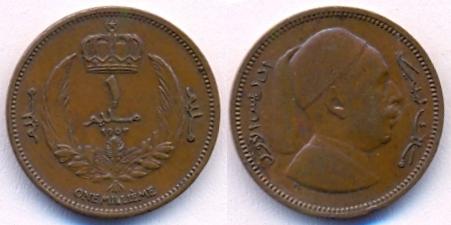 |
KM#1
1 millieme. Year:
1952. Weight:
2.99g [3.00g]. Metal:
Bronze.
Diameter:
18.00 mm. Edge:
Plain. Alignment:
Medal. Mint:
British Royal mint. |
|
Obverse:
Crown on the top. Numeral "١" (1) written in
the center with "مليم" (Millieme) below it and followed by Date "١٩٥٢"
(1952). Wreath surrounds the Value. "مليم" (Millieme) written in Arabic
on both sides anti-clockwise. "ONE MILLIÈME" written at the bottom.
Reverse:
King Idris I's portrait wearing traditional cap, facing right in the center.
(ملك ليبيا) "King of Libya"
written at right side in Arabic anti-clockwise. "إدريس الأول" (Al-Idris,
the First) written at left side in
Arabic anti-clockwise. "PV" engraver initials at the bottom left side.
Mintage:
7,750,000 + 32 Proof.
Minted Years: One year
type. Engraver:
Paul Vincze.
Note:
Paul Vincze (15 August 1907 in Galgagyörk, Hungary – 05 March 1994 in
Grasse, France) was a Jewish-Hungarian designer of coins and medal, and
sculptor. Vincze's artistic works featured with the classical artistic
style as shown on the coins he designed. |
|
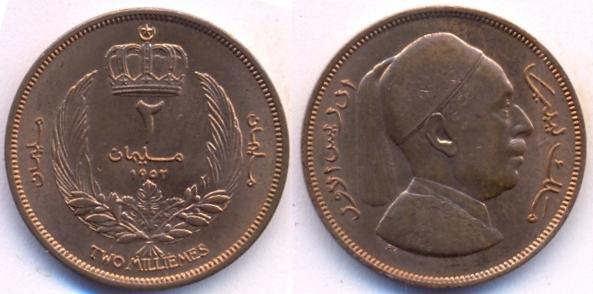 |
KM#2
2 milliemes. Year:
1952. Weight:
5.96g [6.00g]. Metal:
Bronze.
Diameter:
24.00 mm. Edge:
Plain. Alignment:
Medal. Mint:
British Royal mint. Obverse:
Crown on the top. Numeral "٢" (2) written in
the center with "مليمان" (Two Milliemes) below it and followed by Date
"١٩٥٢" (1952). Wreath surrounds the Value. "مليمان" (Two Milliemes) in
Arabic on both sides anti-clockwise. "TWO MILLIÈMES" written at the bottom. |
|
Reverse:
King Idris I's portrait wearing traditional cap, facing right in the center.
(ملك ليبيا) "King of Libya"
written at right side in Arabic anti-clockwise. "إدريس الأول" (Al-Idris,
the First) written at left side in
Arabic anti-clockwise. "PV" engraver initials at the bottom left side.
Mintage:
6,650,000 + 32 Proof.
Minted Years: One year
type. Engraver:
Paul Vincze. |
|
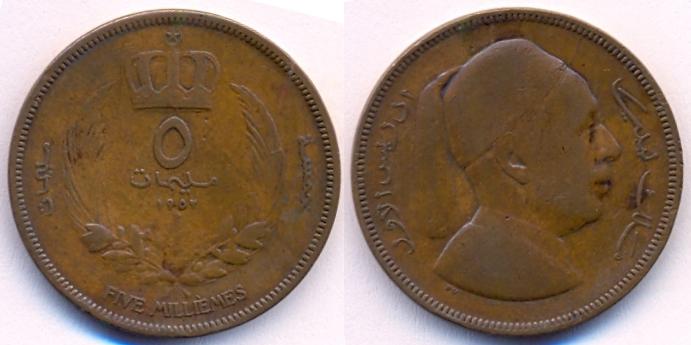 |
KM#3
5 milliemes. Year:
1952. Weight:
9.72g [10.00g]. Metal:
Bronze.
Diameter:
28.00 mm. Edge:
Plain. Alignment:
Medal. Mint:
British Royal mint. Obverse:
Crown on the top. Numeral "٥" (5) written in
the center with "مليمات" (Milliemes) below it and followed by Date
"١٩٥٢" (1952). Wreath surrounds the Value. "خمسة" (Five) written in
Arabic on the left side anti-clockwise and "مليمات" (Milliemes) in
Arabic on right side anti-clockwise. "TWO MILLIÈMES" written at the bottom. |
|
Reverse:
King Idris I's portrait wearing traditional cap, facing right in the center.
(ملك ليبيا) "King of Libya"
written at right side in Arabic anti-clockwise. "إدريس الأول" (Al-Idris,
the First) written at left side in
Arabic anti-clockwise. "PV" engraver initials at the bottom left side.
Mintage:
7,680,000 + 32 Proof.
Minted Years: One year
type. Engraver:
Paul Vincze. |
|
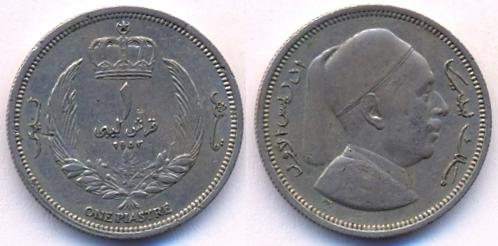 |
KM#4
1 piastre. Year:
1952. Weight:
3.77g [3.75g]. Metal:
Copper-Nickel.
Diameter:
19.50 mm. Edge:
Reeded. Alignment:
Medal. Mint:
British Royal mint. |
|
Obverse:
Crown on the top. Numeral "١" (1) written in
the center with "قرش ليبي" (Libyan Piastre) below it and followed by
Date "١٩٥٢" (1952). Wreath surrounds the Value. "قرش" (Piastre) written
in Arabic on the left side anti-clockwise and "ليبي" (Libyan) in Arabic
on right side anti-clockwise. "ONE PIASTRE" written at the bottom.
Reverse:
King Idris I's portrait wearing traditional cap, facing right in the center.
(ملك ليبيا) "King of Libya"
written at right side in Arabic anti-clockwise. "إدريس الأول" (Al-Idris,
the First) written at left side in
Arabic anti-clockwise. "PV" engraver initials at the bottom left side.
Mintage:
10,200,000 + 32 Proof.
Minted Years: One year
type. Engraver:
Paul Vincze. |
|
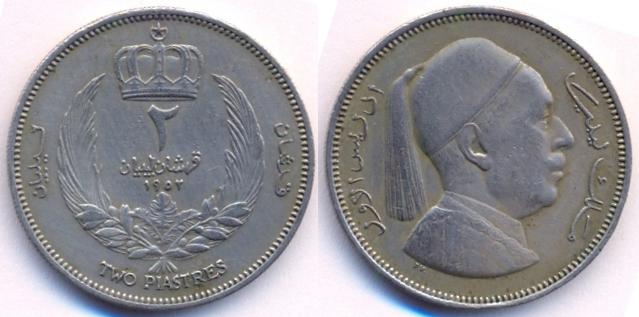 |
KM#5
2 piastres. Year:
1952. Weight:
7.46g [7.50g]. Metal:
Copper-Nickel.
Diameter:
26.00 mm. Edge:
Reeded. Alignment:
Medal. Mint:
British Royal mint. Obverse:
Crown on the top. Numeral "٢" (2) written in
the center with "قرشان ليبيان" (Libyan Two Piastres) below it and
followed by Date "١٩٥٢" (1952). Wreath surrounds the Value. "قرشان" (Two
Piastres) written in Arabic on the left side anti-clockwise and "ليبيان"
(Libyan) in Arabic on right side anti-clockwise. "TWO PIASTRES"
written at the bottom. |
|
Reverse:
King Idris I's portrait wearing traditional cap, facing right in the center.
(ملك ليبيا) "King of Libya"
written at right side in Arabic anti-clockwise. "إدريس الأول" (Al-Idris,
the First) written at left side in
Arabic anti-clockwise. "PV" engraver initials at the bottom left side.
Mintage:
6,075,000 + 32 Proof.
Minted Years: One year
type. Engraver:
Paul Vincze. |
|
|
|
|
1965 - AH 1385 coinage under Idris I (Libyan
Kingdom) |
|
The original plan of restriking the 1952 coin series was
overruled by King Idris. A self-effacing devout Muslim, Idris refused to allow
his portrait to be featured on Libyan currency, so the Senussi crest came to
replace his portrait on coins and notes. |
|
In 1965, a second series of coins was issued in
denominations of 1, 5, 10, 20, 50 and 100 milliemes. The pound was replaced, at
par, by the dinar in 1971 following the Libyan Revolution of 1969. These coins
continued to circulate after 1971 as no new coins were issued until 1975. |
|
|
|
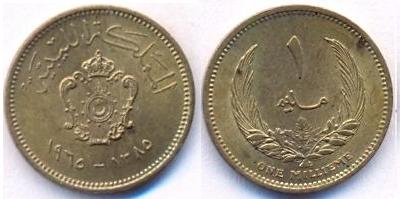 |
KM#6
1 millieme. Year:
1965-AH1385. Weight:
1.69g [1.75g]. Metal:
Nickel-Brass.
Diameter:
16.00 mm. Edge:
Plain. Alignment:
Medal. Mint:
N/A. Obverse:
"المملكة الليبية" (Libyan Kingdom)
written at the top in Arabic.
Crowned national arms in the center. Dates "١٩٦٥ - ١٣٨٥" (1965 - 1385)
written at the bottom. |
|
Reverse:
Numeral "١" (1) written in the center with "مليم" (Millieme)
below it. Wreath surrounds the Value. "ONE MILLIEME" written at the
bottom.
Mintage:
11,000,000.
Minted Years: One year
type. |
|
 |
KM#7
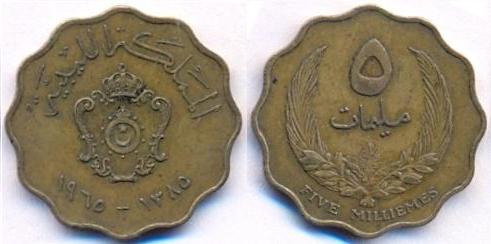
5 milliemes. Year:
1965-AH1385. Weight:
2.53g [2.50g]. Metal:
Nickel-Brass.
Diameter:
12 sided; 20.00 mm. Edge:
Plain. Alignment:
Medal. Mint:
N/A. Obverse:
"المملكة الليبية" (Libyan Kingdom)
written at the top in Arabic.
Crowned national arms in the center. Dates "١٩٦٥ - ١٣٨٥" (1965 - 1385)
written at the bottom. |
|
Reverse:
Numeral "٥" (5) written in the center with "مليمات" (Milliemes)
below it. Wreath surrounds the Value. "FIVE MILLIEMES" written at
the bottom.
Mintage:
8,500,000.
Minted Years: One year
type. |
|
 |
KM#8
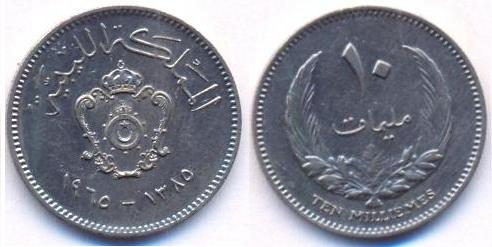
10 milliemes. Year:
1965-AH1385. Weight:
2.99g [3.00g]. Metal:
Copper-Nickel.
Diameter:
19.50 mm. Edge:
Reeded. Alignment:
Medal. Mint:
N/A. Obverse:
"المملكة الليبية" (Libyan Kingdom)
written at the top in Arabic.
Crowned national arms in the center. Dates "١٩٦٥ - ١٣٨٥" (1965 - 1385)
written at the bottom. |
|
Reverse:
Numeral "١٠"
(10) written in the center with "مليمات" (Milliemes)
below it. Wreath surrounds the Value. "TEN MILLIEMES" written at
the bottom.
Mintage:
17,000,000.
Minted Years: One year
type. |
|
 |
KM#9
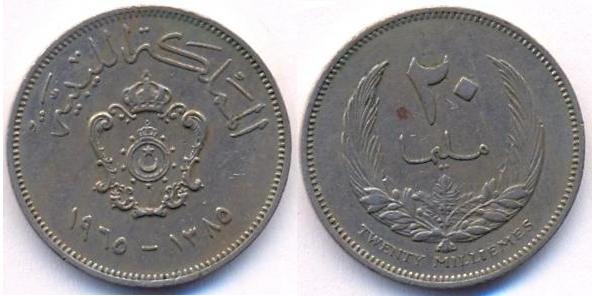
20 milliemes. Year:
1965-AH1385. Weight:
5.84g [6.00g]. Metal:
Copper-Nickel.
Diameter:
24.00 mm. Edge:
Plain. Alignment:
Medal. Mint:
N/A. Obverse:
"المملكة الليبية" (Libyan Kingdom)
written at the top in Arabic.
Crowned national arms in the center. Dates "١٩٦٥ - ١٣٨٥" (1965 - 1385)
written at the bottom. |
|
Reverse:
Numeral "٢٠"
(20) written in the center with "مليما" (Milliemes) below it. Wreath
surrounds the Value. "TWENTY MILLIEMES"
written at
the bottom.
Mintage:
8,750,000.
Minted Years: One year
type. |
|
 |
KM#10
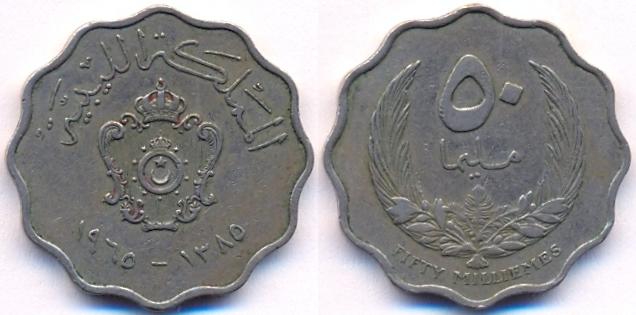
50 milliemes. Year:
1965-AH1385. Weight:
6.93g [7.00g]. Metal:
Copper-Nickel.
Diameter:
12-sided; 26.00 mm. Edge:
Plain. Alignment:
Medal. Mint:
N/A. Obverse:
"المملكة الليبية" (Libyan Kingdom)
written at the top in Arabic.
Crowned national arms in the center. Dates "١٩٦٥ - ١٣٨٥" (1965 - 1385)
written at the bottom. |
|
Reverse:
Numeral "٥٠"
(50) written in the center with "مليما" (Milliemes) below it. Wreath
surrounds the Value. "FIFTY MILLIEMES"
written at
the bottom.
Mintage:
8,000,000.
Minted Years: One year
type. |
|
 |
|
KM#11
100 milliemes. Year:
1965-AH1385. Weight:
10.74g [11.00g]. Metal:
Copper-Nickel.
Diameter:
29.50 mm. Edge:
Reeded. Alignment:
Medal. Mint:
N/A. Obverse:
"المملكة الليبية" (Libyan Kingdom)
written at the top in Arabic.
Crowned national arms in the center. Dates "١٩٦٥ - ١٣٨٥" (1965 - 1385)
written at the bottom. Reverse:
Numeral "١٠٠"
(100) written in the center with "مليم" (Millieme)
below it. Wreath surrounds the Value. "ONE HUNDRED MILLIEMES"
written at the
bottom.
Mintage:
8,000,000.
Minted Years: One year
type. |
|
|
|
|
|
- Guide of the Revolution (de facto
Chief of State)
- Muammar Muhammad Abu
Minyar al-Qaddafi...........01 Sep 1969 - 23 Aug 2011
- He contiues in rebellion at Sirte to 20 Oct 2011.
|
- Chairman of the Revolutionary Command
Council
- Muammar Muhammad Abu Minyar
al-Qaddafi...........08 Sep 1969 - 01 Mar 1979
- Secretaries of the General People's
Congress (nominal chiefs of state)
- Muammar
Muhammad Abu Minyar al-Qaddafi...........02 Mar 1977 - 01 Mar 1979
- He also served as Prime Minister from 16 Jan 1970
to 16 Jul 1972.
- Abdul Ati al-Obeidi..............................01
Mar 1979 - 07 Jan 1981
- Muhammad az-Zaruq
Rajab..........................07 Jan 1981 - 15 Feb 1984
- Mifta al-Usta Umar...............................15
Feb 1984 - 07 Oct 1990
- Abdul Razzaq as-Sawsa............................07
Oct 1990 - 18 Nov 1992
- Zentani Muhammad az-Zentani......................18
Nov 1992 - 03 Mar 2008
- Muftah Muhammad al-Sanusi Kaiba..................03
Mar 2008 - 05 Mar 2009
- Mubarak Abdallah al-Shamikh......................05
Mar 2009 - 26 Jan 2010
- Muhammad Abul-Qasim al-Zwai......................26
Jan 2010 - 23 Aug 2011
|
|
|
|
1975 - AH1395 coinage (Libyan Arab Republic) |
|
Currency:
Libyan Dinar (LYD) = 1000 dirhams |
|
The dinar (Arabic: دينار) is the currency of Libya. Its
ISO 4217 code is "LYD". The dinar is subdivided into 1000 dirham (درهم). It was
introduced in 1971 and replaced the pound at par. It is issued by the Central
Bank of Libya, which also supervises the banking system and regulates credit. In
1972, the Libyan Arab Foreign Bank was established to deal with overseas
investment. Until 1975, old coins denominated in milliemes (equal to the dirham)
circulated. In 1975, coins were introduced in denominations of 1, 5, 10, 20, 50
and 100 dirham which bore the coat of arms of the Federation of Arab Republics.
"الجماهيرية العربية الليبية" [Libyan Arab Republic] is written on all 1975
issues. |
|
|
|
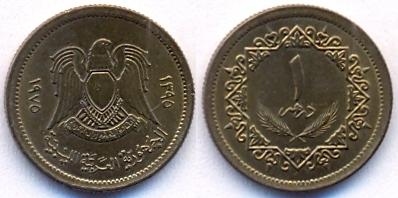 |
KM#12
1 dirham. Year:
1975-AH1395. Weight:
1.69g [1.75g]. Metal:
Brass Clad Steel.
Diameter:
16.00 mm. Edge:
Reeded. Alignment:
Medal. Mint:
N/A. |
|
Obverse:
Coat of arms of the Federation of Arab
Republics in the center with "إتحاد الجمهوريات العربية" (Union of Arab
Republics) written in the banner. Dates "١٩٧٥"
(1975) anti-clockwise on the left side and "١٣٩٥"
(1395) clockwise on the right
side.
"الجماهيرية العربية الليبية"
(Libyan Arab Republic)
written in Arabic at the bottom.
Reverse:
Numeral "١" (1) and "درهم" (dirham) written in Arabic in the center
with wreath below, surrounded by design.
Mintage:
20,000,000 + N/A Proof.
Minted Years: One year
type. |
|
 |
KM#13
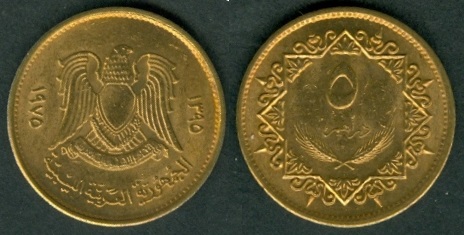
5 dirhams. Year:
1975-AH1395. Weight:
2.48g [2.50g]. Metal:
Brass Clad Steel.
Diameter:
18.00 mm. Edge:
Plain. Alignment:
Medal. Mint:
N/A. |
|
Obverse:
Coat of arms of the Federation of Arab
Republics in the center with "إتحاد الجمهوريات العربية" (Union of Arab
Republics) written in the banner. Dates "١٩٧٥"
(1975) anti-clockwise on the left side and "١٣٩٥"
(1395) clockwise on the right
side.
"الجماهيرية العربية الليبية"
(Libyan Arab Republic)
written in Arabic at the bottom.
Reverse:
Numeral "٥"
(5) and "درهم" (dirham) written in Arabic in the center with wreath below, surrounded by design.
Mintage:
23,000,000 + N/A Proof.
Minted Years: One year
type. |
|
 |
KM#14
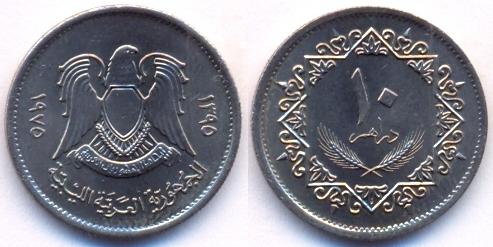
10 dirhams. Year:
1975-AH1395. Weight:
2.98g [3.00g]. Metal:
Copper-Nickel Clad Steel.
Diameter:
19.50 mm. Edge:
Reeded. Alignment:
Medal. Mint:
N/A. |
|
Obverse:
Coat of arms of the Federation of Arab
Republics in the center with "إتحاد الجمهوريات العربية" (Union of Arab
Republics) written in the banner. Dates "١٩٧٥"
(1975) anti-clockwise on the left side and "١٣٩٥"
(1395) clockwise on the right
side.
"الجماهيرية العربية الليبية"
(Libyan Arab Republic)
written in Arabic at the bottom.
Reverse:
Numerals "١٠"
(10) and "درهم" (dirham) written in Arabic in the center with wreath below, surrounded by design.
Mintage:
52,750,000 + N/A Proof.
Minted Years: One year
type. |
|
 |
KM#15
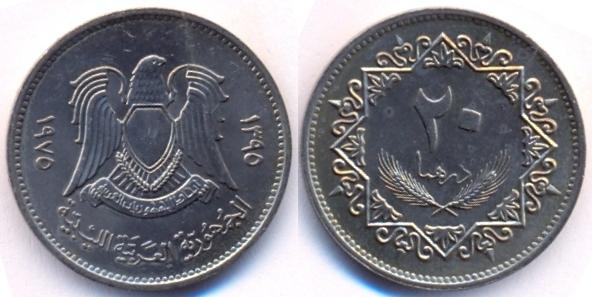
20 dirhams. Year:
1975-AH1395. Weight:
5.41g [5.50g]. Metal:
Copper-Nickel Clad Steel.
Diameter:
24.00 mm. Edge:
Plain. Alignment:
Medal. Mint:
N/A. |
|
Obverse:
Coat of arms of the Federation of Arab
Republics in the center with "إتحاد الجمهوريات العربية" (Union of Arab
Republics) written in the banner. Dates "١٩٧٥"
(1975) anti-clockwise on the left side and "١٣٩٥"
(1395) clockwise on the right
side.
"الجماهيرية العربية الليبية"
(Libyan Arab Republic)
written in Arabic at the bottom.
Reverse:
Numerals "٢٠"
(20) and "درهما" (dirham) written in Arabic in the center with wreath below, surrounded by design.
Mintage:
25,500,000 + N/A Proof.
Minted Years: One year
type. |
|
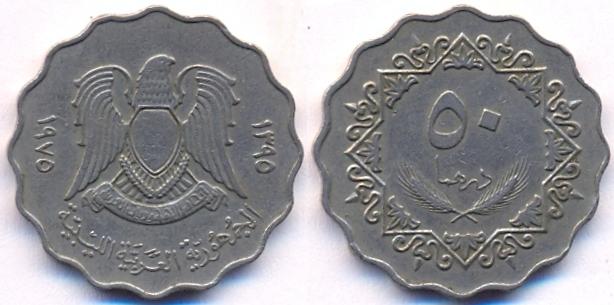 |
KM#16
50 dirhams. Year:
1975-AH1395. Weight:
6.21g [6.25g]. Metal:
Copper-Nickel.
Diameter:
25.00 mm. Edge:
Plain. Alignment:
Medal. Mint:
N/A. |
|
Obverse:
Coat of arms of the Federation of Arab
Republics in the center with "إتحاد الجمهوريات العربية" (Union of Arab
Republics) written in the banner. Dates "١٩٧٥"
(1975) anti-clockwise on the left side and "١٣٩٥"
(1395) clockwise on the right
side.
"الجماهيرية العربية الليبية"
(Libyan Arab Republic)
written in Arabic at the bottom.
Reverse:
Numerals "٥٠"
(50) and "درهما" (dirham) written in Arabic in the center with wreath below, surrounded by design.
Mintage:
25,640,000 + N/A Proof.
Minted Years: One year
type. |
|
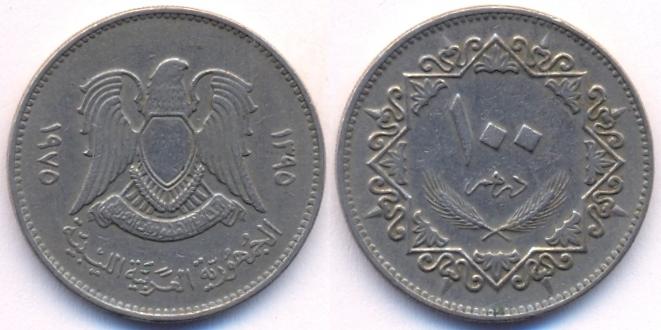 |
KM#17
100 dirhams. Year:
1975-AH1395. Weight:
8.00g [8.00g]. Metal:
Copper-Nickel.
Diameter:
27.50 mm. Edge:
Reeded. Alignment:
Medal. Mint:
N/A. |
|
Obverse:
Coat of arms of the Federation of Arab
Republics in the center with "إتحاد الجمهوريات العربية" (Union of Arab
Republics) written in the banner. Dates "١٩٧٥"
(1975) anti-clockwise on the left side and "١٣٩٥"
(1395) clockwise on the right
side.
"الجماهيرية العربية الليبية"
(Libyan Arab Republic)
written in Arabic at the bottom.
Reverse:
Numerals "١٠٠"
(100) and "درهم" (dirham) written in Arabic in the center with wreath below, surrounded by design.
Mintage:
15,433,000 + N/A Proof.
Minted Years: One year
type. |
|
|
|
|
1979 - AH1399 coinage (Socialist People's
Libyan Arab Jamahiriya) |
|
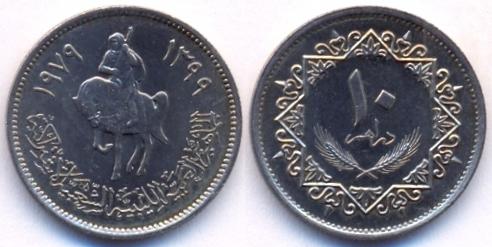
These were followed in 1979 by a second series of coins,
in the same denominations, which bore a design of a horseman in place of the
arms. ¼ and ½ dinar coins were issued in 2001 and 2004, respectively. In 2009,
new 50, 100 dirhams, ¼ and ½ dinar coins were issued. 1, 5, 10, and 20 dirham
coins are rarely used as units of exchange. However, they still retain their
status as legal tenders. |
|
On 2 March 1977, the GPC, at Gaddafi's behest, adopted the
"Declaration of the Establishment of the People's Authority" and proclaimed the
Socialist People's Libyan Arab Jamahiriya (Arabic: الجماهيرية العربية الليبية
الشعبية الاشتراكية, al-Jamāhīrīyah al-Arabīyah al-Lībīyah ash-Sha‘bīyah al-Ishtirākīyah).
In the official political philosophy of Gaddafi's state, the "Jamahiriya" system
was unique to the country, although it was presented as the materialization of
the Third International Theory, proposed by Gaddafi to be applied to the entire
Third World. Jamahiriya (Arabic: جماهيرية jamāhīrīyah) is an Arabic term
generally translated as "state of the masses"; Lisa Anderson has suggested "peopledom"
or "state of the masses" as a reasonable approximations of the meaning of the
term as intended by Gaddafi. |
|
|
|
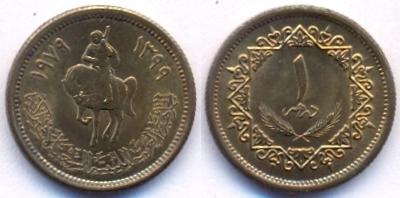 |
KM#18
1 dirham. Year:
1979-AH1399. Weight:
1.74g [1.75g]. Metal:
Brass Clad Steel.
Diameter:
16.00 mm. Edge:
Reeded. Alignment:
Medal. Mint:
N/A. |
|
Obverse:
Armored local horseman in the center.
Dates "١٩٧٩"
(1979) clockwise at the top left side and "١٣٩٩"
(1399) clockwise at the top right
side. "الجمهورية العربية الليبية الشعبية الاشتراكية" (Socialist People's Libyan
Arab Jamahiriya)
in Arabic at the bottom.
Reverse:
Numeral "١" (1) and "درهم" (dirham) written in Arabic in the center
with wreath below, surrounded by design.
Mintage:
1,000,000.
Minted Years: One year
type. |
|
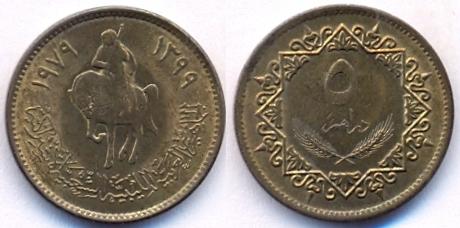 |
KM#19
5 dirhams. Year:
1979-AH1399. Weight:
2.46g [2.50g]. Metal:
Brass Clad Steel.
Diameter:
18.00 mm. Edge:
Plain. Alignment:
Medal. Mint:
N/A. |
|
Obverse:
Armored local horseman in the center.
Dates "١٩٧٩"
(1979) clockwise at the top left side and "١٣٩٩"
(1399) clockwise at the top right
side. "الجمهورية العربية الليبية الشعبية الاشتراكية" (Socialist People's Libyan
Arab Jamahiriya)
in Arabic at the bottom.
Reverse:
Numeral "٥"
(5) and "درهم" (dirham) written in Arabic in the center with wreath below, surrounded by design.
Mintage:
2,000,000.
Minted Years: One year
type. |
|
 |
KM#20
10 dirhams. Year:
1979-AH1399. Weight:
2.99g [3.00g]. Metal:
Copper-Nickel Clad Steel.
Diameter:
19.50 mm. Edge:
Reeded. Alignment:
Medal. Mint:
N/A. |
|
Obverse:
Armored local horseman in the center.
Dates "١٩٧٩"
(1979) clockwise at the top left side and "١٣٩٩"
(1399) clockwise at the top right
side. "الجمهورية العربية الليبية الشعبية الاشتراكية" (Socialist People's Libyan
Arab Jamahiriya)
in Arabic at the bottom.
Reverse:
Numerals "١٠"
(10) and "درهم" (dirham) written in Arabic in the center with wreath below, surrounded by design.
Mintage:
4,000,000.
Minted Years: One year
type. |
|
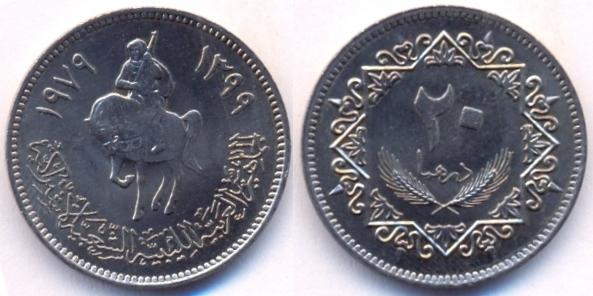 |
KM#21
20 dirhams. Year:
1979-AH1399. Weight:
5.51g [5.50g]. Metal:
Copper-Nickel Clad Steel.
Diameter:
24.00 mm. Edge:
Plain. Alignment:
Medal. Mint:
N/A. |
|
Obverse:
Armored local horseman in the center.
Dates "١٩٧٩"
(1979) clockwise at the top left side and "١٣٩٩"
(1399) clockwise at the top right
side. "الجمهورية العربية الليبية الشعبية الاشتراكية" (Socialist People's Libyan
Arab Jamahiriya)
in Arabic at the bottom.
Reverse:
Numerals "٢٠"
(20) and "درهما" (dirham) written in Arabic in the center with wreath below, surrounded by design.
Mintage:
6,000,000.
Minted Years: One year
type. |
|
 |
KM#22
50 dirhams. Year:
1979-AH1399. Weight:
6.30g [6.25g]. Metal:
Copper-Nickel.
Diameter:
25.00 mm. Edge:
Plain. Alignment:
Medal. Mint:
N/A. |
|
Obverse:
Armored local horseman in the center.
Dates "١٩٧٩"
(1979) clockwise at the top left side and "١٣٩٩"
(1399) clockwise at the top right
side. "الجمهورية العربية الليبية الشعبية الاشتراكية" (Socialist People's Libyan
Arab Jamahiriya)
in Arabic at the bottom.
Reverse:
Numerals "٥٠"
(50) and "درهما" (dirham) written in Arabic in the center with wreath below, surrounded by design.
Mintage:
9,120,000.
Minted Years: One year
type. |
|
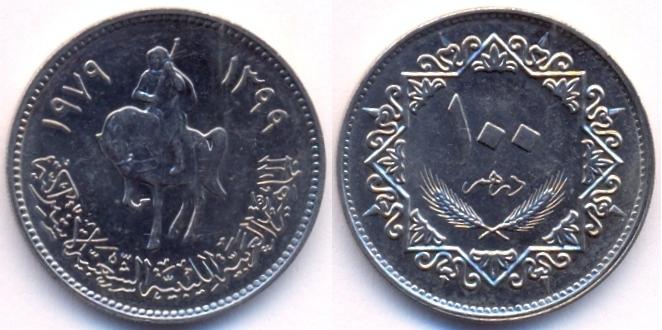 |
KM#23
100 dirhams. Year:
1979-AH1399. Weight:
7.98g [8.00g]. Metal:
Copper-Nickel.
Diameter:
27.50 mm. Edge:
Reeded. Alignment:
Medal. Mint:
N/A. |
|
Obverse:
Armored local horseman in the center.
Dates "١٩٧٩"
(1979) clockwise at the top left side and "١٣٩٩"
(1399) clockwise at the top right
side. "الجمهورية العربية الليبية الشعبية الاشتراكية" (Socialist People's Libyan
Arab Jamahiriya)
in Arabic at the bottom.
Reverse:
Numerals "١٠٠"
(100) and "درهم" (dirham) written in Arabic in the center with wreath below, surrounded by design.
Mintage:
15,000,000.
Minted Years: One year
type. |
|
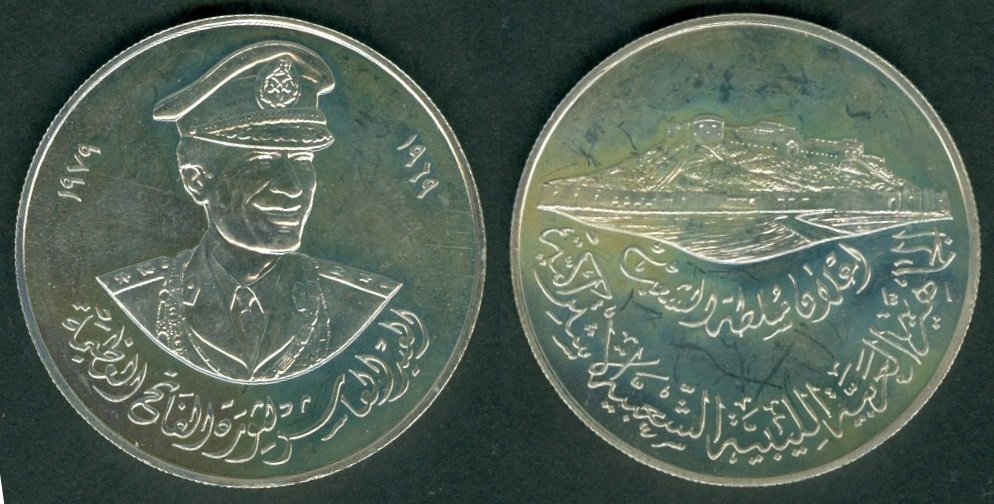 |
|
Medallic Silver Coin. Year:
1979. Weight:
28.08g [28.28g]. Metal:
0.925 Silver.
Diameter:
40.00 mm. Edge:
Reeded. Alignment:
Medal. Mint:
N/A. Obverse:
Muammar Muhammad al-Qaddafi's straight
uniformed portrait facing right in the center.
Dates "١٩٧٩"
(1979) clockwise at the top left side and "١٩٦٩"
(1969) clockwise at the top right
side. "العيد العاشر لثورة الفاتح العظيمة" (The
tenth anniversary of the revolution of the great conqueror)
written
in Arabic at the bottom.
Reverse: Fort Elena Castle in Sabha
in the center with "إعلان
سلطة الشعب" (The
Proclamation of the People's Authority)
written in Arabic below it.
"الجمهورية العربية الليبية الشعبية الاشتراكية" (Socialist People's Libyan
Arab Jamahiriya)
written
in Arabic at the bottom.
Mintage:
N/A.
Minted Years: One year
type. Subject:
10th Anniversary of Great Libyan Revolution.
Note: Fort Elena Castle in Sabha, - city
where Libyan leader Muammar Gaddafi announced his famous "The dawn of
the era of the masses" in 1969.
Sabha, or Sebha (Arabic: سبها Sabhā), is an oasis city in
southwestern Libya, approximately 640 kilometres (400 mi) south of
Tripoli. It was historically the capital of the Fezzan region and the
Military Territory of Fezzan-Ghadames and is now capital of the Sabha
District. Sabha Air Base, south of the city, is a Libyan Air Force
installation that is home to multiple MiG-25 aircraft.
Sabha was where the erstwhile ruler of Libya, Muammar Gaddafi, grew up
and received secondary education and where he also later became involved
in political activism. After the Libyan Civil War and the resultant
instability in the country, Sabha reportedly grew in importance as a
slave auctioning town. The city was later seized by forces loyal to the
Libyan National Army (LNA) and its leader Khalifa Haftar in January
2019. |
|
|
|
|
1369 solar years after Prophet Muhammad's
death (2001 CE) coinage |
|
(Greater Socialist People's Libyan Arab
Jamahiriya) |
|
Libya was renamed in Apr 1986 as Great Socialist People's
Libyan Arab Jamahiriya [(الجماهيرية العربية الليبية الشعبية الإشتراكية
العظمى) al-Jamāhīrīyah al-‘Arabīyah al-Lībīyah ash-Sha‘bīyah al-Ishtirākīyah al-‘Uẓmá].
This phrase is written on all the coins issued in 2001, 2004 and 2009. |
|
|
|
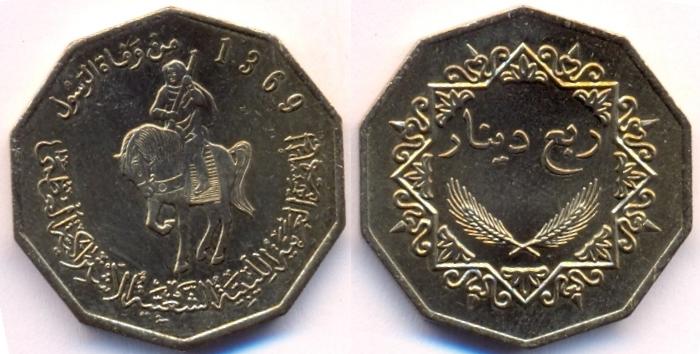 |
|
KM#26
1/4 Dinar. Year:
1369 solar years after Prophet Muhammad's death
[2001 CE]. Weight:
11.27g [11.25g]. Metal:
Nickel-Brass.
Diameter:
29.00 mm. Edge:
Reeded and Plain; 5 patched each. Alignment:
Medal. Mint:
N/A. Obverse:
Armored local horseman in the center.
Date "1369" written at the top right side. "من وفاة ارسول" (after
the death of the prophet) written in Arabic
at the top left side. "الجماهيرية العربية الليبية الشعبية الإشتراكية
العظمى" (Great Socialist People's
Libyan Arab Jamahiriya)
written
in Arabic at the bottom section.
Reverse: "دينار ربع"
(Quarter Dinar) value in Arabic with wreath below
in the center, surrounded by design.
Mintage:
N/A.
Minted Years: One year
type.
Note:
Muhammad P.B.U.H (Arabic: مُحمّد) [b. c.
570 CE – 08 June 632 CE] was an Arab political, social and religious
leader and the founder of Islam. According to Islamic doctrine, he was a
prophet, sent to present and confirm the monotheistic teachings preached
previously by Adam, Abraham, Moses, Jesus, and other prophets. He is
viewed as the final prophet of God in all the main branches of Islam,
though some modern denominations diverge from this belief. Muhammad
united Arabia into a single Muslim polity, with the Quran as well as his
teachings and practices forming the basis of Islamic religious belief.
He is referred to by many appellations, including Messenger of Allah,
The Prophet Muhammad, Allah's Apostle, Last Prophet of Islam. The Libyan
government decided to start a solar calendar from 632 CE after prophet
Muhammad's death instead of using the traditional hijri calendar
(consisting of 12 lunar months in a year of 354 or 355 days). |
|
| |
|
1372 solar years after Prophet Muhammad's death (2004 CE) coinage |
|
(Greater Socialist People's Libyan Arab Jamahiriya) |
| |
|
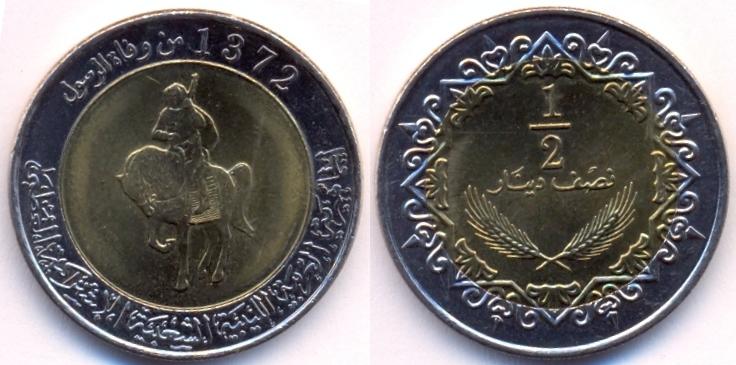 |
|
KM#27
1/2 Dinar. Year:
1372 solar years after Prophet Muhammad's death
[2004 CE]. Weight:
11.62g [11.65g]. Metal:
Bi-metallic; Copper-Nickel outer ring and Brass
in the center.
Diameter:
29.50 mm. Edge:
Reeded. Alignment:
Medal. Mint:
N/A. Obverse:
Armored local horseman in the center.
Date "1372" written at the top right side. "من وفاة ارسول" (after
the death of the prophet) written in
Arabic at the top left side. "الجماهيرية العربية الليبية الشعبية
الإشتراكية العظمى" (Great
Socialist People's Libyan Arab Jamahiriya)
written
in Arabic at the bottom section.
Reverse:
"1/2" written in the center with value "نصف دينار" (Half Dinar)
written in Arabic below it, with wreath below, surrounded by design.
Mintage:
N/A.
Minted Years: One year
type. |
|
| |
|
1377 solar years after Prophet Muhammad's death (PD) - 2009 CE coinage of Greater Socialist People's Libyan Arab Jamahiriya |
| |
| |
|
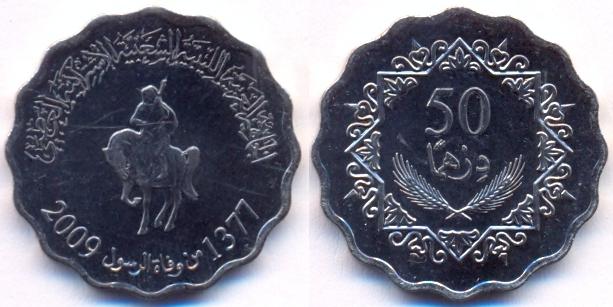 |
KM#28
50 dirhams. Year:
1377 PD -2009. Weight:
5.44g [5.50g]. Metal:
Copper-Nickel.
Diameter:
24.75 mm. Edge:
Plain. Alignment:
Medal. Mint:
N/A. |
|
Obverse:
"الجماهيرية العربية الليبية الشعبية الإشتراكية
العظمى" (Great Socialist
People's Libyan Arab Jamahiriya)
written in Arabic at the top section.
Armored local
horseman in the center.
Dates "1377" at the bottom right side and
"2009" at the bottom left side. "من وفاة ارسول" (after
the death of the prophet) written in
Arabic at the bottom. Reverse:
Numerals "٥٠"
(50) and "درهما" (dirham) written in Arabic in the center with wreath below, surrounded by design.
Mintage:
N/A.
Minted Years: One year
type. |
|
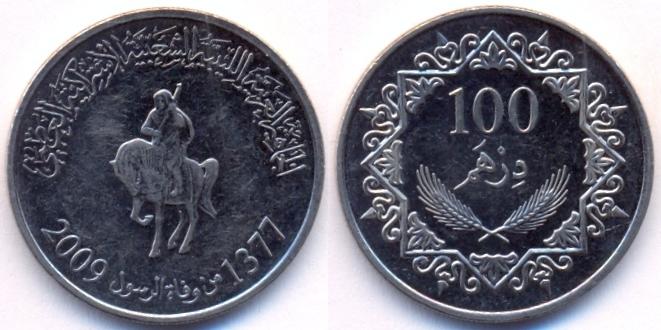 |
KM#29
100 dirhams. Year:
1377 PD -2009. Weight:
6.94g [7.00g]. Metal:
Copper-Nickel.
Diameter:
27.00 mm. Edge:
Plain. Alignment:
Medal. Mint:
N/A. |
|
Obverse:
"الجماهيرية العربية الليبية الشعبية الإشتراكية
العظمى" (Great Socialist
People's Libyan Arab Jamahiriya)
written in Arabic at the top section. Armored local horseman
in the center.
Dates "1377" at the bottom right side and
"2009" at the bottom left side. "من وفاة ارسول" (after
the death of the prophet) written in
Arabic at the bottom. Reverse:
Numerals "١٠٠"
(100) and "درهم" (dirham) written in Arabic in the center with wreath below, surrounded by design.
Mintage:
N/A.
Minted Years: One year
type. |
|
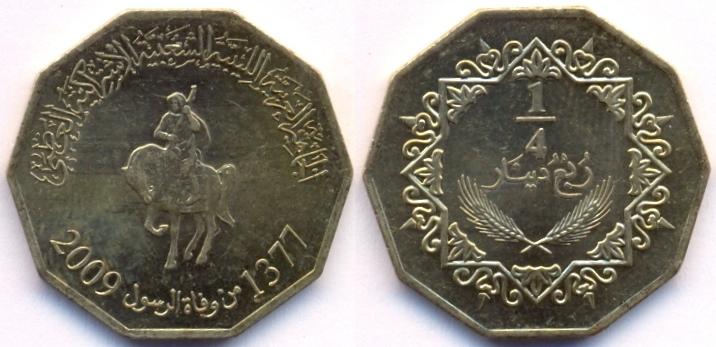 |
| KM#30
1/4 Dinar. Year:
1377 solar years after Prophet Muhammad's death
- 2009 CE. Weight:
8.14g [8.15g]. Metal:
Nickel-Brass.
Diameter:
29.00 mm. Edge:
Reeded and Plain; 5 patched each. Alignment:
Medal. Mint:
N/A. Obverse:
"الجماهيرية العربية الليبية الشعبية الإشتراكية
العظمى" (Great Socialist
People's Libyan Arab Jamahiriya)
written in Arabic at the top section. Armored local horseman
in the center.
Dates "1377" at the bottom right side and
"2009" at the bottom left side. "من وفاة ارسول" (after
the death of the prophet) written in
Arabic at the bottom. Reverse:
"1/4" written in the center with value "دينار ربع" (Half Dinar)
written in Arabic below it, with wreath below, surrounded by design.
Mintage:
N/A.
Minted Years: One year
type.
Note: Besides
the design and legend size difference from 1369 PD issue, this coin
has a horizontal edge on the top instead of the pointed one. The
thickness of the coin is also reduced as indicated from the weight. |
|
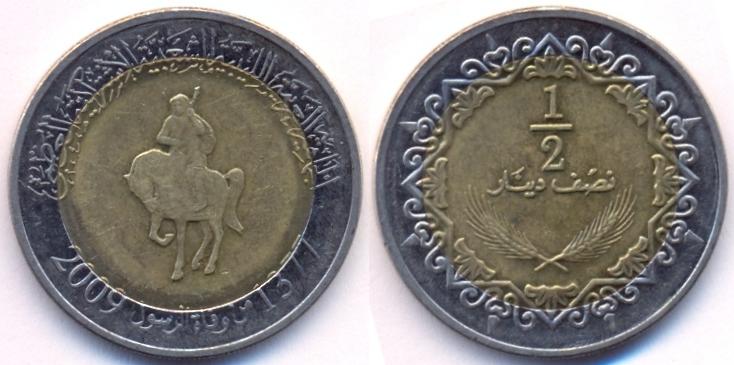 |
| KM#31
1/2 Dinar. Year:
1377 solar years after Prophet Muhammad's death
- 2009 CE. Weight:
10.33g [10.50g]. Metal:
Bi-metallic; Copper-Nickel outer ring and Brass
in the center.
Diameter:
29.50 mm. Edge:
Reeded. Alignment:
Medal. Mint:
N/A. Obverse:
"الجماهيرية العربية الليبية الشعبية الإشتراكية
العظمى" (Great Socialist
People's Libyan Arab Jamahiriya)
written in Arabic at the top section. Armored local horseman
in the center.
Dates "1377" at the bottom right side and
"2009" at the bottom left side. "من وفاة ارسول" (after
the death of the prophet) written in
Arabic at the bottom.
Reverse:
"1/2" written in the center with value "نصف دينار" (Half Dinar)
written in Arabic below it, with wreath below, surrounded by design.
Mintage:
N/A.
Minted Years: One year
type. |
|
| |
- Chairman of the National Transitional
Council
- Mustafa Muhammad Abdul Jalil.....................05
Mar 2011 - 08 Aug 2012
- in rebellion to 23 Aug 2011 in Benghazi.
- President of the General National
Congress
- Mohammed Ali Salim (acting)......................09
Aug 2012 – 10 Aug 2012
- Mohamed Yousef el-Magariaf.......................10
Aug 2012 - 28 May 2013
- Giuma Ahmad Atigha (acting)......................28
May 2013 - 25 Jun 2013
- Nouri Abusahmain.................................25
Jun 2013 - 04 Aug 2014
- President
of the House of Representatives
- Abu Bakr Baira (acting)..........................04
Aug 2014 – 05 Aug 2014
- Akila Saleh Issa.................................05
Aug 2014 - date
- On 28 August 2020, Prime Minister Fayez al-Sarraj
suspends Interior Minister Fathi Bashagha and names Khalid Ahmad Mazen as
acting minister. On 29 August 2020, al-Sarraj appoints Salah al-Namroush as
defense minister. On 03 September 2020, the suspended interior minister
Fathi Bashagha is restored to his post. On 13 September 2020, the prime
minister of the Tobruk-based government, Abdullah al-Thani, resigns. On 16
September 2020, the chairman of the Presidential Council and prime minister,
Fayez al-Sarraj, announces his intention to step down by the end of October.
On 30 October 2020, Prime Minister Fayez al-Sarraj retracts his decision to
resign by the end of October.
|
| |
|
2014 (AH 1435) |
| |
|
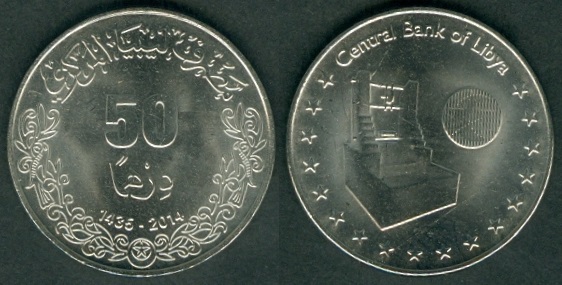 |
KM#33
50 Dirhams. Year:
2014-AH1435. Weight:
5.01g [5.00g]. Metal:
Copper-nickel clad steel.
Diameter:
22.90 mm. Edge:
Reeded. Alignment:
Medal. Mint:
N/A. Obverse:
"مصرف ليبيا المركزي"
(Central
Bank of Libya) in
Arabic written at the top.
"50 dirhama" value in Arabic in the center. Dates "1435 - 2014" at the
bottom. Decorated design at the bottom section. |
|
Reverse:
"Central Bank of Libya" written at the top. North African
well for irrigation on the left side and round shape hologram ("crescent"
from one angle and "star" from another angle) on the right in the center. 17 stars near the
edge at the bottom section.
Mintage:
N/A.
Minted Years: One year
type.
Note: This type of well used mostly
for irrigation. It is construction in such a way to withdraw large
quantity of water at a time. Therefore it needs a force of domestic
animals to pull the water out. Water afterwards is directed towards
special canals and irrigated field crops. The coin is reported to be
released for circulation on 15th December 2014. |
|
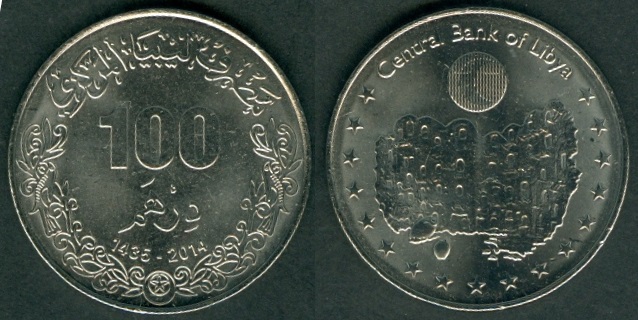 |
KM#35
100 Dirhams. Year:
2014-AH1435. Weight:
6.52g [6.50g]. Metal:
Copper-nickel clad steel.
Diameter:
26.00 mm. Edge:
Plain. Alignment:
Medal. Mint:
N/A. Obverse:
"مصرف ليبيا المركزي"
(Central
Bank of Libya) in
Arabic written at the top.
"100 dirhama" value in Arabic in the center. Dates "1435 - 2014" at the
bottom. Decorated design at the bottom section. |
|
Reverse:
"Central Bank of Libya" written at the top. A round shape hologram ("crescent"
from one angle and "star" from another angle) above the Kasr
Kabaw. Interior view of Kasr Kabaw in the center. 17 stars near the
edge at the bottom section.
Mintage:
N/A.
Minted Years: One year
type.
Note:
Kasr Kabaw is a Berber Granary fortress-village located in Kabaw, Nalut
District of Tripolitania Region (North-West part of Libya). The coin is
reported to be released for circulation on 15th December 2014. |
|
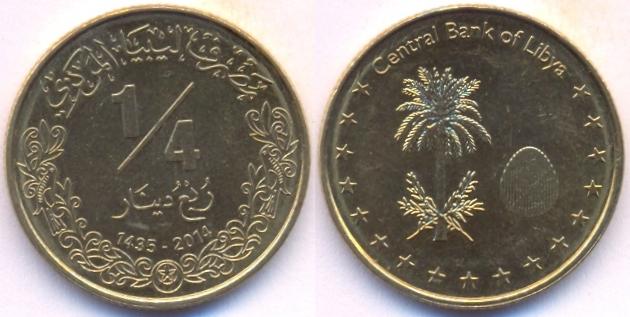 |
KM#32
1/4 Dinar. Year:
2014-AH1435. Weight:
6.56g [6.60g]. Metal:
Brass.
Diameter:
26.00 mm. Edge:
Reeded. Alignment:
Medal. Mint:
N/A. Obverse:
"مصرف ليبيا المركزي"
(Central
Bank of Libya)
in Arabic written at the top. Value "1/4" in the center with "ربع دينار"
(Quarter Dinar) written below it.
Dates "1435 - 2014" at the bottom. Decorated
design at the bottom section. |
|
Reverse:
"Central Bank of Libya" written at the top. Tree at left
side and oval shape hologram (Value "1/4" from one angle and "crescent /
star" from another angle) on the right in the center. 17 stars near the
edge at the bottom section.
Mintage:
N/A.
Minted Years: One year
type.
Note: The new quarter-dinar coin was
issued on 16th February 2014 to commemorate the third anniversary of the
revolution. |
|
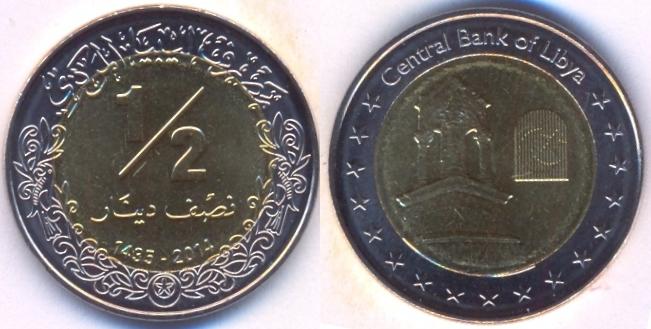 |
KM#33
1/2 Dinar. Year:
2014-AH1435. Weight:
7.09g [7.10g]. Metal:
Bi-metallic; Copper-Nickel outer ring and Brass
in the center.
Diameter:
27.00 mm. Edge:
Reeded. Alignment:
Medal. Mint:
N/A. Obverse:
"مصرف ليبيا المركزي"
(Central
Bank of Libya)
in Arabic written at the top. Value "1/2" in the center with "نصف
دينار" (Half Dinar) written below it. Dates "1435 - 2014" at the bottom. Decorated
design at the bottom section. |
|
Reverse:
"Central Bank of Libya" written at the top. Stage at left side and hologram (Value "1/2" from one angle and "crescent /
star" from another angle) on the right in the center. 17 stars near the
edge at the bottom section.
Mintage:
N/A.
Minted Years: One year
type.
Note: Issued on 11th May 2014. |
|
| |
|
2017 (AH 1438) |
| |
|
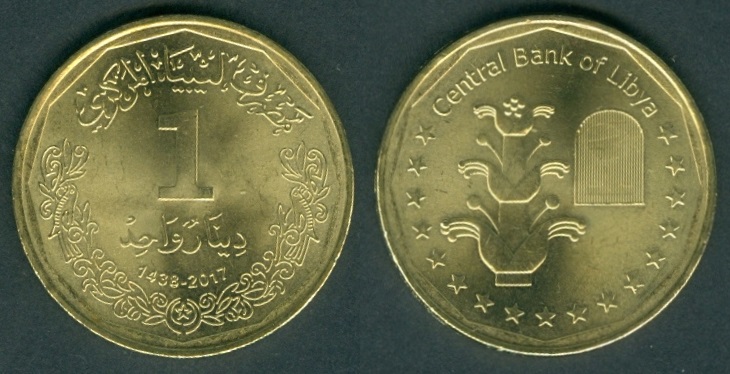 |
| KM#36
Dinar. Year:
2017-AH1438. Weight:
9.21g [9.25g]. Metal:
Brass plated steel.
Diameter:
29.00 mm. Edge:
Reeded with Lettered; (*
numeral 1 downwards *) repeated 7 times
when Date side (Obverse side) is on the top. Alignment:
Medal. Mint:
Russia.
Obverse:
"مصرف ليبيا المركزي"
(Central
Bank of Libya)
in Arabic written at the top. Numeral "1" in the center with "دينار
واحد" (One Dinar) written below it. Dates "1438 - 2017" at the bottom. Decorated
design at the bottom section.
Reverse:
"Central Bank of Libya" written at the top. Silphium /
Salvia plant in the center left side. Hologram "1" or "crescent
facing right with star" at the center right side. 17 stars near the
edge at the bottom section.
Mintage:
N/A.
Minted Years: One year
type.
Issue Date: 02 Nov 2017.
Issued by: The Beida-based
Central Bank of Libya (East Libya). As a result of the
devaluation of the dinar paper currency, the Central Bank of Libya
announces the launch of a new coin (1) one dinar for trading, as of
Thursday, 02-11-2017, in accordance with the provisions of Law No.
(1) of 2005 and its amendments. Russia has been supplying new Dinar
banknotes for Beida CBL since May 2016. |
|
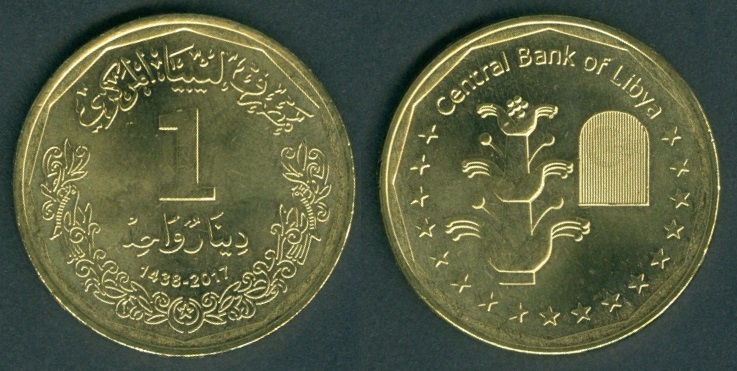 |
| Same as above coin, but...
Weight:
9.39g [9.25g]. Edge:
Reeded with Lettered; (*
numeral 1 upwards *) repeated 7 times
when Date side (Obverse side) is on the top. |
|
| |
| |
|
|
| |
|
|
| Countries
/ Territories |
| |
|
Chiefa Coins | |
|