| |
 |
 |
| |
|
Oman |
| |
 |
 |
| |
| The Sultanate
of Oman (formerly Muscat and Oman), an independent monarchy located in the
southeastern part of the Arabian Peninsula. Capital: Muscat. Oman was ruled
by Umayyads between 661-750, Abbasids between 750-931, 932-933 and 934-967,
Qarmatians between 931-932 and between 933-934, Buyids between 967-1053,
Seljuks of Kirman between 1053-1154. The economy is
based on agriculture, herding and petroleum. Petroleum products, dates, fish
and hides are exported. The Portuguese who captured Muscat, the capital and
chief port, in 1508, made the first European contact with Muscat and Oman.
They occupied the city, utilizing it as a naval base and factory and holding
it against land and sea attacks by Arabs and Persians until finally ejected
by local Arabs in 1650. It was next occupied by the Persians who maintained
control until 1741,when it was taken by Ahmed ibn Sa'id of the present
ruling family. Muscat and Oman was the most powerful state in Arabia during
the first half of the 19th century, until weakened by the persistent attack
of interior nomadic tribes. British influence, initiated by the signing of a
treaty of friendship with the Sultanate in 1798,remains a dominant fact of
the civil and military phases of the government, although Britain recognizes
the Sultanate as a sovereign state. Sultan Sa'id bin Taimur was overthrown
by his son, Qabus bin Sa'id, on July 23, 1970. The new sultan changed the
nation's name to Sultanate of Oman. |
| |
c.650 Kings of the Azd clan convert to
Islam.
661 - 1811/1821
Oman (Uman) ruled by the Ibadi community under a leader styled
Imam al-Muslimin, a member of the Azd clan.
697 - 748
Direct rule by the Caliph.
16 May 893 - 897
Direct rule by the Caliph.
931 - 932
Rule by the Karmatian heretics (Qaramita).
933 - 934
Rule by the Karmatian heretics (Qaramita).
943 - 951
Direct rule by the Caliph
972 - 1050
Rule by the Iranian Buyid dynasty.
1053 - 1154
Rule by the Saljuq Turks.
1154 - 1406
Ruled by Nabhani Kings (style Malik).
1443 - 1470
Ruled by Nabhani Kings.
01 Apr 1515 - 26 Jan 1650 Muscat a Portuguese possession (Mascate).
1550 - 1551
Muscat occupied by the Ottoman Empire.
1581 - 1588
Muscat occupied by the Ottoman Empire.
c.1600 - 1624
Ruled by Nabhani Kings.
1624 Imami rule restored, under
Ya`ariba lineage.
1741 - 1749
Muscat occupied by Persia.
10 Jun 1749 Al ´Bu Sa`id lineage accedes to the Imamate.
1784 While Imams rule continues,
Muscat and Oman becomes a de facto
sovereign state under a secular Al ´Bu Sa`id ruler.
1800 - 1801
Bahrain occupied by Muscat and Oman.
1792 - 08 Sep 1958 Gwadar (Gwadur),
port enclave in Baluchistan, part of Oman.
Ceded to Pakistan on 08 Sep 1958.
20 Mar 1820 First treaty with Britain.
14 Jul 1854 - 30 Nov 1967 Kuria Muria (Khuryan Muryan) Islands ceded
to U.K.
(from 1 Apr 1937 under Aden [Yemen] to 1963; from 1963 under
the chief political resident of the Persian Gulf
of the Persian Gulf [at Bahrain] [included the islands of
Hasikiya, Sawda, Hallaniya, and Qibliya]).
04 May 1855 Second treaty with Britain.
06 Apr 1861 Separation of Zanzibar from Oman and style Sultan recognized
(though not immediately in domestic
use) by U.K. mediation.
03 Oct 1868 Imams rule briefly restored.
30 Jan 1871 Sultanate of Muscat and Oman restored.
20 Mar 1891 - 02 Dec 1971 British protectorate over Muscat and Oman
(under the chief
political resident of the
Persian Gulf; see under Bahrain).
24 May 1913 - 11 Aug 1957 Imami government in the interior of Oman, usually
in
opposition to the sultan's rule.
09 Jun 1965 - 11 Dec 1975 Secessionist rebellion in Dhofar (Zufar).
09 Aug 1970 Sultanate of Oman |
|
|
- 'AD
- An ancient district in what is now southwestern
Oman, running from the sea up into the Dhofar Mountains and thence to the
edge of the Rub` al-Khali. In the highlands are to be found scattered groves
of the frankincense tree, source of what some regard as the finest of
aromatic incenses. The region may also be roughly the locale where camels
were first domesticated. 'Ad is known as the tribal Kingdom in which lay the
city of Ubar, a major transshipment point for the frankincense trade in
ancient times. Kingdom of 'Ad Existed as a tribal state from perhaps 900 BCE
to perhaps 500 CE. Claudius Ptolemy's (2nd Cent. CE) Geographos refers to
the place by a Hellenized version of the inhabitants of the chief city: the
Iobaritae (Ubar).
- Ad ibn Kin'ad.........................................fl.
10th cent. BCE ?
- Unknown rulers
- al-Dahn ?
- Khuljan...............................................fl.
4th or 3rd cent. BCE ?
- Unknown rulers
- Shaddad...............................................fl.
4th, 5th, or 6th cent. CE ?
- Sometime between 300 and 600 CE the 'Adid state
seems to have crumbled, due in large measure to a natural catastrophe which
seems to have destroyed much of Ubar, but also owing to increasing pressure
from the Kingdom of Hadramaut (and after c. 290 CE, of Himyar) and, oddly
enough, the rise of Christianity (in which burial customs shifted, leaving a
far smaller market for frankincense).
-
Umayyad
Caliphate........................................650 - 750
-
Abbasid
Caliphate........................................750 - c. 1000
- Local sheikhdoms and
petty emirates..................c. 1000 - c. 1500
- Badr ibn Tuwariq...............................................fl.
c. 1500
- Portugal................................................1508 - 1649
- Within Oman
thereafter...
- In the immediate district there resides a local
tribe, the Shahra, who still collect frankincense, use among themselves a
language very different from Arabic, and regard themselves as a people to be
descendents of 'Ad.
|
- Kingdom of Makan c.2200-c. 550 BCE. The
Sumerians referred to Oman as "Makan". It was a primary source of copper for
Mesopotamia throughout the Bronze Age. At this time the names of the kings
of Makan are mostly undocumented.
- Manium........................................................late
2200's BCE
- Unknown rulers
- Pade (in Izki-Qade, in the
interior)..........................fl. c. 640
-
Taharka.......................................................early 600's
- Unknown rulers
- Persia...........................................6th, 5th, and 4th cent. BCE
- Artabazus.................................................early
400's
- MASCAT
- Banu KAHTAN
- Himyar Azangadjar ben Abd
al-Shams....................c. 370 - c. 348
- Malik ben Himyar......................................c.
348 - c. 320
- --- ben
Malik.........................................c. 320 - c. 300
- Saqsaq
- Yasar
- An-Numan
- Asma
- Shaddad ben Ad.................................................c. 200
- Luqman ben Ad
- Zu-Shadakh ben Ad
- Persia after about c. 140 BCE
- generally unknown
sequence.........................130's BCE - 635 CE
- QALHAT
- al-'AZDI
- Malik ibn Fahm...........................................200's
CE ? followed by...
- Honat ibn Malik and...
- Selim ibn Malik
- The region was inhabited by local
Semitic populations who formed several tribal Kingdoms (for example,
Ad), but otherwise left little mark. The area was no doubt heavily
influenced by successive Persian regimes, but periods of actual occupation
by Persia are difficult to trace.
- Sporadic Persian occupations.............................3rd - 7th centuries
- al-JULANDA
The al-Julanda were the
first Imams of the radical Ibadi-Khariji sect of Islam which held most of
the Omani interior for centuries. The Kharijis began as a fundamentalist
sect in Iraq which murdered the Caliph Ali and attempted to murder his
rival and successor, Mu'awiyah, because they rejected the premise that any
man could be a successor to the Prophet.
- al-Julanda ibn al-Muntasir............................c.
600 - c. 630
- Djafar ibn al-Julanda.................................c.
630 - c. 651 with...
- Abbad I ibn al-Muntasir...............................c.
630 - c.640
- Abbad
II..............................................c. 651 - c. 659
- Sulayman..............................................c.
659 - 697
-
Umayyad
Caliphate........................................697 - 750
- Caliphate governors
- Sa'id ibn Abbad.....................................fl.
early 700's with...
- Sulayman ibn Abbad..................................fl.
early 700's
- al-Julanda ibn Masud
al-Azd.........................748 - 751
- Imams with an annual term of
office......................751 - 791
- Shaykh Musa ibn Abu Djabar al-Azd..............................791
- Shaykh Muhammad ibn
Abi Affan al-Azd.....................791 - 792
- Shaykh al-Warith ibn Ka'ab
al-Yahmad.....................792 - 804
- Unknown ruler
- Shaykh Ghassan bin
Abdullah al-Yahmad....................807 - 823
- Shaykh Abd
al-Malik bin Humaid al-Azd....................824 - 840
- Unknown ruler
- Shaykh al-Muhanna bin
Jayfar al-Yahmad...................842 - 851
- as-Salt ibn Malik al-Azd.................................851 - 887
- Shaykh Rashid ibn Nadhar.................................887 - 890
- Shaykh al-Azzan bin
Tamim................................890 - 893
- Unknown ruler
- Shaykh Muhammed ibn al-Hassan al-Azd
(1st time)..........897 - 898
- Azzan ibn Hazbar al-Maliki
al-Yahmad.....................898 - 899
- Abdallah ibn Muhammad al-Haddani.........................899 - 900
- as-Salt ibn
al-Qasim...........................................900
- Shaykh Muhammad ibn al-Hassan al-Azd
(2nd time)................900
- al-Hasan ibn Said al-Shahtani............................900 - 905
- al-Hawari ibn Matraf al-Haddani..........................905 - 912
- Umar ibn
Muhammad........................................912 - 931
- Muhammad ibn Yazid al-Kinda..............................932 - 933
- al-Haqim ibn al Milaa
al-Bahri...........................933 - 935
- Abu'l Qasim Said ibn Abdallah............................936 - 939
- Rashid ibn
al-Waheed.....................................939 - 943
- Unknown ruler
- Badr ibn Khattal (at
Huzu, Iran).........................945
- 946
- He is known to produce
extremely rare silver Dirhams at Huzu in c. AH 334 (945-946). This ruler may
not been related to the Julandids. All known coins struck at Huzu are rather
well-struck though often found worn or damaged.
- Abu Muhammad Rizwan ibn Djafar...........................951 - 973
- He is known to produce very
rare silver Dirhams at Huzu in c. AH 338-349 (949-960).
- Shaykh Ward ibn Ziyad..........................................973
- Buyids of
Iraq...........................................973 - 1050
- al-Khalil bin Shadhan..........................................fl.
1002
- Rashid ibn
Said.........................................1050 - 1053
- Hafs ibn
Rashid................................................1053
- Rashid ibn Ali..........................................1053 - 1055
- Abu Djaber Musa ibn Musa al-Maali.......................1055 - 1057
- Unknown ruler
- Seljuqs of Kirman.......................................1063 - 1116
- Mohammed ibn Habis......................................1116 - 1119
- Rashid ibn
Ali..........................................1119 - 1130
- Musa ibn Djaber al-Maali................................1130 - 1154
- Mohammed ibn Hanbash....................................1154 - 1161
- Hafs ibn
Muhammad.......................................1162 - 1165
- Disunity. Omani territory represented
by several local states, most notably Suhar in the north, and later Nizwa in
the central area. The hinterland very thinly occupied, if at all, by nomadic
Bedouins.
|
- NIZWA
- A settlement in central Oman, the site of a
Kharijite Imamate in later Mediaeval times.
- Salim bin Rashid al-Kharusi...................1331
- 1338
- al-JULANDA
- Malik ibn Ali...........................................1406 - 1429
- Abu'l Hasan Abdallah....................................1430
- 1443/51
- Umar ibn al-Khattab al-Azdi
(1st time)..................1451
- 1452 d. 1489
- Unknown ruler
- Umar ibn al-Khattab al-Azdi
(2nd time)..................1480
- 1489
- Muhammad ibn Sulayman...................................1489
- 1491
- Umar ash-Sharif.........................................1491
- 1492
- Muhammad ibn Sulayman..........................................1492
- Ahmad ibn Muhammad
ar-Raiki.............................1492 - 1499
- Abu'l Hasan ibn Abd
as-Salam............................1499 - 1500
- Muhammed ibn Ismail.....................................1500
- 1535
- Portugal................................................1515 - 1560
- Portuguese Protectorate
imposed on 15 Apr 1515 and expelled on 01 Jan 1650.
- Baraqat ibn
Muhammad (1st
time)....................1535
- 1560
- Abdallah ibn
Muhammad.....................................1560
- Baraqat ibn
Muhammad (2nd
time)...........................1560
- Suhar after 1560...
|
- SUHAR (SOHAR)
- A town on the coast of northern Oman, about 135
miles (215 km.) northwest of Muscat.
-
Persia.....................................< 4th century CE - 633
- The Prophet
Muhammad's elected successors...............633 - 661
-
Umayyad
Caliphate.......................................661 - 750
-
Abbasid
Caliphate.......................................750 - c. 800
- al-Julanda
Imams.....................................c. 800 - c. 970
- With the disintegration of
Abbasid authority over Oman, local governors began to add their names to the
coinage. Two rulers are known for producing very rare silver Dirham coins.
- Ahmad ibn Hilal......................................c.
903 - c. 918 (AH 290-305)
- Abd al-Halim ibn
Ibrahim.............................c. 925
- c. 926 (AH 313)
- WAJIHID
- An Arab dynasty in Oman,
originally empowered by Abbasid governors of the region.
All coins produced by this
dynasty bear the mint name "Uman". Most coins are well-struck though rarely
well preserved. They are extremely rare coins.
- Yusuf ibn Wajih.........................................925 - 943
(AH 314-332)
- Silver Dirhams are known to
be produced from 925 to 936, while gold Dinar from 925 to 943 and silver
Dirham from 937 to 943 are with heir Muhammad ibn Yusuf.
- Muhammad ibn
Yusuf...................................c. 943 - 952
- Gold Dinar and silver
Dirham are known to be produced from 943 to 952 on his name.
- Umar ibn
Yusuf.......................................c. 952 - c. 961
- Extremely rare gold Dinar
and silver Dirham are known to be produced from 952 to 961 on his name.
- Amirs of Oman
- After the collapse of the
Wajihid, various local amirs gained authority over parts of Oman, only one
ruler is known to produce some extremely rare silver Dirhams.
- Hallaj ibn Hatim.....................................c.
978 - c. 982 (AH 358-361)
- BUYID
- Fana Khusraw Abu Shuja
Adud al-Dawla..................< 972 - 983
- Buyid overlordship not
acknowledged 983-990.
- Marzuban Abu Kalinjar
Samsam al-Dawla ibn Adud al-Dawla.990 - 998
- He was governor of
Khuzistan under his father Adud al-Dawla from 978 to 983. During this time
he produced gold Dinars and debased silver Dirhams cite his father as
overlord. Samsam al-Dawla became ruler of Iraq from 983 to 987 and produced
gold Dinars debased silver Dirhams. Later he became ruler in Fars and Kirman
from 990 to 998. He produced silver Dirhams as nominal vassal of Fakhr al-Dawla
from 990-997 and later as independent ruler 997-998.
- Firuz Abu Nasr Baha
ad-Dawla ibn Adud al-Dawla..........998 - 1012
- Ruler of Iraq and Khuzistan
from 989-1012 and in Fars from 998. He has produced gold Dinars during all
this reign. His Dinars of Suq al-Ahwaz mint are among the most common of all
Islamic gold coins, especially those dated AH 398 and 399. Heavily debased
Dinars (viruallu pure silver with gold wash) of these two dates are
considered imitation or presumably contemporary, though their function
remains unknown. Other mints are rare. Baha al-Dawla is cited as overlord on
numerous Hasanwayhid, Uqaylid and Marwanid coins in addition to his own
coins.
- Abu Shuja Sultan ad-Dawla
ibn Baha al-Dawla............1012
- 1021
- Ruler of Iraq, Khuzistan
and Fars and is known to produce gold Dinar and silver Dirhams.
- Musharrif al-Dawla.....................................1021
- 1024
- Coins in the name of Sultan
al-Dawla struck in AH 413 (1022) and 414 (1023) are issues of Musharrif al-Dawla
(1021-1024), who for diplomatic reasons refrained from placing his own name
on the coinage, but continued to recognize the deposed Sultan al-Dawla.
- Marzuban Abu Kalijar
Imad ad-Din ibn Sultan al-Dawla...1024 - 1048
- Ruler of Fars and Iraq
after 1044. He is known to produce gold Dinar and silver Dirhams.
- MUKRAMID - Local governors of the Buyids
- The family of Mukram was
briefly independent in Oman.
All Mukramid coins are
extremely rare and bear the name of "Uman". The billion Dirham coins were
carelessly struck on broad flans, and usually occur poorly struck and much
worn. The Dinars were relatively well manufactured and rarely exhibit much
sign of wear.
- Abu Muhammad I al-Husayn
ibn Mukram............1000/04 - c.1020
- Ali ibn al-Husayn Abu
'l Qasim Nasir ad-Din.....c.1020 - c.1036
- Very rare gold Dinar
and extremely rare silver Dirham are known to be produced on his name.
- (Abu'l-Jaysh)
Abu'l-Hasan ibn Ali
Nasir ad-Din..c.1036 - c.1039
- Extremely rare gold
Dinar are known to be produced from 1036 to 1039 on his name. Omani
coins command a large premium due to strong demand in Oman and in the
gulf region. They are far more expensive than coins of similar rarity
from less avidly collected mints. After Abu'l-Hasan there was no further
coinage in Oman until AH1311 (1893-1894). Imported coins were used,
mainly from India.
- vacant
- Abu Muhammad II ibn
Ali...........................1040 - 1042
- Under Buyids
directly..................................1042 - 1055
- Unknown rulers
- NABHANID
- First capital at Bakhla;
later transferred to Suhar.
- Malik ibn Ali..........................................1106
- ?
- Abu Muhammed al-Fallah.................................1154
- c. 1170
- Abu Muhammed Arar.............................................c.
1170
- Unknown rulers
- Abu Muhammad al-Muzaffar......................................c.
1250
- Unknown ruler
- Abu Maali Kahlan.......................................1262
- 1265
- Umar...................................................1265
- 1276
- Hilal..................................................1276
- 1278
- Khahtan................................................1278
- 1285
- Unknown ruler
- Abu Muhammad ibn
Habhan.......................................c. 1330
- Unknown rulers
- Makhzum ibn al-Fallah..................................1406
- 1435
- Abul Hassan of
Oman....................................1434 - 1451
- Omar bin al-Khattab....................................1451
- 1490
- Sulayman ibn Sulayman...............................c.
1450 - 1488 ?
- Ibadi Imams (al-Julanda)
at Nizwa......................1488 - 1507
- Omar al-Sharif.........................................1490
- 1500
- Muhammad bin Ismail....................................1500
- 1529
- Portugal...............................................1507 - 1560
- Portuguese protectorate
imposed on 15 April 1515.
- Barakat bin
Muhammad...................................1529 - 1560
- Abdullah ibn Muhammad..................................1560 - 1624 with ...
- Habhan ibn al-Fallah................................c.
1615 - 1617 and then ?
- Umayr ibn Himyar.......................................1617
- 1624
- Yarubids (Oman)
thereafter...
|
- Several coastal points to
Portugal......................1508 - 1649
- Captain-Major Rui
Freire de Andrada................1623 - 1633
- OMAN
- YARUBI (YA'ARIBA)
- Nasr ibn Murshid........................................1625 - 1649
- Sultan I ibn Saif.......................................1649 - 1669
- Portuguese protectorate
ended with their expulsion on 01 January 1650.
- Ab'ul-Arab ibn Sultan...................................1669 - 1692
- Saif
I ibn Sultan "Qayd al-Ard".........................1692 - 15 Oct 1711
- He was also Imam from 1692 to 15
Oct 1711. He pressed down the East African
coast. A major obstacle was Fort Jesus (renamed to Fort Isa), housing the
garrison of a Portuguese settlement at Mombasa. After a two-year siege, it
fell to Saif in 1698.
- Sultan
II ibn Saif...............................15 Oct 1711 - 1718
- Saif
II ibn Sultan (1st
time)...........................1718
- Sep 1724
- After the death in 1718 of the fifth Yaruba Imam
of Oman, Sultan bin Saif II, a struggle began between rival contenders for
the Imamate. Fort al-Jalali was damaged during this civil war. The country
became divided between Saif bin Sultan II and his cousin Bal'arab bin Himyar,
rival Imams. Finding his power dwindling, Saif bin Sultan II asked for help
from Nader Shah of Persia. In 1738 the two forts were surrendered to the
Persian forces. The Persians reembarked for Persia, taking their loot with
them.
- al-Muhanna ibn Sultan
ibn Majid (dissident).............1719 - 1720
- Ya'rub ibn Ab’ul-Arab
(dissident)................14
Jun 1722 - 16 Mar 1723
- BANU GHAFIR
- Muhammad ibn Nasir...............................02
Oct 1724 - Mar 1728
- YARUBI (YA'ARIBA)
- Saif II
ibn Sultan (2nd
time)...................11
Apr 1728 - 1743 with...
- A few years later Saif bin Sultan II, who had been
deposed, again called for help. A Persian expedition arrived at Julfar
around October 1742. The Persians made an unsuccessful attempt to take
Muscat, defeated by a stratagem of the new Imam Sultan bin Murshid. Later in
1743 the Persians returned, bringing Saif bin Sultan II with them. They took
the town of Muscat, but the al-Jalali and al-Mirani forts held out and Saif
bin Sultan II would not order them to yield. Omani historians say that the
Persian commander, Mirza Taki, invited Saif to a banquet on his ship. Saif
became stupefied by wine and his seal was taken from him. It was used to
forge orders to the forts' commanders to surrender, a ruse that was
successful.
- Sultan
III ibn Murshid ibn Adi......................Feb 1742 - 20 Jun 1743
- Ab’ul-Arab II ibn Himyar
ibn Sultan al-Ghafiri (1st)....1732 -
1738 as dissident
- Persia..................................................1741 - 1749
- Ab’ul-Arab II ibn Himyar
ibn Sultan al-Ghafiri (2nd)....1744 -
1748
- al BU SA'IDI
(title: Imams)
- Abu Hilal Ahmad ibn
Sa'id........................10 Jun 1749 - 14 Dec 1783
- Sa'id I ibn
Ahmad................................15 Dec 1783 - 1784
- He abdicated secular power
to his son Hamid and retired to Rustaq and died in 1803.
- [title: Hami Masqat wa Uman
(or Sayyid) (Hami of Muscat and Oman)]
- Hamid ibn Sa'id.........................................1784
- 13 Mar 1792
- Sultan ibn
Ahmad....................................Mar 1792 - 14 Nov 1804
- Salim I ibn
Sultan...............................20 Nov 1804 - 14 Sep 1806 with...
- Sa'id II ibn
Sultan..............................20 Nov 1804 - 19 Oct 1856
- Said deposed his brother as
joint-ruler on 14 Sep 1806. In 1840 he moved his capital from Muscat, Oman,
to Stone Town, Zanzibar. Upon Sa'id's death in 1856, his third son Thuwayni
ibn Sa'id became Sultan of Muscat and Oman, while his sixth son Sayyid Majid
bin Sa'id became Sultan of Zanzibar.
- Badr ibn Sayf (regent).............................1804
- 31 Jul 1806
- Sayyid Thuwayni ibn
Sa'id........................19 Oct 1856 - 11 Feb 1866
- Sayyid Salim II ibn
Thuwayni.....................11 Feb 1866 - 01 Oct 1868
- [title: Imam; from 06 Apr
1861, Sultan Masqat wa Uman (Sultan of Muscat and Oman)]
- Azzan ibn Qays...................................03
Oct 1868 - 30 Jan 1871
- He deposed his distant
relative Sayyid Salim ibn Thuwaini and ruled according to religious law. He
also opposed the Saudi interference in the Buraimi Oasis and was eventually
killed by Salim's uncle, Sayyid Turki ibn Sa'id.
- Sayyid Turki ibn Sa'id...........................31
Jan 1871 - 04 Jun 1888
- He was the fifth son of
Said ibn Sultan. British Protectorate imposed on 20 March 1891.
- Abdul-Aziz ibn
Said (regent)...................Aug
1875 - Dec 1875
- Sayyid Faisal ibn
Turki..........................04 Jun 1888 - 05 Oct 1913
- He was the Imam and second son of
Turki ibn Sa'id. By 1913 control over the interior was completely lost, and
a reconstituted imamate was again a threat to Muscat. In May 1913, Salim ibn
Rashid al Harthi was elected imam at Tanuf and spearheaded a revolt against
the sultan that combined both Hinawi and Ghafiri tribal groups.
- alWasik Billah
alMajid Sayyid Taimur ibn Faisal..09 Oct 1913 - 10 Feb 1932
- Between 1915 and 1920, the
sultan's forces were aided by British financial and matériel support against
the rebel tribes, ensuring adequate resistance but not total victory. An
uneasy situation of no war, no peace, existed, with the sultan controlling
Muscat and the coastal towns and the imam ruling the interior. This was
tacitly codified in the Treaty of As Sib in 1920, brokered by the British
political agent in Muscat. The treaty was between the sultan and the tribes,
represented by Shaykh Isa ibn Salih al Harthi, leader of the Al Harth tribe.
- Ali (in
rebellion at Suhar as Sultan)...................1920 -
1932
- He was a Paramount chief (tamimah)
of Bani Bu `Ali (Ghafiri Arabs) from 1913 to 1932.
- Sa'id III ibn Taimur.............................10
Feb 1932 - 23 Jul 1970
- When Sultan Taimur ibn Faisal abdicated for
financial reasons in 1932, his twenty-two-year-old elder son Said ibn Taimur
inherited an administration that was in debt. Despite the wealth that Oman
accumulated through its vast petroleum reserves, the Sultan Sa'id ibn Taimur
refused to use this money for the benefit of his subjects, and the country
essentially remained a feudal monarchy, run at Said's whim. In 1965, the
province of Dhofar revolted, this time with the support of China and some of
the nationalist Arab states, followed by an assassination attempt in 1966,
which had a marked effect on Said causing him to become even more erratic in
governing the country. Reportedly, even wearing eyeglasses was discouraged,
and the Sultan meted out punishments to people who appeared in his dreams.
No one was safe from the sultan's paranoia, not even his own son, Qaboos,
who was kept under virtual house arrest at the Sultan's palace in Salalah.
Qaboos staged a coup in 1970 and exiled / deposed his father to the United Kingdom.
- [title: from 09 Aug 1970,
Sultan Uman (Sultan of Oman)]
- Qaboos ibn Sa'id.................................23
Jul 1970 - 10 Jan 2020
- Omani Tribal Polities
(Paramount chiefs) existed from 1880's to 1971. They were from al-Hiri (al-Harith
tribe of al-Sharquiyyah), Bani Bu `Ali (Ghafiri Arabs), Bani Hina, Bani
Riyam (Ghafiri Arabs) and Bani Ruwaha. Tariq ibn Taimur served as
the first Prime Minister from 14 Aug 1970 to 02 Jan 1972. Later Qaboos ibn
Sa'id became Prime Minister from 02 Jan 1972 onwards. Boundary agreement
reportedly signed and ratified with UAE in 2003 for entire border, including
Oman's Musandam Peninsula and Al Madhah exclave, but details have not been
made public. Sultan Qaboos ibn Sa`id dies on 10 January 2020. On January 11
his cousin Haitham ibn Tariq is announced and sworn in as the new sultan.
- Haitham bin Tariq Al
Sa'id.......................11 Jan 2020 - date
- He
is a graduate of the Pembroke College, University of Oxford Foreign Service
Programme (FSP) in 1979. He was named Sultan of Oman by the royal family and
Qaboos's will. He took an oath before an emergency session of the Council of
Oman in Al-Bustan. He previously served as
Minister of Heritage and Culture in the Sultanate of Oman. Haitham's father was Tariq bin Taimur, son of
Sultan Taimur bin Feisal. His half-brother Asaad bin Tariq is the Deputy
Prime Minister. He is described as "Outward-looking and Western-oriented".
On 18 August 2020, in a government restructuring, Badr ibn Hamad ibn Hamoud
Al Busaidi is appointed foreign minister and Sultan ibn Salem ibn Saeed al-Habsi
finance minister. The new government is sworn in on 26 August 2020.
|
|
|
- (title: Imam)
- They were always in opposition towards the government. Some part of Oman
was ruled by Ibadite imams who exercised spiritual and often temporal
authority over the region. There were often tensions between these imams and
the sultans of Muscat and in 1913, the election of Salim ibn Rashid al-Kharusi
as imam led to the proclamation of the Imamate of Oman with its capital at
Nizwa.
- Salim ibn Rashid al-Kharusi.................................24
May 1913 - 23 Jul 1920
- Abu Abd Allah Muhammad
ibn Abd Allah al-Khalili al-Kharusi..30 Jul 1920 - May 1954
- Ghalib ibn Ali al-Hinawi
(1st time)............................May
1954 - 26 Sep 1955
- Ghalib ibn Ali al-Hinawi
(2nd time)............................Jul
1957 - 11 Aug 1957
-
In 1954, a new imam, Ghalib bin Ali, attempted to gain further Omani
independence from Muscat, an effort that took Sultan Said Bin Taimur of
Muscat and his British suzerains five years to suppress. In 1957, Nizwa was
taken, the imam was overthrown and exiled, and his position was abolished.
In 1959, the last forces of the Imamate were defeated and the name of the
whole of Muscat and Oman was changed to the Sultanate of Oman in 1970.
Following its overthrow, the Imamate of Oman issued postage stamps of
dubious postal value with silver and gold coins dated 1971 under the name of the State
of Oman.
|
|
|
|
Coinage of Oman |
|
|
|
In the 1890s, coins for 1⁄12 and ¼ anna (⅓ and 1 paisa)
were minted specifically for use in Muscat and Oman by ruler Faisal bin Turki.
Before 1940, the Indian rupee and the Maria Theresa Thaler (known locally as the
Rial) were the main currencies circulating in Muscat and Oman, as the state was
then known, with rupees circulating on the coast and Thaler in the interior.
Maria Theresa Thaler were valued at 230 paisa, with 64 paisa (16 Annas) equal to the
Rupee.
In AH 1359 (1940), coins were introduced for use in Dhofar region in
denominations of 10, 20 and 50 baisa. ½ Rial coins were added in AH 1367 (1948),
followed by 3 baisa in AH 1378 (1959) for Dhofar region as well. In AH 1365
(1946), 2, 5 and 20 baisa (mistakenly written as baiza) coins were introduced
for general use in Oman. 200 Baiza equal to Muscat Riyal (Sa'idi Riyal). In AH 1378 (1959) Rial Saidi (not to be confused with
Saudi riyal) and later in AH 1380 (1960) and AH 1381 (1961) ½ Rial Saidi
were introduced in Oman. Sa'idi Rial was equal to the British pound. It replaced the Gulf
rupee at a rate of approximately 21 rupees to the Sa'idi Rial. In AH 1380 (1960)
3 baisa and in AH 1381 (1961) 5 baisa were particularly introduced for Muscat
province. The Indian Rupee and, from 1959, the Gulf Rupee continued to circulate
in Oman till 1970. The Kuwaiti Dinar from 1961 and Bahraini Dinar from 1965 were
also concurrently used till 1970. On 07th May 1970, the new Sa'idi Rial was subdivided into 1000
baisa. The Indian Rupee lost it's financial importance on 20th May 1970 and the
Maria Theresa Thaler were valued at approximately 450 baisa. The Rial Omani replaced the Rial Saidi at par
on 18th November 1972. The currency name
was altered due to the regime change in 1970 and the subsequent change of the
country's name. |
|
In AH 1390 (1970), a coinage for all of Muscat and Oman
was introduced. Denominations were 2, 5, 10, 25, 50 and 100 baisa. In AH 1395
(1975), new coins were issued with the country's name given as Oman. 100 baisa,
¼ and ½ Rial coins in base metal were introduced for circulation in late 1970s
and early 1980s. |
|
|
Click below on earlier coinage of British India used on
the coastal areas of Oman:
-
East India Company
(inc. William IV and Victoria)16 Aug 1765 - 30
Sep 1858
-
Victoria.........................................01
Nov 1858 - 22 Jan 1901
-
Edward VII.......................................22
Jan 1901 - 06 May 1910
-
George V.........................................06
May 1910 - 20 Jan 1936
-
George VI........................................12
Dec 1936 - 15 Aug 1947
|
|
|
|
Muscat & Oman Coinage under ruler: Faisal bin
Turki. |
|
Currency:
Rupee = 16 Annas = 64 baisas. |
|
These Quarter Annas were produced of the same size as used
in the British India. |
|
Scott Cordry has indicated around 80 types of Quarter Annas from
1311 to 1316 in his collection. In his collection, it also includes three types
with counter stamped. One counter stamp belongs to Sayyid Taimur/Sultan Taimur with "س ت"
marks. Two counter stamp belongs to Sayyid Said/Sultan Said; one having
small (separated) and the other large (connected) "س س"
marks.
These were counter stamped on various dates. There are still some more types
with collectors, so do not consider his list to be completed. I will also be
using Scott E. Cordry's reference numbers starting with SC in my
below listing. Note that H+ refers to the minute hand on the clock indicating
the starting point for the obverse side legend. |
|
|
|
AH 1311 [1894] |
|
|
|
 |
KM#2 Quarter Anna.
Year: AH1311 [1894].
Weight: 6.63 g.
Metal: Copper.
Diameter: 26.25 mm. Edge:
Plain. Alignment:
Medal. Mint:
Oman. Obverse Legends
clockwise from the bottom in English: Al
Jalali Fort and old
city view in the center. "IMAM OF MUSCAT & OMAN SULTAN FESSAL BIN TOORKY"
written around the city view. Date "·1311·" at the bottom.
Note: Year on both sides. |
|
Reverse legends in Arabic: "إمام مسقط وعمان
السلطان فيصل بن تركي بن سعيد بن سلطان" (Imam Muscat and
Oman Al Sultan Faisal bin Turki bin Sa'id bin Sultan) with date "١٣١١"
(AH 1311) at the bottom within the wreath.
Mintage:
N/A. Mintage Years: One year type.
Note: This coin is referred as
SC-1 having flagpole on both turret.
SC-2 has flagpole on right turret and SC-3 has flagpole on left turret.
Al Jalai Fort or Ash
Sharqiya Fort, is a fort in the harbor of Old Muscat, Oman. The
fort was built by the Portuguese under Philip I of Portugal in the 1580s
to protect the harbor after Muscat had twice been sacked by Ottoman
forces. It fell to Omani forces in 1650. During the civil wars between
1718 and 1747, the fort was twice captured by Persians who had been
invited to assist one of the rival Imams. The fort was extensively
rebuilt later.
At times, Al Jalali served as a refuge or a jail for a member of the
royal family. For much of the 20th century it was used as Oman's main
prison, but this function ended in the 1970s. Fort al-Jalali was
restored in 1983 and converted into a private museum of Omani cultural
history that is accessible only to dignitaries visiting the country.
Exhibits include cannons, old muskets and matchlocks, maps, rugs and
other artifacts. |
|
|
|
|
AH 1312 [1895] |
|
|
|
 |
KM#4.1 Quarter Anna.
Year: AH1312 [1895].
Weight: 6.18 g.
Metal: Copper.
Diameter: 25.00 mm. Edge:
Plain. Alignment:
Medal. Mint:
Muscat. Obverse
Legends
"ضرب في مسقط" (Struck at Muscat) written in center circle with Value "¼
Anna" and Date "١٣١٢".
"FESSUL · BIN · TURKEE" (upper part) and "· IMAM · MUSCAT ·" (lower
part). Star on each side. |
|
Reverse legends in Arabic from bottom to top:
"فيصل بن تركي بن سعيد بن سلطان، الإمام مسقط وعمان"
(Faisal bin Turki
bin Sa'id bin Sultan, Imam Muscat and Oman).
Mintage:
N/A. Mintage Years: One year type.
Note: This coin is referred as
SC-4 starting with dot at H+45 with no "OMAN" in the
legend with solid inner circle. Five line Arabic legend within wreath on
the reverse having no Dot or Star at the top. |
|
 |
KM#4.2 Quarter Anna.
Year: AH1312 [1895].
Weight: 6.23 g.
Metal: Copper.
Diameter: 25.50 mm. Edge:
Plain. Alignment:
Rotated (2 o' clock). Mint:
Muscat. Obverse
Legends
"ضرب في مسقط" (Struck at Muscat) written in center
without center circle with Value "¼
Anna" and Date "١٣١٢".
"FESSUL ♦ BIN ♦ TURKEE" (upper part) and " IMAM ♦ MUSCAT ♦" (lower
part). Diamond on each side. |
|
Reverse legends in Arabic from bottom to top:
"فيصل بن تركي بن سعيد بن سلطان، الإمام مسقط وعمان"
(Faisal bin Turki
bin Sa'id bin Sultan, Imam Muscat and Oman).
Mintage:
N/A. Mintage Years: One year type.
Note: This coin is referred as
SC-5 starting with diamond at H+45 with no "OMAN" in the
legend and without inner circle. "IMAUM"
written instead of "IMAM". Five line Arabic legend within wreath on
the reverse having no Dot or Star at the top. |
|
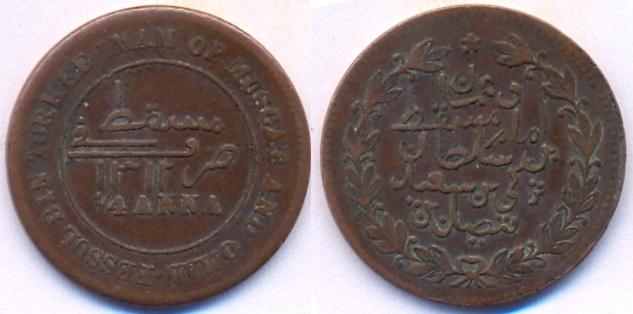
 |
KM#6 Quarter Anna.
Year: AH1312 [1895].
Weight: 6.32 g.
Metal: Copper.
Diameter: 26.20 mm. Edge:
Plain. Alignment:
Medal. Mint:
Muscat. Obverse
Legends clockwise from dot at 6 O' clock in English from the bottom:
"Fessul Bin Turkee Imam of Muscat and Oman" written in outer circle.
"ضرب في مسقط" (Struck at Muscat) written in center circle with Value "¼
Anna" and Date "١٣١٢". |
|
Reverse legends in Arabic from bottom to top:
"فيصل بن تركي بن سعيد بن سلطان، الإمام مسقط وعمان"
(Faisal bin Turki
bin Sa'id bin Sultan, Imam Muscat and Oman) written in center within
wreath around and star at the top.
Mintage:
N/A. Mintage Years: AH
1312-1313.
Note: This coin is referred as
SC-10 starting with dot at H+30 with inner
circle. Flat "1" from the top in "1/4 Anna". Five line Arabic legend
within wreath on the reverse with Star at the top. The last two digits
in Date are smaller in size. |
|
 |
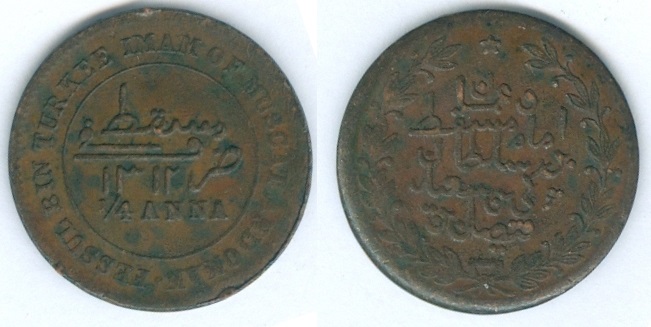
Same as above coin, but...
Weight:
6.42 g.
Diameter: 25.50 mm. Note:
Date digits are of equal length. Tilted "1" from the top in "1/4 Anna".
Having visible small edge denticles on reverse side. On the Reverse
side, the two dots at the lower left side above "Bin" and two dot dots
at the lower right side in "Turki" are tilted while in the above coin
they are straight. |
|
 |
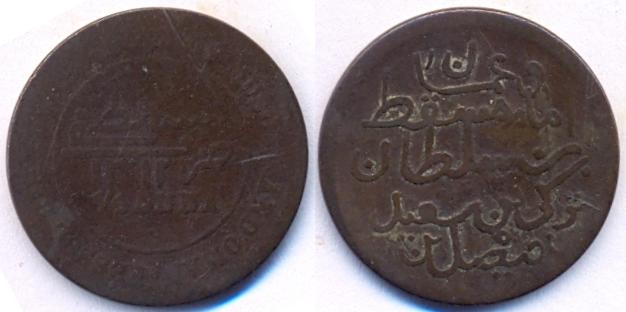
Same as above coin, but having minor difference on Reverse side.
Weight:
6.78 g.
Diameter: 25.00 mm.
01. The position of two dots of Muscat are shifted right and
touching the above word.
02. The two dot at the bottom right side are straight while in
the above coin they are titled. |
|
 |
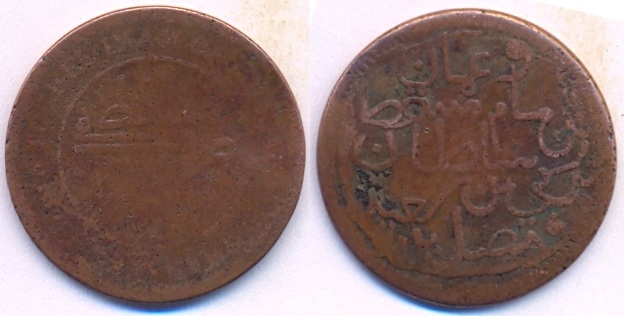
KM#8.1 Quarter Anna.
Year: AH1312 [1895].
Weight: 5.96 g.
Metal: Copper.
Diameter: 25.30 mm. Edge:
Plain. Alignment:
Medal. Mint:
Muscat. Obverse
Legends clockwise in English:
"ضرب في مسقط" (Struck at Muscat) written in center circle with Value "¼
ANNA" and Date "١٣١٢". "Fessul Bin Turkee Imam of Muscat and Oman"
written in outer circle. |
|
Reverse legends in Arabic from bottom to top:
"فيصل بن تركي بن سعيد بن سلطان، الإمام مسقط وعمان"
(Faisal bin Turki
bin Sa'id bin Sultan, Imam Muscat and Oman).
Mintage:
N/A. Mintage Years: One year type.
Note: This coin is referred as
SC-11 H+30 with inner circle.
Five line Arabic legend without wreath and star. "ن" in Oman is at the top on the
reverse side of the coin. |
|
 |
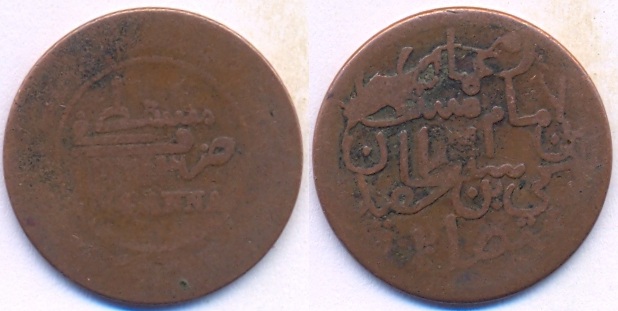
Quarter Anna.
Year: AH1312 [1895].
Weight: 5.96 g.
Metal: Copper.
Diameter: 25.50 mm. Edge:
Plain. Alignment:
Medal. Mint:
Muscat. Obverse
Legends clockwise from dot at 6 O' clock in English:
"ضرب في مسقط" (Struck at Muscat) written in center circle with Value "¼
ANNA" and Date "١٣١٢". "Fessul Bin Turkee Imam of Muscat and Oman"
written in outer circle. |
|
Reverse legends in Arabic from bottom to top:
"فيصل بن تركي بن سعيد بن سلطان، الإمام مسقط وعمان"
(Faisal bin Turki
bin Sa'id bin Sultan, Imam Muscat and Oman).
Mintage:
N/A. Mintage Years: One year type.
Note: This coin is referred as
SC-12 having H+30 with inner circle.
Five line Arabic legend without wreath and star. "ن" in Oman is at the
top left side on the reverse side of the coin. It has plain or small edge denticles. |
|
 |
Same as above coin, but...
Diameter: 25.50 mm. Weight:
5.33 g. Note:
Plain border on reverse side with different formation of legend size/thickness
and position of Arabic characters. This coin is also referred as
SC-12. |
|
 |
KM#8.2 Quarter Anna.
Year: AH1312 [1895].
Weight: 7.05 g.
Metal: Copper.
Diameter: 25.50 mm. Edge:
Plain. Alignment:
Medal. Mint:
Muscat. Obverse
Legends clockwise from dot at 6 O' clock in English:
"ضرب في مسقط" (Struck at Muscat) written in center circle with Value "¼
ANNA" and Date "١٣١٢". "Fessul Bin Turkee Imam of Muscat and Oman"
written in outer circle. This coin has different formation of
legend size and position of Arabic characters than the above coin. |
|
Reverse legends in Arabic from bottom to top:
"فيصل بن تركي بن سعيد بن سلطان، الإمام مسقط وعمان"
(Faisal bin Turki
bin Sa'id bin Sultan, Imam Muscat and Oman).
Mintage:
N/A. Mintage Years: One year type.
Note: This coin is referred as
SC-13 having H+30 with inner
circle. Five line Arabic legend without wreath and star. "ن" in Oman is at the top left side
on the reverse side of the coin. It has long edge denticles. |
|
 |
Same as above coin, but...
Diameter: 26.00 mm. Weight:
6.14 g. Note:
Long edge denticles on reverse side with different/wide formation of legend size/thickness
and gaps in position of Arabic characters. |
|
|
|
|
AH 1313 [1896] |
|
|
|
 |
KM#6 Quarter Anna.
Year: AH1313 [1896].
Weight: 6.31 g.
Metal: Copper.
Diameter: 25.50 mm. Edge:
Plain. Alignment:
Medal. Mint:
Muscat. Obverse
Legends clockwise from dot at 6 O' clock in English:
"ضرب في مسقط" (Struck at Muscat) written in center circle with Value "¼
ANNA" and Date "١٣١٣". "Fessul Bin Turkee Imam of Muscat and Oman"
written in outer circle. |
|
Reverse legends in Arabic from bottom to top:
"فيصل بن تركي بن سعيد بن سلطان، الإمام مسقط وعمان"
(Faisal bin Turki
bin Sa'id bin Sultan, Imam Muscat and Oman).
Mintage:
N/A. Mintage Years: AH
1312-1313.
Note: This coin is referred as
SC-17 H+30 starting with Dot and
having Solid inner circle. Equal thickness bars above Date. Five line Arabic legend with wreath and star
at the top. "ن" in Oman
at the top. |
|
 |
Same as above coin, but...
Diameter: 25.50 mm. Weight:
5.65 g. Note:
Thin bar with pointed end at the left, above Date. Thinner legends of
five lines on Reverse side than above coin. |
|
 |
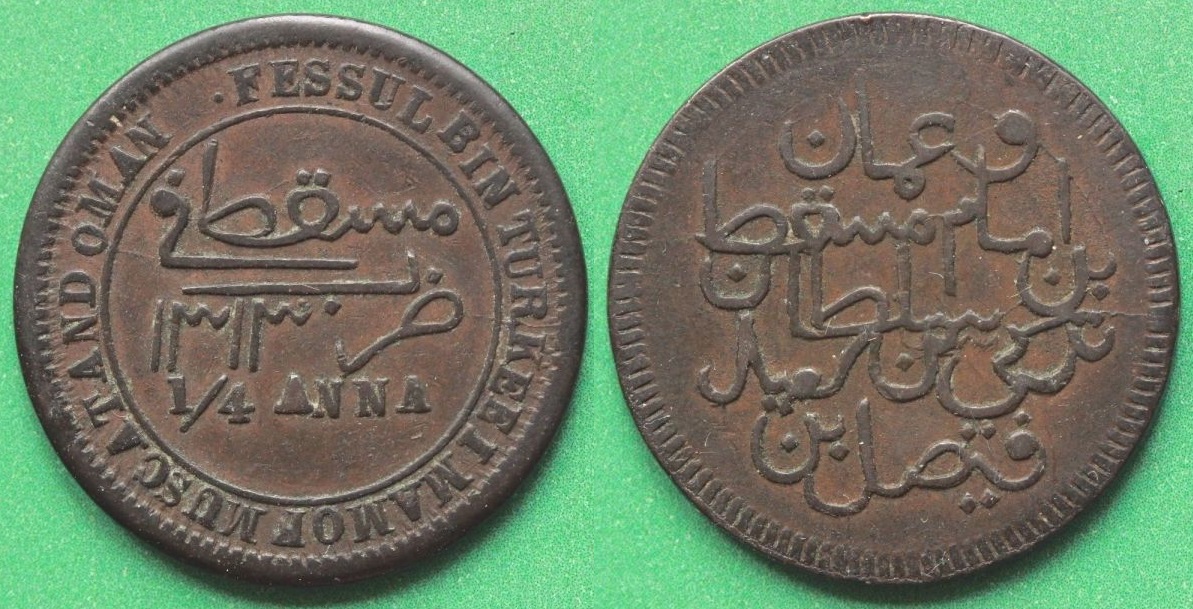
Quarter Anna.
Year: AH1313 [1896].
Weight: 6.31 g.
Metal: Copper.
Diameter: 25.50 mm. Edge:
Plain. Alignment:
Medal. Mint:
Muscat. Obverse
Legends clockwise from dot at 6 O' clock in English:
"ضرب في مسقط" (Struck at Muscat) written in center circle with Value "¼
ANNA" and Date "١٣١٣". "Fessul Bin Turkee Imam of Muscat and Oman"
written in outer circle. |
|
Reverse legends in Arabic from bottom to top:
"فيصل بن تركي بن سعيد بن سلطان، الإمام مسقط وعمان"
(Faisal bin Turki
bin Sa'id bin Sultan, Imam Muscat and Oman).
Mintage:
N/A. Mintage Years: One year type.
Note: This coin is referred as
SC-18 H+30 starting with Dot and
having Solid inner circle. Five line Arabic legend with no wreath and no
star. "ن" in Oman at the right. |
|
 |
KM#9.1 Quarter Anna.
Year: AH1313 [1896].
Weight: 6.97 g.
Metal: Copper.
Diameter: 25.50 mm. Edge:
Plain. Alignment:
Rotated. Mint:
Muscat. Obverse
Legends clockwise from dot in English:
"ضرب في مسقط" (Struck at Muscat) written in center circle with Value "¼
ANNA" and Date "١٣١٣". "Fessul Bin Turkee Imam of Muscat and Oman"
written in outer circle. |
|
Reverse legends in Arabic from bottom to top:
"فيصل بن تركي بن سعيد بن سلطان، الإمام مسقط وعمان"
(Faisal bin Turki
bin Sa'id bin Sultan, Imam Muscat and Oman).
Mintage:
N/A. Mintage Years: One year type.
Note: This coin is referred as
SC-20 H+55 starting with Dot and
having thin inner circle. Dot to the right of second "3" in date.
Five line Arabic legend without wreath and star. "ن" in Oman
to the left. Long to medium edge denticles on the reverse side of the
coin. |
|
 |
Quarter Anna.
Year: AH1313 [1896].
Weight: 5.51 g.
Metal: Copper.
Diameter: 25.50 mm. Edge:
Plain. Alignment:
Medal. Mint:
Muscat. Obverse
Legends clockwise in English:
"ضرب في مسقط" (Struck at Muscat) written in center circle with Value "¼
ANNA" and Date "١٣١٣". "Fessul Bin Turkee Imam of Muscat and Oman"
written in outer circle. |
|
Reverse legends in Arabic from bottom to top:
"فيصل بن تركي بن سعيد بن سلطان، الإمام مسقط وعمان"
(Faisal bin Turki
bin Sa'id bin Sultan, Imam Muscat and Oman).
Mintage:
N/A. Mintage Years: One year type.
Note: This coin is referred as
SC-22 H+58 starting with No Dot and
having thin inner circle. Dot to the right of second "3" in date.
Five line Arabic legend without wreath and star. "ن" in Oman
to the left. Long edge denticles on the reverse side of the
coin. SC-23 is same as SC-22 except, it has no reverse denticles. |
|
 |
KM#9.2 Quarter Anna.
Year: AH1313 [1896].
Weight: 6.95 g.
Metal: Copper.
Diameter: 25.50 mm. Edge:
Plain. Alignment:
Medal. Mint:
Muscat. Obverse
Legends clockwise in English:
"ضرب في مسقط" (Struck at Muscat) written in center circle with Value "¼
ANNA" and Date "١٣١٣". "Fessul Bin Turkee Imam of Muscat and Oman"
written in outer circle. |
|
Reverse legends in Arabic from bottom to top:
"فيصل بن تركي بن سعيد بن سلطان، الإمام مسقط وعمان"
(Faisal bin Turki
bin Sa'id bin Sultan, Imam Muscat and Oman).
Mintage:
N/A. Mintage Years: One year type.
Note: This coin is referred as
SC-24 H+00 starting with No Dot and
having inner circle. Dot above second "3" in date.
Long edge denticles. Five line Arabic legend without wreath and star. "ن" in Oman
to the left. Long edge denticles on the reverse side of the coin as
well. The word "امام" is
touching "سلطان". |
|
 |
Quarter Anna.
Year: AH1313 [1896].
Weight: 6.07 g.
Metal: Copper.
Diameter: 25.00 mm. Edge:
Plain. Alignment:
Medal. Mint:
Muscat. Obverse
Legends clockwise in English:
"ضرب في مسقط" (Struck at Muscat) written in center circle with Value "¼
ANNA" and Date "١٣١٣". "Fessul Bin Turkie Imam of Muscat and Oman"
written in outer circle. |
|
Reverse legends in Arabic from bottom to top:
"فيصل بن تركي بن سعيد بن سلطان، الإمام مسقط وعمان"
(Faisal bin Turki
bin Sa'id bin Sultan, Imam Muscat and Oman).
Mintage:
N/A. Mintage Years: One year type.
Note: This coin is referred as
SC-26 H+55 starting with No Dot and
having solid inner circle. No Dot above or on right of second "3" in date.
Date touching the Value.
TURKEE is written as TURKIE. Long edge
denticles. Five line Arabic legend without wreath and star. Small "ن" in Oman
to the left. Medium edge denticles on the reverse side. |
|
|
|
|
AH 1314 [1897] |
|
|
|
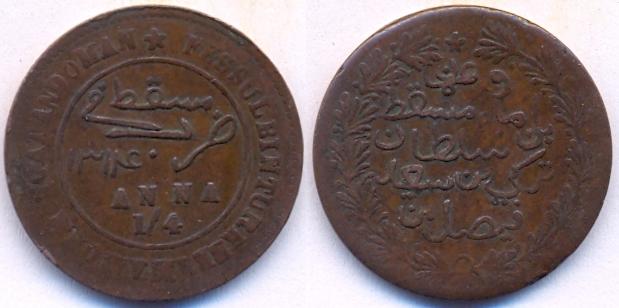 |
KM#10.1 Quarter Anna.
Year: AH1314 [1897].
Weight: 6.60 g.
Metal: Copper.
Diameter: 25.50 mm. Edge:
Plain. Alignment:
Medal. Mint:
Muscat. Obverse
Legends:
"Fessul Bin Turkee Imam of Muscat and Oman" written in outer circle.
"ضرب في مسقط" (Struck at Muscat) written in center circle with Value "¼
Anna" and Date "١٣١۴" (with
Persian "4" in date). |
|
Reverse legends in Arabic from bottom to top:
"فيصل بن تركي بن سعيد بن سلطان، الإمام مسقط وعمان"
(Faisal bin Turki
bin Sa'id bin Sultan, Imam Muscat and Oman).
Mintage:
N/A. Mintage Years: One year type.
Note: This coin is having H+00 starting with Star with solid inner
circle. Dot at the above right side of "4" in date. "ANNA" written above
"¼" with small Date. Five line Arabic legend within wreath on the reverse with Star at
the top. Star close of the ends of the wreath. "ن" in Oman at the right
side. |
|
 |
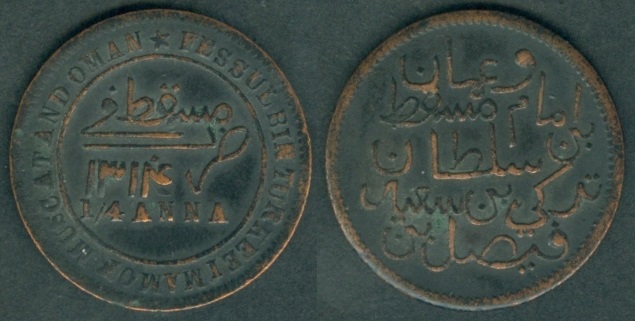
KM#10.2 Quarter Anna.
Year: AH1314 [1897].
Weight: 6.22 g.
Metal: Copper.
Diameter: 25.50 mm. Edge:
Plain. Alignment:
Medal. Mint:
Muscat. Obverse
Legends:
"Fessul Bin Turkee Imam of Muscat and Oman" written in outer circle.
"ضرب في مسقط" (Struck at Muscat) written in center circle with Value "¼
Anna" and Date "١٣١۴" (with
Persian "4" in date). |
|
Reverse legends in Arabic from bottom to top:
"فيصل بن تركي بن سعيد بن سلطان، الإمام مسقط وعمان"
(Faisal bin Turki
bin Sa'id bin Sultan, Imam Muscat and Oman).
Mintage:
N/A. Mintage Years: One year type.
Note: This coin is referred as
SC-30 having H+00 starting with Star with solid inner
circle. Dot above "4" in Date. Five line Arabic legend within wreath on the reverse with Star at
the top. Star far from the ends of the wreath. "ن" in Oman at the
right side. |
|
 |
KM#11.1 Quarter Anna.
Year: AH1314 [1897].
Weight: 5.99 g.
Metal: Copper.
Diameter: 25.50 mm. Edge:
Plain. Alignment:
Medal. Mint:
Muscat. Obverse
Legends clockwise from star at 12 O'clock in English at the top:
"Fessul Bin Turkee Imam of Muscat and Oman" written in outer circle.
"ضرب في مسقط" (Struck at Muscat) written in center circle with Value "¼
Anna" and Date "١٣١۴" (with
Persian "4" with extra stroke in date). |
|
Reverse legends in Arabic from bottom to top:
"فيصل بن تركي بن سعيد بن سلطان، الإمام مسقط وعمان"
(Faisal bin Turki
bin Sa'id bin Sultan, Imam Muscat and Oman).
Mintage:
N/A. Mintage Years: One year type.
Note: This coin is referred as
SC-35 having H+00 starting with Star
with solid inner circle. Dot above "4" in date and having uncertain dash
above first "N" in ANNA. Five line Arabic legend without wreath and
Star. The first Arabic word in line four is jagged. "ن" in Oman at the
left side. |
|
 |
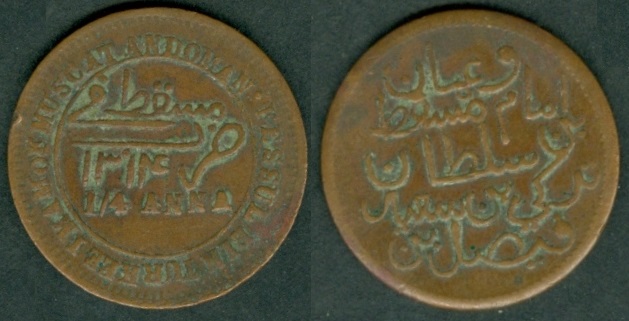
Same as above coin KM#11.1, but having thick legends on
both sides. Secondly the color of the coin is brown.
Weight: 6.25 g.
Diameter: 25.30 mm. Alignment:
Medal. |
|
 |
Type2: Thick Date
and thicker legends within the inner circle on Obverse side. On the
Reverse side, the placement / position of the Arabic characters differ
from above coin.
Weight: 6.41 g.
Diameter: 25.30 mm. |
|
 |
KM#11.2 Quarter Anna.
Year: AH1314 [1897].
Weight: 5.92 g.
Metal: Copper.
Diameter: 25.40 mm. Edge:
Plain. Alignment:
Medal. Mint:
Muscat. Obverse
Legends clockwise from 2 O'clock in English:
"Fessul Bin Turkee Imam of Muscat and Oman" written in outer circle.
"ضرب في مسقط" (Struck at Muscat) written in center circle with Value "¼
Anna" and Date "١٣١۴" (with
Persian "4" in date). |
|
Reverse legends in Arabic from bottom to top:
"فيصل بن تركي بن سعيد بن سلطان، الإمام مسقط وعمان"
(Faisal bin Turki
bin Sa'id bin Sultan, Imam Muscat and Oman).
Mintage:
N/A. Mintage Years: One year type.
Note: This coin is referred as
SC-36 having H+10 starting with dot
with solid inner circle. Dot at above position between digit "3" and "1"
in Date. Five line Arabic legend without wreath and star. "ن" in Oman at
the left side. |
|
 |
KM#11.3 Quarter Anna.
Year: AH1314 [1897].
Weight: 6.39 g.
Metal: Copper.
Diameter: 25.40 mm. Edge:
Plain. Alignment:
Medal. Mint:
Muscat. Obverse
Legends clockwise from 2 O'clock in English:
"Fessul Bin Turkee Imam of Muscat and Oman" written in outer circle.
"ضرب في مسقط" (Struck at Muscat) written in center circle with Value "¼
Anna" and Date "١٣١۴" (with
Persian "4" in date). |
|
Reverse legends in Arabic from bottom to top:
"فيصل بن تركي بن سعيد بن سلطان، الإمام مسقط وعمان"
(Faisal bin Turki
bin Sa'id bin Sultan, Imam Muscat and Oman).
Mintage:
N/A. Mintage Years: One year type.
Note: This coin is referred as
SC-37 having H+10 starting with dot
with solid inner circle. Dot at above position between digit "3" and "1"
in Date. Five line Arabic legend without wreath and
star. The first Arabic word in line four is smoother (missing/washed).
"ن" in Oman at the left side. Incomplete "م"
tail in "امام" (First
word from the right side in second row) and slanting line instead of three
waves in "سعيد" (Last word on the left side in
fourth row). |
|
 |
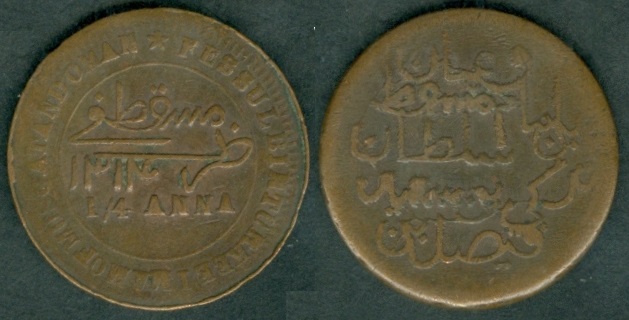
Same as above coin, but slightly rotated from reverse
side as shown.
Diameter: 25.5 mm. Weight:
6.58 g. |
|
 |
Quarter Anna.
Year: AH1314 [1897].
Weight: 6.68 g.
Metal: Copper.
Diameter: 25.50 mm. Edge:
Plain. Alignment:
Medal. Mint:
Muscat. Obverse
Legends clockwise from 12 O'clock in English at the top:
"Fessul Bin Turkee Imam of Muscat and Oman" written in outer circle.
"ضرب في مسقط" (Struck at Muscat) written in center circle with Value "¼
Anna" and Date "١٣١۴" (with
Persian "4" in date).
Note: Date and legends touching/overlapping
each other within the center circle. |
|
Reverse legends in Arabic from bottom to top:
"فيصل بن تركي بن سعيد بن سلطان، الإمام مسقط وعمان"
(Faisal bin Turki
bin Sa'id bin Sultan, Imam Muscat and Oman).
Mintage:
N/A. Mintage Years: One year type.
Note: H+00 starting with Star
with inner circle. Date and legends touching/overlapping each other
within the center circle. Five line Arabic legend without wreath and
no Star. Words touching/overlapping each other. |
|
|
|
|
AH 1315 [1898] |
|
|
|
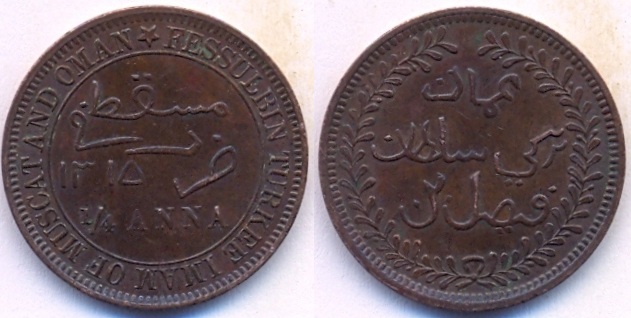 |
KM#3.1 Quarter Anna.
Year: AH1315 [1898].
Weight: 5.60 g.
Metal: Copper.
Diameter: 26.30 mm. Edge:
Plain. Alignment:
Medal. Mint:
Ralph Heaton & Sons, Birmingham.
Obverse Legends clockwise from star in English:
"ضرب في مسقط" (Struck at Muscat) written in center circle with Value "¼
ANNA" and Date "١٣١٥". "Fessul Bin Turkee Imam of Muscat and Oman"
written in outer circle. Star at the top. |
|
Reverse legends in Arabic from bottom to top:
"فيصل بن تركي، سلطان عمان" (Faisal bin
Turki, Sultan of Oman) written in center within wreath around.
Mintage:
N/A. Mintage Years:
One year type.
Note: No Star between wreath points on reverse side. This coin is referred as
SC-61
having Symmetrical or triangle type thin "5" in date.
Thinner date. This Heaton mint coin exists in Copper and Brass. |
|
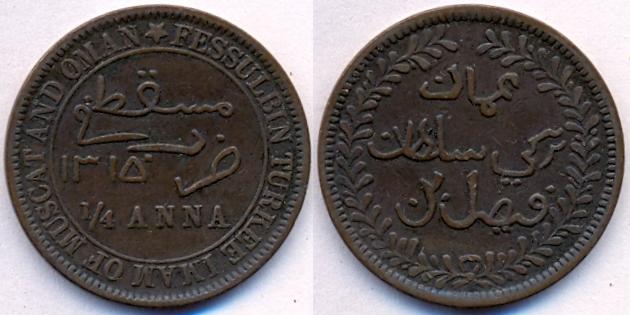 |
Same as above coin, but
dark in color with thick legends on the observe side. Thick date.
Weight: 5.32 g. |
|
 |
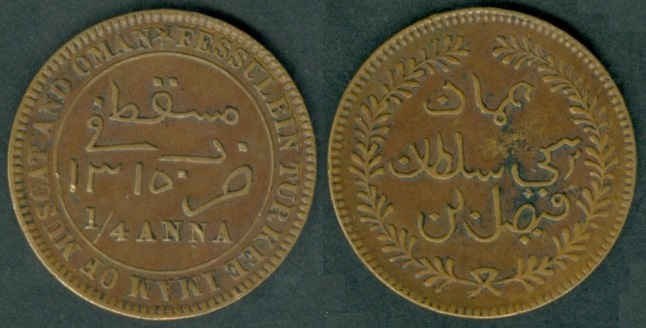
KM#3.2 Quarter Anna.
Year: AH1315 [1898].
Weight: 5.69 g.
Metal: Copper.
Diameter: 26.30 mm. Edge:
Plain. Alignment:
Medal. Mint:
probably at Bombay, India.
Obverse Legends clockwise from star in English:
"ضرب في مسقط" (Struck at Muscat) written in center circle with Value "¼
ANNA" and Date "١٣١٥". "Fessul Bin Turkee Imam of Muscat and Oman"
written in outer circle. Star at the top. |
|
Reverse legends in Arabic from bottom to top:
"فيصل بن تركي، سلطان عمان" (Faisal bin
Turki, Sultan of Oman) written in center within wreath around.
Mintage:
N/A. Mintage Years:
One year type.
Note: This type is known as crude
issue with many die varieties. This coin is referred as
SC-62c
having an angled "5" in date and has
squares instead of dots in both sides of Arabic legends. It has the
curve exactly above the second "N" in "ANNA". The
"ن" in Oman is aligned with the third leaf of the wreath on the left
side.
Note:
Scott Cordry have recorded 7 obverse dies for angled "5"
in date types. |
|
 |
Same as above coin with thinner Arabic legends. It is Reddish in color.
Weight: 5.74 g. |
|
 |
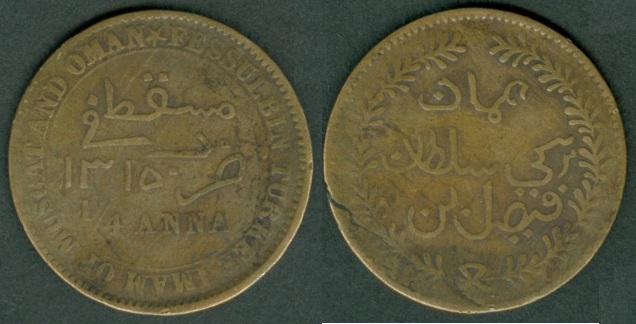
Quarter Anna.
Year: AH1315 [1898].
Weight: 5.71 g.
Metal: Brass.
Diameter: 26.00 mm. Edge:
Plain. Alignment:
Medal. Mint:
probably at Bombay, India.
Obverse Legends clockwise from star in English:
"ضرب في مسقط" (Struck at Muscat) written in center circle with Value "¼
ANNA" and Date "١٣١٥". "Fessul Bin Turkee Imam of Muscat and Oman"
written in outer circle. Star at the top. |
|
Reverse legends in Arabic from bottom to top:
"فيصل بن تركي، سلطان عمان" (Faisal bin
Turki, Sultan of Oman) written in center within wreath around.
Mintage:
N/A. Mintage Years:
One year type.
Type2: It also having an angled "5" in date and has
squares instead of dots in both sides of Arabic legends. It has the
curve exactly between the two "N"s in "ANNA", which makes it different
from above coin. Secondly the "ن" in Oman is aligned with the fourth
leaf of the wreath on the left side. Third it is
slightly smaller in diameter than the above coin. |
|
 |
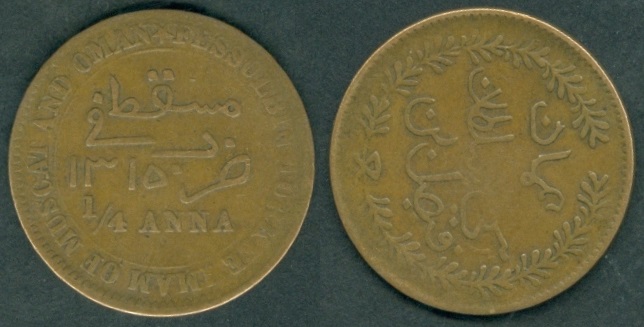
Same as above coin but having probably a die crack at the Reverse side
of the coin at left bottom.
Weight: 4.99 g. |
|
 |
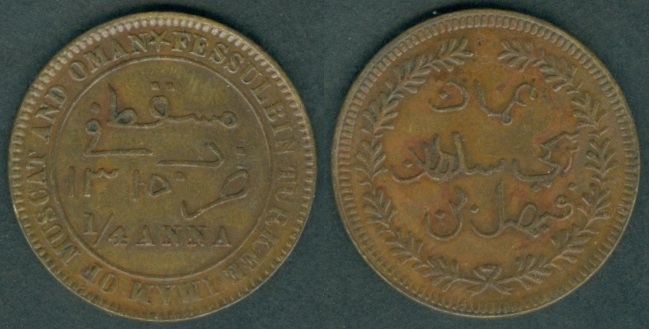
Same as above coin but rotated on reverse side as seen.
It is Light Brown in color.
Weight: 5.38 g. |
|
 |
 |
|
Quarter Anna.
Year: AH1315 [1898].
Weight: 5.66 g.
Metal: Copper.
Diameter: 26.00 mm. Alignment:
Medal; slightly rotated.
Type3: This coin have Obverse side as of above coin with angled 5 in
Date. Squares instead of dots in both sides of Arabic legends. It has
the curve exactly between the two "N"s in "ANNA".
The diameter of the coin is also same as above coin. The Reverse side
is however same as below coin (KM#3.3) with tilted dots in
Arabic word Turki as shown in above image. The "ن" in Oman is aligned
with the fourth leaf of the wreath on the left side. |
|
 |
KM#3.3 Quarter Anna.
Year: AH1315 [1898].
Weight: 5.18 g.
Metal: Copper.
Diameter: 25.00 mm. Edge:
Plain. Alignment:
Medal. Mint:
N/A.
Obverse Legends clockwise from star in English:
"ضرب في مسقط" (Struck at Muscat) written in center circle with Value "¼
ANNA" and Date "١٣١٥". "Fessul Bin Turkee Imam of Muscat and Oman"
written in outer circle. Star at the top. |
|
Reverse legends in Arabic from bottom to top:
"فيصل بن تركي، سلطان عمان" (Faisal bin
Turki, Sultan of Oman) written in center within wreath around.
Mintage:
N/A. Mintage Years:
One year type.
Note: This coin is referred as SC-62b
H+00 starting with star with solid inner circle. Arabic style "5"
in date having Thicker
right side line. It has the curve exactly between the two "N"s in
"ANNA". The "ن" in Oman is aligned with fourth leaf of the
wreath on the left side. Three line Arabic legend with wreath but no star. Seven
bunches on each sides of wreath. The knot at the bottom is not connected
to the bottom left side leaf bunch. Note:
Scott Cordry have recorded 12 obverse dies for almost
Arabic style "5" in date types. |
|
 |
Same as above coin, but perhaps in Brass metal and
also rotated as shown.
Weight: 5.48 g. |
|
 |
Same as above coin, but perhaps in Bronze-Brass metal and
also rotated as shown. It has thick legends within circle on Obverse
side than above coin. Weight:
5.22 g. |
|
 |
Same as above coin, but rotated as shown.
Reddish in color and has thin legends within circle on Obverse side.
Diameter: 25.80 mm.
Weight: 5.57 g. |
|
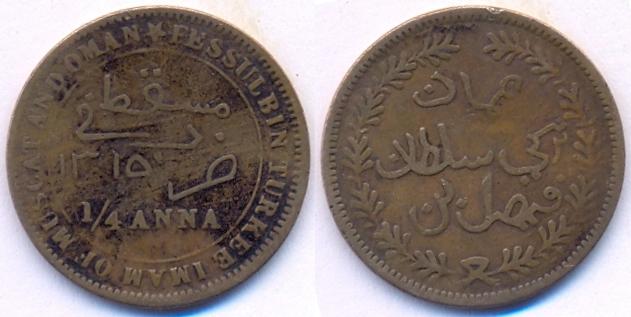 |
Same as above coin, but...
01. has thinner legends on observe side within circle.
02. both dots on Reverse side in Arabic legend of word "Faisal" are touching.
03. The digit "5" in date looks more like a triangle.
04. The Obverse side is slightly off-flan. Weight: 5.53 g. |
|
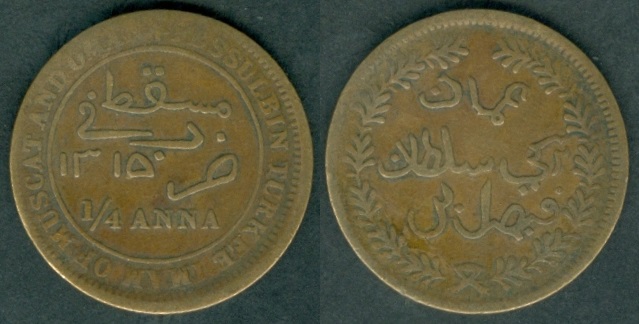 |
Thick legend on Obverse side and slightly
off-flan. Weight: 5.31 g. |
|
 |
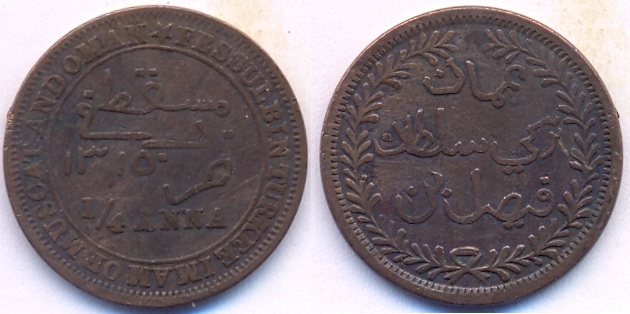
Very thick legends on both sides. Reverse
side is rotated as shown.
Weight:
5.22 g.
Diameter: 25.50 mm. |
|
 |
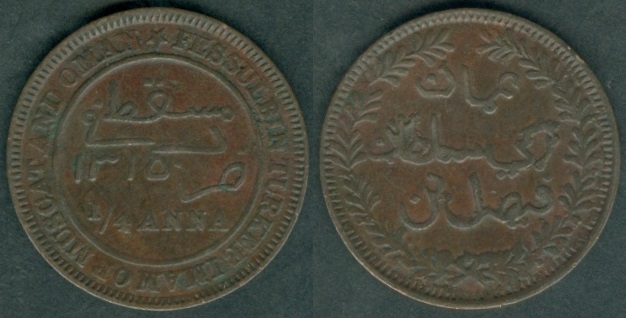
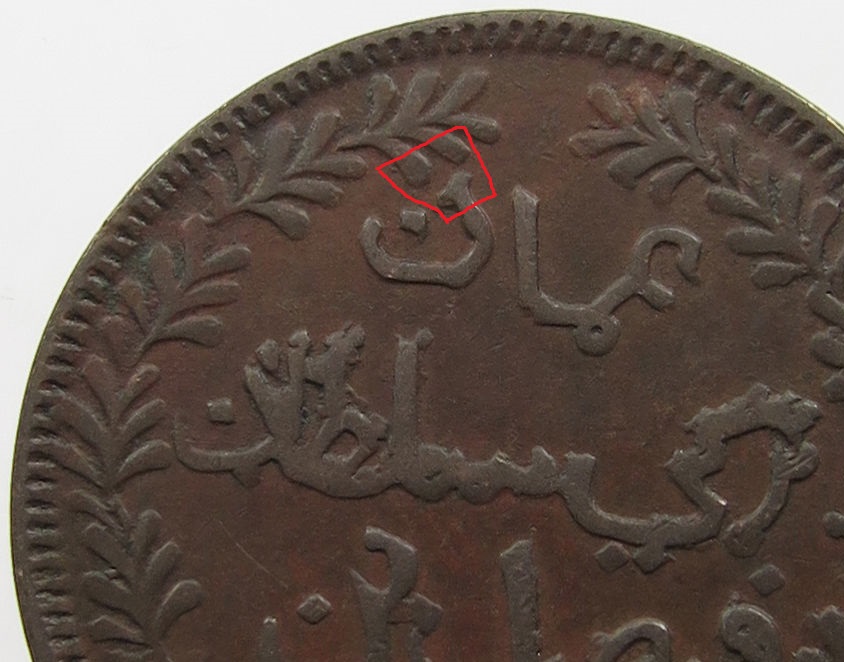
Quarter Anna.
Year: AH1315 [1898].
Weight: 6.62 g.
Metal: Copper.
Diameter: 25.50 mm. Edge:
Plain. Alignment:
Medal. Mint:
probably at Calcutta, India.
Obverse Legends clockwise from star in English:
"ضرب في مسقط" (Struck at Muscat) written in center circle with Value "¼
ANNA" and Date "١٣١٥". "Fessul Bin Turkee Imam of Muscat and Oman"
written in outer circle. Star at the top. |
|
Reverse legends in Arabic from bottom to top:
"فيصل بن تركي، سلطان عمان" (Faisal bin
Turki, Sultan of Oman) written in center within wreath around.
Mintage:
N/A. Mintage Years:
One year type.
Type1: This coin is referred as
SC-62a
having an symmetrical but more rounded "5" in date. It has
the curve exactly above first "N" in "ANNA". It has
squares instead of dots in both sides of Arabic legends. Seven bunches
on each sides of wreath. The "ن" in Oman is aligned with the second leaf
of the wreath on the left side. Note:
Scott Cordry have recorded 12 obverse dies for symmetrical
but more rounded "5" in date types. |
|
 |
 |
|
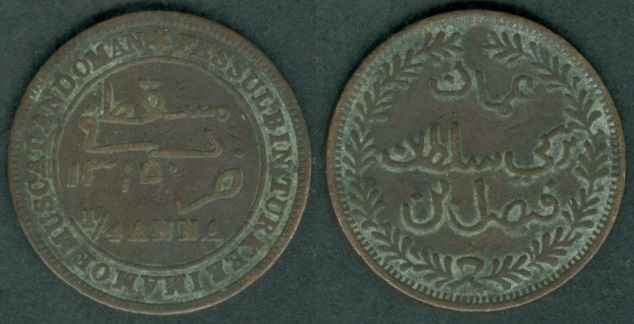
Type2: It has the curve exactly
between the two "N"s in "ANNA". Normal size of digits
in
Date. The "ن" in Oman is aligned between the second and
third leaf of the wreath on the left side. The lower
part of the Reverse side seems to be double strike creating
overlapping characters in the middle and bottom lines and
also creating extra leaves. Weight:
5.71 g. |
|
 |
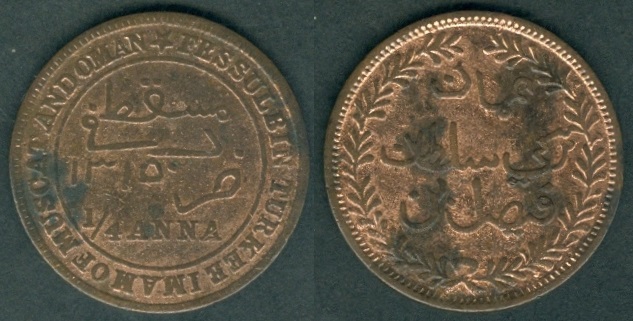
Type3:
It has the curve exactly above second "N" in "ANNA". In
Date, Digit "3" is elongated on right side. Digit "1"
between "3" and "5" is taller. The "ن" in Oman is aligned between the second leaf of the wreath on
the left side. Weight: 6.43 g. |
|
 |
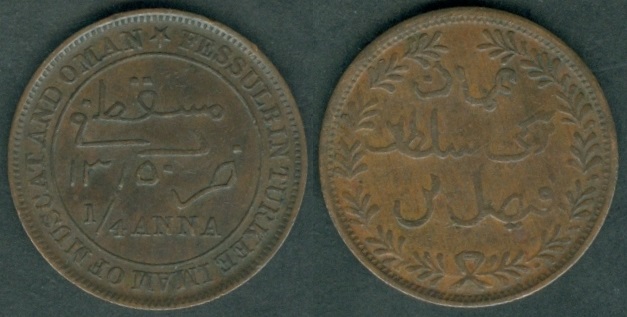
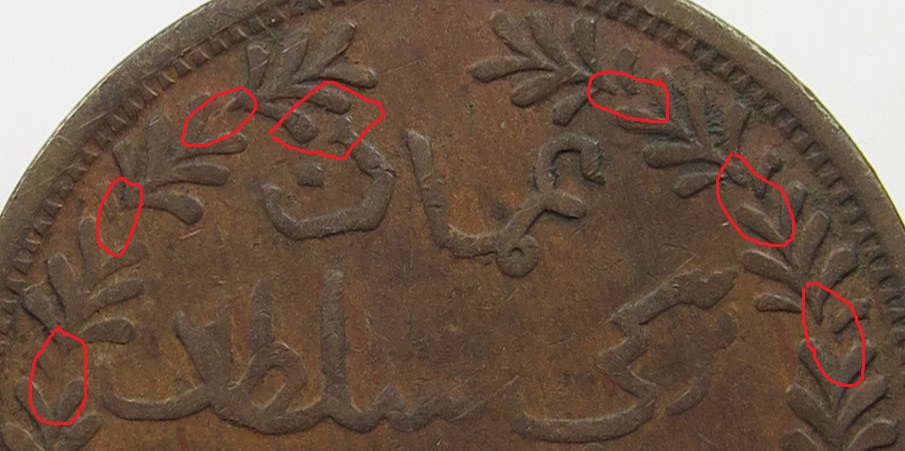
Same as above type3 but having some thick leaves. Brown in color. Weight: 6.30 g. |
|
 |
 |
|
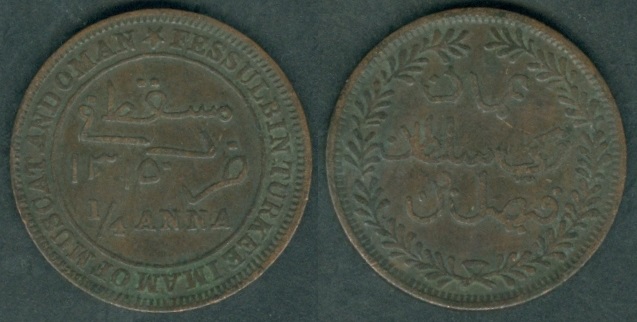
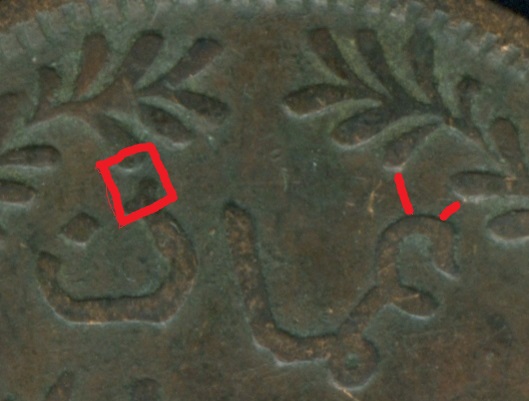
Type4: It has the curve exactly
above the second "N" in "ANNA". Digit "1" between "3"
and "5" in Date is much titled. The "ن" in Oman is aligned
between the second and third third leaf of the wreath on the
left side. There is no center stem on both sides of the
wreath connecting the leaves together, creating gap between
them. Weight:
5.87 g. |
|
 |
 |
|
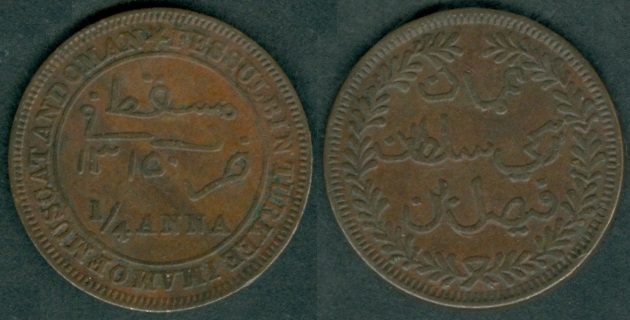
Type5: It has the curve exactly
above the second "N" in "ANNA". Digit "1" between "3"
and "5" in Date is much titled. The "ن" in Oman is aligned
between the third third leaf of the wreath on the
left side. Weight:
6.40 g. |
|
 |
 |
|
Type6: It has the curve exactly above second "N" but a bit far from
"ANNA". In Date, Digit "3" is normal. Digit "1" between "3"
and "5" is taller. The "ن" in Oman is aligned
and very close with the third
leaf of the wreath on the left side. Weight: 6.36 g. |
|
 |
Quarter Anna.
Year: AH1315 [1898].
Weight: 6.48 g.
Metal: Copper.
Diameter: 25.00 mm. Edge:
Plain. Alignment:
Medal. Mint:
probably at Calcutta, India.
Obverse Legends clockwise from star in English:
"ضرب في مسقط" (Struck at Muscat) written in center circle with Value "¼
ANNA" and Date "١٣١٥". "Fessul Bin Turkee Imam of Muscat and Oman"
written in outer circle. Star at the top. |
|
Reverse legends in Arabic from bottom to top:
"فيصل بن تركي، سلطان عمان" (Faisal bin
Turki, Sultan of Oman) written in center within wreath around.
Mintage:
N/A. Mintage Years:
One year type. Note:
Crude style. This coin is referred as
SC-41
having an angled "5" but more rounded in date. It has the curve
exactly above second "N" in "ANNA". It has
squares instead of dots in both sides of Arabic legends. Eight bunches
on the left side and Seven bunches
on right sides of wreath. |
|
 |
Quarter Anna.
Year: AH1315 [1898].
Weight: 5.45 g.
Metal: Copper.
Diameter: 24.80 mm. Edge:
Plain. Alignment:
Medal. Mint:
N/A. Obverse Legends
clockwise from 6 O'clock in English:
"ضرب في مسقط" (Struck at Muscat) written in center circle with Value "¼
ANNA" and Date "١٣١٥". "Fessul Bin Turkee Imam of Muscat and Oman"
written in outer circle. |
|
Reverse legends in Arabic from bottom to top:
"فيصل بن تركي، سلطان عمان" (Faisal bin
Turki, Sultan of Oman) written in center within wreath around.
Mintage:
N/A. Mintage Years:
One year type.
Note: Dot
at above position between 1 and 5 in the date. The digit "5" is
oval having a different
style. "Zarb" (Mint) written close to circle on the right side. Star at the top on
reverse sides. "ن" in Sultan at the left
side. Number of bunches 6 on each side. Not listed style in Krause
publication. |
|
 |
Same as above coin, but in Brass metal. It
has tilted "1" in date and the word "سلطان"
(Sultan) has some difference in style and position of the last character
"ن" in Sultan is at the left side downwards.
Diameter: 25.00 mm.
Weight: 5.28 g. |
|
 |
Quarter Anna.
Year: AH1315 [1898].
Weight: 5.51 g.
Metal: Copper.
Diameter: 25.50 mm. Edge:
Plain. Alignment:
Medal. Mint:
N/A. Obverse Legends
clockwise from star in English:
"ضرب في مسقط" (Struck at Muscat) written in center circle with
Value "¼ ANNA" and Date "١٣١٥". "Fessul Bin Turkee Imam of Muscat and
Oman" written in outer circle. Star at the top. |
|
Reverse legends in Arabic from bottom to top:
"فيصل بن تركي، سلطان عمان"
(Faisal bin Turki, Sultan of Oman) written in center within
wreath around.
Mintage:
N/A. Mintage Years:
One year type.
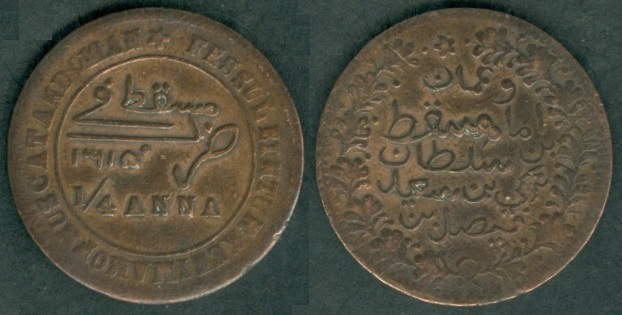
Note: This coin is referred as SC-39
having H+00 starting with star with solid inner circle. Persian
"5" in the date. Three line Arabic
legend with wreath. No star at the top. Shaddah (small w) above "س"
in Sultan is missing. Number of bunches 6 on each side. "ن" in
Sultan at the left side. Not listed style in Krause publication. |
|
 |
Same as above coin, but in Bronze metal.
01. It has word "ANNA" decreasing in size from left to right.
02. The "ن" in Sultan at the left side is larger than the
above coin.
Diameter: 25.50 mm.
Weight: 6.25 g. |
|
 |
Quarter Anna.
Year: AH1315 [1898].
Weight: 7.00 g.
Metal: Copper.
Diameter: 24.85 mm. Edge:
Plain. Alignment:
Medal. Mint:
N/A. Obverse Legends
clockwise from star in English:
"ضرب في مسقط" (Struck at Muscat) written in center circle with
Value "¼ ANNA" and Date "١٣١٥". "Fessul Bin Turkee Imam of Muscat and
Oman" written in outer circle. Star at the top. |
|
Reverse legends in Arabic from bottom to top:
"فيصل بن تركي بن سعيد بن سلطان، الإمام مسقط وعمان"
(Faisal bin Turki
bin Sa'id bin Sultan, Imam Muscat and Oman) written in center within
wreath around.
Mintage:
N/A. Mintage Years:
One year type.
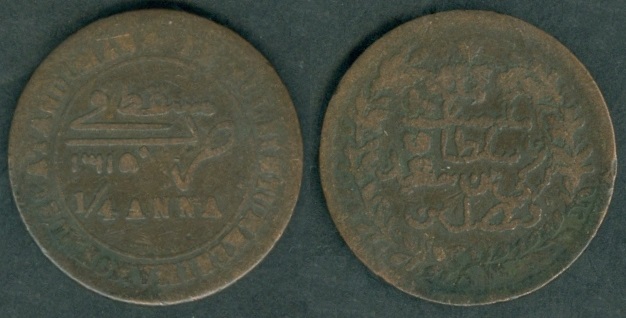
Note: This coin is referred as SC-43
having H+00 starting with star with solid inner circle. It has
"3" retrograde (opposite, backwards in direction) in the date. Five line Arabic
legend with wreath and star at the top. Shaddah (small w) above "س"
in Sultan is missing. Number of bunches 7 on each side. Not listed style
in Krause publication. |
|
 |
Type2: Same as above coin but the 5
lines legends on the Reverse side has thick and the position of Arabic
alphabets / characters differ, especially the word "Sultan" from above
coin.
Diameter: 24.85 mm.
Weight: 7.31 g.
Heavier than all Quarter Annas of Oman and Muscat series. |
|
 |
Quarter Anna.
Year: AH1315 [1898].
Weight: 5.88 g.
Metal: Copper.
Diameter: 25.50 mm. Edge:
Plain. Alignment:
Medal. Mint:
N/A. Obverse Legends
clockwise from star in English:
"ضرب في مسقط" (Struck at Muscat) written in center circle with
Value "¼ ANNA" and Date "١٣١٥". "Fessul Bin Turkee Imam of Muscat and
Oman" written in outer circle. Star at the top. |
|
Reverse legends in Arabic from bottom to top:
"فيصل بن تركي، سلطان عمان"
(Faisal bin Turki, Sultan of Oman) written in center within
wreath around.
Mintage:
N/A. Mintage Years:
One year type.
Note: This coin is referred as SC-45
having H+00 starting with star having solid inner circle. It has
"3" retrograde (opposite, backwards in direction) in the date.
Three line Arabic
legend with wreath. No star at the top. Shaddah (small w) above "س"
in Sultan is missing. Number of bunches 7 on each side. Not
listed style in Krause publication. |
|
 |
Quarter Anna.
Year: AH1315 [1898].
Weight: 6.21 g.
Metal: Copper.
Diameter: 25.00 mm. Edge:
Plain. Alignment:
Medal. Mint:
N/A. Obverse Legends
clockwise from star in English:
"ضرب في مسقط" (Struck at Muscat) written in center circle with
Value "¼ ANNA" and Date "١٣١٥". "Fessul Bin Turkee Imam of Muscat and
Oman" written in outer circle. Star at the top. |
|
Reverse legends in Arabic from bottom to top:
"فيصل بن تركي، سلطان عمان" (Faisal bin
Turki, Sultan of Oman) written in center within wreath around.
Mintage:
N/A. Mintage Years:
One year type.
Note: This coin is referred as SC-47
having H+00 starting with star having solid
inner circle. Persian "5" in date. Arabic legend touching second "A" in
ANNA.
ANNA over ¼. Three line Arabic legend with wreath
having no star at the top. Small legends with Number of bunches
7 on
each side. Not listed style in Krause publication. SC-48
type has same Obverse side but having 6 bunches on each side
at the Reverse side. |
|
 |
Quarter Anna.
Year: AH1315 [1898].
Weight: 5.93 g.
Metal: Copper.
Diameter: 25.00 mm. Edge:
Plain. Alignment:
Medal. Mint:
N/A. Obverse Legends
clockwise from star in English:
"ضرب في مسقط" (Struck at Muscat) written in center circle with Value "¼
ANNA" and Date "١٣١۵". "Fessul Bin Turkee Imam of Muscat and Oman"
written in outer circle. Star at the top. |
|
Reverse legends in Arabic from bottom to top:
"فيصل بن تركي، سلطان عمان" (Faisal bin
Turki, Sultan of Oman) written in center within wreath around. Star at
the top.
Mintage:
N/A. Mintage Years:
One year type.
Note: This coin is referred as SC-51
having H+00 starting with star with DOTTED
inner circle. Persian "5" in date. Arabic legend touching second "N" in
ANNA. Three line Arabic legend with wreath and star at the top. Shaddah (small w) above "س"
in Sultan exists. Small legends with Number of bunches 6 on
each side.
"ن" in Sultan at the left side. Not listed style in Krause publication. |
|
 |
Quarter Anna.
Year: AH1315 [1898].
Weight: 5.68 g.
Metal: Copper.
Diameter: 25.00 mm. Edge:
Plain. Alignment:
Medal. Mint:
N/A. Obverse Legends
clockwise from star in English:
"ضرب في مسقط" (Struck at Muscat) written in center circle with Value "¼
ANNA" and Date "١٣١۵". "Fessul Bin Turkee Imam of Muscat and Oman"
written in outer circle. Star at the top. |
|
Reverse legends in Arabic from bottom to top:
"فيصل بن تركي، سلطان عمان" (Faisal bin
Turki, Sultan of Oman) written in center within wreath around. Star at
the top.
Mintage:
N/A. Mintage Years:
One year type.
Note: This coin is referred as SC-52
having H+00 starting with star with DOTTED
inner circle. Persian "5" in date. Arabic legend far from second "N" in
ANNA. Three line Arabic legend with wreath and star at the top.
"ن" in Sultan at the left side. Number of bunches 7 on each
side. Shaddah (small w) above "س"
in Sultan is missing. "ن" connected to "ا" in Oman. "ن" in
Oman having the dot and touching the star at the top. |
|
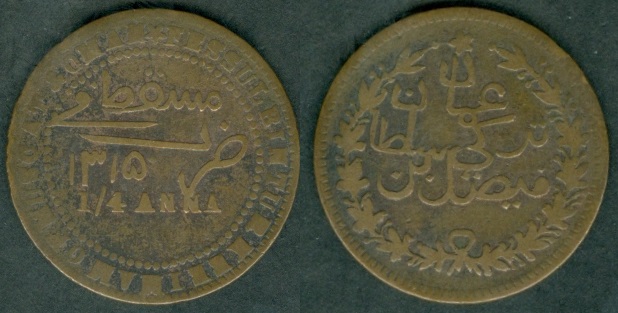 |
Same as above coin, but...
Weight: 5.62 g.
Diameter: 25.00 mm.
Note: H+00 starting with Star
with inner circle. Left side of Arabic legends in the center touches the DOTTED
inner circle. Arabic legend touching second "N" in ANNA.
Three line Arabic legend on the reverse shifted upwards with wreath and
Star having words touching each other. |
|
 |
KM#12.2 Quarter Anna.
Year: AH1315 [1898].
Weight: 5.57 g.
Metal: Copper.
Diameter: 25.00 mm. Edge:
Plain. Alignment:
Medal. Mint:
N/A. Obverse Legends
clockwise from star in English:
"ضرب في مسقط" (Struck at Muscat) written in center circle with Value "¼
ANNA" and Date "١٣١۵". "Fessul Bin Turkee Imam of Muscat and Oman"
written in outer circle. Star at the top. |
|
Reverse legends in Arabic from bottom to top:
"فيصل بن تركي، سلطان عمان" (Faisal bin
Turki, Sultan of Oman) written in center within wreath around. No star
at the top.
Mintage:
N/A. Mintage Years:
One year type.
Note: This coin is referred as SC-52a
having H+00 starting with star with DOTTED
inner circle. Persian "5" in date. Arabic legend almost touching second "N" in
ANNA. Three line Arabic legend with wreath and no star at the top.
"ن" in Sultan at the left side. Number of
bunches 8 on each
side. Shaddah (small w) above "س"
in Sultan is missing. "ن" connected to "ا" in Oman.
Missing the dot "ن" in Oman. |
|
 |
Quarter Anna.
Year: AH1315 [1898].
Weight: 6.16 g.
Metal: Copper.
Diameter: 25.50 mm. Edge:
Plain. Alignment:
Medal. Mint:
N/A. Obverse Legends
clockwise from diamond in English:
"ضرب في مسقط" (Struck at Muscat) written in center circle with Value "¼
ANNA" and having very tiny Date
"١٣١۵". "Fessul Bin Turkee Imam
of Muscat and Oman" written in outer circle.
Diamond at the top. |
|
Reverse legends in Arabic from bottom to top:
"فيصل بن تركي، سلطان عمان" (Faisal bin
Turki, Sultan of Oman) written in center within wreath around.
Mintage:
N/A. Mintage Years:
One year type.
Note: This coin is referred as SC-55
H+00 starting with Diamond with DOTTED
inner circle. Persian "5" in date. Very tiny Date with Diamond
on the right side. Arabic legend touching second "N" in
ANNA. Three line Arabic legend with wreath. No star at the top. Shaddah (small w) above "س"
in Sultan missing. Number of bunches 6 on each side. "ن"
connected to "ا" in Oman. "ن" in Oman having the dot. |
|
 |
KM#12.3 Quarter Anna.
Year: AH1315 [1898].
Weight: 5.53 g.
Metal: Copper.
Diameter: 25.00 mm. Edge:
Plain. Alignment:
Medal. Mint:
N/A. Obverse Legends
clockwise from star in English:
"ضرب في مسقط" (Struck at Muscat) written in center circle with Value "¼
ANNA" and Date "١٣١۵". "Fessul Bin Turkee Imam of Muscat and Oman"
written in outer circle. Star at the top. |
|
Reverse legends in Arabic from bottom to top:
"فيصل بن تركي، سلطان عمان" (Faisal bin
Turki, Sultan of Oman) written in center within wreath around.
Mintage:
N/A. Mintage Years:
One year type.
Note: This coin is referred as SC-58
H+00 starting with star with DOTTED
inner circle. Persian "5" in date. "1/4" written below "ANNA". Arabic legend touching second "A" in
ANNA. Three line Arabic legend with wreath. No star at the top. Shaddah (small w) above "س"
in Sultan missing. Number of bunches 6 on each side.
"ن" in Sultan at the upper left side. |
|
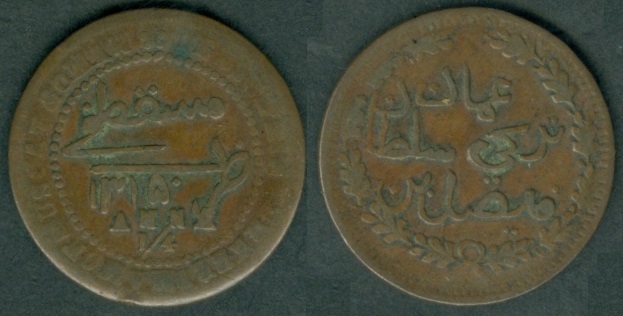 |
Same as above coin, but having broken base of five in Date making it
"١٣١٨" (1318) instead of "١٣١٥"
(1315). This coin is
having larger size of legend "ANNA 1/4" than the above coin.
Weight: 6.44 g.
Diameter: 25.00 mm.
Note: This coin is sometimes listed
as KM#16 in some Krause publication catalogues. This coin is referred as SC-57.
|
|
 |
KM#13 Quarter Anna.
Year: AH5131 = 1315 [1898].
Weight: 5.50 g.
Metal: Copper.
Diameter: 25.00 mm. Edge:
Plain. Alignment:
Medal. Mint:
N/A. Obverse Legends
clockwise from star in English:
"ضرب في مسقط"
(Struck at Muscat) written in center circle with Value "¼ ANNA" and Date
"۵١٣١" (5131). "Fessul Bin Turkee Imam of Muscat and Oman"
written in outer circle. Star at the top. Entire Date backwards
type. Even the digit 3 in Date is retrograde (mirror image). |
|
Reverse legends in Arabic from bottom to top:
"فيصل بن تركي، سلطان عمان" (Faisal bin
Turki, Sultan of Oman) written in center within wreath around.
Mintage:
N/A. Mintage Years:
One year type.
Note: This coin is referred as SC-50
H+00 starting with star with solid
inner circle. Persian "5" in date. "1/4" written below "ANNA". Arabic legend touching second "A" in
ANNA. Three line Arabic legend with wreath. No star at the top. Shaddah (small w) above "س"
in Sultan missing. Number of bunches 6 on each side.
"ن" in Sultan at the proper left side. |
|
|
|
|
AH 1316 [1899] |
|
|
|
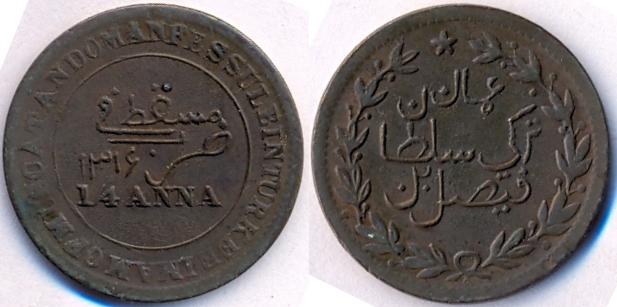 |
KM#15.1 Quarter Anna.
Year: AH1316 [1899].
Weight: 5.72 g.
Metal: Copper.
Diameter: 26.2 mm. Edge:
Plain. Alignment:
Medal. Mint:
Muscat. Obverse
Legends clockwise from 12 O'clock in English:
"ضرب في مسقط" (Struck at Muscat) written in center with Value "¼ ANNA"
and Date "١٣١۶". "Fessul Bin Turkee Imam of Muscat and Oman" written in
outer circle. |
|
Reverse legends in Arabic from bottom to top:
"فيصل بن تركي، سلطان عمان" (Faisal bin
Turki, Sultan of Oman) written in center within wreath around. Star at
the top.
Mintage:
N/A. Mintage Years:
One year type.
Note: This coin is referred as SC-63
having H+00 starting with FESSUL with solid inner circle. No
space within digit "3". The digit "6" in date is in Persian. The dot on
the right side of digit "6" is slightly above. The Arabic legend almost
touching first "N" in "ANNA". Three line Arabic
legend with wreath and star at the top. Shaddah (small w) above "س"
in Sultan is missing. Number of bunches 6 on each side. 42 leaves with berries in wreath. Local Coinage. |
|
 |
KM#15.2 Quarter Anna.
Year: AH1316 [1899].
Weight: 5.49 g.
Metal: Bronze.
Diameter: 25.0 mm. Edge:
Plain. Alignment:
Medal. Mint:
N/A. Obverse Legends
clockwise from 12 O'clock in English:
"ضرب في مسقط" (Struck at Muscat) written in center circle with Value "¼
ANNA" and Date "١٣١۶". "Fessul Bin Turkee Imam of Muscat and Oman"
written in outer circle. |
|
Reverse legends in Arabic from bottom to top:
"فيصل بن تركي، سلطان عمان" (Faisal bin
Turki, Sultan of Oman) written in center within wreath around. Star at
the top.
Mintage:
N/A. Mintage Years:
One year type.
Note: This coin is referred as SC-64
having H+00 starting with FESSUL with solid inner circle. Thick digit "3"
in Date. The digit "6" in date is in Persian. The dot on the
right side of digit "6" is slightly above. Hook above AN in "ANNA".
Three line Arabic legend with wreath. Very dim dots in Arabic legend. Star at the top
and very close to the wreath. Shaddah (small
w) above "س" in Sultan is
visible and thick.
Number of bunches 7 on each side. 48 leaves with no berries in wreath. |
|
 |
Same as above coin, but...
Metal: Brass.
Weight: 5.50 g.
|
|
 |
Same as above coin, but...
Metal: Bronze.
Weight: 5.47 g.
Note: The dot on the
right side of digit "6" has a diamond above it. Thick dots in
Arabic reverse legend. Shaddah (small
w) above "س" in Sultan is
properly visible and normal.
|
|
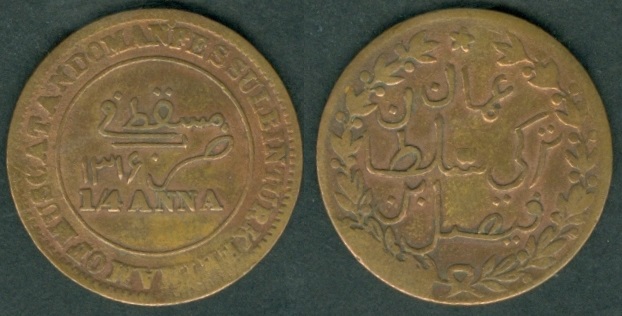 |
KM#15.3 Quarter Anna.
Year: AH1316 [1899].
Weight: 5.52 g.
Metal: Bronze.
Diameter: 25.0 mm. Edge:
Plain. Alignment:
Medal. Mint:
N/A. Obverse Legends
clockwise from 12 O'clock in English:
"ضرب في مسقط" (Struck at Muscat) written in center circle with Value "¼
ANNA" and Date "١٣١۶". "Fessul Bin Turkee Imam of Muscat and Oman"
written in outer circle. |
|
Reverse legends in Arabic from bottom to top:
"فيصل بن تركي، سلطان عمان" (Faisal bin
Turki, Sultan of Oman) written in center within wreath around. Star at
the top.
Mintage:
N/A. Mintage Years:
One year type.
Note: This coin is referred as SC-65
having H+00 starting with dot
before FESSUL near rim with solid inner circle. The digit "6" in date is
in Persian. The dot on the right side of digit "6" is slightly above.
The Arabic legend almost touching first "N" in "ANNA". Three line Arabic
legend with wreath and star at the top. Shaddah (small
w) above "س" in Sultan
is visible and thick. Number of bunches 7 on each side. 48 leaves with berries in wreath.
It has visible gaps between the lines. |
|
 |
KM#15.4 Quarter Anna.
Year: AH1316 [1899].
Exactly same as above coin KM#15.2 but having legends "1/4 ANNA" shifted left side within
inner circle with minor
differences in thickness of characters. No berries on the reverse side.
Weight:
5.94 g. Metal:
Copper.
Diameter: 26.3 mm. |
|
 |
Space within digit "3" in this coin and below two coins as
well. |
|
Reverse legends in Arabic from bottom to top:
"فيصل بن تركي، سلطان عمان" (Faisal bin
Turki, Sultan of Oman) written in center within wreath around. Star at
the top.
Mintage:
N/A. Mintage Years:
One year type.
Note: This coin is referred as SC-66
having H+00 starting with FESSUL with solid inner circle. Space
within digit "3". The digit "6" in date is in Persian. The dot on the
right side of digit "6" is on the same level. Small hook above second "N" in "ANNA".
Three line Arabic legend with wreath and star at the top. Shaddah (small
w) above "س" in Sultan
is missing. Number of bunches 6 on each side. 42 leaves with no berries in wreath. |
|
 |
Same as above coin with different size of
legend like in date and
"1/4 ANNA" on observe side in center circle. Mostly black in
color. Weight: 5.82 g.
|
|
 |
Exactly same as above coin but slightly rotated from
Reverse side, thinner date and in brown color. Weight:
5.75 g. |
|
 |
KM#14 Quarter Anna.
Year: AH1316 [1899].
Weight: 5.65 g.
Metal: Copper.
Diameter: 25.00 mm. Edge:
Plain. Alignment:
Medal. Mint:
Muscat. Obverse
Legends clockwise from dot in English:
"ضرب في مسقط" (Struck at Muscat) written in center with Value "¼ ANNA"
and Date "١٣١۶". "Fessul Bin Turkee Imam of Muscat and Oman" written in
outer circle. |
|
Reverse legends in Arabic from bottom to top:
"فيصل بن تركي، سلطان عمان" (Faisal bin
Turki, Sultan of Oman) written in center within wreath around. Star at
the top.
Mintage:
N/A. Mintage Years:
One year type.
Note: This coin is referred as SC-68
H+00 starting with Dot having DOTTED
inner circle. The digit "6" in date is in Persian. The dot on the right
side is slightly above the digit "6". Three line
Arabic legend with wreath. Dot (berry) at the top. Shaddah (small w) above "س"
in Sultan is missing. 42 leaves with berries in wreath. Local Coinage. |
|
 |
Quarter Anna.
Year: AH1316 [1899].
Weight: 5.87 g.
Metal: Copper/Brass.
Diameter: 24.80 mm. Edge:
Plain. Alignment:
Medal / Rotated. Mint:
Muscat. Obverse
Legends clockwise from dot in English:
"ضرب في مسقط" (Struck at Muscat) written in center with Value "¼ ANNA"
and Date "١٣١۶". "Fessul Bin Turkee Imam of Muscat and Oman" written in
outer circle. |
|
Reverse legends in Arabic from bottom to top:
"فيصل بن تركي، سلطان عمان" (Faisal bin
Turki, Sultan of Oman) written in center within wreath around. Star at
the top.
Mintage:
N/A. Mintage Years:
One year type.
Note: This coin is referred as SC-69
H+00 starting with Dot having DOTTED
inner circle. The digit "6" in date is in Persian. The dot on the right
side is slightly above the digit "6". Three line
Arabic legend with wreath. Star at the top. Shaddah (small w) above "س"
in Sultan is missing. 42 leaves with berries in wreath. |
|
|
|
|
|
|
|
|
Zufar (Dhofar, Dhufar) time line and coinage
under Muscat and Oman Ruler: Sa'id bin Taimur. |
|
|
c.1096 Zafar founded with capital at Mirbat.
1265 - 1271
Persian occupation.
1325 - 1429?
Ruled by Kathiri Sultanate (Hadramaut).
1421 Sultanate of Zafar
1462/63 - 1804
Ruled by Kathiri Sultanate (Hadramaut).
1804 - 1829
Ruled by Saiyid Muhammad Aqil Adjaybi.
1539 Ottoman occupation.
1829 Annexed by Oman.
1876 Katiri and Qara` tribes
recognize suzerainty of Oman.
1879 Annexed by Oman.
1885 - 1886
Independent during revolt. Ruled by Saiyid Fadl Alawi Moplah.
09 Jun 1965 Dhofari revolt directed by the Dhofar Liberation Front (DLF).
Secretary General Musalim bin Nufl (09 Jun 1965 - 1968).
Sep 1968 Renamed Popular Front for the Liberation of the
Occupied
Arabian Gulf (PFLOAG). Secretary General Mohammad Ahmad Saïd
al Ghassani (01 Sep 1968 - 1975).
1971 PFLOAG merged with the
National Democratic Front Liberation of
Oman and Arabian Gulf (armed activity in central and northern
Oman from June 1970) to form the Popular Front for the
Liberation of Oman and the Arab Gulf.
Late 1971 A revolutionary government was set up de facto in
Dhofar.
19 Jan 1972 Failed attack on port of Mirbat.
Mar 1975 Peace agreement signed.
01 Dec 1975 Last PFLOAG occupied village, Dulkut, liberated.
11 Dec 1975 Sultan of Oman declares the rebellion terminated. |
|
|
|
|
|
 |
KM#22 10 Baisa.
Year: AH1359 [1940].
Weight: 3.86g.
Metal: Copper-Nickel.
Diameter: 22.00 mm. Edge:
Plain. Alignment:
Medal. Mint:
Bombay, India. Obverse:
"ظفار" (Dhofar) written on the top. Oman
emblem in the center. "10 بيسة" (Baiza) written on both sides. Date at
the bottom. |
|
Reverse legends in Arabic:
"الواثق بالله سعيد بن تيمور سلطان مسقط وعمان"
(Confident in God Sa'id bin Taimur, Sultan of Muscat and Oman).
Mintage: 572,000. Mintage Years: One year type.
Note: This 10 Baisa
AH1359 as KM#22a is also produced in Gold (Mintage: N/A). |
|
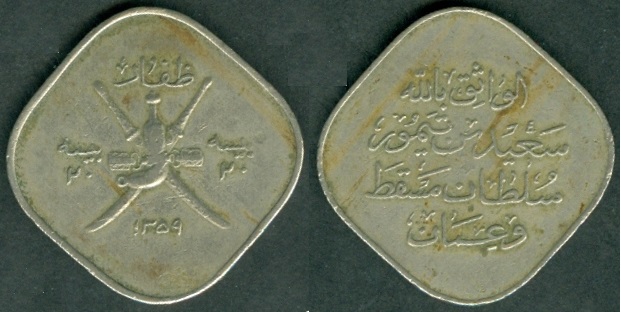 |
KM#23 20 Baiza.
Year: AH1359 [1940].
Weight: 5.75 g.
Metal: Copper-Nickel.
Diameter: 26.50 mm. Edge:
Plain. Alignment:
Medal. Mint:
Bombay, India. Obverse:
"ظفار" (Dhofar) written on the top. Oman
emblem in the center. "20 بيسة" (Baiza) written on both sides. Date at
the bottom. |
|
Reverse legends in Arabic:
"الواثق بالله سعيد بن تيمور سلطان مسقط وعمان"
(Confident in God Sa'id bin Taimur, Sultan of Muscat and Oman).
Mintage: 35,000.
Mintage Years: One year type.
Note: This 20 Baisa
AH1359 as KM#23a is also produced in Gold (Mintage: N/A). |
|
 |
KM#24 50 Baiza.
Year: AH1359 [1940].
Weight: 7.56 g.
Metal: Copper-Nickel.
Diameter: 26.00 mm. Edge:
Plain. Alignment:
Medal. Mint:
Bombay, India. Obverse:
"ظفار" (Dhofar) written on the top. Oman
emblem in the center. "50 بيسة" (Baiza) written on both sides. Date at
the bottom. |
|
Reverse legends in Arabic:
"الواثق بالله سعيد بن تيمور سلطان مسقط وعمان"
(Confident in God Sa'id bin Taimur, Sultan of Muscat and Oman).
Mintage: 65,000.
Mintage Years: One year type.
Note: This 50 Baisa
AH1359 as KM#24a is also produced in Gold (Mintage: N/A). |
|
 |
|
KM#29
½ Rial.
Year: AH1367 [1948].
Weight: 13.92g
(14.03g).
Metal: 0.500 Silver.
Diameter: 33.00 mm. Edge:
Security. Alignment:
Medal. Mint:
Bombay, India. Obverse:
"نصف ريال ظفاري"
(Dhofar Half Riyal) written on the top and then
"Al-Sultanate Al-Sa'idya" below it. Oman emblem in the center with
wreath below it.
Reverse legends in Arabic from bottom to top:
"سعيد بن تيمور سلطان مسقط وعمان" (Sa'id bin Taimur, Sultan Muscat
and Oman) written in center circle surrounded by circular design.
Mintage: 200,000
including 410 Proof. Mintage Years:
One year type.
Note: On reverse
side, it has larger outer circle with thinner legends than the below coin. |
|
 |
|
½ Rial.
Year: AH1367 [1948].
Weight: 13.90 g
(14.03 g).
Metal: 0.500 Silver.
Diameter: 33.00 mm.
Edge:
Security. Alignment:
Medal. Mint:
Bombay, India. Obverse:
"نصف ريال ظفاري"
(Dhofar Half Riyal) written on the top and then "Al-Sultanate Al-Sa'idya"
below it. Oman emblem in the center with wreath below it.
Reverse legends in Arabic from bottom to top:
"سعيد بن تيمور سلطان مسقط وعمان" (Sa'id bin Taimur,
Sultan Muscat and Oman) written in center circle surrounded by circular
design.
Mintage: N/A.
Mintage Years: One year type.
Note: Thick reverse legends with smaller
outer circle, unlisted style in Krause publication. Legends are same as
for KM#29a in gold metal. |
|
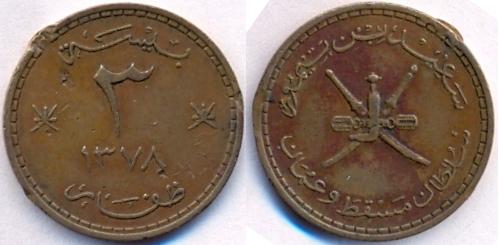 |
KM#30 3 Baisa.
Year: AH1378 [1959].
Weight: 2.73 g.
Metal: Bronze.
Diameter: 20.00 mm. Edge:
Plain. Alignment:
Medal. Mint:
Royal British Mint. Obverse:
"بيسة" (Baiza) written at the top. Large Value "٣"
(3) in the center with date below it. Small Oman emblem on both sides. "ظفار"
(Dhofar) written at the bottom. |
|
Reverse legends in Arabic:
"سعيد بن تيمور" (Sa'id bin Taimur) written at the
top. "سلطان مسقط وعمان" (Sultan of Muscat and Oman) written at the
bottom. Oman emblem in the center.
Mintage:
8,000,000. Mintage Years: One year type. |
|
|
|
|
Muscat province coinage under Muscat and Oman.
Ruler: Sa'id bin Taimur. |
|
|
|
 |
KM#32 3 Baisa.
Year: AH1380 [1960].
Weight: 1.98 g.
Metal: Bronze.
Diameter: 17.50 mm. Edge:
Plain. Alignment:
Medal. Mint:
Royal British Mint. Obverse:
"بيسة" (Baiza) written at the top. Large Value "٣"
(3) in the center with date below it. Small Oman emblem on both sides. "مسقط"
(Muscat) written at the bottom. |
|
Reverse legends in Arabic:
"سعيد بن تيمور" (Sa'id bin Taimur) written at the
top. "سلطان مسقط وعمان" (Sultan of Muscat and Oman) written at the
bottom. Oman emblem in the center.
Mintage:
10,000,000. Mintage Years: One year type. |
|
 |
KM#33 5 Baisa.
Year: AH1381 [1961].
Weight: 3.59 g.
Metal: Copper-Nickel.
Diameter: 20.00 mm. Edge:
Reeded. Alignment:
Medal. Mint:
Royal British Mint. Obverse:
"بيسة" (Baiza) written at the top. Sailing Ship
with Date below it, in the center circle. Numeral "٥" (5) on both sides. "مسقط"
(Muscat) written at the bottom. |
|
Reverse legends in Arabic:
"سعيد بن تيمور" (Sa'id bin Taimur) written at the
top. "سلطان مسقط وعمان" (Sultan of Muscat and Oman) written at the
bottom. Oman emblem in the center.
Mintage:
5,000,000. Mintage Years: One year type. |
|
|
|
|
General coinage of Muscat and Oman under ruler:
Sa'id bin Taimur. |
|
|
|
Currency:
Saidi Rial = 1000 (new) baisas. |
|
|
|
AH 1365 [1946] |
|
|
|
 |
KM#25
2 Baiza.
Year: AH1365 [1946].
Weight: 2.87 g.
Metal: Copper-Nickel.
Diameter: 19.50 mm. Edge:
Plain. Alignment:
Medal. Mint:
Bombay, India. Obverse:
"سلطان مسقط وعمان" (Sultan of Muscat and Oman)
written at the top in circular form. "سعيد بن تيمور" (Sa'id bin Taimur) written in the center with Date below it.
Reverse:
Oman emblem in the center. Numeral Value "٢" (2)
on both sides. Written Value "بيزتان" (Two Baizas) in Arabic at the
bottom. Mintage:
1,500,000. Mintage Years: One year type. |
|
Note:
This coin is similar in shape and size of British India 1/2 Anna. The
word "Baiza" is used instead of "Baisa". |
|
 |
KM#26 5 Baiza.
Year: AH1365 [1946].
Weight: 3.84 g.
Metal: Copper-Nickel.
Diameter: 21.00 mm. Edge:
Plain. Alignment:
Medal. Mint:
Bombay, India. Obverse:
"سلطان مسقط وعمان" (Sultan of Muscat and Oman)
written at the top in circular form. "سعيد بن تيمور" (Sa'id bin Taimur) written in the center with Date below it.
Reverse:
Oman emblem in the center. Written Value "خمس"
(five) written on the right side and "بيزات" (Baizas) at the left side.
Numeral Value "٥" (5) at the bottom. Mintage:
3,849,000. Mintage Years: One year type. |
|
Note:
This coin is similar in shape and size of British India one Anna. The
word "Baiza" is used instead of "Baisa". |
|
 |
KM#27 20 Baiza.
Year: AH1365 [1946].
Weight: 5.86 g.
Metal: Copper-Nickel.
Diameter: 26.50 mm. Edge:
Plain. Alignment:
Medal. Mint:
Bombay, India.
|
|
Obverse:
"سلطان مسقط وعمان" (Sultan of Muscat and Oman)
written at the top in circular form. "سعيد بن تيمور" (Sa'id bin Taimur) written in the center with Date below it.
Reverse:
Oman emblem in the center. Written Value "عشرون"
(twenty) written on the right side and "بيزه" (Baiza) at the left side.
Numeral Value "٢٠" (20) at the bottom. Mintage:
1,135,000. Mintage Years: One year type.
Note: This coin is similar in shape and size of British India two Annas. The
word "Baiza" is used instead of "Baisa". |
|
|
|
|
AH 1378 - 1381 [1959-1961] |
|
|
|
 |
| KM#31 Saidi Riyal.
Year: AH1378 [1959].
Weight: 28.00 g
(28.07 g).
Metal: 0.833 Silver.
Diameter: 38.60 mm. Edge:
Reeded. Alignment:
Medal. Mint:
British Royal Mint. Obverse:
"ريال السعيدي" (Saidi Riyal) written at the top.
Large Numeral "١" (1) written in the center with date below it. Small
Oman emblem on both side. "Al-Sultanate Al-Sa'idya" written at the bottom.
Reverse within circle:
"سعيد بن تيمور" (Sa'id bin Taimur) written at the top in inner
circle. Oman Emblem in the center. "سلطان مسقط وعمان" (Sultan of Muscat
and Oman) written at the bottom within inner circle. Small Sailboat and
Palm tree images in alternative form (8 each) in outer circle.
Mintage:
1,000,000 + 100 Proof. Mintage Years: One year type.
Note: KM#31a also exists with the same weight, shape, date and design but
having 0.500 silver with mintage of 400,000. |
|
 |
KM#34 1/2 Saidi Riyal.
Year: AH1380 [1960].
Weight: 13.91 g
(14.03 g).
Metal: 0.500 Silver.
Diameter: 33.00 mm. Edge:
Reeded. Alignment:
Medal. Mint:
British Royal Mint. |
|
Obverse: Obverse:
"نصف ريال السعيدي" (Saidi Half Riyal) written at
the top. Large Numeral "١/٢" (1/2) written in the center. Date written
at the bottom.
Reverse: "سعيد بن
تيمور" (Sa'id bin Taimur) written at the top. Oman Emblem in
the center. "سلطان مسقط وعمان" (Sultan of Muscat and Oman) written at
the bottom.
Mintage:
300,000. Mintage Years:
AH 1380 and AH 1381. |
 |
Same as above coin KM#34, but...
Year: AH1381 [1961].
Weight: 13.90 g.
Mintage:
850,000. |
|
|
|
|
AH 1390 [1970] |
|
|
|
Currency:
Rial = 100 baisas. |
|
|
|
 |
KM#36 2 Baisa.
Year: AH1390 [1970].
Weight: 1.75 g.
Metal: Bronze.
Diameter: 16.00 mm. Edge:
Plain. Alignment:
Medal. Mint:
British Royal Mint. Obverse:
"بيسة" (Baisa) written at the top. Large Value "٢"
(2) in the center. Small Oman emblem on both sides. Date written at the bottom. |
|
Reverse: "سعيد بن
تيمور" (Sa'id bin Taimur) written at the top. Oman emblem in the center.
"سلطان مسقط وعمان" (Sultan of Muscat and Oman) written at the bottom.
Mintage:
4,000,000. Mintage Years:
One year type. |
|
 |
KM#37 5 Baisa.
Year: AH1390 [1970].
Weight: 3.10 g.
Metal: Bronze.
Diameter: 19.00 mm. Edge:
Plain. Alignment:
Medal. Mint:
British Royal Mint. Obverse:
"بيسة" (Baisa) written at the top. Large Value "٥"
(5) in the center. Small Oman emblem on both sides. Date written at the bottom. |
|
Reverse: "سعيد بن
تيمور" (Sa'id bin Taimur) written at the top. Oman emblem in the center.
"سلطان مسقط وعمان" (Sultan of Muscat and Oman) written at the bottom.
Mintage:
3,400,000. Mintage Years:
One year type. |
|
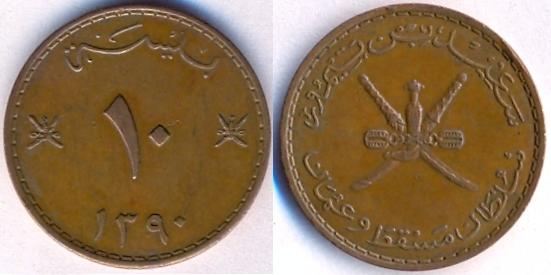 |
KM#38 10 Baisa.
Year: AH1390 [1970].
Weight: 4.70 g.
Metal: Bronze.
Diameter: 22.50 mm. Edge:
Plain. Alignment:
Medal. Mint:
British Royal Mint. Obverse:
"بيسة" (Baisa) written at the top. Large Value
"١٠" (10) in the center. Small Oman emblem on both sides. Date written at the bottom. |
|
Reverse: "سعيد بن
تيمور" (Sa'id bin Taimur) written at the top. Oman emblem in the center.
"سلطان مسقط وعمان" (Sultan of Muscat and Oman) written at the bottom.
Mintage:
4,500,000. Mintage Years:
One year type. |
|
 |
KM#39 25 Baisa.
Year: AH1390 [1970].
Weight: 2.90 g.
Metal: Copper-Nickel.
Diameter: 18.00 mm. Edge:
Reeded. Alignment:
Medal. Mint:
British Royal Mint. Obverse:
"بيسة" (Baisa) written at the top. Large Value
"٢٥" (25) in the center. Small Oman emblem on both sides. Date written at the bottom. |
|
Reverse: "سعيد بن
تيمور" (Sa'id bin Taimur) written at the top. Oman emblem in the center.
"سلطان مسقط وعمان" (Sultan of Muscat and Oman) written at the bottom.
Mintage:
2,000,000. Mintage Years:
One year type. |
|
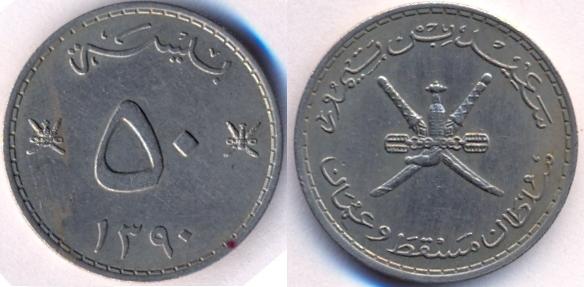 |
KM#40 50 Baisa.
Year: AH1390 [1970].
Weight: 6.40 g.
Metal: Copper-Nickel.
Diameter: 24.00 mm. Edge:
Reeded. Alignment:
Medal. Mint:
British Royal Mint. Obverse:
"بيسة" (Baisa) written at the top. Large Value
"٥٠" (50) in the center. Small Oman emblem on both sides. Date written at the bottom. |
|
Reverse: "سعيد بن
تيمور" (Sa'id bin Taimur) written at the top. Oman emblem in the center.
"سلطان مسقط وعمان" (Sultan of Muscat and Oman) written at the bottom.
Mintage:
1,600,000. Mintage Years:
One year type.
Note: KM#40a 50 Baisa also
exists in 12.81 g, 0.916 Gold. Mintage: 350 pieces. |
|
 |
|
KM#41 100 Baisa.
Year: AH1390 [1970].
Weight: 11.30 g.
Metal: Copper-Nickel.
Diameter: 28.00 mm. Edge:
Reeded. Alignment:
Medal. Mint:
British Royal Mint. Obverse:
"بيسة" (Baisa) written at the top. Large Value
"١٠٠" (100) in the center. Small Oman emblem on both sides. Date written at the bottom.
Reverse: "سعيد بن
تيمور" (Sa'id bin Taimur) written at the top. Oman emblem in the center.
"سلطان مسقط وعمان" (Sultan of Muscat and Oman) written at the bottom.
Mintage:
1,000,000. Mintage Years:
One year type.
Note: KM#41a 100 Baisa also
exists in 22.63 g, 0.916 Gold. Mintage: 350 pieces. |
|
|
|
|
Sultanate of Oman coinage. Ruler: Qaboos ibn
Sa'id. |
|
|
|
AH 1395 [1975] |
|
|
|
 |
KM#50 5 Baisa.
Year: AH1395 [1975].
Weight: 3.10 g.
Metal: Bronze.
Diameter: 19.00 mm. Edge:
Plain. Alignment:
Medal. Mint:
British Royal Mint. Obverse:
"بيسة" (Baisa) written at the top. Large Value "٥"
(5) in the center. Small Oman emblem on both sides. Date written at the bottom. |
|
Reverse: "قابوس بن
سعيد" (Qaboos bin Sa'id) written at the top. Oman emblem in the
center. "سلطان عمان" (Sultan of Oman) written at the bottom.
Mintage:
6,000,000. Mintage Years:
AH1395 (1975), AH1400 (1979), AH1406 (1985), AH1410 (1989)
and AH1418 (1997). |
|
 |
KM#51 10 Baisa.
Year: AH1395 [1975].
Weight: 4.70 g.
Metal: Bronze.
Diameter: 22.50 mm. Edge:
Plain. Alignment:
Medal. Mint:
British Royal Mint. Obverse:
"بيسة" (Baisa) written at the top. Large Value
"١٠" (10) in the center. Small Oman emblem on both sides. Date written at the bottom. |
|
Reverse: "اعملوا علي
تنمية الموارد الغذائية" (Work on the development of food resources)
written at the top. Two palm trees on an island in the center. "سلطنة
عمان" (Sultanate of Oman) written at the bottom.
Mintage:
1,000,000. Mintage Years:
One year type.
Subject: F.A.O. issue. |
|
 |
KM#52 10 Baisa.
Year: AH1395 [1975].
Weight: 4.70 g.
Metal: Bronze.
Diameter: 22.50 mm. Edge:
Plain. Alignment:
Medal. Mint:
British Royal Mint. Obverse:
بيسة" (Baisa) written at the top. Large Value "١٠"
(10) in the center. Small Oman emblem on both sides. Date written at the bottom. |
|
Reverse: "قابوس بن
سعيد" (Qaboos bin Sa'id) written at the top. Oman emblem in the
center. "سلطان عمان" (Sultan of Oman) written at the bottom.
Mintage:
6,000,000. Mintage Years:
AH1395 (1975), AH1400 (1979), AH1406 (1985),
AH1410 (1989) and AH1418 (1997). |
|
 |
KM#45a 25 Baisa.
Year: AH1395 [1975].
Weight: 3.03 g.
Metal: Copper-Nickel.
Diameter: 18.00 mm. Edge:
Reeded. Alignment:
Medal. Mint:
British Royal Mint. Obverse:
"بيسة" (Baisa) written at the top. Large Value
"٢٥" (25) in the center. Small Oman emblem on both sides. Date written at the bottom. |
|
Reverse: "قابوس بن
سعيد" (Qaboos bin Sa'id) written at the top. Oman emblem in the
center. "سلطان عمان" (Sultan of Oman) written at the bottom. Mintage:
4,500,000. Mintage Years:
AH1395 (1975), AH1400 (1979), AH1406 (1985),
AH1410 (1989) and AH1418 (1997). |
|
 |
KM#46a 50 Baisa.
Year: AH1395 [1975].
Weight: 6.40 g.
Metal: Copper-Nickel.
Diameter: 24.00 mm. Edge:
Reeded. Alignment:
Medal. Mint:
British Royal Mint. Obverse:
"بيسة" (Baisa) written at the top. Large Value
"٥٠" (50) in the center. Small Oman emblem on both sides. Date written at the bottom. |
|
Reverse: "قابوس بن
سعيد" (Qaboos bin Sa'id) written at the top. Oman emblem in the
center. "سلطان عمان" (Sultan of Oman) written at the bottom.
Mintage:
2,500,000. Mintage Years:
AH1395 (1975), AH1400 (1979), AH1406 (1985),
AH1410 (1989) and AH1418 (1997). |
|
|
|
|
1978 |
|
|
|
 |
|
KM#64 1/2 Rial.
Year: AH1398 - 1978.
Weight: 13.45 g.
Metal: Copper-Nickel.
Diameter: 7-sided, 30.00 mm. Edge:
Plain. Alignment:
Medal. Mint:
British Royal Mint. Obverse:
"سلطنة عمان" (Sultanate of Oman) written at the top. Oman emblem in
the center. Dates "1978" written on on the left side and "١٣٩٨"
(1978) at the right side. "SULTANATE OF OMAN" written at the bottom.
Reverse:
"اعملوا علي تنمية الموارد الغذائية" (Work on
the development of food resources) written at the top. Lemon in the
center with "F.A.O" written above it. "منظمة الأغذية والزراعة" (Food
and Agriculture Organization) written above F.A.O. Numeral "١/٢"
(1/2) written below the lemon in the center. Written value "نصف ريال"
(Half Riyal) written at the bottom. Mintage:
15,000. Mintage Years:
One year type.
Subject: F.A.O. issue. |
|
 |
|
KM#65 Rial.
Year: AH1398 - 1978.
Weight: 15.01 g
[15.00g].
Metal: 0.500 Silver.
Diameter: 32.00 mm. Edge:
Reeded. Alignment:
Medal. Mint:
British Royal Mint at Llantrisant (Wales). Obverse:
"سلطنة عمان" (Sultanate of Oman) written at the top. Oman emblem in
the center. Dates "1978" written on on the left side and "١٣٩٨"
(1978) at the right side. "SULTANATE OF OMAN" written at the bottom.
Reverse:
"اعملوا علي تنمية الموارد الغذائية" (Work on
the development of food resources) written at the top. "منظمة
الأغذية والزراعة" (Food and Agriculture Organization) written below
it. Fish facing left in the
center with "F.A.O" written above it. Numeral "١"
(1) written below the Fish. Written value "ريَالْ واحد"
(One Riyal) written at the bottom. Mintage:
15,000. Mintage Years:
One year type.
Subject: F.A.O. issue. |
|
|
|
|
AH 1400 [1979-1980] |
|
|
|
 |
Same as above coin KM#50, 5 Baisa
but... Year: AH1400 [1979].
Weight: 3.10 g.
Mintage:
3,000,000. |
|
 |
Same as above coin KM#52, 10 Baisa
but... Year: AH1400 [1979].
Weight: 4.70 g.
Mintage:
5,250,000. |
|
 |
Same as above coin KM#45a, 25 Baisa
but...
Year: AH1400 [1979].
Weight: 3.03 g.
Mintage:
5,250,000. |
|
 |
Same as above coin KM#46a, 50 Baisa
but... Year: AH1400 [1979].
Weight: 6.40 g.
Mintage:
2,750,000. |
|
 |
KM#66 1/4 Rial.
Year: AH1400 - 1980.
Weight: 6.50 g.
Metal:
Aluminum-Bronze.
Diameter: 26.00 mm. Edge:
Lettered in Arabic "Sultanate | Oman | 1400 |". Alignment:
Medal. Mint:
British Royal Mint. Obverse:
"سلطنة عمان" (Sultanate of Oman) written at
the top. Oman emblem in the center. Dates "1980" and "١٤٠٠" (AH
1400) written as the bottom. |
|
Reverse: "البنك
المركزي العماني" (Central Bank
of Oman) written at the top. "ربع ريال" (Quarter Rial) written at
the bottom. Value "١/٤" (1/4) written in the center.
Mintage:
4,000,000. Mintage Years:
One year type.
Note: By keeping the date side on top the edge description is
upside down. |
|
 |
|
KM#67 1/2 Rial.
Year: AH1400 - 1980.
Weight: 10.00 g.
Metal:
Aluminum-Bronze.
Diameter: 30.00 mm. Edge:
Reeded. Alignment:
Medal. Mint:
British Royal Mint. Obverse:
"سلطنة عمان" (Sultanate of Oman) written at
the top. Oman emblem in the center. Dates "1980" and "١٤٠٠" (AH
1400) written as the bottom.
Reverse: "البنك
المركزي العماني" (Central Bank
of Oman) written at the top. "نصف ريال" (Half Riyal) written at the bottom.
Value "١/٢" (1/2) written in the center. Mintage:
2,000,000. Mintage Years:
One year type. |
|
|
|
|
AH 1404 [1984] |
|
|
|
 |
KM#68 100 Baiza.
Year: AH1404 - 1984.
Weight: 4.20 g.
Metal: Copper-Nickel.
Diameter: 21.50 mm. Edge:
Reeded. Alignment:
Medal. Mint:
British Royal Mint. Obverse:
"سلطنة عمان" (Sultanate of Oman) written at
the top. Oman emblem in the center. Dates "1984" and "١٤٠٤" (AH
1404) written as the bottom. |
|
Reverse: "البنك
المركزي العماني" (Central Bank
of Oman) written at the top. Value "١٠٠" (100) written in the
center. "بيسة" (Baisa) written at the bottom.
Mintage:
4,000,000. Mintage Years:
One year type. |
|
|
|
|
AH 1406 [1985] |
|
|
|
 |
Same as above coin KM#50, 5 Baisa but... Year: AH1406 [1985].
Weight: 3.10 g.
Mintage:
2,000,000. |
|
 |
Same as above coin KM#52, 10 Baisa but... Year: AH1406 [1985].
Weight: 4.70 g.
Mintage:
3,000,000. |
|
 |
Same as above coin KM#45a, 25 Baisa
but... Year: AH1406 [1985].
Weight: 3.03 g.
Mintage:
4,000,000. |
|
 |
Same as above coin KM#46a, 50 Baisa
but...
Year: AH1406 [1985].
Weight: 6.40 g.
Mintage:
4,000,000. |
|
|
|
|
AH 1410 [1989] |
|
|
|
 |
Same as above coin KM#50, 5 Baisa
but..
Year: AH1410 [1989].
Weight: 3.10 g.
Mintage:
5,000,000. |
|
 |
Same as above coin KM#52, 10 Baisa
but..
Year: AH1410 [1989].
Weight: 4.70 g.
Mintage:
6,000,000. |
|
 |
Same as above coin KM#45a, 25 Baisa
but... AH1410 [1989].
Weight: 3.03 g.
Mintage:
7,000,000. |
|
 |
Same as above coin KM#46a, 50 Baisa
but...
Year: AH1410 [1989].
Weight: 6.40 g.
Mintage:
4,000,000. |
|
|
|
|
AH 1411 - 1990 |
|
The Central Bank of Oman issued a special coin Proof set to commemorate the
celebration of the 20th National Day anniversary of Sultanate of Oman and Qaboos bin
Sa'id as its ruler. All coin depict the famous landmarks on the reverse
side. |
|
|
|
 |
KM#76 5 Baisa.
Year: AH1411 [1990].
Weight: 3.11 g.
Metal: Bronze.
Diameter: 19.00 mm. Edge:
Plain. Alignment:
Medal. Mint:
British Royal Mint. Obverse:
"سلطنة عمان" (Sultanate
of Oman) written at the top separated by a Crown. Oman National
Emblem in the center. "٥" (5) and "بيسة" (baiza)
written below the Emblem. "البنك
المركزي العماني"
(Central Bank of Oman) written at the bottom. |
|
Reverse: "العيد
الوطني العشرون" (Twentieth National Day Anniversary) written at the top.
Sports complex in the center. "مجمع السلطان قابوس الرياضي" (Sultan
Qaboos Sports Complex) written at the bottom.
Mintage:
3,200 (Only Proofs). Mintage Years:
One year type. |
|
 |
KM#77 10 Baisa.
Year: AH1411 [1990].
Weight: 4.76 g.
Metal: Bronze.
Diameter: 22.50 mm. Edge:
Plain. Alignment:
Medal. Mint:
British Royal Mint. Obverse:
"سلطنة عمان" (Sultanate
of Oman) written at the top separated by a Crown. Oman National
Emblem in the center. "١٠" (10) and "بيسة" (baiza)
written below the Emblem. "البنك
المركزي العماني"
(Central Bank of Oman) written at the bottom. |
|
Reverse: "العيد
الوطني العشرون" (Twentieth National Day Anniversary) written at the top.
Central Bank of Oman building in the center. "مبني البنك المركزي
العماني" (Building of Central Bank of Oman) written at the bottom.
Mintage:
3,200 (Only Proofs). Mintage Years:
One year type. |
|
 |
KM#78 25 Baisa.
Year: AH1411 [1990].
Weight: 3.00 g.
Metal: Copper-Nickel.
Diameter: 18.00 mm. Edge:
Reeded. Alignment:
Medal. Mint:
British Royal Mint. Obverse:
"سلطنة عمان" (Sultanate
of Oman) written at the top separated by a Crown. Oman National
Emblem in the center. "٢٥" (25) and "بيسة" (baiza)
written below the Emblem. "البنك
المركزي العماني"
(Central Bank of Oman) written at the bottom. |
|
Reverse: "العيد
الوطني العشرون" (Twentieth National Day Anniversary) written at the top.
Royal Hospital complex/building in the center. "المستشفى السلطاني"
(Royal Hospital) written at the bottom.
Mintage:
3,200 (Only Proofs). Mintage Years:
One year type. |
|
 |
KM#79 50 Baisa.
Year: AH1411 [1990].
Weight: 6.48 g.
Metal: Copper-Nickel.
Diameter: 24.00 mm. Edge:
Reeded. Alignment:
Medal. Mint:
British Royal Mint. Obverse:
"سلطنة عمان" (Sultanate
of Oman) written at the top separated by a Crown. Oman National
Emblem in the center. "٥٠" (50) and "بيسة" (baiza)
written below the Emblem. "البنك
المركزي العماني"
(Central Bank of Oman) written at the bottom. |
|
Reverse: "العيد
الوطني العشرون" (Twentieth National Day Anniversary) written at the top.
Water Canal with two palm trees and mountain in the background shown
in the center. "نظام الري في عمان" (Irrigation system in Oman)
written at the bottom.
Mintage:
3,200 (Only Proofs). Mintage Years:
One year type. |
|
 |
KM#80 100 Baisa.
Year: AH1411 [1990].
Weight: 4.25 g.
Metal: Copper-Nickel.
Diameter: 21.60 mm. Edge:
Reeded. Alignment:
Medal. Mint:
British Royal Mint. Obverse:
"سلطنة عمان" (Sultanate
of Oman) written at the top separated by a Crown. Oman National
Emblem in the center. "١٠٠" (100) and "بيسة" (baiza)
written below the Emblem. "البنك
المركزي العماني"
(Central Bank of Oman) written at the bottom. |
|
Reverse: "العيد
الوطني العشرون" (Twentieth National Day Anniversary) written at the top.
University building in the center. "جامعة السلطان قابوس" (Sultan
Qaboos University) written at the bottom.
Mintage:
3,200 (Only Proofs). Mintage Years:
One year type. |
|
 |
|
KM#81 2 Rials.
Year: AH1411 [1990].
Weight: 20.00 g.
Metal: 0.925 Silver.
Diameter: 30.00 mm. Edge:
Reeded. Alignment:
Medal. Mint:
British Royal Mint. Obverse:
"سلطنة عمان" (Sultanate
of Oman) written at the top separated by a Crown. Oman National
Emblem in the center. "٢" (2) and "ريال" (Rial) written below
the Emblem. "البنك
المركزي العماني"
(Central Bank of Oman) written at the bottom.
Reverse: "العيد
الوطني العشرون" (Twentieth National Day Anniversary) written at the top.
Sultan Qaboos portrait wearing Turban in the center circle facing
left. Building/Industrial structure on the left side and
leafs/medical symbol at the right side below his protrait.
Mintage:
3,200 (Only Proofs). Mintage Years:
One year type. |
|
|
|
|
AH 1411 - 1991 |
|
|
|
 |
KM#82 100 Baisa.
Year: AH1411 - 1991.
Weight: 7.00 g.
Metal: Bi-Metallic,
Aluminumn-Bronze center and Copper-Nickel ring.
Diameter: 25.00 mm. Edge:
Reeded. Alignment:
Medal. Mint:
British Royal Mint. Obverse:
"قابوس بن سعيد" (Qaboos bin
Sa'id) written at
the top. Dates "١٩٩١" (1991) written on the left side and "١٤١١" (AH
1411) on the right side. Oman emblem in the center. Value
"١٠٠" (100) and "بيسة" (Baisa) written below the emblem. "البنك
المركزي العماني" (Central Bank
of Oman) written at the bottom within center circle. "سلطان
عمان" (Sultan
of Oman) written at the bottom in outer circle. |
|
Reverse:
"الذكرى المئوية لإصدار أول سك نقدي في مسقط"
(The centenary of the first monetary currency of Muscat) written in Arabic at the top. Oman KM#2
picture of observe side in the center circle. Dates "١٤١١" (AH 1411)
and "١٣١١" (AH 1311) below the coin picture in outer circle. "100
YEARS OF COINAGE" written at the bottom. Mintage:
N/A + 1,000 Proof. Mintage Years:
One year type. |
|
|
|
|
ND (1995) |
|
|
|
.jpg) |
KM#94 10 Baisa.
Year: ND (1995).
Weight: 4.70 g.
Metal: Bronze Clad
Steel.
Diameter: 22.50 mm. Edge:
Plain. Alignment:
Medal. Mint:
British Royal Mint.
Obverse: "قابوس
بن سعيد - سلطان عمان" (Qaboos bin
Sa'id - Sultan of Oman) written
at the top. Oman emblem in the center. Value "10 BAISAS" on the left
side and in Arabic "١٠" and "بيسة" on the right side. A small star
on each side. "QABOOS BIN SAID - SULTAN OF OMAN" written at the
bottom. |
|
Reverse:
"ذكرى ٥٠ منظمة الأغذية والزراعة للأمم المتحدة"
(Commemorating 50 years of Food and agriculture organization of
United Nations) written at the top. 50th year of FAO UN logo in the
center. A small star on each side. "COMMEMORATING FIFTY YEARS OF F.A.O. UN"
written at the bottom.
Mintage: N/A + 224
Proof. Mintage Years:
One year type.
Subject: F.A.O. UN issue. |
|
.jpg) |
KM#95 50 Baisa.
Year: ND (1995).
Weight: 6.40 g.
Metal: Copper-Nickel.
Diameter: 24.00 mm. Edge:
Reeded. Alignment:
Medal. Mint:
British Royal Mint.
Obverse: "قابوس
بن سعيد - سلطان عمان" (Qaboos bin
Sa'id - Sultan of Oman) written
at the top. Oman emblem in the center. Value "50 BAISAS" on the left
side and in Arabic "٥٠" and "بيسة" on the right side. A small star
on each side. "QABOOS BIN SAID - SULTAN OF OMAN" written at the
bottom. |
|
Reverse:
"الذكرى الخمسين عاما من الأمم المتحدة"
(Commemorating fifty years of United Nations) with dates "١٩٤٥ -
١٩٩٥" written at the top. 50th year of UN logo in the center. A
small star on each side. "1945-1995
COMMEMORATING FIFTY YEARS OF UN" written at the bottom. Mintage:
N/A. Mintage Years:
One year type.
Subject: UN issue. |
|
|
|
|
AH 1418 [1997] |
|
|
|
 |
Same as above coin KM#50, 5 Baisa
but..
Year: AH1418 [1997].
Weight: 3.10 g.
Mintage:
N/A.
Note:
Unlisted in Krause publication 37th edition
2009. |
|
 |
Same as above coin KM#52, 10 Baisa but.. Year: AH1418 [1997].
Weight: 4.70 g.
Mintage:
N/A. |
|
 |
Same as above coin KM#45a, 25 Baisa
but... Year: AH1418 [1997].
Weight: 3.03 g.
Mintage:
N/A. |
|
 |
Same as above coin KM#46a, 50 Baisa
but... Year: AH1418 [1997].
Weight: 6.40 g.
Mintage:
N/A. |
|
|
|
|
AH 1420 - 1999 |
|
|
|
 |
KM#150 5 Baisa.
Year: AH1420 - 1999.
Weight: 2.65 g.
Metal: Bronze Clad
Steel.
Diameter: 19.00 mm. Edge:
Plain. Alignment:
Medal. Mint:
British Royal Mint. Obverse:
"بيسة" (Baisa) written at the top. Large Value "٥"
(5) in the center. Small Oman emblem on both sides. Dates written at the bottom. |
|
Reverse: "قابوس بن
سعيد" (Qaboos bin Sa'id) written at the top. Oman emblem in the center.
"سلطان عمان" (Sultan of Oman) written at the bottom.
Mintage:
N/A. Mintage Years:
AH1420 - 1999, AH1429 - 2008, AH1432 - 2011
and AH1434 - 2013. |
|
 |
KM#151 10 Baisa.
Year: AH1420 - 1999.
Weight: 4.04 g.
Metal: Bronze Clad
Steel.
Diameter: 22.50 mm. Edge:
Plain. Alignment:
Medal. Mint:
British Royal Mint. Obverse:
بيسة" (Baisa) written at the top. Large Value "١٠"
(10) in the center. Small Oman emblem on both sides. Dates written at the bottom. |
|
Reverse: "قابوس بن
سعيد" (Qaboos bin Sa'id) written at the top. Oman emblem in the center.
"سلطان عمان" (Sultan of Oman) written at the bottom.
Mintage:
N/A. Mintage Years:
AH1420 - 1999, AH1429 - 2008, AH1432 - 2011
and AH1434 - 2013. |
|
 |
KM#152 25 Baisa.
Year: AH1420 - 1999.
Weight: 3.03 g.
Metal: Copper-Nickel.
Diameter: 18.00 mm. Edge:
Reeded. Alignment:
Medal. Mint:
British Royal Mint. Obverse:
"بيسة" (Baisa) written at the top. Large Value
"٢٥" (25) in the center. Small Oman emblem on both sides. Dates written at the bottom. |
|
Reverse: "قابوس بن
سعيد" (Qaboos bin Sa'id) written at the top. Oman emblem in the center.
"سلطان عمان" (Sultan of Oman) written at the bottom.
Mintage:
N/A. Mintage Years:
One year type. |
|
 |
KM#153 50 Baisa.
Year: AH1420 - 1999.
Weight: 6.40 g.
Metal: Copper-Nickel.
Diameter: 24.00 mm. Edge:
Reeded. Alignment:
Medal. Mint:
British Royal Mint. Obverse:
"بيسة" (Baisa) written at the top. Large Value
"٥٠" (50) in the center. Small Oman emblem on both sides. Dates written at the bottom. |
|
Reverse: "قابوس بن
سعيد" (Qaboos bin Sa'id) written at the top. Oman emblem in the center.
"سلطان عمان" (Sultan of Oman) written at the bottom. Mintage Years:
One year type. |
|
| |
|
AH 1428 - 2008 [Note:
The last nine days of AH1428 coincides with 01st Jan to 09th Jan 2008] |
| |
|
 |
KM#152a 25 Baisa.
Year: AH1428 - 2008.
Weight: 2.63 g.
Metal: Nickel Clad
Steel.
Diameter: 18.00 mm. Edge:
Reeded. Alignment:
Medal. Mint:
Royal Canadian Mint. Obverse:
"بيسة" (Baisa) written at the top. Large Value
"٢٥" (25) in the center. Small Oman emblem on both sides. Dates written at the bottom. |
|
Reverse: "قابوس بن
سعيد" (Qaboos bin Sa'id) written at the top. Oman emblem in the
center. "سلطان عمان" (Sultan of Oman) written at the bottom.
Mintage:
N/A. Mintage Years:
AH1428 - 2008, AH1431 - 2010 and AH1434 - 2013. |
|
 |
KM#153a 50 Baisa.
Year: AH1428 - 2008.
Weight: 5.57 g.
Metal: Nickel Clad
Steel.
Diameter: 24.00 mm. Edge:
Reeded. Mint:
Royal Canadian Mint. Obverse:
Value "بيسة" (Baisa) written at the top. Large Value
"٥٠" (50) in the center. Small Oman emblem on both sides. Dates written at the bottom. |
|
Reverse: "قابوس بن
سعيد" (Qaboos bin Sa'id) written at the top. Oman emblem in the center.
"سلطان عمان" (Sultan of Oman) written at the bottom. Mintage Years:
AH1428 - 2008, AH1431 - 2010 and AH1434 - 2013. |
|
| |
|
AH 1429 - 2008 |
| |
|
 |
Same as above coin KM#150, 5 Baisa
but... Year: AH1429 - 2008.
Weight: 2.65 g.
Mint:
Royal Canadian Mint. Mintage:
N/A. |
|
 |
Same as above coin KM#151, 10 Baisa but... Year: AH1429 - 2008.
Weight: 4.04 g.
Mint:
Royal Canadian Mint. Mintage:
N/A. |
|
| |
|
AH 1431 - 2010 |
| Note: This
year coins were produced with different design of emblem. |
| |
|
 |
Same as above coin KM#152a, 25 Baisa
but... Year: AH1431 - 2010.
Weight: 2.63 g.
Mint:
Royal Canadian Mint. Mintage:
N/A. |
|
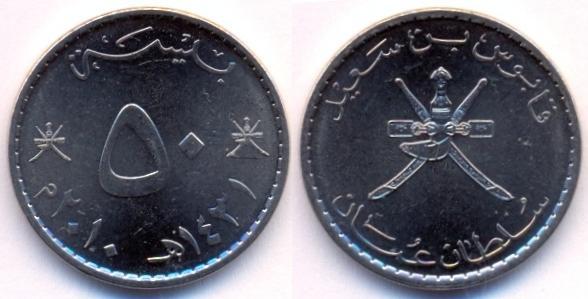 |
Same as above coin KM#153a, 50 Baisa
but... Year: AH1431 - 2010.
Weight: 5.57 g.
Mint:
Royal Canadian Mint. Mintage:
N/A. |
|
| |
|
AH 1432 - 2011 |
| |
|
 |
Same as above coin KM#150, 5 Baisa
but... Year: AH1432 - 2011.
Weight: 2.61 g.
Mint:
Royal Canadian Mint. Mintage:
N/A. |
|
 |
Same as above coin KM#151, 10 Baisa
but... Year: AH1432 - 2011.
Weight: 4.09 g.
Mint:
Royal Canadian Mint. Mintage:
N/A. |
|
| |
|
AH 1434 - 2013 |
| |
|
 |
Same as above coin KM#150, 5 Baisa
but...
Year: AH1434 - 2013.
Weight: 2.64 g.
Mint:
Royal Canadian Mint. Mintage:
N/A. |
|
 |
Same as above coin KM#151, 10 Baisa but... Year: AH1434 - 2013.
Weight: 4.00 g.
Mint:
Royal Canadian Mint. Mintage:
N/A. |
|
 |
Same as above coin KM#152a, 25 Baisa
but... Year: AH1434 - 2013.
Weight: 2.64 g.
Mint:
Royal Canadian Mint. Mintage:
N/A. |
|
 |
Same as above coin KM#153a, 50 Baisa
but...
Year: AH1434 - 2013.
Weight: 5.59 g.
Mint:
Royal Canadian Mint. Mint:
N/A. |
|
| |
|
2014 |
| |
|
 |
| One Rial.
Year: 2014.
Weight: 28.28g.
Metal: 0.999 Silver.
Diameter: 38.61 mm. Edge:
Reeded. Alignment:
Medal. Mint:
Japan Mint. Obverse:
"العيد الوطني الرابع والأربعون ٢٠١٤" written at the top. Oman
Council's building in the center with "مجلس عمان" written above it
and "Oman Council" written below it. "44th National Day 2014"
written at the bottom.
Reverse:
"البنك المركزي العماني" (Central Bank of Oman)
written at the top. Oman emblem in the center. "سلطنة عمان"
(Sultanate of Oman) written at the upper part of the circle and
"SULTANATE OF OMAN" written at the lower part of the
circle. "ONE RIYAL" is written at the left side and "ريال واحد" (One
Rial) written at the right side. "CENTRAL BANK OF OMAN" written at
the bottom. Mintage:
1,000 Proof. Mintage Years:
One year type.
Issue Date: 11
November 2014.
Oman Council: The Oman
Council's Building was opened on 12th November 2012. Under the basic
statute of the State, the Oman Council constitutes the State
Council, whose members are Omani expertise appointed by His Majesty
the Sultan, and the Shura Council (Majlis Al-Shura) whose members
are selected through votes from the Omani public. His Majesty Sultan
Qaboos session of the Oman Council and delivers his Royal speech in
which he addresses top local issues and a number of regional and
international developments of local concerns. |
|
| |
|
AH 1437 - 2015 |
| The Central Bank of Oman issued a
special coin set as circulation coins to commemorate the celebration of the
45th National Day (Anniversary) of Sultanate of Oman and Qaboos bin Sa'id as its ruler.
All coin depict the 45th National Day logo on the reverse side. |
| |
|
 |
5 Baisa.
Year: AH1437 - 2015.
Weight: 2.64g.
Metal: Copper plated
Steel.
Diameter: 19.00 mm. Edge:
Plain. Alignment:
Medal. Mint:
Suomen Rahapaja, Finland. |
| Obverse: "قابوس بن
سعيد" (Qaboos bin Sa'id) written at the
top. "سلطنة عمان"
(Sultanate of Oman) and Date (1437 H) written above Oman emblem within
the center circle. "2015" and "SULTANATE OF OMAN" written below the
Oman emblem within the center circle. "5 BAISA" written on the left
side. "٥" (5) and "بيسة" (baiza)
written on the right side. "سلطان عمان" (Sultan of Oman) written at the bottom
in outer circle.
Reverse:
45th National Day (Anniversary) of Qaboos bin Sa'id's rule
logo in the center. "سلطنة عمان" (Sultanate of Oman) written at the
upper part of the circle and "العيد الوطني خمسة وأربعين المجيد"
(Glorious Forty-fifth National Day) at the lower part of the
circle. "٤٥" (45) is written below the Oman emblem. Year "٢٠١٥"
(2015) written at the left side and "١٤٣٧" (AH1437) written at the
right side.
Mintage:
N/A + 5,000 Proof. Mintage Years:
One year type. |
|
 |
10 Baisa.
Year: AH1437 - 2015.
Weight: 4.08g.
Metal: Copper plated
Steel.
Diameter: 22.50 mm. Edge:
Plain. Alignment:
Medal. Mint:
Suomen Rahapaja, Finland. |
|
Obverse: "قابوس بن
سعيد" (Qaboos bin Sa'id) written at the
top. "سلطنة عمان"
(Sultanate of Oman) and Date (1437 H) written above Oman emblem within
the center circle. "2015" and "SULTANATE OF OMAN" written below the
Oman emblem within the center circle. "10 BAISA" written on the left
side. "١٠" (10) and "بيسة" (baiza)
written on the right side. "سلطان عمان" (Sultan of Oman) written at the bottom
in outer circle.
Reverse:
45th National Day (Anniversary) of Qaboos bin Sa'id's rule
logo in the center. "سلطنة عمان" (Sultanate of Oman) written at the
upper part of the circle and "العيد الوطني خمسة وأربعين المجيد"
(Glorious Forty-fifth National Day) at the lower part of the
circle. "٤٥" (45) is written below the Oman emblem. Year "٢٠١٥"
(2015) written at the left side and "١٤٣٧" (AH1437) written at the
right side.
Mintage:
N/A + 5,000 Proof. Mintage Years:
One year type. |
|
 |
25 Baisa.
Year: AH1437 - 2015.
Weight: 2.65g.
Metal: Nickel clad
Steel.
Diameter: 18.00 mm. Edge:
Reeded. Alignment:
Medal. Mint:
Suomen Rahapaja, Finland. |
|
Obverse: "قابوس بن
سعيد" (Qaboos bin Sa'id) written at the
top. "سلطنة عمان"
(Sultanate of Oman) and Date (1437 H) written above Oman emblem
within the center circle. "2015" and "SULTANATE OF OMAN" written
below the Oman emblem within the center circle. "25 BAISA" written on the left
side. "٢٥" (25) and "بيسة" (baiza)
written on the right side. "سلطان عمان" (Sultan of Oman) written at the bottom
in outer circle.
Reverse:
45th National Day (Anniversary) of Qaboos bin Sa'id's rule
logo in the center. "سلطنة عمان" (Sultanate of Oman) written at the
upper part of the circle and "العيد الوطني خمسة وأربعين المجيد"
(Glorious Forty-fifth National Day) at the lower part of the
circle. "٤٥" (45) is written below the Oman emblem. Year "٢٠١٥"
(2015) written at the left side and "١٤٣٧" (AH1437) written at the
right side.
Mintage:
N/A + 5,000 Proof. Mintage Years:
One year type. |
|
 |
50 Baisa.
Year: AH1437 - 2015.
Weight: 5.55g.
Metal: Nickel clad
Steel.
Diameter: 24.00 mm. Edge:
Reeded. Alignment:
Medal. Mint:
Suomen Rahapaja, Finland. |
|
Obverse: "قابوس بن
سعيد" (Qaboos bin Sa'id) written at the
top. "سلطنة عمان"
(Sultanate of Oman) and Date (1437 H) written above Oman emblem within
the center circle. "2015" and "SULTANATE OF OMAN" written below the
Oman emblem within the center circle. "50 BAISA" written on the left
side. "٥٠" (50) and "بيسة" (baiza)
written on the right side. "سلطان عمان" (Sultan of Oman) written at the bottom
in outer circle.
Reverse:
45th National Day (Anniversary) of Qaboos bin Sa'id's rule
logo in the center. "سلطنة عمان" (Sultanate of Oman) written at the
upper part of the circle and "العيد الوطني خمسة وأربعين المجيد"
(Glorious Forty-fifth National Day) at the lower part of the
circle. "٤٥" (45) is written below the Oman emblem. Year "٢٠١٥"
(2015) written at the left side and "١٤٣٧" (AH1437) written at the
right side.
Mintage:
N/A + 5,000 Proof. Mintage Years:
One year type. |
|
 |
|
100 Baisa.
Year: AH1437 - 2015.
Weight: 9.70g.
Metal: Copper-Nickel.
Diameter: 27.25 mm. Edge:
Plain. Alignment:
Medal. Mint:
Suomen Rahapaja, Finland.
Obverse: "قابوس بن
سعيد" (Qaboos bin Sa'id) written at the
top. "سلطنة عمان"
(Sultanate of Oman) and Date (1437 H) written above Oman emblem within
the center circle. "2015" and "SULTANATE OF OMAN" written below the
Oman emblem within the center circle. "100 BAISA" written on the left
side. "١٠٠" (100) and "بيسة" (baiza)
written on the right side. "سلطان عمان" (Sultan of Oman) written at the bottom
in outer circle. Reverse:
45th National Day (Anniversary) of Qaboos bin Sa'id's rule
logo in the center. "سلطنة عمان" (Sultanate of Oman) written at the
upper part of the circle and "العيد الوطني خمسة وأربعين المجيد"
(Glorious Forty-fifth National Day) at the lower part of the
circle. "٤٥" (45) is written below the Oman emblem. Year "٢٠١٥"
(2015) written at the left side and "١٤٣٧" (AH1437) written at the
right side.
Mintage:
N/A + 5,000 Proof. Mintage Years:
One year type. |
|
 |
|
One Rial.
Year: AH1327 - 2015.
Weight: 28.28g.
Metal: 0.999 Silver.
Diameter: 38.61 mm. Edge:
Reeded. Alignment:
Medal. Mint:
Huguenin, Switzerland.
Obverse:
45th National Day (Anniversary) of Qaboos bin Sa'id's rule
logo in the center. "سلطنة عمان" (Sultanate of Oman) written at the
upper part of the circle and "العيد الوطني خمسة وأربعين المجيد"
(Glorious Forty-fifth National Day) at the lower part of the
circle. "٤٥" (45) is written below the Oman emblem. Year "٢٠١٥"
(2015) written at the left side and "١٤٣٧" (AH1437) written at the
right side.
Reverse:
"البنك المركزي العماني" (Central Bank of Oman)
written at the top. Oman emblem in the center. "سلطنة عمان"
(Sultanate of Oman) written at the upper part of the circle and
"SULTANATE OF OMAN" written at the lower part of the
circle. "ONE RIYAL" is written at the left side and "ريال واحد" (One
Rial) written at the right side. "CENTRAL BANK OF OMAN" written at
the bottom. Mintage:
3,000 Proof. Mintage Years:
One year type.
Issue Date: 08
December 2015.
Note: This coin also exists
with the same diameter in 0.916 Gold but having weight of 37.80
grams (Mintage: 300).
|
|
 |
|
One Rial.
Year: AH1327 - 2015.
Weight: 28.28g.
Metal: 0.999 Silver.
Diameter: 38.61 mm. Edge:
Reeded. Alignment:
Medal. Mint:
Huguenin, Switzerland. Obverse:
Colored Sultan Qaboos's portrait wearing traditional turban facing
straight in the center surrounding with circular design. "قابوس بن
سعيد - سلطان عمان" (Qaboos bin Sa'id
- Sultan of Oman) written above his portrait. Year "2015" written at
the left side and "١٤٣٧" (AH1437) at the right side. "QABOOS BIN
SAID - SULTAN OF OMAN" written the the bottom. Reverse:
"البنك المركزي العماني" (Central Bank of Oman)
written at the top. Oman emblem in the center. "سلطنة عمان"
(Sultanate of Oman) written at the upper part of the circle and
"SULTANATE OF OMAN" written at the lower part of the
circle. "ONE RIYAL" is written at the left side and "ريال واحد" (One
Rial) written at the right side. "CENTRAL BANK OF OMAN" written at
the bottom. Mintage:
3,000 Proof. Mintage Years:
One year type.
Issue Date: 08
December 2015.
Note: This coin also exists
with the same diameter in 0.916 Gold but having weight of 37.80
grams (Mintage: 300).
|
|
| |
|
Sultanate of Oman coinage. Ruler: Haitham bin Tariq Al
Sa'id. |
| |
|
AH 1441 - 2020 |
On 19 August 2020, The Central Bank
of Oman (CBO) has issued a set of coins carrying the name of Sultan Haitham
Bin Tareq, the first since he took power earlier this year. The new coins
are denominations of 5, 10, 25 and 50 Baisa. The new coins will go into
circulation starting in September 2020, Oman’s official news agency (ONA)
reported.
The front side of each coin carries the name of Haitham, the Sultan of Oman,
and the national emblem, while the back side states the denomination as well
as the dates of the Islamic and Gregorian years.
Haitham ascended to the throne in January after the death of Sultan Qaboos
who had ruled Oman for nearly five decades. |
| |
|
|
5 Baisa.
Year: AH1441 - 2020.
Weight: 2.64g.
Metal: Copper plated
Steel.
Diameter: 19.00 mm. Edge:
Plain. Alignment:
Medal. Mint:
N/A. |
| Obverse:
"خمسة بيسة" (Five Baisa) written at the top. Large Value
"5" in the center with "BAISA" written below it. Small Oman emblem on both sides. Dates written at the bottom.
Reverse: "هيثم
بن طارق" (Haitham bin Tariq) written at the top. Oman emblem in the center.
"سلطان عمان" (Sultan of Oman) written at the bottom. Mintage Years:
One year type. |
|
|
10 Baisa.
Year: AH1441 - 2020.
Weight: 4.08g.
Metal: Copper plated
Steel.
Diameter: 22.50 mm. Edge:
Plain. Alignment:
Medal. Mint:
N/A. |
| Obverse:
"عشرة بيسة" (Ten Baisa) written at the top. Large Value
"10" in the center with "BAISA" written below it. Small Oman emblem on both sides. Dates written at the bottom.
Reverse: "هيثم
بن طارق" (Haitham bin Tariq) written at the top. Oman emblem in the center.
"سلطان عمان" (Sultan of Oman) written at the bottom. Mintage Years:
One year type. |
|
|
25 Baisa.
Year: AH1441 - 2020.
Weight: 2.65g.
Metal: Nickel clad
Steel.
Diameter: 18.00 mm. Edge:
Reeded. Alignment:
Medal. Mint:
N/A. |
| Obverse:
"خمسة وعشرون بيسة" (Twenty-Five Baisa) written at the top. Large Value
"25" in the center with "BAISA" written below it. Small Oman emblem on both sides. Dates written at the bottom.
Reverse: "هيثم
بن طارق" (Haitham bin Tariq) written at the top. Oman emblem in the center.
"سلطان عمان" (Sultan of Oman) written at the bottom. Mintage Years:
One year type. |
|
|
50 Baisa.
Year: AH1441 - 2020.
Weight: 5.55g.
Metal: Nickel clad
Steel.
Diameter: 24.00 mm. Edge:
Reeded. Alignment:
Medal. Mint:
N/A. |
|
Obverse:
"خمسون بيسة" (Fifty Baisa) written at the top. Large Value
"50" in the center with "BAISA" written below it. Small Oman emblem on both sides. Dates written at the bottom.
Reverse: "هيثم
بن طارق" (Haitham bin Tariq) written at the top. Oman emblem in the center.
"سلطان عمان" (Sultan of Oman) written at the bottom. Mintage Years:
One year type. |
|
| |
| |
|
|
| |
|
|
| Countries
/ Territories |
| |
|
Chiefa Coins | |
|