| |
 |
 |
| |
| East India
Company |
| |
| The most important of the
various East India companies, this company was a major force in the history
of India for more than 200 years. The original charter was granted by Queen
Elizabeth I on December 31, 1600, under the title of "The Governor and
Company of Merchants of London Trading into the East Indies". The company
was granted a monopoly of trade in Asia, Africa, and America, with the
formal restriction that it might not contest the prior trading rights of
"any Christian prince". The company was managed by a governor and 24
directors chosen from its stockholders. In early voyages it penetrated as
far as Japan, and in 1610 and 1611 its first factories, or trading posts,
were established in India in the provinces of Madras and Bombay. Under a
perpetual charter granted in 1609 by King James I, the company began to
compete with the Dutch trading monopoly in the Malay Archipelago, but after
the massacre of Amboina the company conceded to the Dutch the area that
became known as the Netherlands East Indies. Its armed merchantmen, however,
continued to attack Dutch, French, and Portuguese competitors. In 1650 and
1655 the company absorbed rival companies that had been incorporated under
the Commonwealth and Protectorate by Oliver Cromwell. In 1657 Cromwell
ordered it reorganized as the sole joint-stock company with rights to the
Indian trade. In the reign of Charles II the company acquired sovereign
rights in addition to its trading privileges. In 1689, with the
establishment of administrative districts called presidencies in the Indian
provinces of Bengal, Madras, and Bombay, the company began its long rule in
India. Silk, spices, cotton, and indigo were among the treasures brought
back to Europe. It was continually harassed by traders who were not members
of the company and were not licensed by the Crown to trade. In 1698, under a
parliamentary ruling in favour of free trade, these private newcomers were
able to set up a new company, called the New Company or English Company. The
East India Company, however, bought control of this upstart, and in 1708 an
act of Parliament amalgamated the two as "The United Company of Merchants of
England Trading to the East Indies". The charter was renewed several times
in the 18th century, each time with financial concessions to the Crown. The
victories of Robert Clive, a company official, over the French at Arcot in
1751 and at Plassey in 1757 made the company the dominant power in India.
All European rivalry vanished with the defeat of the French at Pondicherry
in 1761. In 1773 the British government established a governor-generalship
in India, thereby greatly decreasing administrative control by the company;
however, its governor of Bengal, Warren Hastings, became the first
governor-general of India. In 1784 the India Act created a department of the
British government to exercise political, military, and financial control
over the Indian affairs of the company, and for the next half century
British control was extended over most of the subcontinent. In 1813 the
company’s monopoly of the Indian trade was abolished, and in 1833 it lost
its China trade monopoly. Its annual dividends of 10.5 per cent were made a
fixed charge on Indian revenues. The company continued its administrative
functions until the Indian Mutiny (1857-1859), a widespread revolt that
began with the Indian soldiers in the company’s Bengal army. In 1858, by the
Act for the Better Government of India, the Crown assumed all governmental
responsibilities held by the company, and its 24,000-man military force was
incorporated into the British army. The company was dissolved on January 1,
1874, when the East India Stock Dividend Redemption Act came into effect. Motto:
Auspicio Regis et Senatus Angliae = "By command of the King and Parliament
of England". |
| |
- Governor General (1773 - 1833)
- Below is the list of Governor General of Fort
William in Bengal according to the Regulating Act of 1773. These
Governor Generals are also known as the Governor General of British East
India Company from 1773 to 1833.
- Warren
Hastings.....................................20 Oct 1774 - 01 Feb 1785
- Sir John
Macpherson (acting)........................01
Feb 1785 - 12 Sep 1786
- Charles Cornwallis
Earl Cornwallis (1st
time).......12
Sep 1786 - 28 Oct 1793
- Sir John Shore
(Lord Teignmouth)....................28 Oct 1793 - 18 Mar 1798
- Sir Alured Clarke
(acting)..........................18 Mar
1798 - 18 May 1798
- Richard Colley
Wellesley, Baron Wellesley...........18 May 1798 - 30 Jul 1805
From 1799, Richard
Colley Wellesley, Marquess Wellesley, Earl of Mornington.
- Charles
Cornwallis, Marquess Cornwallis (2nd
time)..30 Jul
1805 - 05 Oct 1805
- Sir George Hilario
Barlow (acting)..................10
Oct 1805 - 31 Jul 1807
- Gilbert
Elliot-Murray-Kynynmound, Baron Minto.......31 Jul 1807 - 04 Oct 1813
Also known as Baron Minto
(1st Earl of) Minto.
- Francis Rawdon-Hasting,
Earl of Moira...............04 Oct 1813 - 09 Jan 1823
- From 1817, Francis
Rawdon-Hasting, Marquess of Hastings.
- John Adam (acting)..................................09
Jan 1823 - 01 Aug 1823
- William Pitt
Amherst, Baron Amherst.................01 Aug 1823 - 13 Mar 1828
- From 1826, William Pitt
Amherst, Earl Amherst.
- William
Butterworth Bayley (acting).................13
Mar 1828 - 04 Jul 1828
- William Henry
Cavendish-Bentinck, Lord Bentinck.....04 Jul 1828 - 1833
- He continued as Governor General of India
until 20 Mar 1835 according to Charter Act of 1833.
|
| |
| Bengal
Presidency |
| |
| In 1633 a group of 8
Englishmen obtained a permit to trade in Bengal from the Nawab of Orissa.
Shortly thereafter trading factories were established at Balasore and
Hariharpur. Although greater trading privileges were granted to the East
India Company by the Emperor Shah Jahan in 1634. By 1642 the two original
factories were abandoned. In 1651, through an English surgeon named
Broughton, a permit was acquired to trade at Benegal. Hugli was the first
location, followed by Kasimbazar, Balasore and Patna (the last three in
1653). Calcutta became of increasing importance in this area and on December
20, 1699 Calcutta was declared a presidency and renamed Fort Wililam. During
these times there were many conflicts with the Nawab, both diplomatic and
military and the ultimate outcome was the intervention of Clive and the
restoration of Calcutta as an important trading center. During the earlier
trading times in Bengal most of the monies used were imported Rupees from
the Madras factory. These were primarily of the Arcot type. After Clive's
victory one of the concessions in the peace treaty was the right to make
Mughal type coinage. The Nawab gave specific details as to what from the
coinage should take. In 1766 Emperor Shah Alam gave the East India Company
possession in Bengal, Orissa and Bihar. This made the company nominally
responsible only to the Empeeror. In 1777 the "Frozen Year 19" of Shah Alam
Rupees were made at Calcutta and were continued until 1835. The Arcot Rupees
were discontinued at Calcutta about 1777. Coins of Bengal Presidency were
produced from ca. 1642 to 1835. |
The Bengal Presidency
originally comprising east and west Bengal, was a colonial region of the
British Empire in South-Asia and beyond it. It comprised areas which are now
within Bangladesh, and the present day Indian States of West Bengal, Assam,
Bihar, Meghalaya, Orissa and Tripura. Penang and Singapore were also
considered to be administratively a part of the Presidency until they were
incorporated into the Crown Colony of the Straits Settlements in 1867.
Calcutta was declared a Presidency Town of the East India Company in 1699,
but the beginnings of the Bengal Presidency proper can be dated from the
treaties of 1765 between the East India Company and the Mughal Emperor and
Nawab of Oudh which placed Bengal, Meghalaya, Bihar and Orissa under the
administration of the Company.
At its height, gradually added, were the annexed princely states of Uttar
Pradesh, Uttarakhand, Punjab, Haryana, and Himachal Pradesh and portions of
Chhatisgarh, Madhya Pradesh, and Maharashtra in present day India, as well
as the provinces of North West Frontier and Punjab, both now in Pakistan,
and most of Burma (present day Myanmar). In 1874 Assam, including Sylhet,
was severed from Bengal to form a Chief-Commissionership, and the Lushai
Hills were added to that in 1898. The Presidency of Bengal, unlike those of
Madras and Bombay, eventually included all of the British possessions north
of the Central Provinces (Madhya Pradesh), from the mouths of the Ganges and
Brahmaputra to the Himalayas as well as the Punjab. In 1831, the
North-Western Provinces were created, which were subsequently included with
Oudh in the United Provinces (Uttar Pradesh). Just before the First World
War the whole of Northern India was divided into the four
lieutenant-governorships of the Punjab, the United Provinces, Bengal,
Eastern Bengal and Assam, and the North-West Frontier Province under a
Commissioner. |
| |
| Monetary System:
Rupee = 64 Pice = 192 Pie. (Mohur = 15
Rupees).
Mints: Alinagar Kalkatah (Calcutta), Azimabad (Patna), Banaras (Banares,
Varanasi), Calcutta (Kalkatah), Farrukhabad, Jahangirnagar, Muhammadabad Banaras, Murshidabad,
Patna and Sagar. |
| |
|
 |
KM#120 1/16 Anna.
Year:
AH1195-RY22 (1782-1784).
Weight: 2.00g [1.81g].
Metal: Copper.
Diameter:
15.80 mm. Edge:
Plain.
Alignment: Coin.
Mint: Falta
(Fulta).
Obverse: Shah Alam Badshah
(Emperor Shah Alam) with year 1195.
One star at the top and another on the right side.
Reverse: Sanat 22 Julus (in
the 22nd year of his reign). Five stars in field.
Mintage: N/A.
Mintage Years:
One year type. |
|
Note: Same above coin as KM#121 also exists with same weight
but with diameter 14.50 mm having two thick stars under RY22. |
|
 |
KM#123 1/8 Anna.
Year:
AH1195-RY22 (1782-1784).
Weight: 3.69g [3.64g].
Metal: Copper.
Diameter:
18.30 mm. Edge:
Plain.
Alignment: Coin.
Mint: Falta
(Fulta).
Obverse: Shah Alam Badshah
(Emperor Shah Alam) with year 1195. One star at the top and another
on the right side.
Reverse: Sanat 22 Julus (in
the 22nd year of his reign). Five stars in field.
Mintage: N/A.
Mintage Years:
One year type. |
|
Note: Same above coin as KM#122 also exists with same weight
but with diameter 19.60 mm having two thin and large stars under
RY22. |
|
 |
KM#125 1/4 Anna.
Year:
AH1195-RY22 (1782-1784).
Weight: 6.73g [7.27g].
Metal: Copper.
Diameter:
22.70 mm. Edge:
Plain.
Alignment: Coin.
Mint: Falta
(Fulta).
Obverse: Shah Alam Badshah
(Emperor Shah Alam) with year 1195.
One star at the top and another on the right side.
Reverse: Sanat 22 Julus (in
the 22nd year of his reign). Five stars in field.
Mintage: N/A.
Mintage Years:
One year type. |
|
Note: Same above coin as KM#124 also exists with same weight
but with diameter 23.70 mm. |
|
 |
KM#126 1/2 Anna.
Year:
AH1195-RY22 (1782-1784).
Weight: 14.46g [14.54g].
Metal: Copper.
Diameter:
26.00 mm. Edge:
Plain.
Alignment: Coin.
Mint: Falta
(Fulta).
Obverse: Shah Alam Badshah
(Emperor Shah Alam) with year 1195.
One star at the top and another on the right side.
Reverse: Sanat 22 Julus (in
the 22nd year of his reign). Five stars in field.
Mintage: N/A.
Mintage Years:
One year type. |
|
Note: Same above coin as KM#127 also exists with same weight
but with diameter 23.00 mm. |
|
.jpg) |
KM#51 ½ Pice.
Year:
ND (1795-1796).
Weight: 4.10g [4.36g].
Metal: Copper.
Diameter:
24.70 mm. Edge:
Plain.
Alignment: Medal.
Mint: Calcutta.
Obverse: Sana julus 37 Shah Alam
badshah (in the 37th year of the Emperor Shah Alam).
Reverse: Written value in Bengali (Adha
Pai Sikka), Persian (Nim Pai Sikka) and Hindi (Adha Pai Sikka).
Mintage: N/A.
Mintage Years:
One year type. |
|
Note: Same coin as KM#50 also exists with weight: 5.82g with
diameter 23-24 mm. |
|
.jpg) |
KM#27.1 Pice.
Year:
ND (1815-1829).
Weight: 6.14g [6.23g].
Metal: Copper.
Diameter:
25.00 mm [22-26 mm].
Edge:
Plain.
Alignment: Medal.
Mint:
Murshidabad.
Obverse: Sana julus 37 Shah Alam
badshah (in the 37th year of the Emperor Shah Alam).
Reverse: Written value in Persian (Yek pai sikka) and Hindi (Ek Pai sikka).
Mintage: N/A.
Mintage Years:
One year type. |
|
Note: Thick letters. Many Die variety exists with minor
differences. This coin also exists as KM#27.2 and KM#27.3 with major
difference in the legend size and other details. |
|
.jpg) |
KM#53 Pice.
Year:
ND (1795-1831).
Weight: 7.53g [8.73g].
Metal: Copper.
Diameter:
28.70 mm [27-30 mm].
Edge:
Plain.
Alignment: Medal.
Mint: Calcutta.
Obverse: Sana julus 37 Shah Alam
badshah (in the 37th year of the Emperor Shah Alam).
Reverse: Written value in Bengali (Ek
Pai sikka), Persian (Yek pai sikka) and Hindi (Ek Pai sikka).
Mintage: N/A.
Mintage Years:
One year type. |
|
Note: This coin was made in year 1795, 1796, 1802, 1809,
1817, 1829 and 1831. Same coin as KM#52 also exists with weight: 11.64g with
diameter 29-30 mm. KM#56 is also recorded with the same design as
well with 26 mm. |
|
.jpg) |
KM#65 / Pr 336 Trisul Pice.
Year:
ND (1820-1824).
Weight: 6.04g.
Metal: Copper.
Diameter:
23.00 mm. Edge:
Plain.
Alignment: Medal.
Mint:
Farrukhabad.
Obverse:
Trisul (trident) symbol. Sana julus 45 Shah Alam badshah (in the
45th year of the Emperor Shah Alam).
Reverse:
Trisul (trident) symbol. Value in Persian and Hindi: Ek pai sicca =
One pai.
Mintage: N/A.
Mintage Years:
One year type. |
|
Note: Other varieties also exists,
minted in Sagar like KM#71 as 1st issue with size 21-22 mm ND
(1826-1833), KM#72 as 2nd issue with obverse having 6-petalled
rosette replacing the trident with size 21-22 mm ND (1833) and
KM#A65 as 3rd issue with obverse having six pointed star replacing
the trident with size 22-24 mm ND (1834-1835). |
|
.jpg) |
KM#58 / Pr 215 Pie.
Year:
ND (1831-1835).
Weight: 2.16g [2.16].
Metal: Copper.
Diameter:
16.50 mm. Edge:
Plain.
Alignment:
Coin.
Mint: Calcutta.
Obverse:
The value in English: "ONE PIE" and Bengali:
এফআই. |
|
Reverse:
The value in two languages: Urdu: Ek Pie and in Nagari:
ऎक पाई
(= One Pie).
Mintage: N/A.
Mintage Years:
One year type.
Note: Crescent with pointed edge upwards Privy Mark at the
bottom, between of two Hindi words. |
|
.jpg) |
KM#59 Half Anna.
Year:
ND (1831-1835).
Weight: 12.58g [12.96].
Metal: Copper.
Diameter:
27.70 mm. Edge:
Plain.
Alignment: Medal.
Mint: Calcutta.
Obverse:
The value in English: HALF ANNA and Bengali (Bengali = Adha ana =
Half Anna).
Reverse:
The value in two languages: Persian: Nim Anna and in Nagari:
आधा आना
(= Half Anna).
Mintage: N/A.
Mintage Years:
One year type.
Note: Crescent with pointed edge upwards Privy Mark at the
bottom, between of two Hindi words. |
|
Rotated.jpg) |
Weight: 12.48g [12.96].
Alignment: Medal, slightly rotated as
shown. |
|
 |
KM#80.3 1/16 Rupee.
Year:
RY19 ND (AH 1192 or 1778 CE).
Weight: 0.67g [0.73g].
Metal: Silver.
Diameter:
9.50 mm. Edge:
Plain.
Alignment: Medal.
Mint:
Murshidabad (New Calcutta).
Obverse: Shah
Alam II) Badshah. Reverse: Persian-julus
(formula) 19 with mint name.
Mintage: N/A.
Mintage Years:
One year type. |
|
 |
KM#84.2 / Pridmore 139 Rupee.
Year:
AH1200 -
Frozen RY19 [1786].
Weight: 11.59g [11.66g].
Metal: Silver.
Diameter:
24.00 mm x 22.00 mm. Edge:
Plain.
Alignment: Coin.
Mint:
Murshidabad.
Obverse: Sikka Zad Bar Haft Kishwur Sayaye Fazl Shah Alam
Badshah Elah Hami Din Mohammad
(Struck coin on the seven climes, Shadow of Allah's favour, Shah
Alam Emperor, Defender of the faith of Muhammad) / 1200.
Crescent countermark. |
|
Reverse: Zarb Murshidabad Sanat 19 Julus Maimanet Manus
(Stuck at Murshidabad in the 19th year of
his tranquil prosperous reign).
Mintage: N/A.
Mintage Years:
AH1183//10, AH1183//11, AH1184//11,
AH1185//11, AH1185//12, AH1186//12 frozen, AH1187//12 frozen,
AH1187//15 frozen, AH1188//12 frozen, AH1189//12 frozen, AH1189//15
frozen, AH1190//15 frozen, AH1190//19 frozen, AH1191//19,
AH1192//19, AH1193//19 frozen, AH1194//19 frozen, AH1195//19 frozen,
AH1196//19 frozen, AH1197//19 frozen, AH1198//19 frozen, AH1199//19
frozen, AH1200//19 frozen, AH1201//19 frozen, AH1202//19 frozen,
AH1203//19 frozen and AH1204//19 frozen. |
|
 |
KM#40.1 Rupee.
Year:
AH 1203 - RY17/31 (1789).
Weight: 11.27g [11.33g].
Metal: Silver.
Diameter:
22.50 mm. Edge:
Plain.
Alignment: Rotated.
Mint:
Muhammadabad Banaras.
Obverse: Sikka Zad Bar Haft Kishwur Sayaye Fazl Shah Alam
Badshah Elah Hami Din Mohammad
(Struck coin on the seven climes, Shadow of Allah's favour, Shah
Alam Emperor, Defender of the faith of Muhammad). Stylish fish at
right (mintmark) and sun (mintmark) in the center. Date (AH
1203) in lower field. |
|
Reverse: Zarb
Muhammadabad Banaras sanat 17 / 31 julus maimanat manus
(Struck at Muhammadabad Banaras in the year 17/31 of reign associated
with tranquil prosperity) in Persian.
Lotus (mintmark) in central field.
Darogah mark seen in the minted city name Banaras.
Mintage: N/A.
Mintage Years:
AH1190//17, AH1191//17, AH1192//17,
AH1193//17-20, AH1193//17-21, AH1194//17-21, AH1194//17-22,
AH1195//17-22, AH1195//17-23, AH1196//17-24, AH1197//17-25,
AH1198//17-26, AH1199//17-26, AH1199//17-27, AH1200//17-27,
AH1201//17-28, AH1201//17-29, AH1202//17-28 Error, AH1202//17-29,
AH1202//17-30, AH1203//17-30, AH1203//17-31, AH1204//17-32,
AH1205//17-33, AH1206//17-33, AH1206//17-34, AH1207//17-34,
AH1207//17-35, AH1208//17-35, AH1208//17-36, AH1209//17-36,
AH1209//17-37, AH1210//17-37, AH1210//17-38, AH1211//17-38,
AH1211//17-39, AH1212//17-39, AH1212//17-40, AH1213//17-33 Error,
AH1213//17-40, AH1213//17-41, AH1214//17-41, AH1214//17-42 and
AH1215//17-42.
Note: Banaras or Kashi is now known
as Varanasi (from Varuna river and Assi ghat). It is a North Indian
city on the banks of the Ganges in Uttar Pradesh, India, 320
kilometres (200 mi) south-east of the state capital, Lucknow, and
121 kilometres (75 mi) east of Allahabad. The spiritual capital of
India, it is the holiest of the seven sacred cities (Sapta Puri) in
Hinduism and Jainism, and played an important role in the
development of Buddhism. |
|
 |
KM#40.2 Rupee.
Year:
AH 1226 - RY17/49 (1811).
Weight: 11.30g [11.33g].
Metal: Silver.
Diameter:
23.00 mm. Edge:
Plain.
Alignment: Medal.
Mint:
Muhammadabad Banaras.
Obverse: Sikka Zad Bar Haft Kishwur Sayaye Fazl Shah Alam
Badshah Elah Hami Din Mohammad
(Struck coin on the seven climes, Shadow of Allah's favour, Shah
Alam Emperor, Defender of the faith of Muhammad). Stylish
fish at right (mintmark) and sun (mintmark) in the center. Date (AH
1226) in lower field. |
|
Reverse: Zarb
Muhammadabad Banaras sanat 17 / 49 julus maimanat manus
(Struck at Muhammadabad Banaras in the year 17/49 of reign associated
with tranquil prosperity) in Persian.
Lotus (mintmark) in central field.
Darogah mark seen in the minted city name Banaras.
Mintage: N/A.
Mintage Years: AH
1219//17-47, AH 1220//17-48, AH 1221//17-48, AH 1221//17-49,
AH 1222//17-49, AH 1223//17-49, AH 1224//17-49, AH 1225//17-49,
AH 1226//17-49 and AH 1226//17-49 fish with barbels. |
|
 |
KM#41 Rupee.
Year:
AH 1229 - RY17/49 (1814).
Weight: 11.33g [11.33g].
Metal: Silver.
Diameter:
23.25 mm. Edge:
Plain.
Alignment: Rotated.
Mint:
Muhammadabad Banaras.
Obverse: Sikka Zad Bar Haft Kishwur Sayaye Fazl Shah Alam
Badshah Elah Hami Din Mohammad
(Struck coin on the seven climes, Shadow of Allah's favour, Shah
Alam Emperor, Defender of the faith of Muhammad). Stylish
fish at right (mintmark) and sun (mintmark) in the center. Date (AH
1229) in lower field. Fish with barbels. |
|
Reverse: Zarb
Muhammadabad Banaras sanat 17 / 49 julus maimanat manus
(Struck at Muhammadabad Banaras in the year 17/49 of reign associated
with tranquil prosperity) in Persian.
Lotus (mintmark) in central field.
Without
Darogah mark in the minted city name Banaras.
Mintage: N/A.
Mintage Years: AH 1227//17-49,
AH 1228//17-49 and AH 1229//17-49 (1812-1814). |
|
 |
KM#115 Quarter Rupee.
Year:
Frozen date 1204AH with 19th Regnal Year (minted during 1830-1833).
Weight: 3.10g [2.90 - 3.10g].
Metal: Silver.
Diameter:
16.50 mm. Edge:
Plain.
Alignment: Medal.
Mint:
Murshidabad (Calcutta).
Obverse:
"Shah Alam Badshah" with AH date
"1204" at the top. |
|
Reverse: Zarb Murshidabad
(Stuck at Murshidabad) with regnal year
"19" at the top.
Mintage: N/A.
Mintage Years:
One year type. Note: KM#96.1 and 96.2 exists with
Oblique milling (minted during 1793-1818) and KM#104 exists with
Vertical milling edge (minted during 1830). Although the mint name
on the coin is Murshidabad, these coins were struck at the Calcutta
mint (crescent mint,ᵕ mark on middle left of obverse side at 9'O
clock) |
|
 |
KM#116 Half Rupee.
Year:
Frozen RY19 (minted in 1830).
Weight: 6.17g [5.80g].
Metal: Silver.
Diameter:
23.00 mm. Edge:
Plain.
Alignment: Medal.
Mint:
Murshidabad (New Calcutta).
Obverse: Sikka Zad Bar Haft Kishwur Sayaye Fazl Shah Alam
Badshah Elah Hami Din Mohammad
(Struck his coin on the seven climes, Shadow of the Devine favour,
Shah Alam Emperor, Defender of Muhammad's religion). |
|
Reverse: Zarb Murshidabad Sanat 19 Julus Maimanet Manus
(Stuck at Murshidabad in the 19th year of
his tranquil prosperous reign).
Mintage: N/A.
Mintage Years:
One year type. Image shows crescent
privy mark ᵕ for Calcutta mint on upper left of reverse side at 10'
O clock. |
|
 |
KM#99 Rupee.
Year:
Frozen RY19 (minted in 1793).
Weight: 11.59g [11.66g].
Metal: Silver.
Diameter:
26.00 mm. Edge:
Oblique milling (Grained right).
Alignment: Medal; slightly rotated.
Mint:
Murshidabad written but actually Calcutta (as
no mint mark seen).
Obverse: Sikka Zad Bar Haft Kishwur Sayaye Fazl Shah Alam
Badshah Elah Hami Din Mohammad
(Struck coin on the seven climes, Shadow of Allah's favour, Shah
Alam Emperor, Defender of the faith of Muhammad). |
|
Reverse: Zarb Murshidabad Sanat 19 Julus Maimanet Manus
(Stuck at Murshidabad in the 19th year of
his tranquil prosperous reign).
Mintage: N/A.
Mintage Years:
One year type. It is Calcutta mint as
this coin has no small dot in any of the dotted group on Obverse
side. This coin has Privy marks in the middle line of Obverse side
of the coin by looking at the three dot groups to differentiate
mints for Calcutta, Dacca, Murshidabad and Patna.
- Calcutta: No Privy mark (small dot) in the center of any of
the three dotted group.
- Dacca (Dhaka): Privy mark (small dot) in the center of first dot group (group
of four
dots in circle). This group of dots are in the center of the
coin or third group from right to left in the center row.
- Murshidabad: Privy mark (small dot) in the center of second dot group
(group five dots in circle). This group of dots are second group
from right to left in the center row.
- Patna: Privy mark (small dot) in the center of third dot group (group five
dots in circle). This group of dots are located exactly at 3' O
clock.
|
|
|
 |
Edge:
Oblique milling (Grained right) of the
above coin. |
|
|
 |
KM#70 Rupee.
Year:
Frozen RY45 (minted in 1833-1835).
Weight: 11.65g [11.68g].
Metal: 0.909 Silver.
Diameter:
25.00 mm. Edge:
Reeded.
Alignment: Medal.
Mint: Farrukhabad
written but actually Sagar (as no mint mark seen).
Obverse: Sikka Zad Bar Haft Kishwur Sayaye Fazl Shah Alam
Badshah Elah Hami Din Mohammad
(Struck coin on the seven climes, Shadow of Allah's favour, Shah
Alam Emperor, Defender of the faith of Muhammad).
Reverse: Zarb Farrukhabad Sanat 45 Julus Maimanet Manus
(Stuck at Farrukhabad in the 45th year of
his tranquil prosperous reign).
Mintage: N/A.
Mintage Years:
One year type. |
This coin has Privy marks on both Obverse and Reverse sides of the
coin to differentiate mints for Farrukhabad, Calcutta, Banaras and
Sagar.
- Farrukhabad: mint mark dot '•' in the center of four dotted
circle on Reverse side at 5' O clock.
- Calcutta: mint mark inverted v '^' on Obverse side between
4' O clock and 5' O clock.
- Banaras: mint mark both inverted v '^' on Obverse side and
dot '•' in dotted cluster on Reverse sides.
- Sagar: no mint mark.
|
|
 |
Edge:
Vertical milling (Reeded) of the
above coin. Note: The same
coin as KM#69 was also produced in Oblique milling (Grained right)
edge. |
|
 |
KM#78 Rupee.
Year:
Frozen RY45 (minted in 1833-1835).
Weight: 11.64g [11.68g].
Metal: 0.909 Silver.
Diameter:
26.25 mm. Edge:
Reeded.
Alignment: Medal.
Mint:
Farrukhabad (actually struck at Calcutta).
Obverse: Sikka Zad Bar Haft Kishwur Sayaye Fazl Shah Alam
Badshah Elah Hami Din Mohammad
(Struck coin on the seven climes, Shadow of Allah's favour, Shah
Alam Emperor, Defender of the faith of Muhammad).
Reverse: Zarb Farrukhabad Sanat 45 Julus Maimanet Manus
(Stuck at Farrukhabad in the 45th year of
his tranquil prosperous reign).
Mintage: N/A.
Mintage Years:
One year type.
Note: Broad rims and without mint mark. |
|
 |
Edge:
Plain of the
above coin. Note: The same
coin as KM#77 was also produced with plain edge but having thin
border rim and mint mark: Crescent on the left top side (10 O'
clock) on the
reverse side. |
|
| |
| |
| |
| Bombay
Presidency |
| |
| Following a naval victory
over the Portuguese on December 24, 1612, negotiations were started
developed into the opening of the first East India Company factory at Surat
in 1613. It later grew to encompass much of western and central India, as
well as part of the Arabian Peninsula and areas later included in Pakistan.
At its greatest extent, the Bombay Presidency comprised the present-day
state of Gujarat, the western two-thirds of Maharashtra state, including the
regions of Konkan, Desh, and Kandesh, and northwestern Karnataka state of
India; it also included Pakistan's Sindh province (1843-1935) and the
British territory of Aden in Yemen (1839-1939). It consisted of districts
which were directly under British rule. It did not include the native or
princely states, whose internal administration was the responsibility of
local rulers, but it was responsible for managing the defence of many
princely states and for British relations with them. |
| Silver coins of the New World as well as various other foreign
coins were used in early trade. Within the decade the Mughal mint at Surat
was melting all of these foreign coins and re-minting them as various
denominations of Mughal coinage. Bombay became an English holding as part of
the dowry of Catherine of Braganza, Princess of Portugal when she was
betrothed to Charles II of England. Also including in the dowry was Tangier
and $500,000. With this acquisition the trading center of the Indian West
Coast moved from Surat to Bombay. Possession of Bombay island took place on
February 08, 1665 and by 1672 the East India Company had a mint in Bombay to
serve their trading interests. European designed coins were struck here
until 1717. Experimental issues of Mughal style Rupees with regnal years
pertaining to the reigns of James II and William and Mary were made in
1693-1694. From 1717 to 1778, the Mughal style Bombay Rupee was the
principal coin of the West India trade, although bulk foreign coins were
used for striking Rupees at Surat. After the East India Company took over
the city of Surat in 1800, they slowed the mint production and finally
transferred all activity to Bombay in 1815. Bombay presidency coins were
produced from 1672 to 1835. Bombay is now known as Mumbai these days. |
| |
| Monetary System:
Rupee = 64 Pice (Paisa) = 192 Pie = 256 Reas. [Mohur (Ashrafi) = 15
Rupees; Anglina Rupee = 48 Copperoons = 528 Tinnys (Bujruk) ].
Mints: Ahmadabad, Bombay (Mumbai), Surat and Tellicherry (Malabar
Coast) |
| Banner words: AUSP:
REG: & SEN. ANG = "Under the auspices of the king and senate of England". |
| |
|
 |
KM#132 / P80. Pice.
Year:
A°7° = 1672/7.
Weight: 10.07g [13.00g].
Metal: Cast
Copper.
Diameter:
21.00 mm [22.00 mm].
Edge:
Plain.
Alignment: Coin.
Mint: Bombay.
Obverse:
Shield with coat-of-arms of the Honorable English Company of the
East Indies in the center circle. "HON : SOC : ANG : IND : ORI"
written clockwise in outer circle.
Reverse:
"MON : BMBAYA ANGLIC REGIMS A°7°" written in center circle. "A DEO
PAX: & INCREMENTUM" in outer circle clockwise.
Mintage: N/A.
Mintage Years:
One year type. |
|
|
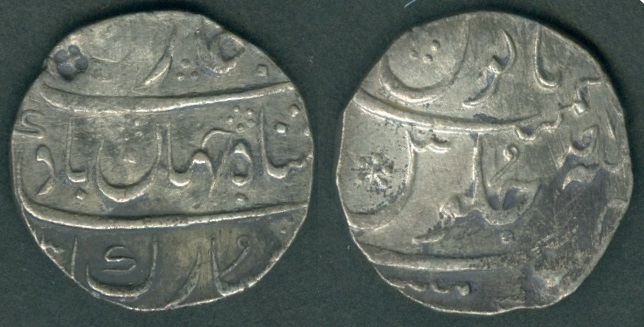 |
KM#160 Rupee.
Year:
AH xx31 - Ahad [1719].
Weight: 11.33g.
Metal: Silver.
Diameter:
26.00 mm. Edge:
Plain.
Alignment: Rotated.
Mint:
Mumbai (Bombay).
Obverse:
Sikka Mubarak Badshah Ghazi Shah Jahan (Auspicious coin of the fighter of infidels (Ghazi), the emperor Shah
Jahan) / xx31. The coin should be dated AH1131. |
|
Reverse:
Zarb Mumbai (Ahad) julus maimanat manus (Struck at Mumbai in
the year First of the
accession associated with tranquil prosperity).
Mintage: N/A.
Mintage Years:
One year type. Ruler:
citing
Rafi ul-Daulah Shah Jahan II S/o Rafi ush-Shah
(ruled in 1719 only).
Note:
Somehow Scarce. |
|
|
 |
KM#163 Rupee.
Year:
AH 114x - RY17 [1734].
Weight: 11.48g.
Metal: Silver.
Diameter:
24.50 mm. Edge:
Plain.
Alignment: Coin.
Mint:
Mumbai (Bombay).
Obverse:
Sikka Mubarak Badshah Ghazi Muhammad Shah. [Auspicious coin of Emperor Muhammad Shah the
fighter of infidels (Ghazi)] /
114x.
The coin should be dated AH1147. |
|
Reverse:
Zarb Mumbai (17) julus maimanat manus (Struck at Mumbai in
the year 17 of the
accession associated with tranquil prosperity).
Mintage: N/A. Mintage Years:
AH1132//2, AH11xx//3, AH1134//4, AH1135//5, AH1136//6, AH1136//7,
AH1137//7, AH1138//8, AH1139//9, AH1141//11, AH1142//12, AH1143//13,
AH1144//14, AH1145//15, AH1146//16, AH1147//17, AH1148//18,
AH1149//19, AH1150//19, AH1151//21, AH1152//22, AH1155//25,
AH1156//26, AH1157//27, AH1159//29, AH11xx//30 and AH1161//31 (1719-1748). Ruler:
citing
Roshan Akhtar
Mohammed Shah S/o Khujistan Akhtar (1719-1748). Note:
Somehow Scarce. Note: The
five-petalled flower with stem became the mintmark for Bombay in
1735 during the reign of Muhammad Shah, and was continued in the
reigns of Ahmad Shah Bahadur and Alamgir II. |
|
 |
Same as above coin, but...
Year:
AH 115x - RY21 [1738].
Weight: 11.51g.
Diameter:
21.50 mm.
Alignment: Coin.
Mint:
Mumbai (Bombay).
The coin should be dated AH1151. |
|
.jpg) |
KM#273 1/5 Rupee.
Year:
ND (1730-1796).
Weight: 2.22g [2.20 - 2.29g].
Metal: Silver.
Diameter:
12.50 mm. Edge:
Plain.
Alignment: Coin.
Mint:
Mumbai (Bombay).
Obverse:
Character “5” inverted.
Reverse: Julus Maimanet Manus
(in tranquil prosperous reign).
Mintage: N/A.
Mintage Years:
One year type. |
|
Note: Originally minted in
Bombay, the one-fifth rupee ("Bombay Billy") was later minted at
Cannanore, even while naming Bombay as the mint name. Cannanore was
within the Bombay Presidency. Note the inverted 5 to represent the
denomination. |
|
 |
KM#176 Rupee.
Year:
ND - RY4 [1759].
Weight: 11.47g.
Metal: Silver.
Diameter:
20.00 mm. Edge:
Plain.
Alignment: Medal.
Mint:
Mumbai (Bombay).
Obverse:
Sikka Mubarak Badshah Ghazi Alamgir (Auspicious coin of the fighter
of infidels (Ghazi), the emperor Alamgir) /
ND.
Unlisted Date in Krause Publications. |
|
Reverse:
Zarb Mumbai (4) julus maimanat manus (Struck at Mumbai in
the year 4 of the
accession associated with tranquil prosperity).
Mintage: N/A. Mintage Years:
AH1169//2 (1756), AH1170//2 frozen (1757) and
AH1173//5 frozen (1760). Ruler:
citing
Aziz ud-Din Alamgir II S/o Jahandar Shah (1754-1759). Note:
Common. |
|
 |
KM#A178 Rupee.
Year:
ND [1760].
Weight: 11.32g.
Metal: Silver.
Diameter:
18.50 mm. Edge:
Plain.
Alignment: Medal.
Mint:
Surat.
Obverse:
Sikka Mubarak Badshah Ghazi Shah Jahan (Auspicious coin of the fighter
of infidels (Ghazi), the emperor Shah Jahan) /
ND.
|
|
Reverse:
Zarb Surat (Ahad) julus maimanat manus (Struck at Surat in
the year First of the
accession associated with tranquil prosperity).
Mintage: N/A. Mintage Years:
One year type. Ruler:
citing Shah Jahan III [Muhyi-e-Millat] S/o Muyhi-e-Sunnat (11 Dec
1759 - 25 Dec 1760).
Note: Scarce. Previously listed as KM#475.4 under India
Mughal Empire. Shah Jahan III (1711 – 1772), (شاه جہان ۳) also
known as Muhi-ul-millat was Mughal Emperor who ruled briefly. He was
the son of Muhi-us-Sunnat, the eldest son of Muhammad Kam Bakhsh who
was the youngest son of Aurangzeb. He was placed on the Mughal
throne in December 1759 as a result of the intricacies in Delhi with
the help of Imad-ul-Mulk. He was later deposed by Maratha Sardars in
December 1760. |
|
 |
KM#189 2 Pice (Double Pice).
Year:
1773.
Weight: 10.11g [10.28g].
Metal: Copper.
Diameter:
21.00 mm. Edge:
Plain.
Alignment:
Rotated.
Mint: Bombay.
Obverse:
Large crown divides G-R at top, "BOMB" written below with date 1773.
Reverse:
United East India Company Bale mark.
Mintage: N/A.
Mintage Years:
One year type.
Note:
The letters in the balemark may be arranged in the usual way, or the
E and the I may be transposed. |
|
|
 |
KM#195 / Pr 126 1½ Pice (6 Reas).
Year:
1791.
Weight: 9.79g [official: 9.71g, but can
be 8.74g - 10.48g].
Metal: Copper.
Diameter:
28.50 mm [27.40 - 28.80 mm]. Edge:
Oblique milling (Grained right).
Alignment: Coin.
Mint: Soho.
Obverse:
United East India Company Bale mark.
Reverse: Balanced Scales with Persian
inscription "Adil" (Justice) written between pans.
Mintage: 2,690,351 (including 1791 and
1794 issues).
Mintage Years:
1791 and 1794. |
|
Note: There may
or may not be a tiny dot below the letter V in the shield. The
holders (looking like tassels), from which the chains are suspended,
vary in sizes (Narrow to Wide). The pointed rod, pointing downwards
in the center of the balanced scale also varies. 1791 dated coins also exists as
KM#195a proof in Copper Gilt metal and KM#194 in copper but with
small scales and vertical milling. |
|
 |
KM#196 / Pr 118 2 Pice (8 Reas or ½ Anna).
Year:
1794.
Weight: 12.94g [official: 12.95g but
can be 12.13-13.45g].
Metal: Copper.
Diameter:
29.50 mm [29.50 - 31.60 mm]. Edge:
Oblique milling (Grained right).
Alignment: Coin.
Mint: Soho.
Obverse:
United East India Company Bale mark.
Reverse: Balanced Scales with Persian
inscription "Adil" (Justice) written between pans.
Mintage: 1,569,330.
Mintage Years:
1791 and 1794.
Note: This coin has no dot below V and
has short and sharp point in balanced scales. |
|
Note: There may
or may not be a tiny dot below the letter V in the shield. 1791
issues has mintage: 1,174,630.
Pivot: The length and style of the pivot varies.
- I: Medium length and fairly sharp
point.
- II: Longer and blunter point.
- III: Short and sharp point.
Production of these coins is often
attributed to the mint of the East India Company in London. This may
be based on Pridmore, who in discussing why the coins were struck in
England says "Other reasons may have been connected with the
establishment of the Company's mint at London at French Ordinary
Court, equipped with modern machinery from Boulton's Soho foundry".
Doty however places the work firmly at Soho itself. He follows the
coinage from the initial contact between Robert Wissett of the EIC
and Boulton on 11 December 1790 through difficulties in obtaining
the copper from Thomas Williams and the production and shipment of
the different denominations even noting that "simultaneous striking
of the largest and smallest sizes continued until the first day of
December". Doty goes on to support Boulton's pride "He had valid
reason for pride. In nine months' time, he had struck over seventen
million copper coins for Bombay. This would have represented a hefty
output for any public mint of the day; but Boulton's private one at
Soho had achieved several other projects as well". Doty records the
mintage figure for the 2 Pice denomination as 1,174,630. |
|
|
 |
KM#197 ½ Pice.
Year:
1802-1829 (date not visible).
Weight: 5.26g [5.31g].
Metal: Copper.
Diameter:
15.00 mm. Edge:
Plain.
Alignment: Medal.
Mint: Bombay.
Obverse:
United East India Company Bale mark.
Reverse:
Scales, Persian language “Adil” (just).
Mintage: N/A.
Mintage Years:
1802, 1808, 1810, 1813, 1815, 1816, 1818,
1819, 1825, 1826, 1827 and 1829. |
|
 |
KM#198 Pice.
Year: 1802-1829
(date not visible). Weight:
10.49g [10.62g].
Metal: Copper; slightly rotated.
Diameter: 21.00
mm. Edge:
Plain. Alignment:
Medal. Mint:
Bombay.
Obverse: United East India Company Bale
mark. Reverse:
Scales, Persian language “Adil” (just).
Mintage: N/A.
Mintage Years:
1802-1804, 1808-1810, 1813, 1815-1816, 1818-
1819 and 1825-1829. |
|
.jpg) |
KM#211.1 ½ Rupee.
Year:
AH-//46 (1800-1815).
Weight: 5.62g [5.76g].
Metal: Silver.
Diameter:
16.50 mm. Edge:
Plain.
Alignment: Medal.
Mint: Surat.
Obverse: “Shah Alam Badshah” (Emperor
Shah Alam II).
Reverse: Persian-julus (formula) with
reignal year 46 and mint name.
Mintage: N/A.
Mintage Years:
One year type. Privy mark #1. |
|
Note: Mint privy marks on dump
issues often were intended to be “secret” (=privy marks), indicating
changes in standards as well as mint of origin. Ten types are
derived from IV Pridmore. These ten types of Privy marks are
involved on the 4 dots in center and 3 diamonds of the right side on
obverse side, above the center line on such coins. All of them are
minted in Bombay in various years based on these dots and diamonds
designs except the above one, which clearly belongs to Surat mint. |
|
|
 |
KM#259.2 ½ Rupee.
Year:
AH1243 (1827).
Weight: 5.86g.
Metal: Silver.
Diameter:
17.85 mm. Edge:
Plain.
Alignment: Medal.
Mint: Ahmedabad.
Obverse: Sikka Mubarak Badshah Ghazi Akbar Shah
(Blessed Coin of Emperor Warrior Akbar Shah) with Date.
Reverse: Zarb Ahmedabad Julus Maimanet Manus
(Stuck at Ahmedabad in tranquil prosperous reign).
Mintage: N/A.
Mintage Years:
AH1242 (1826), AH1243 (1827), AH1244 (1828)
and AH1248 (1832). |
|
 |
KM#260.1 Rupee.
Year:
AH1241//16 Frozen (1825).
Weight: 11.68g [11.59g].
Metal: Silver.
Diameter:
22.50 mm. Edge:
Plain.
Alignment: Medal.
Mint: Ahmedabad.
Obverse: Sikka Mubarak Badshah Ghazi Akbar Shah
(Blessed Coin of Emperor Warrior Akbar Shah) with Date.
Reverse: Zarb Ahmedabad Sanat 16 Julus Maimanet Manus
(Stuck at Ahmedabad in the 16th year of
his tranquil prosperous reign).
Mintage: N/A.
Mintage Years:
AH 1233//11, AH 1233//12, AH 1234//12, AH
1234//13, AH 1235//13, AH 1235//14, AH 1236//13 Frozen, AH 1236//14
Frozen, AH 1239//15 Frozen and AH 1241//16 Frozen. |
|
The British annexed Ahmedabad from the Gaekwar of Baroda in 1817 and
continued to issue coins from that city until 1835, following on the
previous patterns. They introduced the five-petalled flower with
stem, but retained the "Maratha" mintmark of a sun with rays
extending in four directions (seen on Reverse side of the coin at
the bottom left side). This may be the only type issued by the
British in the name of Muhammad Akbar II, as they continued issuing
fictitious coins of reign year 46 of Shah Alam at their other mints. |
|
|
 |
KM#222 Quarter Rupee.
Year:
Frozen AH1215//46 (1830).
Weight: 2.91g [2.91g].
Metal: Silver.
Diameter:
17.50 mm. Edge:
Plain.
Alignment: Coin.
Mint: Surat.
Obverse: Sikka Mubarak Badshah Ghazi Shah Alam
1215
(Blessed Coin dated 1215 of Emperor Warrior Shah Alam).
Reverse: Zarb Surat Sanat 46 Julus Maimanet Manus
(Stuck at Surat in the 46th year of
his tranquil prosperous reign).
Mintage: N/A.
Mintage Years:
One year type. |
|
This is one of India's first machine-made coins and the first issue
of the new Bombay mint, which commenced operations in 1832 and
continues to this date. The coin is full of fictions. Issued in the
years 1832-1835, lists as the date AH 1215, which corresponds to the
years 1800-01. It is issued in the name of Shah Alam II, who had
died in 1806, and lists his regin year of 46, which corresponds to
AH 1217-1218, thus conflicting with the listed date of AH 1215.
Finally, it names as its mint Surat, even though it was actually
issued in Bombay. All of these fictions are so appropriate for a
coin issued in the name of a puppet Mughal emperor by a powerful
colonial power, whose presence is formally indicated only by the
5-petalled flower at left on the reverse! |
|
 |
KM#223 Half Rupee.
Year:
Frozen AH1215//46 (1830).
Weight: 5.72g [5.83g].
Metal: Silver.
Diameter:
22.50 mm. Edge:
Plain.
Alignment: Coin.
Mint: Surat.
Obverse: Sikka Mubarak Badshah Ghazi Shah Alam
1215
(Blessed Coin dated 1215 of Emperor Warrior Shah Alam).
Reverse: Zarb Surat Sanat 46 Julus Maimanet Manus
(Stuck at Surat in the 46th year of
his tranquil prosperous reign).
Mintage: N/A.
Mintage Years:
One year type. |
|
|
 |
KM#220 Rupee.
Year:
Frozen AH1215//46 (1830).
Weight: 11.57g [11.60g].
Metal: Silver.
Diameter:
27.00 mm. Edge:
Plain.
Alignment: Coin.
Mint: Surat.
Obverse: Sikka Mubarak Badshah Ghazi Shah Alam
1215
(Blessed Coin dated 1215 of Emperor Warrior Shah Alam).
Reverse: Zarb Surat Sanat 46 Julus Maimanet Manus
(Stuck at Surat in the 46th year of
his tranquil prosperous reign).
Mintage: N/A.
Mintage Years:
One year type. |
|
|
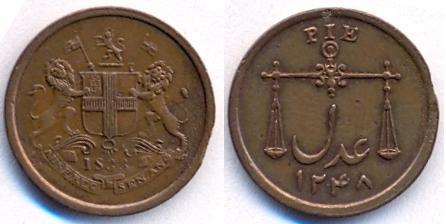 |
KM#261 Pie.
Year:
1833- AH1248.
Weight: 2.10g [2.16g].
Metal: Copper.
Diameter:
12.50 mm. Edge:
Plain.
Alignment: Coin.
Mint: Calcutta.
Obverse:
Loin above shield with date 1833.
The arms of the Company. On the ribbon is the legend: AUSP:REG &
SEN:ANG:
Reverse: Balanced scales with Persian
legend between the pans (translation = Adil = just or fair). The
value above: PIE, AH date (1248) in Arabic figures below.
Large legends with Letters size 1.2 mm.
Mintage: N/A.
Mintage Years:
One year type.
Note: Width of Rim can be Narrow or Broad. |
|
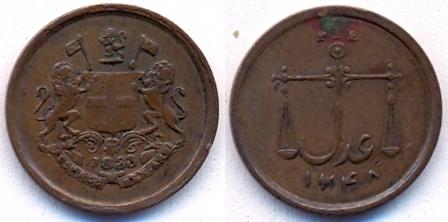 |
KM#262 Pie.
Year:
1833- AH1248.
Weight: 2.15g [2.16g].
Metal: Copper.
Diameter:
12.50 mm. Edge:
Plain.
Alignment: Coin.
Mint: Calcutta.
Obverse:
Loin above shield with date 1833. The arms of the Company. On the
ribbon is the legend: AUSP:REG & SEN:ANG:
Reverse: Balanced scales with Persian
legend between the pans (translation = Adil = justice or fair). The
value above: PIE, AH date (1248) in Arabic figures below.
Small legends with Letters size 0.8 mm.
Mintage: N/A.
Mintage Years:
One year type.
Note: Width of Rim can be Narrow or Broad. |
|
|
 |
KM#231.1 Quarter Anna.
Year:
1830- AH1246.
Weight: 6.27g [6.97g].
Metal: Copper.
Diameter:
24.50 mm. Edge:
Plain.
Alignment: Coin.
Mint: Bombay.
Obverse:
The arms of the Company in the center. On the ribbon is the motto: "AUSPICIO REGIS &
SENATUS ANGLIAE". "EAST INDIA COMPANY" written around the arms of
the Company.
Reverse: Balanced scales with Persian
legend between the pans (translation = Adil = justice or fair). The
value above: "QUARTER ANNA", AH date in Arabic figures below (=1246).
Letters size 1.0 mm.
Mintage: N/A.
Mintage Years:
1830//AH1346 and 1832//AH1346. |
|
Note: The coin's
obverse and reverse is designed from pervious issues. Size of
letters is 1 mm for legends "QUARTER ANNA". KM#231.2 is produced
with 1.5 mm for legends "QUARTER ANNA", having date 1832//AH1347. |
|
 |
Same as above coin. but...
Year:
1832- AH1246.
Weight: 6.28g [6.97g].
Diameter:
25.00 mm. |
|
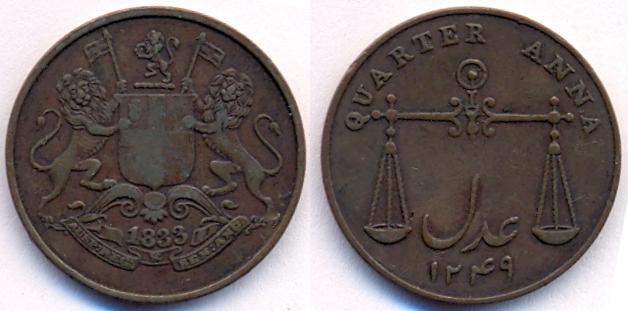 |
KM#232 Quarter Anna.
Year:
1833- AH1249.
Weight: 6.37g [6.97g].
Metal: Copper.
Diameter:
25.00 mm. Edge:
Plain.
Alignment: Coin.
Mint: Calcutta.
Obverse:
The arms of the Company in the center. On the ribbon is the motto: AUSP:REG &
SEN:ANG:
Flat shield without E.I.C.
legend with date 1833.
Reverse: Balanced scales with Persian
legend between the pans (translation = Adil = justice or fair). The
value above: QUARTER ANNA, AH date in Arabic figures below (=1249).
Letters size 1.5 mm.
Mintage: N/A.
Mintage Years:
One year type. |
|
Note: The shield
may be large or small. The rim may be broad, normal or narrow. May
be as 1830-1833 design issue. Size of letters may be 1 mm or 1.5 mm
for legends "QUARTER ANNA". |
|
|
 |
| KM#253 Half Anna.
Year:
1834- AH1249.
Weight: 12.97g [12.95g].
Metal: Copper.
Diameter:
29.50 mm. Edge:
Plain.
Alignment: Coin.
Mint: N/A.
Obverse:
"EAST INDIA COMPANY" written at the top.
The arms of the Company in the center. On the ribbon is the motto: AUSP:REG &
SEN:ANG:
[(Auspicio Regis Et Senatus Anglia); translation: By the
authority of the King and Parliament of England].
Reverse: Balanced scales with Persian
legend "عدل" between the pans (translation = Adil = justice or
fair). The value above: QUARTER ANNA, AH date in Arabic figures
below (=1249).
Mintage: N/A.
Mintage Years:
One year type.
Note: KM#251 has medium legends/size written for "HALF
ANNA", KM#252 has large legends and KM#253 has small legends. |
|
| |
| |
| |
| Madras Presidency |
| |
| The Madras Presidency
(Tamil: சென்னை மாகாணம், Telugu: చెన్నపురి సంస్థానము, Malayalam: മദ്രാസ്
പ്രസിഡന്സി, Kannada: ಮದ್ರಾಸ್ ಪ್ರೆಸಿಡೆನ್ಸಿ, Oriya: ମାଦ୍ରାସ ପ୍ରେସିଡେନ୍ସି),
officially the Presidency of Fort St. George and also known as Madras
Province, was an administrative subdivision of British India. English trade was begun on
the east coast of India in 1611. The first factory was at Mazulipatam and
was maintained intermittently until modern times. Madras was founded in 1639
and Fort St. George was made the chief factory on the east coast in 1641. A
mint was established at Fort St. George where coins of the style of
Vijayanagar were struck. The Madras mint begun minting copper coins after
the renovation. In 1689 silver fanams were authorized to be struck by the
new Board of Directors. In 1692 the Mughal Emperor Aurangzeb gave permission
for Mughal type Rupees to be struck at Madras. These circulated locally and
were also send to Bengal. The chief competition for the Madras coins were
the Arcot Rupees. Some of the bulk coins from Madras were sent to the Nawabs
mint to be made into Arcot Rupees. In 1742 the East India Company applied
for and received permission to make their own Arcot Rupees. Coining
operations ceased in Madras in 1869. Madras Presidency coins were produced
from ca. 1660 to 1835. |
| At its greatest extent,
the presidency included much of southern India, including the present-day
Indian State of Tamil Nadu, the Malabar region of North Kerala, Lakshadweep
Islands, the Coastal Andhra and Rayalaseema regions of Andhra Pradesh,
Ganjam, Malkangiri, Koraput, Rayagada, Nabarangapur and Gajapati districts
of southern Orissa and the Bellary, Dakshina Kannada, and Udupi districts of
Karnataka. The presidency had its winter capital at Madras and summer
capital at Ootacamund. The island of Ceylon was a part of Madras Presidency
from 1793 to 1798 when it was created a Crown colony. Madras Presidency was
neighboured by the Kingdom of Mysore on the northwest, Kingdom of Kochi on
the southwest, and the Kingdom of Hyderabad on the north. Some parts of the
presidency were also flanked by Bombay Presidency. In 1639, the English East India Company purchased the
village of Madraspatnam and one year later it established the Agency of Fort
St George, precursor of the Madras Presidency, although there had been
Company factories at Machilipatnam and Armagon since the very early 17th
century. The agency was upgraded to a Presidency in 1652 before once more
reverting to its previous status in 1655. In 1684, it was re-elevated to a
Presidency and Elihu Yale was appointed as President. In 1785, under the
provisions of Pitt's India Act, Madras became one of three provinces
established by the East India Company. Thereafter, the head of the area was
styled "Governor" rather than "President" and became subordinate to the
Governor-General in Calcutta, a title that would persist until 1947.
Judicial, legislative and executive powers rested with the Governor who was
assisted by a Council whose constitution was modified by reforms enacted in
1861, 1909, 1919 and 1935. Regular elections were conducted in Madras up to
the outbreak of the Second World War in 1939. By 1908, the province
comprised twenty-two districts, each under a District Collector, and it was
further sub-divided into taluks and firqas with villages making up the
smallest unit of administration. Following the Montague-Chelmsford reforms
of 1919, Madras was the first province of British India to implement a
system of dyarchy, and thereafter its Governor ruled alongside a Prime
Minister. In the early decades of the 20th century, many significant
contributors to the Indian independence movement came from Madras. With the
advent of Indian independence on August 15, 1947, the Presidency was
dissolved. Madras was later admitted as a state of the Indian Union at the
inauguration of the Republic of India on January 26, 1950, and was
reorganized in 1956. |
| |
|
 |
KM# A289 Rupee.
Year:
ND - RY 41 [1697].
Weight: 11.53g [11.59g].
Metal: Silver.
Diameter:
22.50 mm. Edge:
Plain.
Alignment:
Rotated.
Mint: Chinapattan
(Madras and now Chennai).
Obverse: Shah Aurangzeb Alamgir sikkah
zad dar jehan cho bedr monir (Shah Aurangzeb Alamgir struck coin in
world like the shining full moon).
Reverse:
Zarb Chinapattan (41) julus maimanat manus (Struck in
Chinapattan in the year
41 of the accession
associated with tranquil prosperity). |
|
Mintage: N/A.
Mintage Years:
AH1103//38, AH-//38, AH-//39, AH-//40,
AH-//41, AH-//42, AH-//43, AH-//44, AH-//45, AH-//48, AH-//49,
AH-//50 and AH-//51.
(1692-1707).
Ruler:
Aurangzeb Alamgir (1658-1707). Note: Scarce. Note: On 22 August
1639, which is referred to as Madras Day, the English East India
Company under Francis Day bought a small strip of land stretching 3
miles on the Coromandel Coast. They got a license to build a fort
and a castle in the contracted region. The ruler Damarla Chennappa
Nayakudu, the Nayaka of Chandragiri, granted the English permission
to build a factory and warehouse for their trading enterprises. The
region was then primarily a fishing village known as "Madraspatnam".
A year later, the English built Fort St. George, the first major
English settlement in India, which became the nucleus of the growing
colonial city and urban Chennai, grew around this Fort. In 1746,
Fort St. George and Madras were captured by the French under General
La Bourdonnais, the Governor of Mauritius, who plundered the town
and its outlying villages. The British regained control in 1749
through the Treaty of Aix-la-Chapelle and strengthened the town's
fortress wall to withstand further attacks from the French and Hyder
Ali, the Sultan of Mysore. They resisted a French siege attempt in
1759 under the leadership of Eyre Coote. In 1769 the city was
threatened by Mysore and the British were defeated by Hyder Ali,
after which the Treaty of Madras ended the war. By the 18th century,
the British had conquered most of the region around Tamil Nadu and
the northern modern–day states of Andhra Pradesh and Karnataka,
establishing the Madras Presidency with Madras as the capital.
Silver rupees were introduced into southern India by Aurangzeb after
his conquest of Golconda and Bijapur in 1687. The company sought
permission to mint rupees in Madras, and received this permission
from Kam Baksh, the son of Aurangzeb, in 1692. The so-called "Madras
rupee" appears to have been struck primarily for use in Bengal.
Chinapattan mint started to issue coins in 1704 in the name of
Mughal Emporor Aurangzeb and later on Shah Alam Bahadur, Jahandar
Shah, Farrukhsiyar and Muhammad Shah. Arcot mint produced coins of
Mughal Emperor Ahmed Shah Bahadur and Machhlipatan mint of Alamgir
II. |
|
 |
Same as above coin but...
Year:
ND - RY 5x [1707].
Weight: 11.50g.
Diameter:
21.25 mm.
Alignment: Medal. This coin
might be RY50 or RY51. My coin has 8 various test marks on the edge. |
|
 |
KM# A302 Rupee.
Year:
AH 1119 - Ahad [1707].
Weight: 11.44g [11.57g].
Metal: Silver.
Diameter:
22.00 mm. Edge:
Plain.
Alignment: Coin.
Mint: Chinapattan
(Madras and now Chennai).
Obverse:
Shah Alam Badshah Ghazi
[Fighter of infidels (Ghazi), Emperor Shah Alam] / ND. Sanah (Year)
with Date written at the bottom. |
|
Reverse:
Zarb Chinapattan (Ahad) julus maimanat manus (Struck
at Chinapattan in the year
First of the accession
associated with tranquil prosperity).
Mintage: N/A. Mintage Years:
AH1119//1, AH1119//2, AH1120//2, AH1120//3,
AH1121//3, AH1121//4, AH1122//4, AH1122//5, AH1123//5, AH1123//6 and
AH1124//6 (1707-1712).
Ruler:
Shah Alam Bahadur S/o Aurangzeb (1707-1712). Note: Scarce. |
|
 |
Same as above coin. but...
Year: ND - RY3 [1709].
Weight: 11.46g.
Diameter:
23.00 mm.
Alignment: Rotated. |
|
 |
KM# E302 Rupee.
Year:
AH 1125 - RY 2 [1714].
Weight: 11.54g [11.57g].
Metal: Silver.
Diameter:
23.00 mm. Edge:
Plain.
Alignment: Rotated.
Mint: Chinapattan
(Madras and now Chennai).
Obverse:
Sikka Zad Az Fazl-e-Haq Bar Sim-O–Zar Badshah Bahar-O-Bar
Farrukh-Siyar (Struck money of gold and silver by the grace
of God, Emperor of sea and land, Farrukh Siyar) / 1125.
|
|
Reverse:
Zarb Chinapattan (2) julus maimanat manus (Struck in
Chinapattan in the year
2 of the accession
associated with tranquil prosperity).
Mintage: N/A.
Mintage Years:
AH1125//2, AH1126//2, AH1126//3, AH1128//5,
AH1129//5, AH1129//6, AH1130//6 and AH1130//7 (1714-1718).
Ruler:
Farrukh-Siyar S/o Azim-ush-Shan (1713-1719). Note: Common
type. |
|
| |
| Monetary System:
1 Dudu = 10 Cash = 2 Fulus
8 Dudu = 1 Fanam
36 Fanam = 1 Pagoda (1688-1802)
42 Fanam = 1 Pagoda (1802-1817)
45 Fanam = 1 Pagoda (1817-1835)
3-1/2 Rupees = 1 Pagoda
Mohur = 15 Rupees
Mints: Arcot, Masulipatnam (Machilipatnam) and Tegnapatam (Fort St.
David). |
| Banner words:
Auspicio Regis & Senatus Angliae = "By command of the King and Parliament of
England". |
| |
|
 |
KM#315 1 Cash.
Year: 1803.
Weight: 0.61g [0.64g].
Metal: Copper.
Diameter:
11.50 mm [11.40 - 11.50 mm]. Edge:
Plain.
Alignment: Coin.
Mint: Soho.
Obverse:
East India Company crest: Lion rampant left carrying crown. Date at
the bottom.
Plain border.
Reverse: Value "Kash" (Cash) in Persian above
center lines and "I. CASH" in English below the two lines.
Plain border.
Mintage: 17,994,240.
Mintage Years:
One year type. |
|
Note: Coin alignment coin has weight
0.61 - 0.64g and Medal alignment weights 0.77g. Similar pieces weighing 1.27g are
modern fantasies, which are referred in “Unusual World Coins” 4th edition. |
|
 |
KM#316 5 Cash / 1 Falus.
Year: 1803.
Weight: 3.06g [official = 3.23g; actual
= 2.99 - 3.17g].
Metal: Copper.
Diameter:
21.00 mm [21.00 - 21.10 mm]. Edge:
Plain.
Alignment: Coin.
Mint: Soho.
Obverse:
"EAST INDIA COMPANY" written above.
Arms of the Company in the center with the date at the bottom. Ribbon inscription:
"AUSPICIO REGIS &
SENATUS ANGLIAE".
Reverse: The value in Persian "panj kas
yek falus ast" (Five Cash makes one Falus). Value in
English below the two lines "V . CASH" at the bottom.
Mintage: 12,304,416.
Mintage Years:
One year type. |
Obverse Varieties:
Letters: The letters may be 0.8mm high
or >0.8mm.
Design: The direction that the
left-hand flagstaff points, is an easily seen difference. The helmet
is also a different shape or perhaps the clip size on the top of the
shield overlapping the helmet. This is most often seen on proofs but
also, more rarely, on currency specimens.
Note: KM#317 exists with same details
and diameter but weight = 2.41g. |
|
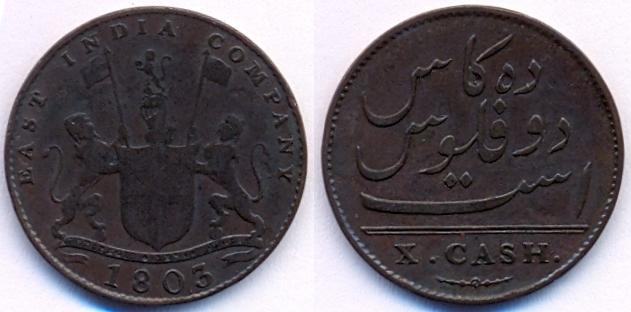 |
KM#319 10 Cash / 2 Falus.
Year: 1803.
Weight: 5.43g [official = 6.47g; actual
= 6.24 - 6.46g].
Metal: Copper.
Diameter:
24.80 mm. Edge:
Plain.
Alignment: Coin.
Mint: Soho.
Obverse:
"EAST INDIA COMPANY" written above.
Arms of the Company in the center with the date at the bottom. Ribbon inscription:
"AUSPICIO REGIS &
SENATUS ANGLIAE". All within a raised toothed border.
Reverse: The value in Persian "dah kas
do falus ast" (Ten Cash makes two Falus). Value in
English below the two lines "X . CASH" at the bottom. All
within a plain raised rim.
Mintage: 6,304,560 (including 1808
heavier and lighter issues).
Mintage Years:
1803 and 1808. |
|
Note: 1808 issue
has heavier weight: 6.47g [actual: 6.47 - 6.56g]. |
|
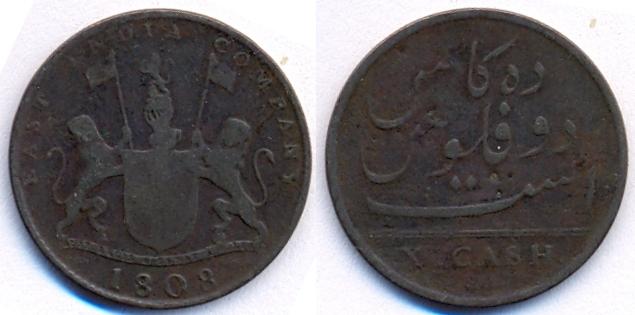 |
KM#320 10 Cash / 2 Falus.
Year: 1808.
Weight: 4.31g [official = 4.66g; actual
= 4.62 - 4.84g].
Metal: Copper.
Diameter:
25.80 mm. Edge:
Plain.
Alignment: Coin.
Mint: Soho.
Obverse:
"EAST INDIA COMPANY" written above.
Arms of the Company in the center with the date at the bottom. Ribbon inscription:
"AUSPICIO REGIS &
SENATUS ANGLIAE".
Reverse: The value in Persian "dah kas
do falus ast" (Ten Cash makes two Falus). Value in
English below the line "X . CASH" at the bottom.
Mintage: 6,304,560 (including KM#319,
1803 and 1808 issues).
Mintage Years:
One year type. |
|
Note: Pridmore
classifies the weights of these coins as heavy issue 1803 and 1808
(6.47g) and a light issue of 1808 (4.66g). However the weights vary
in a more complicated way than this. An example of the light issue
exists, dated 1803, and there are both intermediate weight coins
(5.35g) and very light weight coins (3.36g) dated 1808. Nice salvaged and cleaned examples from the
Admiral Gardner ship are commonly known. This English East India
Company ship that sank on the sands of South Foreland on January 24,
1809 with seven crewmen and a cargo of coins for nearly 200 years.
The ship along with its sister ship Britannia was on its way to
India to pay the workers in Bengal and Madras when a severe storm
ran her aground. |
|
 |
| KM#321 20 Cash / 4 Falus.
Year: 1803.
Weight: 12.54g [official = 12.95g;
actual = 11.90 - 12.32g].
Metal: Copper.
Diameter:
30.70 mm [30.50 - 30.90 mm]. Edge:
Plain.
Alignment: Coin.
Mint: Soho.
Obverse:
"EAST INDIA COMPANY" written above.
Arms of the Company in the center with the date at the bottom. Ribbon inscription:
"AUSPICIO REGIS &
SENATUS ANGLIAE".
Reverse: The value in Persian "bist kas
chahar falus ast" (Twenty Cash makes four Falus). Value in
English below the two lines "XX . CASH" at the bottom.
Mintage: 1,323,360 (including 1808
issue as well).
Mintage Years:
One year type with 1808 issues having less
weight: 9.13 - 9.59g.
Note:
According to Kaslove, this coin also exists in Medal alignment, both
in bronzed and copper as proofs. |
|
|
.jpg) |
KM#309 2½ Cash.
Year: ND (1807).
Weight: 1.10g [official = 1.21g;
actual = 1.06 - 1.30g].
Metal: Copper.
Diameter:
15.70 mm [15.80-17.60 mm]. Edge:
Plain.
Alignment: Coin.
Mint: Madras.
Obverse:
Value in Persian "In do va-nim kas ast" (this is two and a half
cash) at the top and in English "2 1/2 CASH" at the bottom.
Reverse: Value in Telegu top two
lines "Idi 2 1/2 kasulu" and value in Tamil bottom two lines "Idu 2
1/2 kasu" (this is two and a half cash).
Mintage: 561,622 (till March 1808).
Mintage Years:
One year type. |
|
Note:
This coin may exists in Medal and Coin
alignment. This coin also exists with same size and weight as of
five cash planchet. This larger version has been recorded from
Pridmore to have this coin weight: 2.32g and diameter: 21 mm. |
|
.jpg) |
5 Cash.
Year: ND (1807).
Weight: 3.03g [official = 2.41g; actual
= 2.24 - 2.59g].
Metal: Copper.
Diameter:
18.50 mm [19.60 - 21.10 mm]. Edge:
Plain.
Alignment: Coin.
Mint: Madras.
Obverse:
Value in Persian "In panj kas ast" (this is five cash) at the top and in English
"V. CASH" at the bottom.
Reverse: Value in Telegu top two
lines "Idi aedu kasulu" and Tamil bottom two lines "Idu anacu kasu"
(this is five cash).
Mintage: 1,216,822 (till March 1808).
Mintage Years:
One year type.
Note:
Unlisted type in Krause publications. It seems
that the diameter of the coin is reduced as it has many cuts all
around. |
|
Four Varieties exists: 01. The line
separating the Persian from the English legends differs. It may be a
number of dots alone with medal alignment.
02. The line separating the Persian from the English legends
differs. It may be a number of dots alone with coin alignment.
03. The line separating the Persian from the English legends
differs. It may be no separator with medal alignment.
04. The line separating the Persian from the English legends
differs. It may be no separator with coin alignment. |
|
.jpg) |
KM#326 10 Cash.
Year: ND (1807).
Weight: 4.86g [official = 4.83g; actual
= 4.24 - 4.95g].
Metal: Copper.
Diameter:
23.00 mm [22.70 - 26.50 mm]. Edge:
Plain.
Alignment: Medal.
Mint: Madras.
Obverse:
Value in Persian "In dah kas ast" (this is ten cash) at the top and
value in English "X. CASH" at the bottom.
Reverse: Value in Telegu top two
lines "Idi padi kasulu" and Tamil bottom two lines "Idu pattu kasu"
(this is ten cash).
Mintage: 2,127,922 (till March 1808).
Mintage Years:
One year type.
Note: Also exists, struck on a XX Cash planchet. |
| There are 7 obverse and 5 reverse combinations, making 16 types
recorded of this 10 cash coin including one coin alignment issue as
well. The diameter of the flans can vary quite considerably.
Pridmore records a separate catalogue entry for a very large flan
specimen. Obverse Varieties:
Separator: The line separating the
Persian from the English legends differs. It may be a plain line,
two plain lines, a number of dots and stars, or a number of dots
alone. The single plain line variety often has a second thin line
immediately underneath. The double plain line variety is two clearly
separated lines of about the same width. Possible combinations are:
Plain, Two Plain, Dots/Stars, 5 dots/dash, 6 dots/dash, 7 Dots or 9
Dots.
Stop After X: There is usually a stop
after the X value letter. Sometimes this is missing.
Reverse Varieties:
Dividing Line: There may or may not be
a dividing line between the Tamil and Telugu legends. The single
line variety often has a thin second line associated with it. The
double line variety has two distinct lines of about equal width
First Tamil Letter: The first letter in
the Tamil legend may take a number of different forms. This might be
the correct form, a modified form or a square form. |
|
|
.jpg) |
KM#339 2 Fanam.
Year: ND (1807).
Weight: 1.76g [official = 1.85g; actual
= 1.70 - 1.87g].
Metal: 0.920
Silver. Diameter:
12.70 mm [12.10 - 13.20 mm]. Edge:
Plain.
Alignment: Medal; slightly rotated.
Mint: Madras.
Obverse:
Value in Persian "Do Fanam" in the center. "Double Fanam"
in English written in circular clockwise around Persian legends.
Reverse: Value in Telegu "Renddu rukalu" in center and
in Tamil value "Irantu panam" in circular around.
Mintage: 1,511,087 (including below and other
types).
Mintage Years:
One year type.
Note: This coin has no center circle on
both sides. |
|
There are 10 obverse and 6 reverse combinations, making 16 types
recorded of the above KM#339, 2 Fanam coin.
Obverse Varieties:
Centre Circle: There may or may not be
a plain circle surrounding the Persian legend.
Stops in Legend: The stops in the
English legend may be composed of single dots (1), or a quartet of
dots (Q) arranged roughly in the shape of a diamond. (E.g. Q+1 means
quartet after DOUBLE and single after FANAM, 1+Q means single after
DOUBLE and quartet after FANAM). Alternatively there may be no stops
at all (0). Possible combinations are: 1+1, 1+Q, 0+0 or 0+1.
F & A's of FANAM: The second bar of F
of FANAM is missing. A's of FANAM are upside-down V's.
F of FANAM (as E): F of FANAM
represented by E.
Second bar of F: The second bar of the
F is missing.
All letters of FANAM: F represented by
E, 'A's with no bars, N retrograde, M represented by W.
Reverse Varieties:
Centre Circle: The Telugu legend may or
may not be surrounded by a plain circle.
Legend U/S Down: The Telugu legend may
or may not be upside-down relative to the Tamil legend.
Stops in Legend: The stops in the Tamil
legend may be composed of single dots (1), or a quartet of dots (4)
arranged roughly in the shape of a diamond. Alternatively there may
be no stops at all (0). Possible combinations are: Q+Q, 0+0, 1+1 or
1+Q. |
|
.jpg) |
KM#340 2 Fanam.
Year: ND (1807).
Weight: 1.78g [official = 1.85g;
actual = 1.70 - 1.87g].
Metal: 0.920
Silver. Diameter:
12.70 mm [12.10 - 13.20 mm]. Edge:
Oblique milling (Grained right).
Alignment: Medal.
Mint: Madras.
Obverse:
Value in Persian "Do Fanam" in the center circle. "Double Fanam"
in English written in outer circle clockwise.
Reverse: Star at the top. Value in Telegu
"Renddu rukalu" in center
circle and
in Tamil Irantu panam" in outer circle.
Mintage: 1,511,087 (including above and other
types).
Mintage Years:
One year type.
Note: This coin has center circle on
both sides. |
|
-Type2.jpg.jpg) |
Same as above coin, but has some major differences like "Meem"
alphabet missing in the end of Persion "Fanam".
Weight: 1.85g.
Buckle Shape: No Buckle (formed of
dots). Spelling of Legend:
Correct. Stop in Legend:
Yes.
Shading in Buckle:
Not available.
Tamil legend:
Clockwise (opposite from above coin). |
|
.jpg) |
KM#350 2 Fanam.
Year: ND (1808).
Weight: 1.83g [official = 1.85g;
actual = 1.70 - 1.87g].
Metal: 0.920
Silver. Diameter:
12.70 mm [12.10 - 13.20 mm]. Edge:
Oblique milling (Grained right).
Alignment: Medal.
Mint: Madras.
Obverse:
Value in Persian "Do Fanam" in the center circle. "Double Fanam"
in English written in outer circle clockwise.
Reverse: Star at the top. Value in Telegu
"Renddu rukalu" in center
circle and
in Tamil Irantu panam" in outer circle.
Mintage: 6,044,350.
Mintage Years:
One year type. Note: Larger buckle, "Do" in Persian
in larger legend, lines are crossing after "M" in "FANAM"
and the
size of legends are wide and smaller on both sides from the above
KM#340 coin.
|
| There are 24 obverse and 2 reverse combinations,
making 24 types recorded of the above 2 Fanam coins.
Obverse Varieties:
Buckle Shape: The buckle may be square,
short oval, long oval or formed with dots (no buckle).
Spelling of Legend: The legend may be
mis-spelt, e.g. DOUBLE may be spelt DOBLE or DOBBLE, and FANAM spelt FANM or
FANAW.
Diacritical marks: There should be one
diacritical mark in the Persian legend. This mark is above the
central legend (upper mark - U). There may be an extra dot within
the letters (mid mark - M), or another mark below the letters (lower
mark - L). Some coins have no marks.
Stop in Legend: There may or may not be
a stop in the legend.
Shading in Buckle: The shading may or
may not extend into the buckle.
Reverse Varieties:
Tamil legend: The Tamil legend
may run in a clockwise or anti-clockwise direction.
Edge with Vertical reeded types:
- KM#338 2 FANAM: ND(1807) 1.85 g., Silver, 12.5 mm. Obverse:
Value in English around center circle. Reverse: Value in Telugu
and Tamil, without center circle.
- KM#341 2 FANAM: ND(1808) 1.85 g., Silver, 12.5 mm Obverse:
Without center circle, value in English. Reverse: With center
circle, value in Telugu and Tamil.
|
|
|
.jpg) |
KM#351 5 Fanam.
Year: ND (1808).
Weight: 4.52g [official = 4.65g; actual
= 3.92 - 4.74 g].
Metal: 0.920
Silver. Diameter:
22.00 mm [20.50 -22.70 mm]. Edge:
Oblique milling (Grained right).
Alignment: Medal.
Mint: Madras.
Obverse:
Value in Persian "Panj Fanam" in the center circle. "Five Fanam" in
English written in circular clockwise around Persian legends.
Buckled garter at the bottom.
Reverse: Star at the top. The value in
Telugu "Aedu rukalu" in two lines, separated by a bead in the
center. Ribbon containing value in Tamil "Anacu panam" around.
Mintage: 3,953,694.
Mintage Years:
One year type. |
|
-edge.jpg) |
Edge:
Oblique milling (Grained right) of the
above coin. |
|
Based on the below 8 combinations, 19 types recorded of this 5 Fanam
coin. There is usually a bead in the centre of the reverse legend.
However, it is often difficult to see, and using the presence or
absence of this bead as a distinguishing feature for a variety is
not reliable. We have therefore, not used this as a feature.
Stops in legend: There may be no stops
in the English legend, or there may be a centre stop.
Buckle Shape: The buckle may be Large
square, Small square (or medium), oval, or formed with dots. Some
Oval buckles may appear square but can be differentiated by the
rounded corners and the shape of the tongue.
Shading in buckle: The shading may or
may not extend into the buckle.
Cross tongue: The buckle may or may not
have a cross-tongue.
Spelling of FIVE: FIVE may be mis-spelt
FIVB.
The Tamil legend: clockwise or
anti-clockwise direction.
Alignment: Medal and in some rare case
Coin as well.
Edge: Grained right but in some rare
case Grained left as well. |
|
-T1.jpg) |
| KM#352 1/4 Pagoda.
Year: ND (1808).
Weight: 10.49g [official = 10.58g;
actual = 10.26 - 10.71g].
Metal: 0.920
Silver. Diameter:
26.00 mm [25.60 - 28.30 mm]. Edge:
Oblique milling (Grained right).
Alignment: Medal.
Mint: Madras.
Obverse:
Seven tiered Gopuram of a temple, standing on stony ground,
surrounded by 9 stars on each side within the center circle. Value in
Persian (Persian = Pau hun phuli = quarter of a flower, or star,
pagoda) at the lower left side outside the circle and "QUARTER
PAGODA" in English at the right and top side clockwise. Buckled
garter at the bottom.
Reverse: Star at the top. Figure of
Vishnu usually holding a sword in his left hand. Dots, pellets,
crescents and other symbols on each side and a lotus flower below
it. All surrounded by two circles of beads. Ribbon containing Telugu
value "Kal vara hun" on the
left side and Tamil value "Kal vara kun"on the right side.
Mintage: 7,091,587.
Mintage Years:
One year type. |
|
-T2.jpg) |
| Same as above coin, but...
This coin
is having thinner legends on both sides. The "Q" in QUARTER, Dot
circular pattern near the border, Buckle style, Tamil legend
distance from the banner end on the right side and the deity Vishnu
image, sword size in Vishnu's left hand are visible difference from the above coin.
Weight: 10.50g [10.58g].
Diameter:
26.60 mm [25.60 - 28.30 mm].
There are 21 obverse and 16 reverse combinations, making 50 types
recorded of this Quarter Pagoda coin.
Obverse Varieties:
Buckle Shape: The buckle may be
square or oval.
Number of stars: The number of stars on
each side of the gopuram can vary; 7+7 or 8+8 or 9+8 or 9+9.
Stops in Legend: The English legend may
contain no stops, a centre stop alone, an end stop alone, or a
centre stop plus an end stop.
Shading in buckle: The shading may or
may not extend into the buckle.
Cross tongue: The buckle may or may not
have a cross-tongue.
Spelling of QUARTER: QUARTER may be mis-spelt
QUARTE
Spelling of PAGODA: PAGODA may be mis-spelt
PAPAGODA or PAGOD.
Reverse Varieties:
Bead below Vishnu: There may be
zero, one or two beads below Vishnu's feet within the stalk of the
lotus flower. These beads are separate from those that form part of
the circles of beads.
Top Left Cross: Next to Vishnu's left
arm is an arrangement of dots topped by a cross shape, representing
one of his wives. The number of dots that form this figure varies.
Very rarely, one of the beads may be incorporated into the inner
circle of beads. The number of beads in the cross is then expressed
as, 8/9 or 9 or 11.
Top Right Cross: Next to Vishnu's right
arm is an arrangement of dots topped by a cross shape, representing
one of his wives. The number of dots that form this figure varies.
Very rarely, two of the beads may be incorporated into the inner
circle of beads. The number of beads in the cross is then expressed
as, 9 or 9/11 or 11 or 13.
Vishnu's Sword: The facing figure of
Vishnu usually holds a sword in his left hand, but rarer examples
exist with the sword in his right hand, or no sword at all.
Stop in Legend: There may or may not be
a stop between the Tamil and Telugu legends.
Bead above Vishnu: There is sometimes a
single bead above Vishnu's head. This bead is sometimes incorporated
into the inner ring of beads and it is then difficult to determine
if there is a separate bead or not. If there is doubt, then NO bead
is considered to be present.
Note: A Gopuram or Gopura, is a monumental tower, usually
ornate, at the entrance of any temple, especially in Southern India.
This forms a prominent feature of Koils, Hindu temples of the
Dravidian style. They are topped by the kalasam, a bulbous stone
finial. They function as gateways through the walls that surround
the temple complex. |
|
|
 |
KM#408 1/8 Rupee.
Year: AH 1172-RY6.
Weight: 1.42g [1.46g].
Metal: Silver.
Diameter:
13.50 mm. Edge:
Oblique milling.
Alignment: Medal.
Mint: Arcot.
Obverse:
Persian legend: 1172 Sikka Badshah Alamgir = 1172 Money of the
Emperor Alamgir.
Reverse:
Open lotus. Persian legend: Zarb Arkat sanat 6 = Struck at Arcot in
his 6th year.
Mintage: N/A.
Mintage Years:
One year type but minted during 1812-1817.
Note: Closed
lotus form also exists with the same date and reignal year as KM#412
minted 1817-1835. |
|
 |
KM#424 1/8 Rupee.
Year: AH 1172-RY6.
Weight: 1.44g [1.46g].
Metal: Silver.
Diameter:
13.50 mm. Edge:
Oblique milling.
Alignment: Medal.
Mint: Arcot.
Obverse:
Persian legend: 1172 Sikka Badshah Alamgir = 1172 Money of the
Emperor Alamgir.
Reverse:
Rose. Persian legend: Zarb Arkat sanat 6 = Struck at Arcot in his
6th year.
Mintage: N/A.
Mintage Years:
One year type but minted during 1823-1825. |
|
 |
|
KM#427 / Prid#263 Rupee.
Year: AH 1172-RY6.
Weight: 11.59g [11.66g].
Metal: Silver.
Diameter:
26.00 mm. Edge:
Reeded (Vertical milling).
Alignment: Medal.
Mint: Calcutta.
Obverse:
Sikka Mubarak Badshah Ghazi Aziz ad-din Mohammad Alamgir
(Auspicious coin of the fighter of infidels (Ghazi), the emperor
Aziz ad-din Mohammad Alamgir) // 1172.
Reverse:
Rose. Zarb Arkat (6) julus maimanat manus (Struck at Arcot in the
year 6 of the accession associated with tranquil prosperity).
Mintage: N/A.
Mintage Years:
One year type but minted during 1823-1825.
Note: KM#436 / Prid#268 Rupee has the
same specification as above coin but have an additional small
crescent on Reverse side at 5 o' clock near the edge. This issue was
struck by the French as were Arcot Rupees in the names of other
Mughal emperors, dated AH1149-1233.
Other Varieties of Arkat Rupee with Lotus mint
marks:
-
KM# 403 / Prid#247. Silver
Rupee. Weight:
12.10 g.
Diameter: 28.00 mm.
Edge: Oblique
milling. Mint mark:
Open Lotus.
Date: AH 1172//6 Frozen.
Mintage:
2,144,806. Dies and machinery were produced in Calcutta.
-
KM# 410 / Prid.#251, Prid.#252.
Silver Rupee.
Weight: 11.66
g. Diameter:
27.80 mm.
Edge: Indented cord milling.
Mint mark:
Open Lotus. Date:
AH 1172//6 Frozen and AH1176(sic)//6
Frozen. Mintage:
10,939,021 (for both types).
-
KM# 415.1 / Prid#258.
Silver Rupee. Weight:
11.66 g.
Diameter: 27.80 mm.
Edge:
Indented cord milling. Mint mark:
Closed form Lotus.
Date: AH
1172//6 Frozen. Mintage:
63,116,258.
Mint: Madras.
-
KM# 415.2. Silver Rupee.
Weight: 11.66
g. Diameter:
27.80 mm.
Edge: Center graining left.
Mint mark:
Closed form Lotus. Date:
AH 1172//6 Frozen.
Mintage: N/A.
|
|
.jpg) |
KM#422 5 Rupee.
Year: ND (1820).
Weight: 3.87g [3.88g].
Metal: Gold.
Diameter:
19.50 mm. Edge:
Reeded.
Alignment: Medal.
Mint: Madras.
Obverse:
"English East India Company" with emblem.
Reverse: Ingarays Bahadur Comapany - Panj Rupaya (English Brave Company -
Five Rupees).
Mintage: 2,179,573.
Mintage Years:
One year type.
This coin occurs with four varieties. The size of lion and placement
of stop after COMPANY vary. |
|
|
 |
KM#429 2 Pies.
Year: 1825 - AH1240.
Weight: 4.29g [4.27g].
Metal: Copper.
Diameter:
22.00 mm. Edge:
Plain.
Alignment: Coin.
Mint: Royal Mint, London.
Obverse:
Shield with British arms, topped by lion, supported by two lions,
which are holding flags. Banner with motto: AUSP: REGIS & SEN ANGLIAE: ("Under the auspices of the king and senate of England"). Date
above Motto. All within a raised toothed rim.
Reverse: Numeral "2" at the top with
value in Persian "Do Pai" and date "1240", all within wreath.
All with a raised, toothed border.
Mintage: 7,126,104.
Mintage Years:
One year type. |
|
|
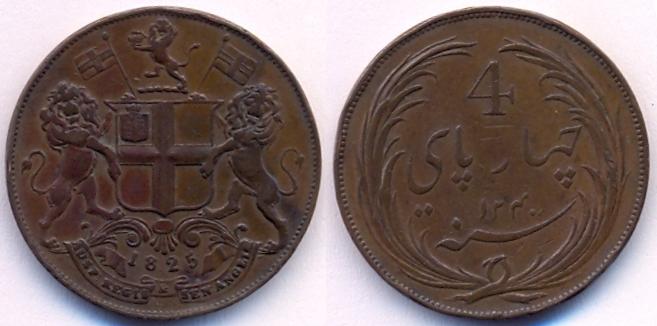 |
| KM#431 4 Pies.
Year: 1825 - AH1240.
Weight: 8.47g [8.55g].
Metal: Copper.
Diameter:
26.70 mm [27.00 mm]. Edge:
Plain.
Alignment: Coin.
Mint: Royal Mint, London.
Obverse:
Shield with British arms, topped by lion, supported by two lions,
which are holding flags. Banner with motto: "AUSP REGIS & SEN
ANGLIAE": ("Under the auspices of the king and senate of England"). Date
above Motto. All within a raised toothed rim.
Reverse: Numeral "4" at the top with
value in Persian "Chahar Pai" and date "1240", all within wreath.
All with a raised, toothed border.
Mintage: 7,136,448.
Mintage Years:
One year type.
Note: There are some varieties of 4
Pies, regarding the wreath tip at the top. This coins has left tip
straight and right tip down as shown. Some more varieties are as
follow:
- KM#430 4 PIES 1824//AH1240, left tip
straight and right tip down (different date than above coin).
- KM#432 4 PIES 1825//AH1240, right tip
points up.
- KM#433 4 PIES 1825//AH1240, right tip
in straight line.
|
|
| |
| |
- Governor General of India
- Below is the list of Governor Generals of
India according to Charter Act of 1833.
- William Henry
Cavendish-Bentinck, Lord Bentinck............1833 - 20 Mar 1835
- Sir Charles
Theophilus (Lord) Metcalfe (acting).....20
Mar 1835 - 04 Mar 1836
- George Eden, Baron
Auckland.........................04 Mar 1836 - 28 Feb 1842
- From 1839, George Eden,
Earl of Auckland
- Edward Law, Baron
(Earl of ) Ellenborough...........28 Feb 1842 - Jun 1844
- William
Wilberforce Bird (acting)......................Jun
1844 - 23 Jul 1844
- Sir Henry Hardinge..................................23
Jul 1844 - 12 Jan 1848
- From May 1846, Viscount
Hardinge.
- James Andrew Broun
Ramsay...........................12 Jan 1848 - 28 Feb 1856
- From 1849, Marquess and
Earl of Dalhousie.
- Charles John
Canning, Viscount Canning..............28 Feb 1856 - 30 Oct 1858
- He continued as Governor General & Viceroy of
India until 21 Mar 1862. As East India Company was dissolved on 30 Oct
1858, Queen Victoria became the ruler of British India until her death
on 22 Jan 1901.
|
| |
| In 1833, the three
presidency was united as East India Company and started to produce one
common coinage. Monetary System:
Rupee = 64 Pice (Paisa) = 192 Pie. [Mohur (Ashrafi) = 15
Rupees] |
| |
| 1835 - coinage
during William IV |
| Banner words: AUSP:
REG: & SEN. ANG = "Under the auspices of the king and senate of England". |
| |
|
 |
KM#445 1/12 Anna / Pie.
Year:
1835.
Weight: 1.97g.
Metal: Copper.
Diameter:
18.00 mm. Edge:
Plain.
Alignment: Medal.
Mint: Bombay.
Obverse:
Arms of the Company, with the date between the scroll and the
ribbon. The ribbon bears the abbreviated Latin motto: AUSP: REG: &
SEN: ANG: with date 1835.
Reverse: The Value in English and
Persian (Suls pai = One-third pice): 1/12 ANNA Within a laurel
wreath. Around this is the legend: EAST INDIA COMPANY. Large legends.
Mintage: 72,313,000.
Mintage Years:
One year type.
Note: Size differentiate between
Bombay, Calcutta and Madras mints. |
|
 |
KM#445 1/12 Anna / Pie.
Year:
1835.
Weight: 2.15g.
Metal: Copper.
Diameter:
17.85 mm [17.7 - 17.9]. Edge:
Plain.
Alignment: Medal.
Mint:
Madras.
Obverse:
Arms of the Company, with the date between the scroll and the
ribbon. The ribbon bears the abbreviated Latin motto: AUSP: REG: &
SEN: ANG: with date 1835.
Reverse: The Value in English and
Persian (Suls pai = One-third pice): 1/12 ANNA Within a laurel
wreath. Around this is the legend: EAST INDIA COMPANY. Small legends.
Mintage: 133,788,000.
Mintage Years:
One year type.
Note: Calcutta mint coins with diameter 17.5 mm
were produced in 1835 as proof and in 1848 with mintage of
14,380,000. |
|
| KM#446.2 Quarter Anna.
Year:
1835.
Weight: 6.47g.
Metal: Copper.
Edge:
Plain.
Obverse:
Arms of the Company, with the date between the scroll and the
ribbon. The ribbon bears the abbreviated Latin motto: "AUSP: REG: &
SEN: ANG:".
Reverse: The value within a wreath of
laurel: ONE QUARTER ANNA. Between the tips of the wreath is the
value in Persian (Yek Pai = One Pice): Around this the legend: EAST
INDIA COMPANY.
Mintage Years:
One year type.
Quarter annas dated 1835 were issued from Calcutta starting in
December 1835 although there was much debate about whether or not to
go ahead with the coinage. In the middle of 1836 the coinage of
copper coins was suspended due to the lack of copper driving up the
price. By the end of June about 17 million pieces had been struck.
It was not until 1838 that a new method for getting the coins into
circulation was introduced [9]. Madras began to strike the coins in
the middle of 1837. Bombay continued to issue the quarter annas that
had been introduced in 1830, before the uniform coinage, and it was
not until 1846/47 that this mint began to strike quarter annas with
the same design as that of the other two mints. Attribution of the
quarter annas dated 1835 to the different mints is difficult.
Pridmore chose to assign coins to the various mints based on the
diameter of their flans. Diameter is certainly a distinguishing
feature for some coins (26.1-26.3mm compared with 25.2-25.5mm).
Pridmore assigns the larger diameter coins to Calcutta, though his
grounds for doing so are not clearly apparent. It may be because he
identifies some proofs with broad rims as issues of the Calcutta
Mint, and these have diameters of 26.2mm. He then divides the
smaller diameter coins between Bombay (25.2-25.3mm) and Madras
(25.4-25.5mm). This difference is very difficult substantiate.
Differences in
Quarter Anna 1835 coins:
- Diameter of the coin: Size
differentiate between Bombay: 25.2 mm (Mintage: 36,766,903),
Calcutta: 26.2 mm (Mintage: 755,059,377) and Madras: 25.5 mm
(Mintage: 186,529,741). 1849 date is known without any mint
details. There is only one type for Bombay mint, seven varieties
of Calcutta mint and two varieties for Madras.
- The numeral 1 in the date may
have a flat top (F) or a sloping top (S). There are other
differences e.g. ornament below shield is attached to the shield
on sloping top variety but detached on flat top variety. Flat
top variety belongs purely to Calcutta mint only.
- The ribs of the lions also
differ: Less clear ribs or very clear ribs.
- The number of berries in wreath may
vary:
- BOMBAY
- 30 (15L;15R), Loops of Ribbon: Large (like two circles),
Ribbon ends: Forked, Wreath tip leaves: 3.
- CALCUTTA
- 18 (9L;9R), Loops of Ribbon: Small, Y in Company: Above.
Ribbon ends: Pointed, Wreath tip leaves: 3. Sloping top of
Numeral "1" in date.
- 18 (9L;9R), Loops of Ribbon: Small, Y in Company: At.
Ribbon ends: Pointed, Wreath tip leaves: 3. Sloping top of
Numeral "1" in date.
- 23 (12L;11R), Loops of Ribbon: Small, Y in Company:
Below. Ribbon ends: Pointed, Wreath tip leaves: 3. Sloping
top of Numeral "1" in date.
- 23 (12L;11R), Loops of Ribbon: Small, Y in Company:
Below. Ribbon ends: Pointed, Wreath tip leaves: 3. Flat top
of Numeral "1" in date.
- 24 (13L;11R), Loops of Ribbon: Smallest, Y in Company:
Below. Ribbon ends: Forked, Wreath tip leaves: 3. Flat top
of Numeral "1" in date.
- 24 (12L;12R), Loops of Ribbon: Smallest, Y in Company:
At. Ribbon ends: Forked, Wreath tip leaves: 4. Flat top of
Numeral "1" in date.
- 27 (13L;14R), Loops of Ribbon: Smallest, Y in Company:
At. Ribbon ends: Forked, Wreath tip leaves: 4. Flat top in
Numeral "1" in date.
- MADRAS
- 17 (8L;9R), Loops of Ribbon: Small, Y in Company: Above.
Ribbon ends: Pointed, Wreath tip leaves: 3.
- 18 (9L;9R), Loops of Ribbon: Small, Y in Company: Above.
Ribbon ends: Pointed, Wreath tip leaves: 3.
- Loops of Ribbon: Large, Small
and Smallest.
- Y of COMPANY: The Y of COMPANY
may point above a berry in the wreath, at a berry in the wreath,
or below a berry.
- Ribbon Ends: The ends of the
ribbon below the bow may be forked or pointed.
- Wreath tip leaves: The number
of leaves in the wreath tip may be 3 or 4.
- Alignment: The 1835 dated coins
exists in both medal and coin rotations.
- Full stop after COMPANY: Mainly Bombay
mint only.
Note:
KM#446.1 has smaller shield produced by Bombay and Madras mint in
both medal and coin rotations. |
|
 |
Weight: 6.17g [6.47g].
Diameter:
26.20 mm.
Mint:
Calcutta.
Note: Berries: 18 (9L;9R).
Sloping 1 in date. No ribs of
the lion.
Loop of Ribbon: Small. Y in COMPANY above berry. Ribbon Ends:
Pointed. 3 leaves in Wreath tip leaves.
Alignment: Medal.
|
|
 |
Weight: 5.74g [6.47g].
Diameter:
26.20 mm.
Mint:
Calcutta.
Note:
Berries: 18 (9L;9R).
Sloping 1 in date. Very clear
ribs of the lion. Loop of Ribbon: Small.
Y in COMPANY at berry. Ribbon Ends: Pointed. 3 leaves in Wreath tip
leaves.
Alignment: Medal. |
|
 |
Weight: 6.41g [6.47g].
Diameter:
26.20 mm.
Mint:
Calcutta.
Note:
Berries: 23 (12L;11R). Sloping 1 in
date. Very clear ribs of the lion. Loop of Ribbon: Small. Y in
COMPANY below berry. Ribbon Ends: Pointed. 3 leaves in Wreath tip
leaves.
Alignment: Coin. |
|
 |
Weight: 6.69g [6.47g].
Diameter:
26.20 mm.
Mint:
Calcutta.
Note:
Berries: 24 (13L;11R).
Flat 1 in date. Very clear ribs of the
lion. Loop of
Ribbon: Smallest. Y in COMPANY below
berry. Ribbon Ends: Forked. 3 leaves in Wreath tip leaves.
Alignment: Medal. |
|
 |
Same as above coin, but slightly rotated as shown.
Weight: 6.47g [6.47g].
Alignment: Medal. |
|
 |
Weight: 6.23g [6.47g].
Diameter:
25.50 mm.
Mint:
Bombay.
Note: Berries: 17 (8L;9R).
Sloping 1 in date. Not clear ribs of the
lion. Loop of Ribbon: Small. Y in COMPANY above berry. Ribbon Ends:
Pointed. 3 leaves in Wreath tip leaves.
Alignment: Medal.
Full stop after COMPANY. |
|
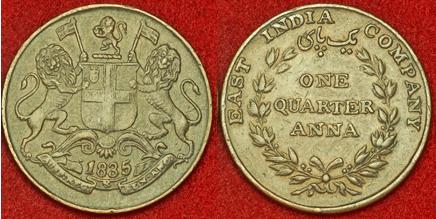 |
Same as above coin, but...
Weight: 6.51g [6.47g].
Mint:
Madras.
Clear ribs of the lion.
Note: Berries: 17 (8L;9R).
The
alphabets in word "QUARTER" is not on the same level and looks
clumsy.
Alignment: Medal. |
|
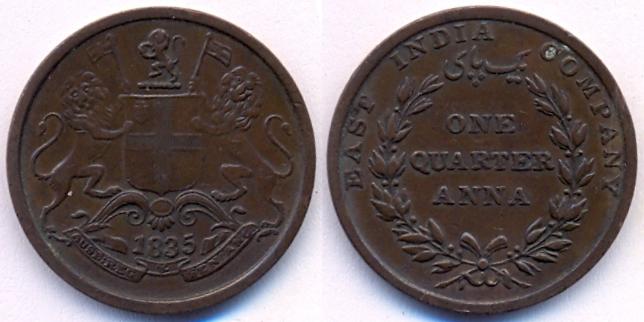 |
Weight: 6.40g [6.47g].
Diameter:
25.50 mm.
Mint:
Madras.
Note: Berries: 18 (9L;9R).
Sloping 1 in date. Not clear ribs of the
lion. Loop of Ribbon: Small. Y in COMPANY above berry. Ribbon Ends:
Pointed. 3 leaves in Wreath tip leaves.
Note: The "R" in QUARTER" is raised
then the rest of the alphabets.
Alignment: Medal. |
|
|
 |
KM#447.1 Half Anna.
Year:
1835.
Weight: 12.72g [12.95g].
Metal: Copper.
Diameter:
29.70 mm. Edge:
Plain.
Alignment: Medal.
Mint:
Bombay.
Obverse:
Arms of the Company. Date between the scroll and the ribbon. The
motto on the ribbon: AUSP: REG: & SEN: ANG:
Reverse: The value within a wreath of
laurel: ONE ANNA. Between the tips of the wreath is the value in
Persian (Do pai = two pice). Around this the legend: EAST INDIA
COMPANY.
Mintage: 8,658,092.
Mintage Years:
One year type with 1845 dated at Calcutta.
This coin has slightly larger legends. |
|
Note: Bombay coin size is 29.5 to 30.5 mm, Calcutta 30.8 mm
and Madras 30.7 to 31.2 mm. Normal and wider rim exists for all
these three mints. Calcutta mint has reeded edge with beaded rim
while Bombay and Madras have plain edge with plain border. |
|
 |
Same as below coin, but... Dark in
colour. Slightly reduced legends.
Weight: 12.99g [12.95g].
Diameter:
30.50 mm. |
|
 |
Same as below coin but... One side is slightly
rotated as shown.
Weight: 12.84g [12.95g].
Diameter:
30.50 mm.
|
|
| Differences in
Quarter Rupee 1835 coins:
- Types:
- Bombay Mint: No initial on neck
with 20 berries. ANNA word in Hindi. Mintage: 5,759,761.
- Calcutta Mint: RS on neck with
20 berries. ANNA word with Hindi or Persian. Mintage: 921,840.
- Calcutta Mint: F incuse or F
relief on neck, 20, 19, 18 or 10 berries exists. Mintage:
9,841,680.
- Date numeral: The date
numerals may be small or large.
- Language of value: The word:
ANNA may be in Hindi or Persian for 20 berries issues only.
- Dot after date: There may or
may not be a dot after the date.
- The number of berries in wreath may
vary: 20 (10L;10R), 19 (10L;9R), 18 (10L;8R) or 10
(6L;4R). Bombay mint contains only 20 berries while Calcutta
mint has all four varieties.
- Initials on bust: There may or
may not be initials in the centre of the truncation of the bust.
Initials on bust can be R.S, F incuse or F relief.
Note: The quarter rupees were
proclaimed current at the same time as the rupees in September 1835. |
|
 |
KM#448.6 Quarter Rupee.
Year:
1835.
Weight: 2.75g [2.92g].
Metal: 0.917
Silver.
Diameter:
19.00 mm. Edge:
Reeded.
Alignment: Medal.
Mint:
Calcutta.
Obverse:
The value in English and Persian (Chahar ana = Four annas): RUPEE
Within a wreath of laurel. Around this the legend: EAST INDIA
COMPANY 1835. 18 berries (10L;8R).
Reverse: Head of the King facing right.
Divided legend: WILLIAM IIII, KING.
Mintage: N/A.
Mintage Years:
One year type.
Note: The type should have in obverse
side "F" in relief truncation, which could not be detected. |
|
 |
Same as above coin with 18 berries. Could not detect the
F in relief truncation. Weight 2.83g. |
|
| Differences in
Half Rupee 1835 coins:
- Types:
- Bombay Mint: No initial on neck
with 20 berries. Mintage: 3,572,756.
- Calcutta Mint: RS on neck with
21 berries. Mintage: 521,380.
- Calcutta Mint: F incuse or F
relief on neck, 21, 20 or 19 berries exists. Mintage: 6,700,099.
- The number of berries in wreath may
vary: 21 (11L;10R), 20 (10L;10R) and 19 (9L;10R). Bombay
mint contains only 20 berries while Calcutta mint has all three varieties.
- Initials on bust: There may or
may not be initials in the centre of the truncation of the bust.
Initials on bust can be R.S, F incuse or F relief.
Note: The half rupees were
proclaimed current at the same time as the rupees in September 1835. |
|
 |
KM#449.1 Half Rupee.
Year:
1835.
Weight: 5.70g [5.83g].
Metal: 0.917
Silver.
Diameter:
24.50 mm. Edge:
Reeded.
Alignment: Medal but reverse side is
slightly rotated showing the bust downwards.
Mint:
Bombay.
Obverse:
The value in English and Persian (Hasht ana = Eight annas): HALF
RUPEE Within a wreath of laurel. Around this the legend: EAST INDIA
COMPANY 1835.
20 berries (10L;10R).
Reverse: Head of the King facing right.
Surrounded by the divided legend: WILLIAM IIII, KING.
Mintage: 3,572,756.
Mintage Years:
One year type. |
|
| |
| Some of the
features to distinguish the types in William IV Rupees. |
| |
Rupees were authorized by
Act XVII, dated 17th August 1835, and details were announced by proclamation
dated 2nd September 1835. With the accession of Queen Victoria in 1837, a
new act, XXXI, 1837, suspended those parts of Act XVII, 1835 that referred
to the issue of the coins with the effigy of the reigning monarch. Rupees
dated 1835 were issued from September 1835 until November 1840, when a
proclamation announced the restoration of Act XVII.
They were only issued from the mints of Bombay and Calcutta, although there
is an official return from the Madras mint claiming a mintage of 1.2 million
rupees bearing the date 1835. Designs for both the obverse and reverse were
prepared at Calcutta. The initials on the truncation of the neck refer to
the mint masters at Calcutta: RS = Robert Saunders (07.04.1826 to
04.01.1836), and F = William Forbes (05.01.1836 to 23.01.1855). Coins bearing
the initials F and RS can definitely be attributed to Calcutta. Pridmore
states that the ratio of 'F' to 'plain' rupees is approximately 2:1 and,
since the ratio of actual coins struck also occurs at this ratio, it is fair
to assume that the 'plain' bust belongs to Bombay.
The major die varieties are fairly easy to identify. However, there have
been a number of observations recording very small differences, particularly
referring to the mid-veins (or ribs) on various leaves in the reverse wreath
by various collectors. |
|
 |
 |
 |
 |
|
Initials: None |
Initials: F relief |
Initials: F incuse |
Initials: R.S. |
|
| |
|
 |
Bud style. |
 |
Two leaves Style |
Leaf group:
The second inner leaf group at the top right
of the wreath may look like a flower bud or like two leaves. It is
above E in ONE. |
|
 |
Wreath end very near. |
 |
Wreath end near. |
Wreath Ends:
The distance between the ends of the wreath
can vary. |
|
 |
No Extra Berry. |
 |
Extra Berry. |
Extra berry:
There may be an extra berry in the gap between
the leaves under the 2nd I of INDIA. |
|
 |
The gap between N and leaf
tip are near. |
 |
The gap between N and leaf tip are far. |
Gap between Wreath & N:
The gap between the right corner of the N in
COMPANY, and the leaf tip and berry in the wreath, can vary. |
|
| |
|
 |
KM#450.1 Rupee.
Year:
1835.
Weight: 11.40g [11.66g].
Metal: 0.917
Silver.
Diameter:
30.50 mm. Edge:
Reeded.
Alignment: Medal.
Mint:
Bombay.
Obverse:
The value in English and Persian: ONE RUPEE. All within a wreath of
laurel. Around this the legend: EAST INDIA COMPANY 1835. All within
a raised, toothed rim.
Reverse: Head of the King facing right.
Surrounded by the divided legend: WILLIAM IIII, KING. All within a
raised, toothed border.
No initial on truncation.
Mintage: 53,713,502.
Mintage Years:
One year type. |
|
The above coin has
Two leaves in leaf group, Wreath end near, Extra Berry with gap
between N and leaf tip are far.
This coin also exists in thin legends. |
|
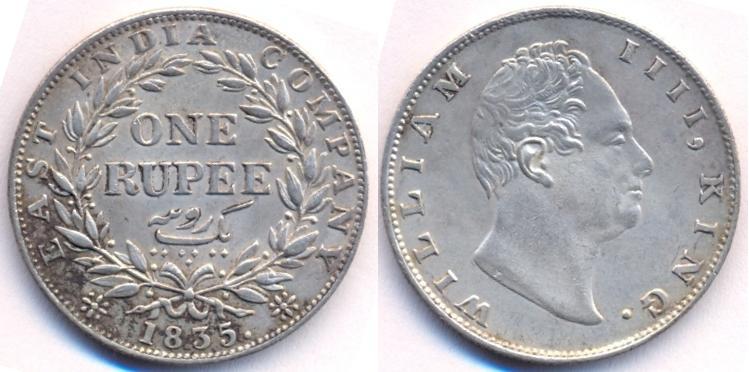 |
KM#450.2 Rupee.
Year:
1835.
Weight: 11.51g [11.66g].
Metal: 0.917
Silver.
Diameter:
30.50 mm. Edge:
Reeded.
Alignment: Medal.
Mint:
Calcutta.
Obverse:
The value in English and Persian: ONE RUPEE. All within a wreath of
laurel. Around this the legend: EAST INDIA COMPANY 1835. All within
a raised, toothed rim.
Reverse: Head of the King facing right.
Surrounded by the divided legend: WILLIAM IIII, KING. All within a
raised, toothed border.
Raised F initial on truncation.
Mintage: 93,329,258 (including F
incuse, RS incuse and No initial with thin legends).
Mintage Years:
One year type. |
|
The above coin has
Bud in leaf group, Wreath end very near, No Extra Berry with gap
between N and leaf tip are near.
Note: Thin dots in Persian one Rupee. |
|
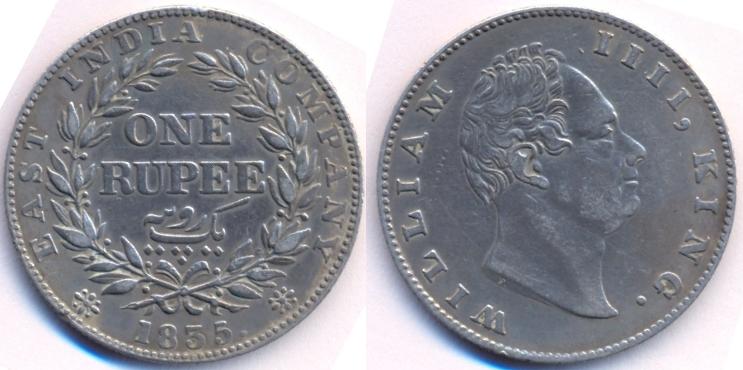 |
KM#450.3 Rupee.
Year:
1835.
Weight: 11.37g [11.66g].
Metal: 0.917
Silver.
Diameter:
30.50 mm. Edge:
Reeded.
Alignment: Medal.
Mint:
Calcutta.
Obverse:
The value in English and Persian: ONE RUPEE. All within a wreath of
laurel. Around this the legend: EAST INDIA COMPANY 1835. All within
a raised, toothed rim.
Reverse: Head of the King facing right.
Surrounded by the divided legend: WILLIAM IIII, KING. All within a
raised, toothed border.
F incuse initial on truncation.
Mintage: N/A (see above).
Mintage Years:
One year type. |
|
The above coin has
Bud in leaf group, Wreath end near, No Extra Berry with gap between
N and leaf tip are far. |
|
 |
KM#450.4 Rupee.
Year:
1835.
Weight: 11.36g [11.66g].
Metal: 0.917
Silver.
Diameter:
30.50 mm. Edge:
Reeded.
Alignment: Medal.
Mint:
Calcutta.
Obverse:
The value in English and Persian: ONE RUPEE. All within a wreath of
laurel. Around this the legend: EAST INDIA COMPANY 1835. All within
a raised, toothed rim.
Reverse: Head of the King facing right.
Surrounded by the divided legend: WILLIAM IIII, KING. All within a
raised, toothed border.
RS initial on truncation.
Mintage: 15,758,812.
Mintage Years:
One year type. |
|
The above coin has
Bud in leaf group, Wreath end very near, Extra Berry with gap
between N and leaf tip are far.
Note:
This coin also exists in thin legends as KM#450.7. The above mintage
includes both Thick and thin legends. |
|
| |
| |
| Coinage during
Queen Victoria |
| 1840 |
| |
Differences in Quarter Rupee 1840 continuous legend coins:
- KM#453.1 => Diameter: 19.5 mm. Mint:
Bombay. Obverse: English head. Mintage: 10,617,480.
- KM#453.2 => Diameter: 19.3 mm.
Mint: Calcutta. Obverse: English head. Reverse: With crescent on
left ribbon bow, 20 berries. Mintage: 12,994,320.
- KM#453.3 => Diameter: 19.6 mm.
Mint: Madras. Obverse: English head.with S incuse on truncation.
Reverse: “v” on right ribbon bow, 20 berries. Mintage:
6,450,480.
- KM#453.4 => Mint: Calcutta. Obverse:
“Indian” head with thinner features. Reverse: 34 berries.
Mintage: including above type.
|
|
 |
KM#453.1 Quarter Rupee.
Year:
1840.
Weight: 2.90g [2.92g].
Metal: 0.917
Silver.
Diameter:
19.50 mm. Edge:
Reeded.
Alignment: Medal.
Mint:
Bombay.
Obverse: The value in English and
Persian (Chahar ana = four annas): ¼
RUPEE within a wreath of laurel.
Around this the legend and date: EAST INDIA COMPANY 1840. 20 Berries
(10L; 10R).
Crossbar of the Numeral 4 in Serif;
pointing north upwards in Value. Dot after Date.
Reverse: Head of the Queen facing left.
Continuous legend: VICTORIA QUEEN.
Mintage:
10,617,480.
Mintage Years:
One year type with some varieties. |
|
Differences in
Quarter Rupee 1840 divided legend coins:
Initials on bust:
- Mule coin having divided legends with 34
berries. Mint: Bombay & Calcutta. Mintage: 40,532.
- W.W. - [Bombay and Calcutta mints and slightly
larger ones by Madras mint]. Mintage: Calcutta: 32,012,400 and Bombay:
8,519,480. This coin exists as Plain 4 and Crosslet 4 in Value from both mints.
- W.W.S - [Madras mint] - Total Mintage for
Madras (including this and below type: 13,663,510.
- W.W.B [Madras mint]
As with the rupee, the quarter rupee dies
had to be modified by Calcutta after the originals had been received
from London in 1849. Again, distinction between coins struck at
Bombay and Calcutta is not possible although Pridmore has raised the
possibility that the coins with a Serif on the 4 in the date may be
from Bombay and Sans Serif for Calcutta. There is no evidence to
support this. The tiny crescent mark on the bow is usually
quite clearly visible on some Serif variety. Madras mint coins have no Dot
after date, Serif Cross-bar of 4 and no Crescent on the bow of the
ribbon. |
|
 |
KM#454.2 Quarter Rupee.
Year:
1840.
Weight: 2.83g [2.92g].
Metal: 0.917
Silver.
Diameter:
19.00 mm. Edge:
Reeded.
Alignment: Medal.
Mint:
N/A.
Obverse: The value in English and
Persian (Chahar ana = four annas): ¼
RUPEE within a wreath of laurel.
Around this the legend and date: EAST INDIA COMPANY 1840.
Reverse: Head of the Queen facing left.
Divided legend: VICTORIA QUEEN.
Mintage: 32,012,400.
Mintage Years:
One year type and some plain and reeded edge
variety exists for 1849. |
|
Note: W.W. truncation mark on the above
coin. No Dot after date, Cross-bar of 4 in Sans serif pointing
eastwards and No Crescent. All coins dated
1840 without dot after date have obverse legend "Victoria Queen"
divided. |
|
Differences in Half Rupee 1840 Continuous legends coins:
- Types:
- Bombay Mint: No initial on
neck. English head. No privy mark on bow. Dot after date.
Mintage: 9,844,380.
- Calcutta Mint: Mintage:
8,049,420 for both types indicated below.
- No initial on neck. English head. Crescent privy mark on
bow. Dot after date.
- No initial on neck. Indian head. Thinner features. Crescent
privy mark on bow. Dot after date.
- Madras Mint: No initial on
neck. English head. Probably visible v privy mark on bow. Dot
after date. Mintage: 1,874,420.
- Madras Mint: S initial on neck.
English head. v privy mark on bow. Dot after date. Mintage:
1,874,420.
- Diameter:
- Bombay Mint: 24.5 - 24.6 mm. Restrikes are an exception to this, often having
the diameter of the Bombay mint (where they were actually struck)
but having the design of another mint.
- Calcutta Mint: 24.2 - 24.4 mm.
- Madras mint: 24.7 - 24.9 mm.
- Initials on bust: There may or
may not be initials on the truncation of the bust. The only
Initial is S incuse and so far no specimen is traced.
- Style: The bust may have an
English or Indian appearance. The most notable distinguishing
feature is the nose.
- Privy mark on Bow: There may be
a crescent or a v on the ribbon bow (images shown below under Rupee
coins). Only one specimen is found having the crescent.
- Dot after date: There is
usually a dot after the date. Occasionally this dot is missing
and are considered MULE or rare samples.
Specimens of a half rupee were submitted
for approval on 25th February 1842, and these were received on 15th
March. As with the rupees, differences such as Indian / English
heads or presence or absence of crescent on ribbon on reverse, are
often difficult to identify. |
|
 |
KM#455.1 Half Rupee.
Year:
1840.
Weight: 5.58g [5.83g].
Metal: 0.917
Silver.
Diameter:
24.50 mm. Edge:
Reeded.
Alignment: Medal.
Mint:
Bombay.
Obverse:
The value in English and Persian (Hasht ana = eight annas): HALF
RUPEE Within a wreath of laurel. Around this the legend: EAST INDIA
COMPANY 1840.
Reverse: Head of the Queen facing left.
Surrounded by a continuous legend: VICTORIA QUEEN.
Mintage: 9,844,380.
Mintage Years:
One year type with various varieties and
mints.
Note:
No initials found as usually. English head. No privy mark on Bow.
There is dot after date. |
|
| |
| Some of the
features to distinguish the types in Queen Victoria Rupees. |
| |
| Victoria had acceded to
the throne in 1837 but the Calcutta Mint was not able to start work on dies
bearing the head of the new Queen until 1838, and even this work was
superseded by the arrival of the obverse matrix die in 03rd April 1839,
prepared under the inspection of Mr Boulton of Birmingham. This die proved
to be the wrong size and more work was required so that coins were not
issued until 1840. Meanwhile the Bombay Mint saw an opportunity to
re-establish to some extent, their independence from Calcutta and produced a
pattern for the new rupee coinage. The engraver of the die is not certainly
known but may have been Jewram Shamji, who was employed at the mint as a
die-cutter and also an engraver. Five specimens were sent to Calcutta in
February 1839, but the design was rejected by the Governor General who was
awaiting dies from England. The new rupees
were announced by proclamation dated 18.11.1840. This stated that from and
after 11th November for Calcutta and from and after 1.4.1841 for Bombay and
Madras, the coins would bear the effigy of Queen Victoria. Striking of the
coins continued for a number of years until the matrix dies became worn. A
new design, the so-called 'divided legend' type, was prepared by William
Wyon and began to be used in Calcutta in 1850 and Bombay and Madras in 1851.
The obverse die for the Victorian coinage originated from a matrix die
prepared in England under the inspection of Mr. Boulton. This required some
local modifications, which were undertaken at Calcutta and then shipped to
Bombay and Madras. Some coins bear the initial S on the truncation of the
neck, and this is attributed to J. T. Smith, who was master of the mint at
Madras from February 1840 to September 1855. Coins with the S initial on the
bust, therefore, can be attributed to Madras. In addition, Pridmore uses two
privy marks to assign coins to the various mints. Some coins have a tiny
crescent on the left part of the ribbon bow on the reverse. These he assigns
to Calcutta. However, this mark is very difficult to see. Some coins have a
tiny v on the right part of the ribbon, and these he attributes to Madras.
Again, this mark is so tiny that it is difficult to see. However, using
these marks it is possible to determine that the diameter of the coins is an
easier guide to the mint of manufacture. Coins of 31.1 to 31.4 mm come from
Calcutta; 31.6 to 31.7 mm from Bombay; and 31.8 to 32.3 mm from Madras. As
stated above, the crescent on the bow on the reverse (see below), because it
is in relief, is often worn away, so its absence can be due to wear.
However, this feature has been included in the main part of the catalogue
because Pridmore has established it. The distinction between 'Indian' and
'English' heads is not easy to see, with the shape of the nose probably
being the best comparator (see pictures of obverse varieties). There are a
number of minor 'varieties' that have not been included in the catalogue,
such as reverse varieties identified by presence and absence of leaf veins,
simply because these minute differences are very hard to identify. All these
differences make the varieties difficult to distinguish one from another.
The simplest approach is probably to start with diameter and identify the
mint. This can then be followed by each of the features in the tables
showing obverse and reverse varieties. Proof restrikes were all struck at
the Bombay Mint and therefore diameters may not match design varieties.
M incuse variety of calcutta mint with 35 berries, sometimes appears like
'I' instead of 'M' incuse because the die became worn out as the large
number of coins were minted continuously with this die. |
| |
|
 |
No initial |
NO IMAGE AVAILABLE |
S initial |
|
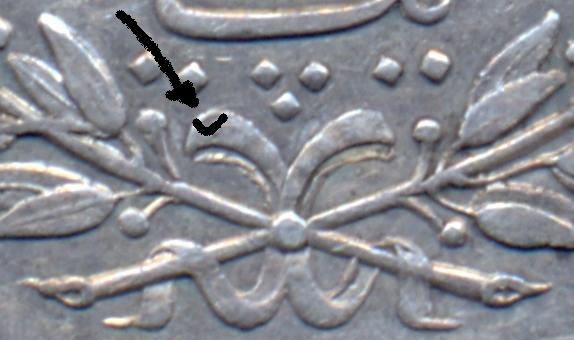 |
Crescent Privy Mark
(Highlighted) |
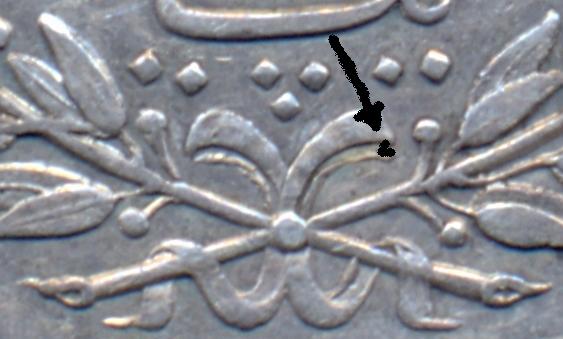 |
v Privy Mark
(Highlighted) |
|
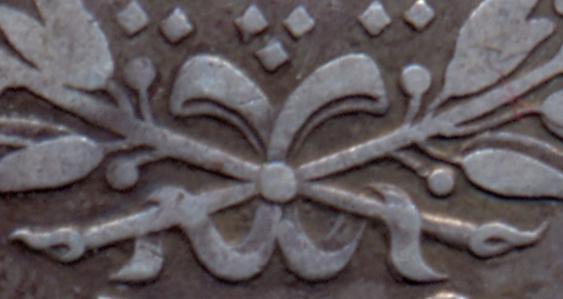 |
No Privy Mark |
 |
M incuse on left ribbon
end |
|
 |
Large Date Digits. Note
the 0 and serif on cross-bar of 4. |
 |
Small Date Digits. Note
the 0 and no serif on cross-bar of 4. |
|
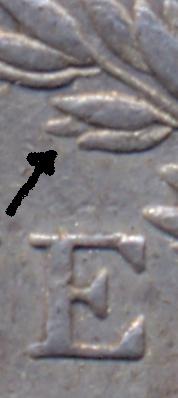 |
Bud above E in ONE |
 |
Two Leaves above E in ONE |
|
 |
34 Berries (Highlighted).
19 left and 15 right. Arrow shows the location of a special berry. |
 |
34 Berries (Highlighted).
19 left and 15 right. Arrow shows the location of a special berry
left of O in ONE.
35 berries variety coin
contains both of these special berries. |
|
 |
English Head |
 |
Indian Head
Various small difference exits like the nose style, bottom of the
bust, the neck alignment, the floating curl, forehead style, etc. |
|
 |
2 mm distance on the left side of the bust from the rim.
|
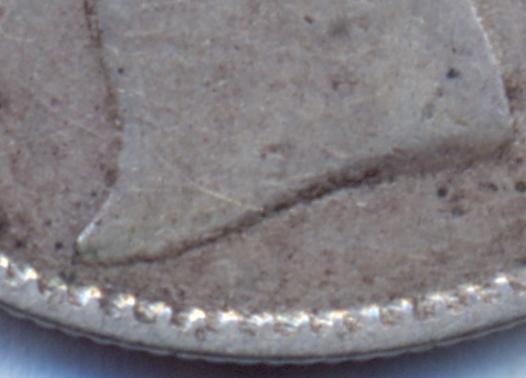 |
1 mm distance on the left side of the bust from
the rim. |
|
 |
No Hair on Ribbon |
 |
Hair on Ribbon |
|
NO IMAGES AVAILABLE |
There may or may not be
diagonal ridges on the top right and the bottom ribbons. The lock of
hair may or may not cross the ridge on the bottom ribbon.
|
NO IMAGES AVAILABLE |
|
|
| |
| Rupee.
Year:
1840.
Weight: 11.66g.
Metal: 0.917
Silver.
Diameter:
31.10 - 32.20 mm. Edge:
Reeded.
Alignment: Medal.
Mint:
Bombay, Calcutta and Madras.
Obverse:
The value in English and Persian (Yek Rupiya = One rupee): ONE
RUPEE. All within a wreath of laurel. Around this the legend and date: EAST
INDIA COMPANY 1840. All within a raised, toothed rim.
Reverse: The head of the Queen facing
left. Continuous legend: VICTORIA QUEEN on the top of the bust.
Below are the various varieties recorded on continuous
legend of VICTORIA QUEEN:
- Bombay Mint [Diameter = 31.6 - 31.7 mm,
Total Mintage = 109,838,073] - 3 types
- Ridges on Ribbon:
None, Initials on
bust: None,
Point of Bust: 2mm,
Lock of Hair: No,
Head Type: English.
Berries in wreath: 19 (10L;9R),
Leaf group: Two Leaves,
Privy Mark: None,
Date Digits: Large.
- Ridges on Ribbon:
None, Initials on
bust: None,
Point of Bust: 2mm,
Lock of Hair: No,
Head Type: English.
Berries in wreath: 19 (10L;9R),
Leaf group: Bud,
Privy Mark: None,
Date Digits: Large.
- Ridges on Ribbon:
Present, Initials
on bust: None,
Point of Bust: 1mm,
Lock of Hair: Yes,
Head Type: English.
Berries in wreath: 35 (20L;15R),
Leaf group: Two Leaves,
Privy Mark: None,
Date Digits: Small.
- Calcutta Mint [Diameter = 31.1 - 31.4 mm,
Total Mintage = 179,934,670] - 10 types
- Ridges on Ribbon:
None, Initials on
bust: None,
Point of Bust: 2mm,
Lock of Hair: Yes,
Head Type: English.
Berries in wreath: 34 (19L;15R bead by
ONE), Leaf group:
Two Leaves, Privy
Mark: Crescent,
Date Digits: Small.
- Ridges on Ribbon:
None, Initials on
bust: None,
Point of Bust: 2mm,
Lock of Hair: Yes,
Head Type: English.
Berries in wreath: 19 (10L;9R),
Leaf group: Two Leaves,
Privy Mark: None,
Date Digits: Large.
(this type are in Proof only - rare).
- Ridges on Ribbon:
None, Initials on
bust: None,
Point of Bust: 2mm,
Lock of Hair: Yes,
Head Type: English.
Berries in wreath: 19 (10L;9R),
Leaf group: Bud,
Privy Mark: None (Crescent may be worn
away?), Date Digits:
Large.
- Ridges on Ribbon:
None, Initials on
bust: None,
Point of Bust: 2mm,
Lock of Hair: No,
Head Type: English.
Berries in wreath: 19 (10L;9R),
Leaf group: Two Leaves,
Privy Mark: None (Crescent may be worn
away?), Date Digits:
Large.
- Ridges on Ribbon:
None, Initials on
bust: None,
Point of Bust: 2mm,
Lock of Hair: No,
Head Type: English.
Berries in wreath: 19 (10L;9R),
Leaf group: Bud,
Privy Mark: Crescent,
Date Digits: Large.
Diameter: 31.60 mm.
- Ridges on Ribbon:
None, Initials on
bust: None,
Point of Bust: 2mm,
Lock of Hair: No,
Head Type: English.
Berries in wreath: 34 (19L;15R bead by
ONE), Leaf group:
Two Leaves, Privy
Mark: Crescent,
Date Digits: Small.
(in Proof only - rare)
- Ridges on Ribbon:
None, Initials on
bust: None,
Point of Bust: 1mm,
Lock of Hair: Yes,
Head Type: English.
Berries in wreath: 35 (20L;15R),
Leaf group: Two Leaves,
Privy Mark: None,
Date Digits: Small.
- Ridges on Ribbon:
Present, Initials
on bust: None,
Point of Bust: 1mm,
Lock of Hair: Yes,
Head Type: Indian.
Berries in wreath: 35 (20L;15R),
Leaf group: Two Leaves,
Privy Mark: Crescent,
Date Digits: Small.
(Proof types also exits and are considered rare).
- Ridges on Ribbon:
Present, Initials
on bust: None,
Point of Bust: 1mm,
Lock of Hair: Yes,
Head Type: Indian.
Berries in wreath: 34 (19L;15R bead by
ONE), Leaf group:
Two Leaves, Privy
Mark: Crescent,
Date Digits: Small.
(in Proof only - rare)
- Ridges on Ribbon:
Present, Initials
on bust: None,
Point of Bust: 1mm,
Lock of Hair: Yes,
Head Type: English.
Berries in wreath: 35 (20L;15R),
Leaf group: Two Leaves,
Privy Mark: Crescent,
Date Digits: Small.
- Madras Mint [Diameter
= 31.8 - 32.3 mm, Total Mintage =
21,898,181] - 6
types
- Ridges on Ribbon:
None, Initials on
bust: None,
Point of Bust: 2mm,
Lock of Hair: No,
Head Type: English.
Berries in wreath: 19 (10L;9R),
Leaf group: Two Leaves,
Privy Mark: v,
Date Digits: Large.
- Ridges on Ribbon:
None, Initials on
bust: S,
Point of Bust: 2mm,
Lock of Hair: No,
Head Type: English.
Berries in wreath: 19 (10L;9R),
Leaf group: Two Leaves,
Privy Mark: v,
Date Digits: Large.
- Ridges on Ribbon:
None, Initials on
bust: S,
Point of Bust: 2mm,
Lock of Hair: No,
Head Type: English.
Berries in wreath: 19 (10L;9R),
Leaf group: Two Leaves,
Privy Mark: None,
Date Digits: Large.
(Proof types also exits and are considered rare).
- Ridges on Ribbon:
None, Initials on
bust: S,
Point of Bust: 2mm,
Lock of Hair: No,
Head Type: English.
Berries in wreath: 20 (10L;10R),
Leaf group: Bud,
Privy Mark: None,
Date Digits: Large or Small ?.
- Ridges on Ribbon:
None, Initials on
bust: S,
Point of Bust: 1mm,
Lock of Hair: Yes,
Head Type: English.
Berries in wreath: 35 (20L;15R),
Leaf group: Two Leaves,
Privy Mark: None,
Date Digits: Small.
- Ridges on Ribbon:
None, Initials on
bust: S,
Point of Bust: 1mm,
Lock of Hair: Yes,
Head Type: English.
Berries in wreath: 34 (19L;15R lower
bead type), Leaf group:
Two Leaves, Privy
Mark: None,
Date Digits: Small.
|
|
 |
KM#457.3
Mint: Bombay.
Diameter: 31.7 mm.
Weight: 11.49g. Ridges on Ribbon:
None, Initials on
bust: None,
Point of Bust: 2mm,
Lock of Hair: No,
Head Type: English.
Berries in wreath: 19 (10L;9R),
Leaf group: Bud,
Privy Mark: None,
Date Digits: Large.
Small diamonds in Persian legend.
Surprising there is a dot between C and Queen Victoria's eye. |
|
 |
KM#457.4
Mint:
Bombay.
Diameter: 31.7 mm.
Weight: 11.28g. Ridges on Ribbon:
None, Initials on
bust: None,
Point of Bust: 2mm,
Lock of Hair: No,
Head Type: English.
Berries in wreath: 19 (10L;9R),
Leaf group: Bud,
Privy Mark: None,
Date Digits: Large.
Large diamonds in Persian legend.
Unknown countermark "B" on Queen Victoria's bust. |
|
 |
KM#457.7
Mint:
Madras.
Diameter: 31.9 mm.
Weight: 11.59g. Ridges on Ribbon:
None, Initials on
bust: None,
Point of Bust: 2mm,
Lock of Hair: No,
Head Type: English.
Berries in wreath: 19 (10L;9R),
Leaf group: Bud,
Privy Mark: v,
Date Digits: Large.
Unlisted type as this coin has Bud
instead of Two Leaves. |
|
 |
KM#457.11 Mint:
Calcutta.
Diameter: 31.2 mm.
Weight: 11.55g.
Ridges on Ribbon:
Present, Initials
on bust: None,
Point of Bust: 1mm,
Lock of Hair: Yes,
Head Type: Indian.
Berries in wreath: 34 (19L;15R lower
bead type), Leaf group:
Two Leaves, Privy
Mark: Crescent,
Date Digits: Small
(Note the 0 and no serif on cross-bar of 4).
Unlisted type as Privy Mark:
Crescent, 34 berries (lower bead type instead of bead by ONE) and
M incuse on left ribbon
end. |
|
| |
When Wyon's new matrices for the silver coinage
reached India in December 1849, work began immediately on preparing the
dies. However, problems were encountered with the convexity of the reverse
and this prevented the obverse being fully raised. New reverse dies were
therefore prepared, copied from Wyon's originals, and were completed in May
1850. The coins continued to show the fixed date of 1840. Dies were sent to
Bombay on 11th February 1851 and to Madras on 17th June 1851. Madras coins
are most easily distinguished by the presence of extra initials added after
W.W. on the truncation of the neck (W.W.S for J. T. Smith, W.W.B for J.H.
Bell? and W.W.BO for T. Boycott?). It is interesting to note that the
diameter of coins with the extra initial, and therefore from Madras, is
30.7-30.8mm, as opposed to 30.5-30.6mm for most coins with the simple W.W.
initials. However, there are a small number of coins with the W.W. initials
that have a diameter of 30.7mm. This would suggest that an extra initial was
not added to all Madras coins, and that diameter should be used to
distinguish the Madras coins from those struck at Bombay and Calcutta, and
that mint attribution should not rely solely on the presence or absence of
the extra initial. Therefore, an extra coin has been added to the catalogue.
NB Total Mintage = 767m. Calcutta = 399m [398,553,660] (52%), Bombay = 313m
[312,598,076] (41%), Madras
= 55m [55,049,201] (7%). Of the coins examined, those with diameter 30.5-30.6 = 54 coins
(90%), diameter 30.7-30.8 = 6 coins (10%). These figures support the
assertion that the coins with diameter 30.5-30.6 are those from Calcutta
plus Bombay and the larger coins are from Madras.
No marks have been identified to conclusively distinguish Calcutta minted
coins from those struck at Bombay, although some possible features have been
suggested such as the presence or absence of a raised mid-vein on the leaf
to the left of the ribbon on the reverse. The mints usually made their privy
marks clearer than this and the argument for this as the distinguishing mark
seems unconvincing. The shading on the ribbon on the reverse recorded by
Pridmore is very difficult to see. This feature has therefore been excluded
the catalogue. Many other minute differences can be identified such as
differences in the leaf veins. Again these have not been included in the
main part of the catalogue since they are too difficult to identify.
Initials on bust:
- W.W. - [Bombay and Calcutta mints and slightly
larger ones by Madras mint]
- W.W.S - [Madras mint]
- W.W.B (large B) - [Madras mint]
- W.W.B (Small B) - [Madras mint]
- W.W.BO - [Madras mint]
- W.W.B. (dot after B) - [Madras mint]
On both issues, the "S" is the initial of Major,
later Lt. Col. J. T. Smith, mintmaster at Madras from February 1840 to
September 1855. The "B" which occurs only on Rupees of Type II, is the
initial of Major, later Lt. Col. J. H. Bell (mintmaster at Madras,
1855-1859). The initials WW which appears on all coins of Type II, are those
of William Wyon. Chief Engraver of the Royal Mint, London, who prepare
obverse design in 1849. |
|
 |
KM#458.2 Rupee.
Year:
1840.
Weight: 11.52g [11.66g].
Metal: 0.917
Silver.
Diameter:
30.50 mm. Edge:
Reeded.
Alignment: Medal.
Mint:
Calcutta.
Obverse:
The value within a wreath of laurel: ONE RUPEE Around this is the
legend and date: EAST INDIA COMPANY 1840 All within a raised,
toothed rim. 28 berries with large diamonds
in Persian One Rupee.
Reverse: "Victoria Queen" divided by
bust facing left.
Mintage: 398,553,660 (including small
diamond varirty).
Mintage Years:
One year type with various varieties including
Bombay mint. 1849 date also exits as KM#458.8. Note:
28 berries (13 on left and 15 on
right). KM#458.1 with small diamonds in Persian legends also exits. |
|
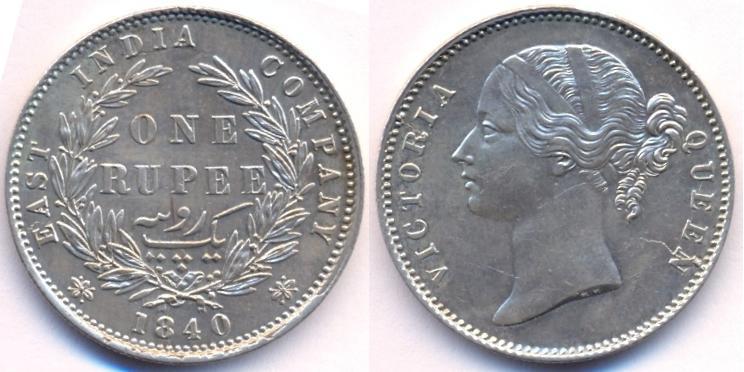 |
Note:
Same as above coin but the Queen Victoria bust side shows some cracks, probably produced on broken die. |
|
| |
| 1841 |
| |
|
Differences in Two Annas 1841 coins:
- Types:
- Bombay Mint: .W.W (Bombay mint
has dot before the Ws) initials on bust. Mintage: 8,427,040.
- Calcutta Mint: W.W. initials on
bust. Mintage: 43,002,080.
- Madras Mint: S.W.W initials on
bust. Mintage: 26,930,380.
- Diameter:
- Bombay Mint: 15.7 mm.
- Calcutta Mint: 15.3 mm.
- Madras mint: 15.7 mm.
- The number of berries in wreath may
vary: 16 (?L;?R), 10 (6L;4R), 9 (5L;4R), 8 (4L;4R).
Bombay mint contains 9 or 10 berries, Calcutta mint contains 9
or 16 berries and Madras has 8 or 9 berries.
- Dot after date: There may or
may not be a dot after the date.
Note: As with
the rupee, the two anna dies had to be modified by Calcutta after
the originals had been received from London in 1849. |
|
 |
KM#460.2 Two Annas.
Year:
1841.
Weight: 1.41g [1.46g].
Metal: 0.917
Silver.
Diameter:
15.30 mm. Edge:
Plain.
Alignment: Medal.
Mint:
Calcutta.
Obverse:
The value in English and Persian (= Do ana = two annas): TWO ANNAS.
All within a wreath of laurel. Around this the legend: EAST INDIA
COMPANY 1841.
Reverse: Head of the Queen facing left.
Divided legend: VICTORIA QUEEN.
Mintage: 43,002,080.
Mintage Years:
One year type.
Note: W.W. initial on truncation. No
dot after date. 9 Berries (5L;4R). |
|
 |
Same as above coin with weight 1.38g. |
|
| |
| 1845 |
| |
|
Note: Between
1835 and 1844 copper coins continued to be issued in the style of
those of William IV, and continued to be dated 1835 (see above
William IV). Bombay had continued to strike coins in the pre
1835 style (i.e. with the scales design) and it was not until 1844
that the design was standardized throughout the EIC territories.
However, the coins issued by the Bombay Mint were dated 1835 in line
with those from the Madras Mint. In January 1845 permission was
granted for the Calcutta mint to strike half annas. These coins were
dated 1845 and the mint continued to issue them with this fixed date
until 1860. |
|
 |
KM#447.1 Half Anna.
Year:
1845.
Weight: 12.95g [12.95g].
Metal: Copper.
Diameter:
31.00 mm. Edge:
Plain.
Alignment: Medal.
Mint:
Calcutta.
Obverse:
Arms of the Company. Date between the scroll and the ribbon. The
motto on the ribbon: AUSP: REG: & SEN: ANG:
Reverse: The value within a wreath of
laurel: HALF ANNA. Between the tips of the wreath is the value in
Persian (Do pai = Two Pice). Around this is the legend: EAST INDIA
COMPANY.
Mintage: 7,788,197 (crossbar
of the Numeral 4 in Serif; pointing north upwards).
Mintage Years:
1835 and 1845. |
|
 |
KM#447.1 Half Anna.
Year:
1845.
Weight: 12.32g [12.95g].
Metal: Copper.
Diameter:
29.70 mm. Edge:
Plain.
Alignment: Medal.
Mint:
Calcutta.
Obverse:
Arms of the Company. Date between the scroll and the ribbon. The
motto on the ribbon: AUSP: REG: & SEN: ANG:
Reverse: The value within a wreath of
laurel: HALF ANNA. Between the tips of the wreath is the value in
Persian (Do pai = Two Pice). Around this is the legend: EAST INDIA
COMPANY.
Mintage: 9,371,813 (crossbar
of the Numeral 4 in San Serif; pointing straight east).
Mintage Years:
1835 and 1845. |
|
| |
| 1853 |
| |
|
In 1848, in response to the Court of Directors
request that copper coin be superseded by silver fractions of a
rupee, the Government of India produced a report that included,
inter alia, reference to the fact that cowrie shells still passed
current for small purchases in Bengal. The Directors, having read
this report, then revised their earlier view and suggested that a
further copper denomination of half pice should be added to the
coinage for use in Bengal. The Government of India agreed to this
and coinage started at the Calcutta mint in 1853, which is the fixed
date shown on the obverse of the coin. |
|
 |
KM#464 Half Pice.
Year:
1853.
Weight: 3.16g [3.23g].
Metal: Copper.
Diameter:
21.00 mm. Edge:
Plain.
Alignment: Medal.
Mint:
Calcutta.
Obverse:
Arms of the Company, with the date between the scroll and the
ribbon. The ribbon bears the abbreviated Latin motto: AUSP: REG: &
SEN: ANG:.
Reverse: The value within a laurel
wreath: PICE. Around this is the legend: EAST INDIA COMPANY.
Mintage: 62,408,000.
Mintage Years:
One year type. |
|
| |
| 1848 |
| |
|
 |
KM#445 1/12 Anna / Pie.
Year:
1848.
Weight: 2.13g.
Metal: Copper.
Diameter:
17.50 mm. Edge:
Plain.
Alignment: Medal.
Mint:
Calcutta.
Obverse:
Arms of the Company, with the date between the scroll and the
ribbon. The ribbon bears the abbreviated Latin motto: AUSP: REG: &
SEN: ANG: with date 1848.
Reverse: The Value in English and
Persian (Suls pai = One-third pice): 1/12 ANNA Within a laurel
wreath. Around this is the legend: EAST INDIA COMPANY. Large
legends.
Mintage: 14,380,000.
Mintage Years:
One year type.
Note: 1835 issue exists in Bombay,
Calcutta and Madras mints. |
|
| |
| 1858 |
| |
The inability of the Indian mints to meet the
enormous demand for coins led to a request for copper coins to be
struck in England. The Royal Mint was unable to meet these
requirements and contracts were placed with Ralph Heaton & Sons and
with James Watt & Co. for the supply of quarter annas. Dies for the
coinage were prepared in the Royal Mint.
- 1857 Quarter Anna coins produced by Soho Mint
in July 1857. Mintage:
47,040,000. The tips of the leaves may be formed from double
leaves or single leaves. This is most obvious at the tips of the
wreath.
- 1858 Quarter Anna coins produced by James Watt & Co.,
Birmingham in May 1860. Mintage: 62,720,000. The tips of the
leaves is formed of a single leaves only. Usually they have
large shield.
- 1858 Quarter Anna coins produced by Ralph Heaton & Sons,
Birmingham. Total Mintage: 172,480,000 (October 1859: 54,880,000, May 1860: 62,720,000, April? 1862:
54,880,000). The tips of the leaves is formed of double
leaves. Usually they have small shield.
|
|
 |
KM#463.1 Quarter Anna.
Year:
1858.
Weight: 6.05g.
Metal: Copper.
Diameter:
25.00 mm. Edge:
Plain.
Alignment: Coin.
Mint:
James Watt & Co., Birmingham.
Obverse:
Arms of the Company, with the date between the scroll and the
ribbon. The ribbon bears the abbreviated Latin motto: AUSP: REG: &
SEN: ANG: Large Shield with date.
Wreath tips are single leaves.
Reverse: The value in Persian and
English: ONE QUARTER ANNA Within a wreath of laurel. Around this the
legend: EAST INDIA COMPANY.
Mintage: 62,720,000.
Mintage Years:
One year type.
Note: One of the
last coins of East India Company. |
|
 |
KM#463.2 Quarter Anna.
Year:
1858.
Weight: 6.29g.
Metal: Copper.
Diameter:
25.00 mm. Edge:
Plain.
Alignment: Coin.
Mint:
Ralph Heaton & Sons, Birmingham.
Obverse:
Arms of the Company, with the date between the scroll and the
ribbon. The ribbon bears the abbreviated Latin motto: AUSP: REG: &
SEN: ANG: Large Shield with date.
Wreath tips are double leaves.
Reverse: The value in Persian and
English: ONE QUARTER ANNA Within a wreath of laurel. Around this the
legend: EAST INDIA COMPANY.
Mintage: 172,480,000.
Mintage Years:
One year type. |
|
| |
| Early Indian coins:
British India coins:
Coins of Indian Princely States and other
colonies:
Coins of "Republic of India" sorted under below
Presidential rulers:
Others:
|
| |
| |
|
|
| India
or Pakistan |
| Countries
/ Territories |
| |
|
Chiefa Coins | |
|