| |
 |
 |
| |
|
Qatar |
| |
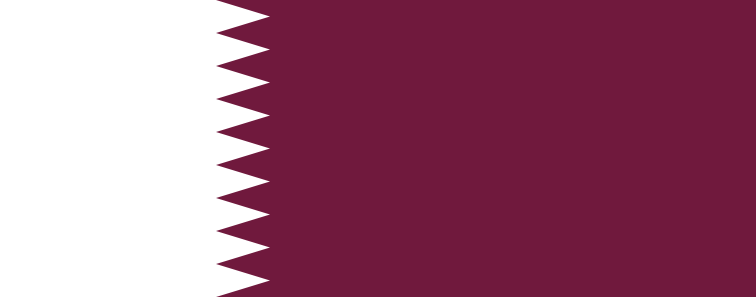 |
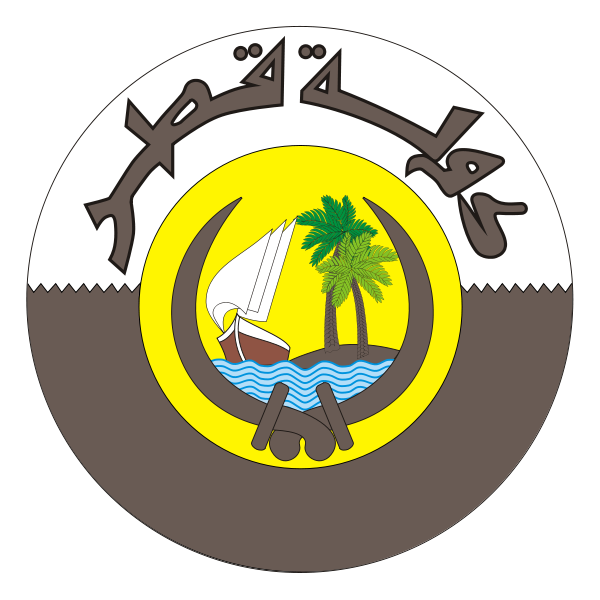 |
| |
1550 - 1670 Part of the Ottoman Empire.
12 Sep 1868
Muhammad ibn Thani signs treaty with the British,
effectively establishing Qatar (previously
considered to be a dependency of Bahrain) as
an independent State (al-Thani authority limited
to Doha and Wakrah, only later expanded to
include the entire peninsula).
1872 Sovereignty of the Ottoman Empire over Qatar
recognized (as kazan [district] of Sandjak
al-Hasa within vilayet of Baghdad [from 1875
Basra] vilayet.
03 Nov 1916
British protectorate (Sheikdom of Qatar)(under
the chief political resident of the
Persian Gulf at Bahrain).
Jul 1937 Zubara annexed, previously under Bahrain.
03 Sep 1971
Independence from Britain (State of Qatar). |
|
|
- Hirah.................................................380
CE - 602
- A pre-Islamic Arab Kingdom,
vassals of the Persians and utilized by them as frontier guards opposing the
Byzantine clients in Ghassan from c. 270 to 633.
- Banu Lakhm
- Maiwia
(fem.)....................................c. 375 - 390
- Amru'l-Qais II
(Hamza)..............................390 - 403
- Nu'man I ibn
Amru’l-Qais............................403 - 433 with...
- Mundhir I ibn Nu’man................................430
- 473
- Aswad ibn Mundhir...................................474
- 494
- Mundhir II ibn Mundhir..............................494
- 500
- Nu'man II ibn Aswad.................................500
- 503
- Abu Ya'fur ibn Alqama...............................503
- 505
- Mundhir III ibn Zikiqa..............................505
- 554
- 'Amr III ibn Mundhir................................554
- 569
- Qabus ibn Mundhir...................................569
- 574
- Zaid ibn Mammad.....................................574
- 575
- Mundhir IV ibn Mundhir..............................575
- 584 with...
- Nu'man III ibn Mundhir..............................580
- 602
-
Persia...................................................602 - c. 635
- Sassanid dynasty of Persia
ruled Qatar during this time. Khusrau II the Victorious (Persian King from
591 to 628) took control of this area and later Caliph Umar ibn al-Khattab
captured it from Yazdegerd III (Persian King from 633-649, died 651) in c.
635.
- The Prophet
Muhammad's
elected successors.............c. 635 - 661
- This area was ruled by
Caliph Umar ibn al-Khattab (634-644), Uttman ibn Affan (644-656), Ali ibn
Abi Talib al-Hashimi (656-660) and Hassan ibn Ali (660-661).
-
Umayyad
Caliphate........................................661 - 750
-
Abbasid
Caliphate........................................750 - 1258
- Bahri Mamluk
(Egypt)....................................1258 – 1390
-
Burji Mamluk (Egypt)....................................1390 - 1516
-
Ottoman Empire..........................................1516 - 1783
- Local occupation by various
Bedawi clans. At times influence from Persia or other regional powers.
- Occupied by the Banu
al-Khalifah...............................18th cent.
-
Bahrain.................................................1783 - 1867
- al-Thani
[title: to 03 Sep 1971: Hakim Qatar ("Ruler of
Qatar") and from 03 Sep 1971: Amir Dawlat Qatar ("Emir of the State of
Qatar")].
- al-Thani ibn Muhammad
ibn Tamir.........................1822 - 1860
- Muhammad ibn al-Thani...................................1860
- 1876
- Muhammad bin Thani was born in Fuwairat and upon
the death of his father, Thani Ibn Mohammad, he became the leader of his
tribe at Fuwairat. In 1847, the Al-Thani Family moved from Fuwairat to Doha,
under the leadership of Mohammad Bin Thani. Eventually, Mohammad Bin Thani
extended his influence throughout Qatar and strengthened his position
externally by making an alliance with Faisal Bin Turki, the Amir of the
second Saudi state, who himself paid a visit to Qatar in early 1851. By
early 1860's Mohammad Bin Thani had emerged as a leading figure in Qatar. On
12 September 1868, he signed a treaty with Colonel Lewis Pelly, British
resident in the Persian Gulf, which recognized the independence of Qatar. In
1871, he made a request to the Ottomans at Al-Hasa for protection against
any external attack, which resulted in Ottoman occupation of Doha the
following year.
-
Protectorate of
Ottoman Empire..........................1872 - 1915
- Kaymakam (district administrator)
- Ahmad
I ibn Muhammad...............................1876 - 1905
- He is according to some
source considered as Regent during this period for Jassim ibn Muhammad.
- Jassim ibn
Muhammad................................1905 - 17 Jul 1913
- Born in 1826 in Muhharaq, Bahrain. It is also the inception of the
modern State of Qatar achieved as a result of Sheikh Jassim's assiduous
efforts that led to gaining full recognition by both powers of Qatar's
independence.
Sheikh Jassim adamantly opposed Ottoman attempts to increase Ottoman
influence in Qatar through appointing administrative personnel in
Alzubara, Doha, Wakra and Khor Aladaid, establishing a customs office
and reinforcing the Ottoman garrison. As a result, a military
confrontation followed and a crucial battle broke out with Qataris led
by Sheikh Jassim. He and his troops, composed of Qatari tribes, fought
bravely, inflicted defeat on the Ottoman troops and achieved victory.
The site of Alwajba Battle of 25 March 1893 was 15 kilometers west of
Doha, the battle was a turning point in Qatar's history. He is
considered to take throne on 18 December 1878. He died in
1913.
- Abdullah ibn
Jassim
(1st time)..............17
Jul 1913 - 1945
- He was born in 1880 and became regent from 13 May to 17 Jul 1913.
Britain and the Ottoman Empire accorded their recognition to Shaikh Abdullah
and his successors, ruler over the whole of the Qatari Peninsula. The
Ottoman also renounced all their rights to Qatar and following the outbreak
of the First World War; Shaikh Abdullah forced the Ottomans to abandon Doha
in 1915.
On 03 November 1916, Britain, in order to bring Qatar under its Trucial
System of Administration, signed a Treaty with Shaikh Abdullah. While Shaikh
Abdullah agreed not to enter into any relations with any other power without
prior consent of the British Government, Percy Zakhariah Cox, the Political
Resident in the Persian Gulf, who signed the Treaty on behalf of his
government, guaranteed the protection of Qatar ‘from all aggression by sea’.
On 05 May 1935, Shaikh Abdullah was able to obtain Britain’s agreement for
the protection of Qatar from inside as well as any outside-unprovoked
attacks.
Following British recognition of Shaikh Hamad, the second son of Shaikh
Abdullah as the Heir Apparent of Qatar, Shaikh Abdullah signed the first Oil
Concession Agreement with the Anglo-Persian Oil Company on 17 May 1935.
Accordingly, in October 1938, drilling of first well in Qatar began and the
discovery of oil was made at Dukhan structure in January 1940. However, the
oil wells were capped as the result of the progress of the Second World War.
- Protectorate of Great
Britain...........................1916 - 03 Sep 1971
- Hammad I ibn
Abdallah..............................1945 - 1947
- Abdullah ibn
Jassim
(2nd time).....................1947
- 20 Aug 1949
- On 30 June 1948, Shaikh Abdullah appointed Shaikh Ali Bin Abdullah Al-Thani
as the Deputy Ruler following the death of Shaikh Hamad on 27 May 1948.
Shaikh Abdullah’s last act as the Ruler was the signing of a Seabed
Concession with Central Mining and Investment Corporation Ltd. on 05 August
1949. The Shaikh died on 25 April 1957.
- Ali ibn
Abdullah............................20 Aug 1949 - 24 Oct 1960
- Title: Sheikh Sir Hafiz Ali bin Abdullah Al-Thani,
KBE was born in 1895 and died on 31 August 1974. He abdicated in favour
of his second son Sheikh Ahmad bin Ali Al-Thani on October 24, 1960.
- Ahmad II ibn
Ali............................03 Sep 1960 - 22 Feb 1972
- He was the Emir of the State of Qatar through
the final years of dependency, presiding over its independence from
Britain in 1971. He was born at Doha in 1917. In 1953 he attended, as
Prince, the Coronation of Queen Elizabeth II at Westminster Abbey. On
February 22, 1972 he was deposed in favour of his cousin. He then lived
in exile, and died in London on November 25, 1977.
- Khalifa ibn Hamad................................22
Feb 1972 - 27 Jun 1995
- He was born in Rayyan in 1932, and was the Emir of Qatar from 1972 until he was deposed by his son Hamad bin Khalifa in
1995. He also severed as the first Prime Minister of Qatar from 29 May 1970
to 27 Jun 1995.
- Hamad II ibn
Khalifa.............................27 Jun 1995 - 25 Jun 2013
- He also severed as the Prime Minister of Qatar
from 27 Jun 1995 to 29 Oct 1996. On 16 Mar 2001, the World Court granted
Bahrain sovereignty over the Hawar Islands and Qitat Jaradah shallows, and Qatar
sovereignty over Zubara and the shallows surrounding the islet of
Fasht-el-Dibal. Hamad II handover the powers to his fourth son Tamim.
- Tamim ibn Hamad II...............................25
Jun 2013 - date
- The emir, Sheikh Hamad ibn Khalifah Al Thani,
abdicates and the crown prince, Sheikh Tamim ibn Hamad Al Thani, becomes
emir. On June 26 Tamim unveils his new cabinet, with Sheikh Abdullah ibn
Nasser ibn Khalifah Al Thani as prime minister and interior minister, Khalid
al-Attiyah as foreign minister, Ali Sharif al-Emadi as finance minister, and
Maj.Gen. Hamad ibn Ali al-Attiyah as minister of state for defense. On 28
January 2020, Prime Minister Sheikh Abdullah ibn Nasser ibn Khalifa Al Thani
resigns. The emir, Sheikh Tamim ibn Hamad Al Thani, accepts the resignation
and appoints Sheikh Khalid ibn Khalifa ibn Abdul Aziz Al Thani as prime
minister, who will also take on the post of interior minister.
|
|
|
|
Qatar and Dubai Coinage
under British Protectorate |
|
|
|
Before the formation of UAE and independence of other Gulf
states in 1971, Indian Rupee and Gulf Rupee were commonly used in this region.
In the early to mid 20th century, the Indian Rupee was extensively used as
currency in the countries of the Persian Gulf and Arabian Peninsula. To reduce
the strain put on India's foreign reserves by gold smuggling caused by this
external use of the rupee, a separate currency was created. The Gulf rupee was
introduced by the Indian government in 1959 as a replacement for the Indian
Rupee, for circulation exclusively outside the country. At the time, the Indian
Rupee was pegged to the British Pound at a rate of 13⅓ rupees = 1 pound. Two
states, Kuwait and Bahrain, replaced the Gulf Rupee with their own currencies
(the Kuwaiti Dinar and the Bahraini Dinar) after gaining independence from
Britain in 1961 and 1965, respectively. Kuwaiti Dinar was equal to 13⅓ Rupees
or 1 British Pound and Bahrani Dinar became equal to 10 Rupees or 0.75 British
Pound. On 06 June 1966, India devalued the Rupee. To avoid following this
devaluation, several of the states using the Rupee adopted their own currencies.
Qatar and most of the Trucial States adopted the Qatar and Dubai Riyal, whilst
Abu Dhabi adopted the Bahraini Dinar. Qatar briefly adopted the Saudi riyal,
then introduced the Qatar and Dubai riyal which was the result of signing the
Qatar-Dubai Currency Agreement on 21 March 1966. The Saudi riyal was worth 1.065
rupees, whilst the Qatar and Dubai riyal was equal to the rupee prior to its
devaluation. Only Oman continued to use the Gulf Rupee,
until 1970, with the government backing the currency at its old peg to the
pound. Oman replaced the Gulf Rupee with its own Rial in 1970 at the rate of 13⅓
rupees or 1 British Pound. Historically, Dirham is derived from "drachm" ancient
Greek coin. The modern Dirham of UAE gained prominence after the discovery of
oil than the rest of the currencies in this region. |
|
|
Click below on earlier coinage of British India and
Republic of India used:
-
East India Company
(inc. William IV and Victoria)16 Aug 1765 -
30 Sep 1858
-
Victoria.........................................01
Nov 1858 - 22 Jan 1901
-
Edward VII.......................................22
Jan 1901 - 06 May 1910
-
George V.........................................06
May 1910 - 20 Jan 1936
-
George VI........................................12
Dec 1936 - 15 Aug 1947
-
Rajendra Prasad..................................26
Jan 1950 - 13 May 1962
-
From 01 April 1957 - 11 May 1959: Indian Rupee = 100 Naye
(new) paise. From 11 May 1959 - 16 June 1966: Gulf Rupee = 100 paise (Banknote
colour / design were changed but Indian coins remained the same).
-
Sarvepalli Radhakrishnan.........................13 May 1962 - 13 May 1967
Also refer to King Saud of Saudi Arabia coinage used
in Qatar: 16 June
1966 - 18 September 1966.
|
|
|
|
Currency:
Qatar and Dubai
Riyal = 100 dirham
(18 September 1966 - 13 May 1973). |
|
|
|
1966 - AH 1386 |
|
Note: The word Qatar in
Arabic contains two dots which are overlapping the inner dotted circle. |
|
|
|
 |
KM#1 1 Dirham. Year:
1966 - AH1386. Weight:
1.50g. Metal:
Bronze.
Diameter: 15 mm. Edge:
Plain. Alignment:
Medal. Mint:
British Royal Mint, UK. Obverse:
Both CE and AH years at the top. Gazelle running right. "قطر و دبي" (Qatar and Dubai) written at the bottom. |
|
Reverse:
16 pearl shells at the top. Numeral value "١" (1) written in the center
and "درهم"
(Dirham)
written below it. "QATAR AND DUBAI" written at the bottom.
Mintage: 1,000,000.
Minted Years:
One year type.
Qatar Ruler: Ahmad II ibn Ali. |
|
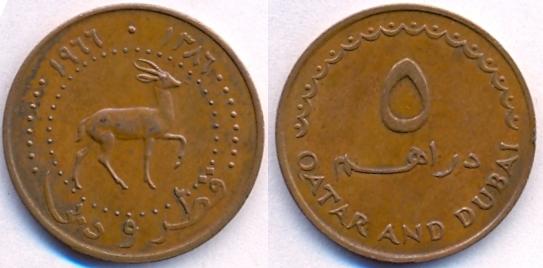 |
KM#2 5 Dirham. Year:
1966 - AH1386. Weight:
3.75g. Metal:
Bronze.
Diameter: 22 mm. Edge:
Plain. Alignment:
Medal. Mint:
British Royal Mint, UK. Obverse:
Both CE and AH years at the top. Gazelle running right. "قطر و دبي" (Qatar and Dubai) written at the bottom. |
|
Reverse:
16 pearl shells at the top. Numeral value "٥" (5) written in the center
and "درهم"
(Dirham)
written below it. "QATAR AND DUBAI" written at the bottom.
Mintage: 2,000,000.
Minted Years: 1966
(AH1386) and 1969 (AH1389).
Qatar Ruler: Ahmad II ibn Ali. |
|
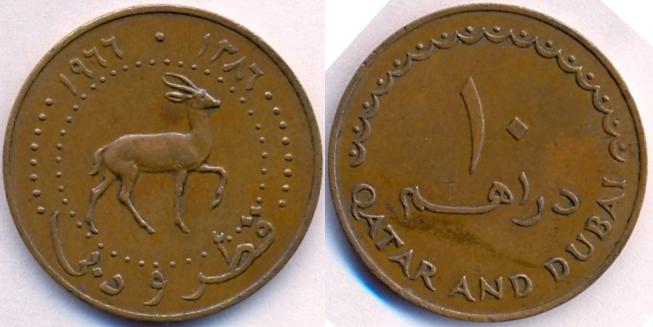 |
KM#3 10 Dirham. Year:
1966 - AH1386. Weight:
7.50g. Metal:
Bronze.
Diameter: 27 mm. Edge:
Plain. Alignment:
Medal. Mint:
British Royal Mint, UK. Obverse:
Both CE and AH years at the top. Gazelle running right. "قطر
و دبي" (Qatar and Dubai) written at the bottom. |
|
Reverse:
16 pearl shells at the top. Numeral value "١٠" (10) written in the center
and "درهم"
(Dirham)
written below it. "QATAR AND DUBAI" written at the bottom.
Mintage: 2,000,000.
Minted Years: 1966
(AH1386) and 1971 (AH1391).
Qatar Ruler: Ahmad II ibn Ali. |
|
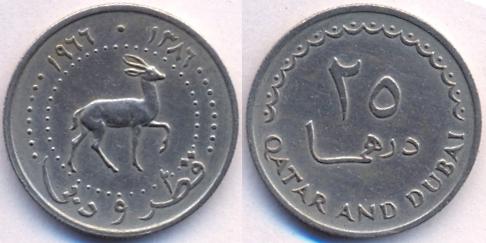 |
KM#4 25 Dirham. Year:
1966 - AH1386. Weight:
3.50g. Metal:
Copper-Nickel.
Diameter: 20 mm. Edge:
Reeded. Alignment:
Medal. Mint:
British Royal Mint, UK. Obverse:
Both CE and AH years at the top. Gazelle running right. "قطر
و دبي" (Qatar and Dubai) written at the bottom. |
|
Reverse:
16 pearl shells at the top. Numeral value "٢٥"
(25) written in the center and
"درهما" (Dirham)
written below it. "QATAR AND DUBAI" written at the bottom.
Mintage: 2,000,000.
Minted Years: 1966
(AH1386) and 1969 (AH1389).
Qatar Ruler: Ahmad II ibn Ali. |
|
 |
KM#5 50 Dirham. Year:
1966 - AH1386. Weight:
6.50g. Metal:
Copper-Nickel.
Diameter: 25 mm. Edge:
Reeded. Alignment:
Medal. Mint:
British Royal Mint, UK. Obverse:
Both CE and AH years at the top. Gazelle running right. "قطر و دبي" (Qatar and Dubai) written at the bottom. |
|
Reverse:
16 pearl shells at the top. Numeral value "٥٠"
(50) written in the center and
"درهما" (Dirham)
written below it. "QATAR AND DUBAI" written at the bottom.
Mintage: 2,000,000.
Minted Years:
One year type.
Qatar Ruler: Ahmad II ibn Ali. |
|
|
|
|
1969 - AH 1389 |
|
|
|
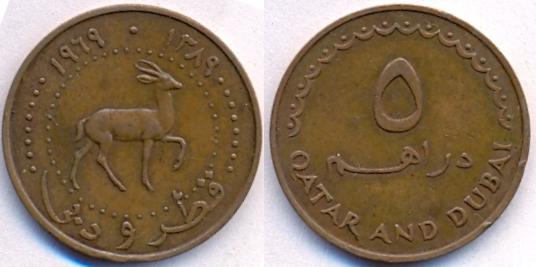 |
Same as mentioned above KM#2, 5 Dirham but... Year:
1969 - AH1389. Weight:
3.75g.
Mintage: 2,000,000. Mint:
British Royal Mint, UK. |
|
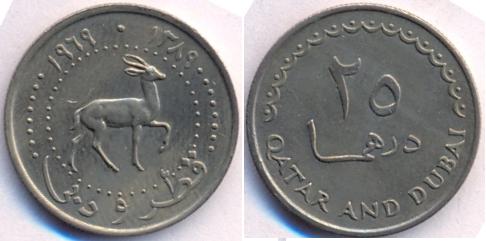 |
Same as mentioned above KM#4, 25 Dirham but... Year:
1969 - AH1389. Weight:
3.50g.
Mintage: 2,000,000. Mint:
British Royal Mint, UK. |
|
|
|
|
1971 - AH 1391 |
|
|
|
 |
Same as mentioned above KM#3, 10 Dirham but... Year:
1971 - AH1391. Weight:
7.50g.
Mintage: 1,500. Mint:
British Royal Mint, UK.
The mintage mentioned above is for Qatar use only based on Krause
publications. Still considered to be a scarce coin. |
|
|
|
|
State of Qatar Coinage |
|
|
|
Qatar achieved independence on 03 Sep 1971, upon
withdrawal of British military presence from the Persian Gulf, and replaced
its special treaty arrangement with Britain with a treaty of general
friendship. Dubai attained independence on 01 Dec 1971, upon termination of Britain's
protective treaty with the Trucial Sheikhdom, and on 02 Dec 1971, entered into
the union of the United Arab Emirates. Despite the fact that the Emirates of
Qatar and the Sheikhdom of Dubai were merged under a monetary union, the two
territories were governed independently from each other. Qatar now uses its own
currency while Dubai uses the United Arab Emirates currency and coins. Below are
the details of coins issued for Qatar. Following Dubai’s entrance into the
United Arab Emirates, Qatar began issuing the Qatari riyal separate from Dubai
on 19 May 1973. |
|
|
|
Currency:
Riyal = 100 dirham (since 13 May 1973). |
|
|
|
1973 - AH 1393 |
|
|
|
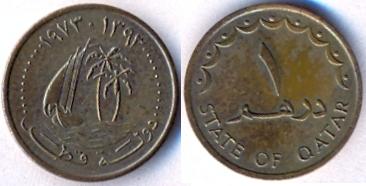 |
KM#2 1 Dirham. Year:
1973 - AH1393. Weight:
1.50g. Metal:
Bronze.
Diameter: 15 mm. Edge:
Plain. Alignment:
Medal. Mint:
British Royal Mint, UK. Obverse:
Both CE and AH years at the top. Qatar emblem in
the center. "دوله قطر" (State of Qatar) written at the bottom. |
|
Reverse:
Nine pearl shells at the top. Numeral value "١" (1) written in the center
and "درهم"
(Dirham)
written below it. "STATE OF QATAR" written at the bottom.
Mintage: 500,000.
Minted Years:
One year type.
Ruler: Khalifa ibn Hamad. |
|
 |
KM#3 5 Dirham. Year:
1973 - AH1393. Weight:
3.75g. Metal:
Bronze.
Diameter: 22 mm. Edge:
Plain. Alignment:
Medal. Mint:
British Royal Mint, UK. Obverse:
Both CE and AH years at the top. Qatar emblem in
the center. "دوله قطر" (State of Qatar) written at the bottom. |
|
Reverse:
Nine pearl shells at the top. Numeral value "٥" (5) written in the
center and "درهم"
(Dirham)
written below it. "STATE OF QATAR" written at the bottom.
Mintage: 1,000,000.
Minted Years: 1973
(AH1393) and 1978 (AH1398).
Ruler: Khalifa ibn Hamad. |
|
 |
KM#1 10 Dirham. Year:
1973 - AH1393. Weight:
7.50g. Metal:
Bronze.
Diameter: 27 mm. Edge:
Plain. Alignment:
Medal. Mint:
British Royal Mint, UK. Obverse:
Both CE and AH years at the top. Qatar emblem in
the center. "دوله قطر" (State of Qatar) written at the bottom.
Note: The coin dated 1972 (AH1392) has the
same mintage but never seen. |
|
Reverse:
Nine pearl shells at the top. Numeral value "١٠" (10) written
in the center and "درهم"
(Dirham)
written below it. "STATE OF QATAR" written at the bottom.
Mintage: 1,500,000.
Minted Years: 1972
(AH1392) and 1973 (AH1393).
Ruler: Khalifa ibn Hamad. |
|
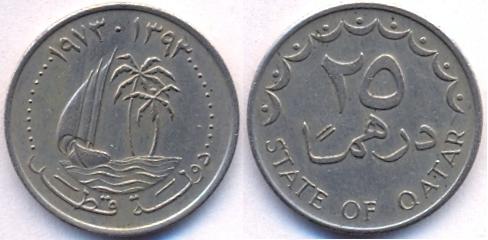 |
KM#4 25 Dirham. Year:
1973 - AH1393. Weight:
3.50g. Metal:
Copper-Nickel.
Diameter: 20 mm. Edge:
Reeded. Alignment:
Medal. Mint:
British Royal Mint, UK. Obverse:
Both CE and AH years at the top. Qatar emblem in
the center. "دوله قطر" (State of Qatar) written at the bottom. |
|
Reverse:
Nine pearl shells at the top. Numeral value "٢٥"
(25) written in the center and
"درهما" (Dirham)
written below it. "STATE OF QATAR" written at the bottom.
Mintage: 1,500,000.
Minted Years: 1973
(AH1393), 1976 (AH1396), 1981 (AH1401), 1987 (AH1407),
1990 (AH1410), 1993 (AH1414), and 1998 (AH1419).
Ruler: Khalifa ibn Hamad. |
|
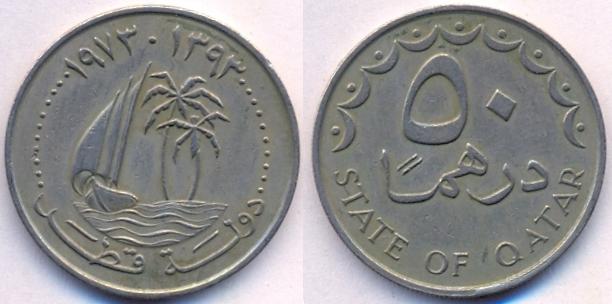 |
KM#5 50 Dirham. Year:
1973 - AH1393. Weight:
6.50g. Metal:
Copper-Nickel.
Diameter: 25 mm. Edge:
Reeded. Alignment:
Medal. Mint:
British Royal Mint, UK. Obverse:
Both CE and AH years at the top. Qatar emblem in
the center. "دوله قطر" (State of Qatar) written at the bottom. |
|
Reverse:
Nine pearl shells at the top. Numeral value "٥٠" (50) written
in the center and "درهما"
(Dirham)
written below it. "STATE OF QATAR" written at the bottom.
Mintage: 1,500,000.
Minted Years: 1973
(AH1393), 1978 (AH1398), 1981 (AH1401), 1987 (AH1407),
1990 (AH1410), 1993 (AH1414), and 1998 (AH1419).
Ruler: Khalifa ibn Hamad. |
|
|
|
|
1976 - AH 1396 |
|
|
|
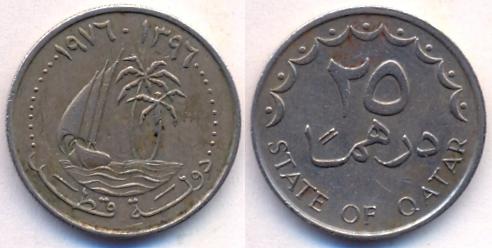 |
Same as mentioned above Qatar KM#4, 25 Dirham
but... Year:
1976 - AH1396. Weight:
3.50g.
Mintage: 2,000,000. Mint:
British Royal Mint, UK. |
|
|
|
|
1978 - AH 1398 |
|
|
|
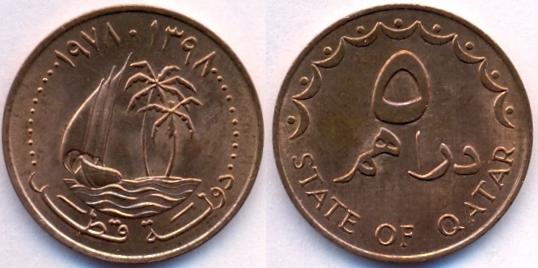 |
Same as mentioned above Qatar KM#3, 5 Dirham
but... Year:
1978 - AH1398. Weight:
3.75g.
Mintage: 1,000,000. Mint:
British Royal Mint, UK. |
|
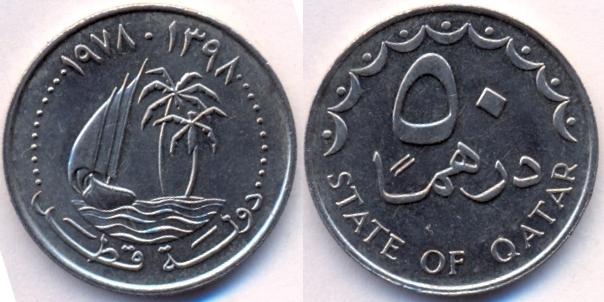 |
Same as mentioned above Qatar KM#5, 50 Dirham
but... Year:
1978 - AH1398. Weight:
6.50g.
Mintage: 2,000,000. Mint:
British Royal Mint, UK. |
|
|
|
|
1981 - AH 1401 |
|
|
|
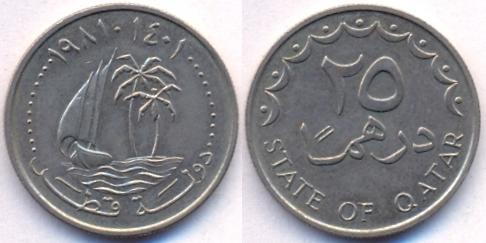 |
Same as mentioned above Qatar KM#4, 25 Dirham
but... Year:
1981 - AH1401. Weight:
3.50g.
Mintage: N/A. Mint:
British Royal Mint, UK. |
|
|
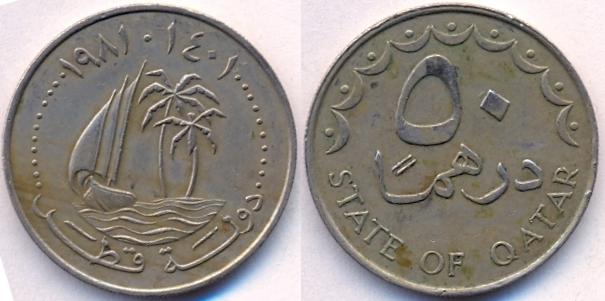
Same as mentioned above Qatar KM#5, 50 Dirham
but... Year:
1981 - AH1401. Weight:
6.50g.
Mintage: N/A. Mint:
British Royal Mint, UK. |
|
|
|
|
1987 - AH 1407 |
|
|
|
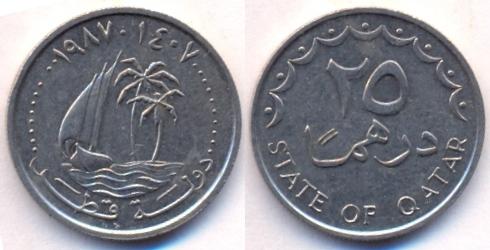 |
Same as mentioned above Qatar KM#4, 25 Dirham
but... Year:
1987 - AH1407. Weight:
3.50g.
Mintage: N/A. Mint:
British Royal Mint, UK. |
|
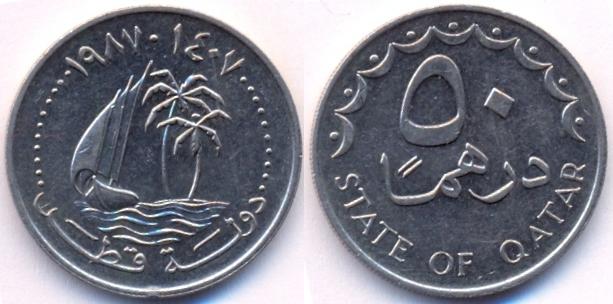 |
Same as mentioned above Qatar KM#5, 50 Dirham
but... Year:
1987 - AH1407. Weight:
6.50g.
Mintage: N/A. Mint:
British Royal Mint, UK. |
|
|
|
|
1990 - AH 1410 |
|
|
|
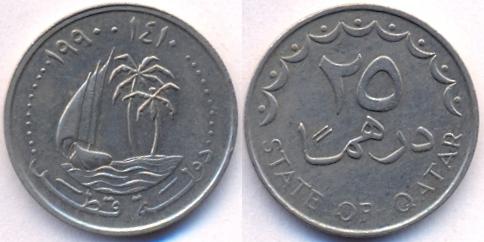 |
Same as mentioned above Qatar KM#4,
25 Dirham but...
Year:
1990 - AH1410. Weight:
3.50g.
Mintage: N/A. Mint:
British Royal Mint, UK. |
|
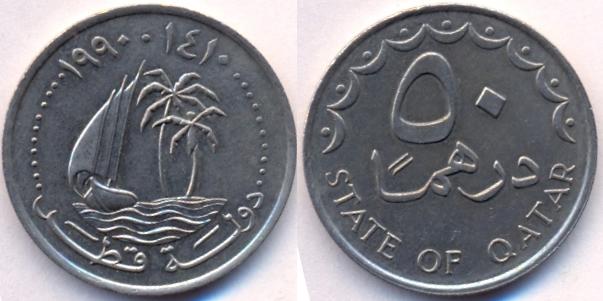 |
Same as mentioned above Qatar KM#5,
50 Dirham but...
Year:
1990 - AH1410. Weight:
6.50g.
Mintage: N/A. Mint:
British Royal Mint, UK. |
|
|
|
|
1993 - AH 1414 |
|
|
|
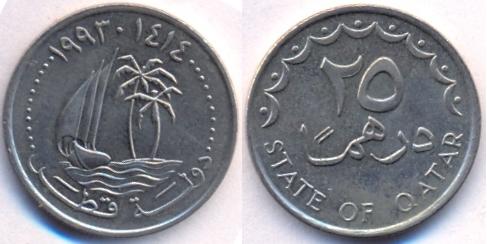 |
Same as mentioned above Qatar KM#4,
25 Dirham but...
Year:
1993 - AH1414. Weight:
3.50g.
Mintage: N/A. Mint:
British Royal Mint, UK. |
|
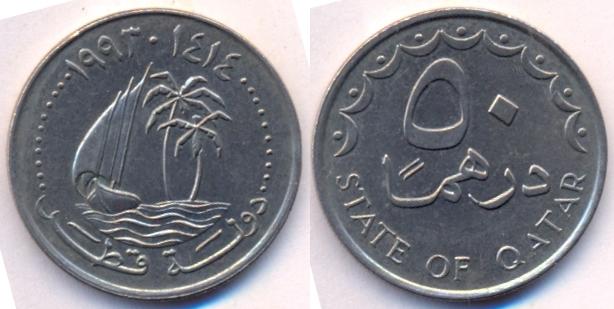 |
Same as mentioned above Qatar KM#5,
50 Dirham but...
Year:
1993 - AH1414. Weight:
6.50g.
Mintage: N/A. Mint:
British Royal Mint, UK. |
|
|
|
|
1998 - AH 1419 |
|
|
|
Khalifa ibn Hamad was the Emir of Qatar from 1972 until
he was deposed by his son Hamad ibn Khalifa in 1995. Hamad II ibn Khalifa
retrain the same images of circulating coins that were produced in 1998. Undated
(probably produced in 1998 or 2006) of 100 Riyals 22.20g .925Ag (Mintage: 400
pieces) and 500 Riyals 17.00g .917Au (Mintage: 100 pieces) were produced with
Bank Building. Another 100 Riyals undated 22.20g .925Ag (Mintage: 1,000 pieces)
coin featuring Qatar University was also produced. These silver and gold coins
had a different Qatar emblem, slight different from the 2006 circulating ones. |
|
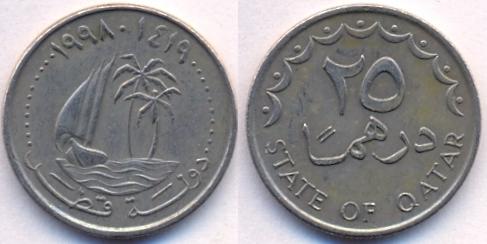 |
Same as mentioned above Qatar KM#4,
25 Dirham but...
Year:
1998 - AH1419. Weight:
3.50g.
Mintage: N/A. Mint:
British Royal Mint, UK.
Ruler: Hamad II ibn Khalifa. |
|
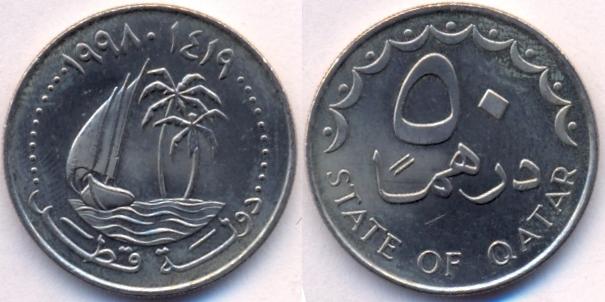 |
Same as mentioned above Qatar KM#5,
50 Dirham but...
Year:
1998 - AH1419. Weight:
6.50g.
Mintage: N/A. Mint:
British Royal Mint, UK.
Ruler: Hamad II ibn Khalifa. |
|
|
|
|
2000 - AH 1421 |
|
|
|
A dot separating CE and AH years was replaced with a minus
sign and secondly English denomination is added. |
|
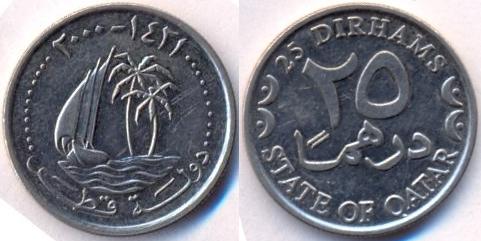 |
KM#8 25 Dirham. Year:
2000 - AH1421. Weight:
3.50g. Metal:
Copper-Nickel.
Diameter: 20 mm. Edge:
Reeded. Alignment:
Medal. Mint:
British Royal Mint, UK. Obverse:
Both CE and AH years at the top. Qatar emblem in
the center. "دوله قطر" (State of Qatar) written at the bottom. |
|
Reverse:
"25 DIRHAMS" written at the top. Numeral value "٢٥"
(25) written in the center and
"درهما" (Dirham)
written below it. Two pearl shells are on both sides. "STATE OF QATAR" written at the bottom.
Mintage: N/A.
Minted Years: 2000
(AH1421) and 2003 (AH1424).
Ruler: Hamad II ibn Khalifa. |
|
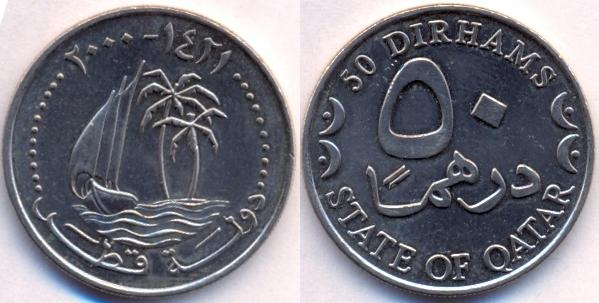 |
KM#9 50 Dirham. Year:
2000 - AH1421. Weight:
6.50g. Metal:
Copper-Nickel.
Diameter: 25 mm. Edge:
Reeded. Alignment:
Medal. Mint:
British Royal Mint, UK. Obverse:
Both CE and AH years at the top. Qatar emblem in
the center. "دوله قطر" (State of Qatar) written at the bottom. |
|
Reverse:
"50 DIRHAMS" written at the top. Numeral value "٥٠"
(50) written in the center and
"درهما" (Dirham)
written below it. Two pearl shells are on both sides. "STATE OF QATAR" written at the bottom.
Mintage: N/A.
Minted Years: 2000
(AH1421) and 2003 (AH1424).
Ruler: Hamad II ibn Khalifa. |
|
|
|
|
2003 - AH 1424 |
|
|
|
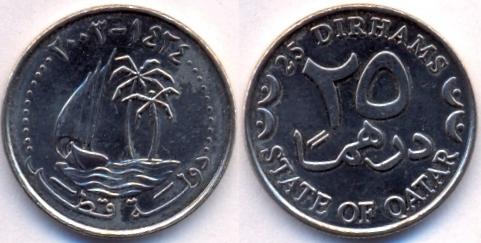 |
Same as mentioned above Qatar KM#8, 25 Dirham
but... Year:
2003 - AH1424. Weight:
3.50g.
Mintage: N/A. Mint:
British Royal Mint, UK. |
|
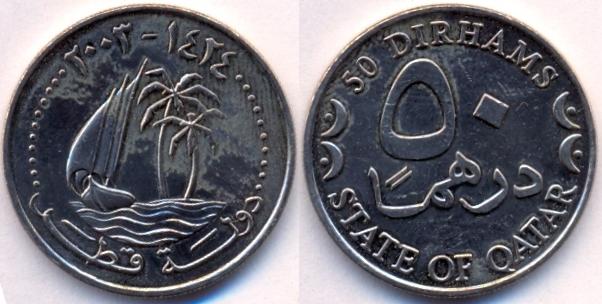 |
Same as mentioned above Qatar KM#9, 50 Dirham
but... Year:
2003 - AH1424. Weight:
6.50g.
Mintage: N/A. Mint:
British Royal Mint, UK. |
|
| |
|
2006 - AH 1427 |
| |
|
Qatar emblem was changed on coins
produced in this year. 15th Asian games were held in Doha (Qatar's
capital) this year, six different one Riyal aluminum-bronze coins, nine
different 10 Riyals 1 ounce silver coins, seven different 100 Riyals 10 grams
gold coins, 300 Riyals 1 kilogram silver coin and 10,000 Riyals 1 kilogram
gold coin were produced by the Perth Mint to celebrate this event. The Doha
Asian Games Organizing Committee chose "Orry", a Qatari Oryx, as the
official mascot of the 15th Asian Games Doha 2006. The
minus sign separating CE and AH years was replaced back with a dot. |
|
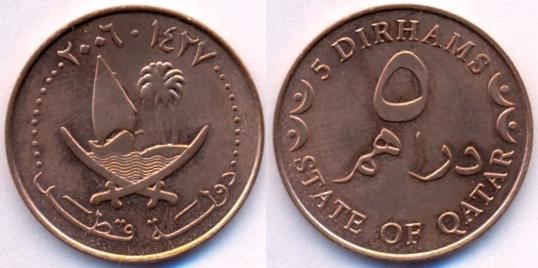 |
KM#12 5 Dirham. Year:
2006 - AH1427. Weight:
3.75g. Metal:
Bronze.
Diameter: 22 mm. Edge:
Plain. Alignment:
Medal. Mint:
Münze Österreich AG, Vienna, Austria.
Obverse:
Both CE and AH years at the top. Qatar emblem in
the center. "دوله قطر" (State of Qatar) written at the bottom. |
|
Reverse:
"5 DIRHAMS" written at the top. Numeral value "٥"
(5) written in the center and
"درهم" (Dirham)
written below it. Two pearl shells are on both sides. "STATE OF QATAR" written at the bottom. Mintage: N/A.
Minted Years: One year
type.
Ruler: Hamad II ibn Khalifa. |
|
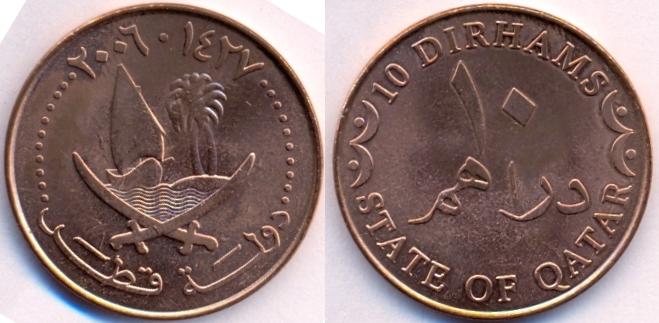 |
KM#13 10 Dirham. Year:
2006 - AH1427. Weight:
7.50g. Metal:
Bronze.
Diameter: 27 mm. Edge:
Plain. Alignment:
Medal. Mint:
Münze Österreich AG, Vienna, Austria. Obverse:
Both CE and AH years at the top. Qatar emblem in
the center. "دوله قطر" (State of Qatar) written at the bottom. |
|
Reverse:
"10 DIRHAMS" written at the top. Numeral value "١٠"
(10) written in the center and
"درهم" (Dirham)
written below it. Two pearl shells are on both sides. "STATE OF QATAR" written at the bottom.
Mintage: N/A.
Minted Years: One year
type.
Ruler: Hamad II ibn Khalifa. |
|
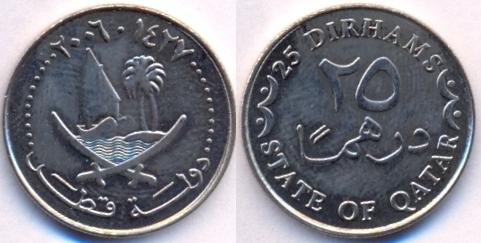 |
KM#14 25 Dirham. Year:
2006 - AH1427. Weight:
3.50g. Metal:
Copper-Nickel.
Diameter: 20 mm. Edge:
Reeded. Alignment:
Medal. Mint:
Münze Österreich AG, Vienna, Austria. Obverse:
Both CE and AH years at the top. Qatar emblem in
the center. "دوله قطر" (State of Qatar) written at the bottom. |
|
Reverse:
"25 DIRHAMS" written at the top. Numeral value "٢٥"
(25) written in the center and
"درهما" (Dirham)
written below it. Two pearl shells are on both sides. "STATE OF QATAR" written at the bottom.
Mintage: N/A.
Minted Years:
One year type.
Ruler: Hamad II ibn Khalifa. |
|
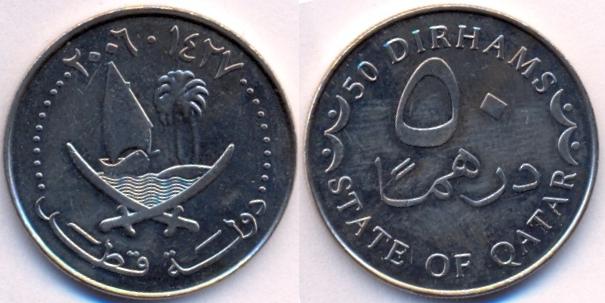 |
KM#15 50 Dirham. Year:
2006 - AH1427. Weight:
6.50g. Metal:
Copper-Nickel.
Diameter: 25 mm. Edge:
Reeded. Alignment:
Medal. Mint:
Münze Österreich AG, Vienna, Austria. Obverse:
Both CE and AH years at the top. Qatar emblem in
the center. "دوله قطر" (State of Qatar) written at the bottom. |
|
Reverse:
"50 DIRHAMS" written at the top. Numeral value "٥٠"
(50) written in the center and
"درهما" (Dirham)
written below it. Two pearl shells are on both sides. "STATE OF QATAR" written at the bottom.
Mintage: N/A.
Minted Years:
One year type.
Ruler: Hamad II ibn Khalifa. |
|
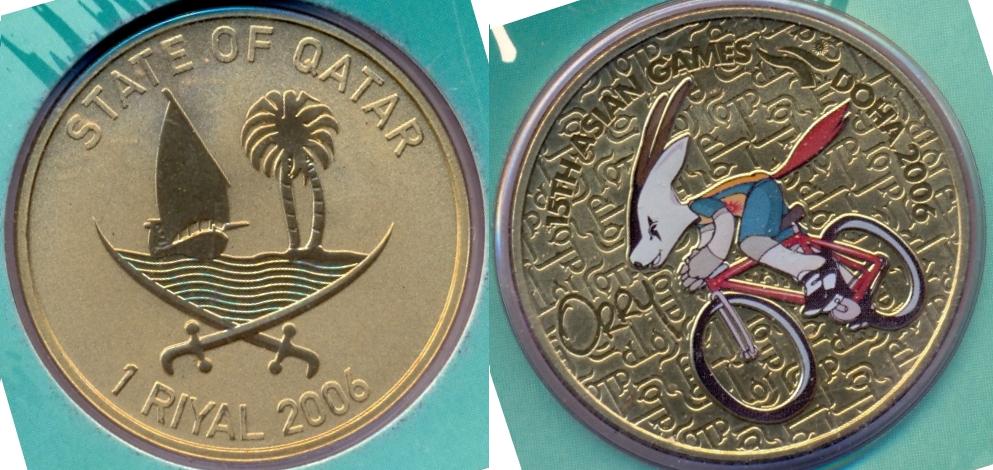 |
| KM#16 1 Riyal. Year:
2006. Weight:
20.00g. Metal:
Aluminum-Bronze.
Diameter: 38.74 mm.
Thickness:
2.55 mm. Edge:
Plain. Alignment:
Medal. Mint:
The Perth Mint. Obverse:
"STATE OF QATAR" written at the top. Qatar emblem
in the center. "1 RIYAL 2006" written at the bottom.
Reverse: "15TH ASIAN
GAMES - DOHA 2006" written at the top. Multicolor
cartoon character Qatari Oryx on bicycle.
Mintage: 25,000.
Minted Years: One year
type. Ruler: Hamad II ibn Khalifa.
Subject: 15th
Asian Games Doha 2006 - The Games of your life. |
|
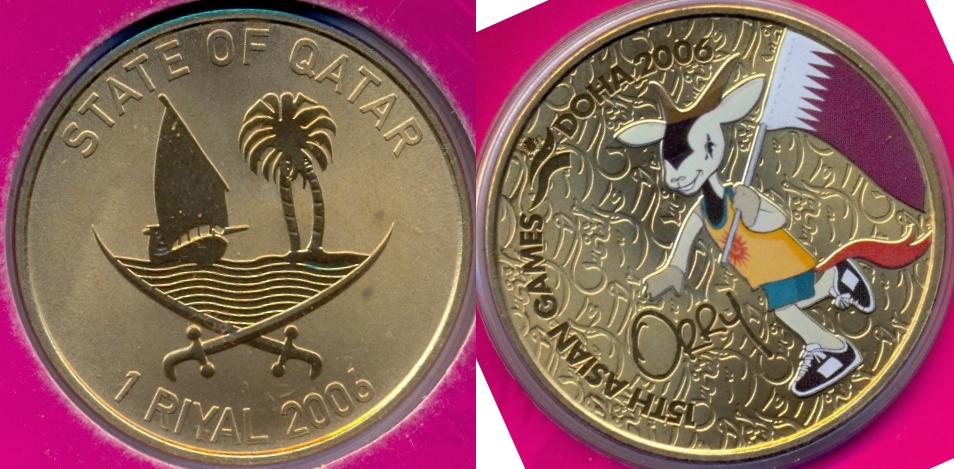 |
| KM#34 1 Riyal. Year:
2006. Weight:
20.00g. Metal:
Aluminum-Bronze.
Diameter: 38.74 mm.
Thickness:
2.55 mm. Edge:
Plain. Alignment:
Medal. Mint:
The Perth Mint. Obverse:
"STATE OF QATAR" written at the top. Qatar emblem
in the center. "1 RIYAL 2006" written at the bottom.
Reverse: "15TH ASIAN
GAMES - DOHA 2006" written at the left side clock-wise. Multicolor
cartoon character Qatari Oryx as Mascot carrying Qatar's flag.
Mintage: 25,000.
Minted Years: One year
type. Ruler: Hamad II ibn Khalifa.
Subject: 15th
Asian Games Doha 2006 - The Games of your life. |
|
 |
| KM#35 1 Riyal. Year:
2006. Weight:
20.00g. Metal:
Aluminum-Bronze.
Diameter: 38.74 mm.
Thickness:
2.55 mm. Edge:
Plain. Alignment:
Medal. Mint:
The Perth Mint. Obverse:
"STATE OF QATAR" written at the top. Qatar emblem
in the center. "1 RIYAL 2006" written at the bottom.
Reverse: "15TH ASIAN
GAMES - DOHA 2006" written at the top and towards right side. Multicolor
cartoon character Qatari Oryx kicking soccer ball.
Mintage: 25,000.
Minted Years: One year
type. Ruler: Hamad II ibn Khalifa.
Subject: 15th
Asian Games Doha 2006 - The Games of your life. |
|
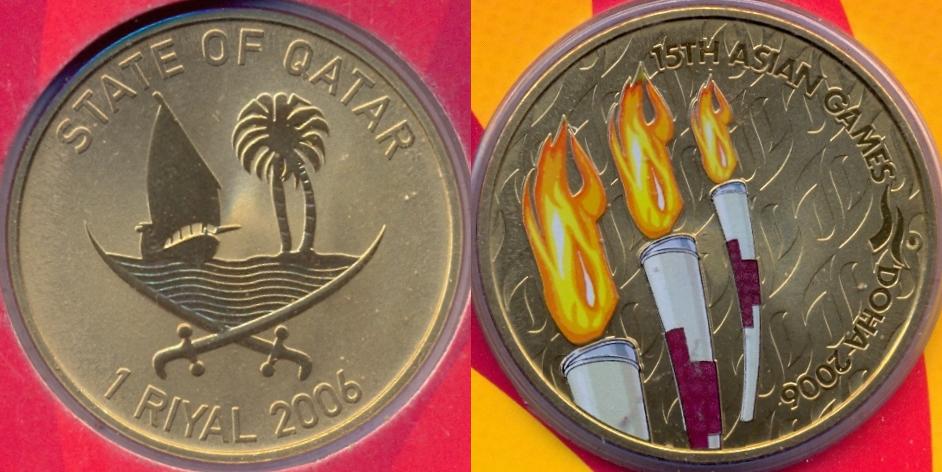 |
| KM#36 1 Riyal. Year:
2006. Weight:
20.00g. Metal:
Aluminum-Bronze.
Diameter: 38.74 mm.
Thickness:
2.55 mm. Edge:
Plain. Alignment:
Medal. Mint:
The Perth Mint. Obverse:
"STATE OF QATAR" written at the top. Qatar emblem
in the center. "1 RIYAL 2006" written at the bottom.
Reverse: "15TH ASIAN
GAMES - DOHA 2006" written at the right side clock-wise. Three
multicolor torches resembling Qatar's flag.
Mintage: 25,000.
Minted Years: One year
type. Ruler: Hamad II ibn Khalifa.
Subject: 15th
Asian Games Doha 2006 - we don't walk...we run. |
|
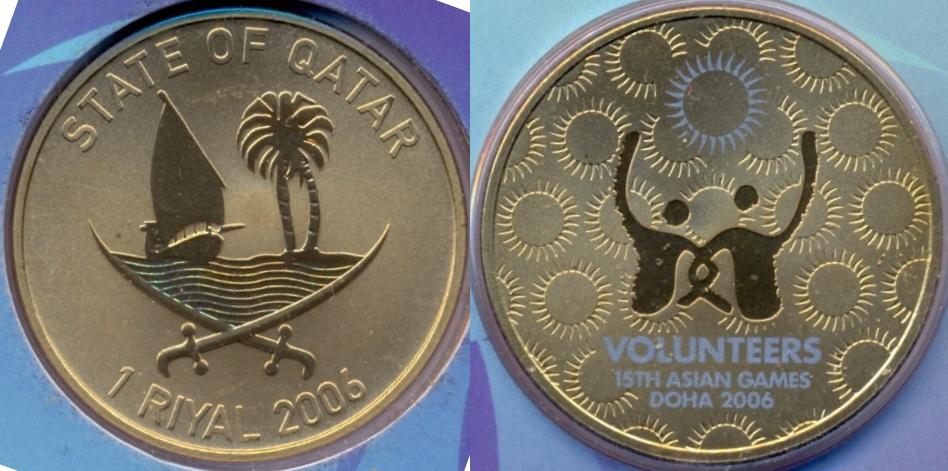 |
| KM#37 1 Riyal. Year:
2006. Weight:
20.00g. Metal:
Aluminum-Bronze.
Diameter: 38.74 mm.
Thickness:
2.55 mm. Edge:
Plain. Alignment:
Medal. Mint:
The Perth Mint. Obverse:
"STATE OF QATAR" written at the top. Qatar emblem
in the center. "1 RIYAL 2006" written at the bottom.
Reverse:
Blue Sun at the top. Two figures
with linked arms in the center. "VOLUNTEERS 15TH ASIAN GAMES DOHA
2006" written at the bottom in three lines.
Mintage: 25,000.
Minted Years: One year
type. Ruler: Hamad II ibn Khalifa.
Subject:
Volunteers - 15th
Asian Games Doha 2006 - be part of the legacy. |
|
 |
| KM#38 1 Riyal. Year:
2006. Weight:
20.00g. Metal:
Aluminum-Bronze.
Diameter: 38.74 mm.
Thickness:
2.55 mm. Edge:
Plain. Alignment:
Medal. Mint:
The Perth Mint. Obverse:
"STATE OF QATAR" written at the top. Qatar emblem
in the center. "1 RIYAL 2006" written at the bottom.
Reverse: Five falling
water drops at the top, Figure
with outstretched arms in the center. "ENVIRONMENT 15TH ASIAN GAMES
DOHA 2006" written at the bottom in three lines.
Mintage: 25,000.
Minted Years: One year
type. Ruler: Hamad II ibn Khalifa.
Subject:
Environment - 15th Asian Games Doha 2006. |
|
| |
|
2008 - AH 1429 |
| The minus sign
separating CE and AH years was replaced back instead of dot, used in 2006
coins. These coins are attracted to magnet, therefore were made of different
metal composition. These coins have smaller emblem on the obverse side and
thick legends of the reverse side than 2006 and 2012 coins. |
| |
|
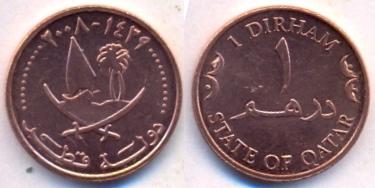 |
KM#69.1 1 Dirham. Year:
2008 - AH1429. Weight:
1.37g. Metal:
Bronze Clad Steel.
Diameter: 15 mm. Edge:
Plain. Alignment:
Medal. Mint:
British Royal Mint, UK. Obverse:
Both CE and AH years at the top. Qatar emblem in
the center. "دوله قطر" (State of Qatar) written at the bottom. |
|
Reverse:
"1 DIRHAM" written at the top. Numeral value "١" (1) written in the center
and "درهم"
(Dirham)
written below it. Two pearl shells are on both sides. "STATE OF QATAR" written at the bottom.
Mintage: N/A.
Minted Years:
One year type.
Ruler: Hamad II ibn Khalifa. |
|
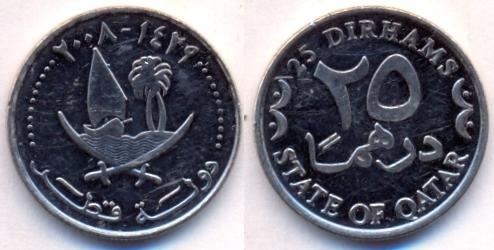 |
KM#14.1 25 Dirham. Year:
2008 - AH1429. Weight:
3.13g. Metal:
Nickel Clad Steel.
Diameter: 20 mm. Edge:
Reeded. Alignment:
Medal. Mint:
British Royal Mint, UK. Obverse:
Both CE and AH years at the top. Qatar emblem in
the center. "دوله قطر" (State of Qatar) written at the bottom.
Note:
"25 Dirhams"
legend in Arabic on reverse side is more thicker than 2006 and 2012 issue. |
|
Reverse:
"25 DIRHAMS" written at the top. Numeral value "٢٥"
(25) written in the center and
"درهما" (Dirham)
written below it. Two pearl shells are on both sides. "STATE OF QATAR" written at the bottom.
Mintage: N/A.
Minted Years:
One year type.
Ruler: Hamad II ibn Khalifa. |
|
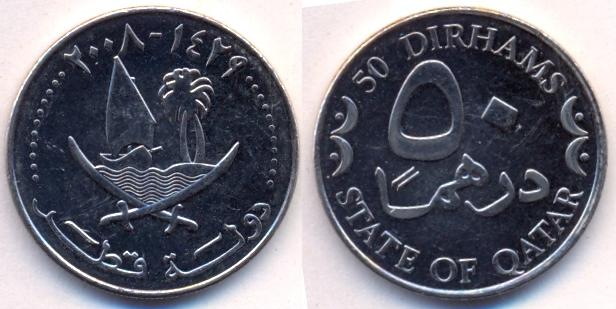 |
KM#15.1 50 Dirham. Year:
2008 - AH1429. Weight:
5.81g. Metal:
Nickel Clad Steel.
Diameter: 25 mm. Edge:
Reeded. Alignment:
Medal. Mint:
British Royal Mint, UK. Obverse:
Both CE and AH years at the top. Qatar emblem in
the center. "دوله قطر" (State of Qatar) written at the bottom.
Mintage: N/A.
Note:
"50 Dirhams"
legend in Arabic on reverse side is more thicker than 2006 and 2012 issue. |
|
Reverse:
"50 DIRHAMS" written at the top. Numeral value "٥٠"
(50) written in the center and
"درهما" (Dirham)
written below it. Two pearl shells are on both sides. "STATE OF QATAR" written at the bottom.
Minted Years: One
year type.
Ruler: Hamad II ibn Khalifa. |
|
| |
|
2012 - AH 1433 |
|
Same legends
style with dot sign separating CE and AH years as in 2006 issue but magnetic as 2008 issues. |
|
|
|
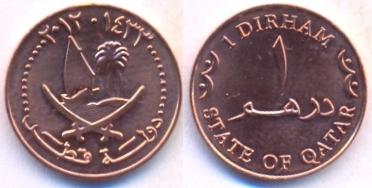 |
KM#69.2 1 Dirham. Year:
2012 - AH1433. Weight:
1.33g. Metal:
Bronze Clad Steel.
Diameter: 15 mm. Edge:
Plain. Alignment:
Medal. Mint:
Münze Österreich AG, Vienna, Austria. Obverse:
Both CE and AH years at the top. Qatar emblem in
the center. "دوله قطر" (State of Qatar) written at the bottom. |
|
Reverse:
"1 DIRHAM" written at the top. Numeral value "١" (1) written in the center
and "درهم"
(Dirham)
written below it. Two pearl shells are on both sides. "STATE OF QATAR" written at the bottom.
Mintage: 1,000,000 (estimated).
Minted Years:
One year type.
Ruler: Hamad II ibn Khalifa. |
|
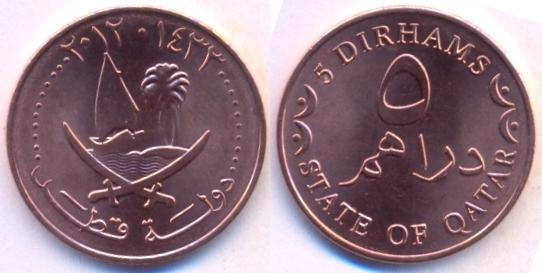 |
KM#12a 5 Dirham. Year:
2012 - AH1433. Weight:
3.75g. Metal:
Bronze Clad Steel.
Diameter: 22 mm. Edge:
Plain. Alignment:
Medal. Mint:
Münze Österreich AG, Vienna, Austria. Obverse:
Both CE and AH years at the top. Qatar emblem in
the center. "دوله قطر" (State of Qatar) written at the bottom. |
|
Reverse:
"5 DIRHAMS" written at the top. Numeral value "٥"
(5) written in the center and
"درهم" (Dirham)
written below it. Two pearl shells are on both sides. "STATE OF QATAR" written at the bottom.
Mintage: 1,000,000 (estimated).
Minted Years: One year
type.
Ruler: Hamad II ibn Khalifa. |
|
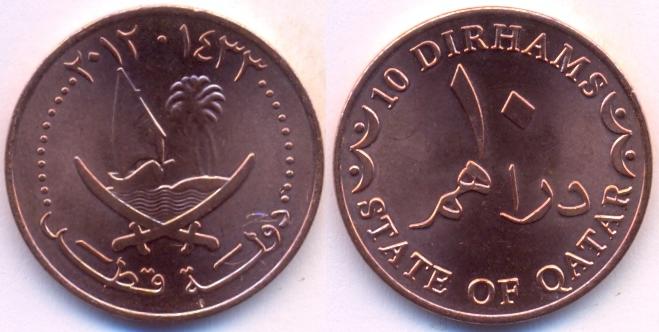 |
KM#13a 10 Dirham. Year:
2012 - AH1433. Weight:
7.47g. Metal:
Bronze Clad Steel.
Diameter: 27 mm. Edge:
Plain. Alignment:
Medal. Mint:
Münze Österreich AG, Vienna, Austria. Obverse:
Both CE and AH years at the top. Qatar emblem in
the center. "دوله قطر" (State of Qatar) written at the bottom. |
|
Reverse:
"10 DIRHAMS" written at the top. Numeral value "١٠"
(10) written in the center and
"درهم" (Dirham)
written below it. Two pearl shells are on both sides. "STATE OF QATAR" written at the bottom.
Mintage: 1,000,000 (estimated).
Minted Years: One year
type.
Ruler: Hamad II ibn Khalifa. |
|
 |
KM#14.2 25 Dirham. Year:
2012 - AH1433. Weight:
3.19g. Metal:
Bronze Clad Steel.
Diameter: 20 mm. Edge:
Reeded. Alignment:
Medal. Mint:
Münze Österreich AG, Vienna, Austria. Obverse:
Both CE and AH years at the top. Qatar emblem in
the center. "دوله قطر" (State of Qatar) written at the bottom. |
|
Reverse:
"25 DIRHAMS" written at the top. Numeral value "٢٥"
(25) written in the center and
"درهما" (Dirham)
written below it. Two pearl shells are on both sides. "STATE OF QATAR" written at the bottom.
Mintage: 12,000,000 (estimated).
Minted Years: One year
type.
Ruler: Hamad II ibn Khalifa. |
|
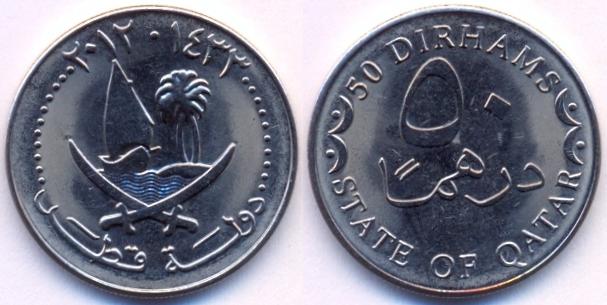 |
KM#15.2 50 Dirham. Year:
2012 - AH1433. Weight:
5.73g. Metal:
Bronze Clad Steel.
Diameter: 25 mm. Edge:
Reeded. Alignment:
Medal. Mint:
Münze Österreich AG, Vienna, Austria. Obverse:
Both CE and AH years at the top. Qatar emblem in
the center. "دوله قطر" (State of Qatar) written at the bottom. |
|
Reverse:
"50 DIRHAMS" written at the top. Numeral value "٥٠"
(50) written in the center and
"درهما" (Dirham)
written below it. Two pearl shells are on both sides. "STATE OF QATAR" written at the bottom.
Mintage: 15,000,000 (estimated).
Minted Years: One year
type.
Ruler: Hamad II ibn Khalifa. |
|
|
|
|
2016 - AH 1437 |
| Both CE and AH years
are changes to English digits. The minus sign separating CE and AH years.
Stylish legends of Arabic and English is used. Instead of numeral digit as Value in English,
the complete word is used. Arabic digit is replaced with English digit in
the center of reverse side. |
| |
|
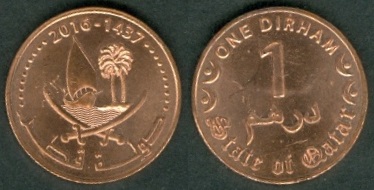 |
1 Dirham. Year:
2016 - AH1437. Weight:
1.41g. Metal:
Bronze Clad Steel.
Diameter: 15 mm. Edge:
Plain. Alignment:
Medal. Mint:
N/A. Obverse:
Both CE and AH years at the top. Qatar emblem in
the center. "دوله قطر" (State of Qatar) written at the bottom. |
|
Reverse:
"ONE DIRHAM" written at the top. Numeral value "1" written in the center
and "درهم"
(Dirham)
written below it. Two pearl shells are on both sides. "STATE OF QATAR" written at the bottom.
Mintage: N/A.
Minted Years:
One year type.
Ruler: Tamim ibn Hamad
II. |
|
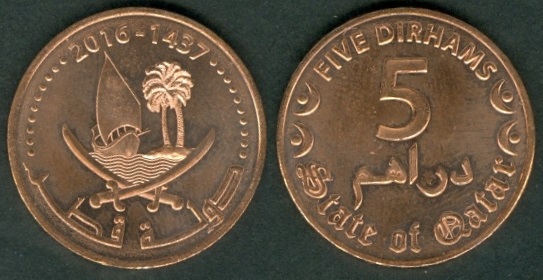 |
5 Dirham. Year:
2016 - AH1437. Weight:
3.85g. Metal:
Bronze Clad Steel.
Diameter: 22 mm. Edge:
Plain. Alignment:
Medal. Mint:
N/A. Obverse:
Both CE and AH years at the top. Qatar emblem in
the center. "دوله قطر" (State of Qatar) written at the bottom. |
|
Reverse:
"FIVE DIRHAMS" written at the top. Numeral value "5" written in the center and
"درهم" (Dirham)
written below it. Two pearl shells are on both sides. "STATE OF QATAR" written at the bottom.
Mintage: N/A.
Minted Years: One year
type.
Ruler: Tamim ibn Hamad
II. |
|
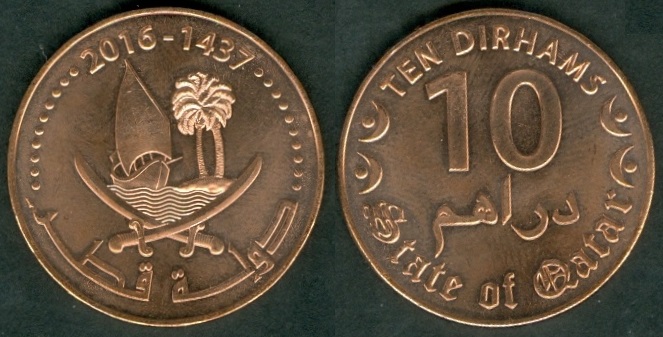 |
10 Dirham. Year:
2016 - AH1437. Weight:
7.55g. Metal:
Bronze Clad Steel.
Diameter: 27 mm. Edge:
Plain. Alignment:
Medal. Mint:
N/A. Obverse:
Both CE and AH years at the top. Qatar emblem in
the center. "دوله قطر" (State of Qatar) written at the bottom. |
|
Reverse:
"TEN DIRHAMS" written at the top. Numeral value "10" written in the center and
"درهم" (Dirham)
written below it. Two pearl shells are on both sides. "STATE OF QATAR" written at the bottom.
Mintage: N/A.
Minted Years: One year
type.
Ruler: Tamim ibn Hamad
II. |
|
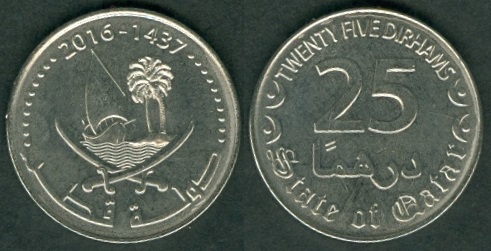 |
25 Dirham. Year:
2016 - AH1437. Weight:
3.19g. Metal:
Bronze Clad Steel.
Diameter: 20 mm. Edge:
Reeded. Alignment:
Medal. Mint:
N/A. Obverse:
Both CE and AH years at the top. Qatar emblem in
the center. "دوله قطر" (State of Qatar) written at the bottom. |
|
Reverse:
"TWENTY FIVE DIRHAMS" written at the top. Numeral value "25" written in the center and
"درهما" (Dirham)
written below it. Two pearl shells are on both sides. "STATE OF QATAR" written at the bottom.
Mintage: N/A.
Minted Years: One year
type.
Ruler: Tamim ibn Hamad
II. |
|
 |
50 Dirham. Year:
2016 - AH1437. Weight:
5.82g. Metal:
Bronze Clad Steel.
Diameter: 25 mm. Edge:
Reeded. Alignment:
Medal. Mint:
N/A. Obverse:
Both CE and AH years at the top. Qatar emblem in
the center. "دوله قطر" (State of Qatar) written at the bottom.
Mintage: N/A.
Minted Years: One year
type.
Ruler: Hamad II ibn Khalifa. |
|
Reverse:
"FIFTY DIRHAMS" written at the top. Numeral value "50" written in the center and
"درهما" (Dirham)
written below it. Two pearl shells are on both sides. "STATE OF QATAR" written at the bottom.
Mintage: N/A.
Minted Years: One year
type.
Ruler: Tamim ibn Hamad
II. |
|
| |
|
|
| |
|
|
| Countries
/ Territories |
| |
|
Chiefa Coins | |
|