| |
 |
 |
| |
| Khyber-Pakhtunkhwa |
| |
Since ancient times the region has been
invaded and ruled by numerous groups and created Empires: Afghans,
Persians, Greeks, Maurya, Scythians, Kushans, Huns, Arabs,
Turks, Mongols, Mughals, Sikhs, and the British. Between 2000 and
1500 BC, the Aryans split off into an Iranian branch, represented by
the Pakhtuns who came to dominate most of the region, and various
Dardic peoples who came to populate much of the north. Earlier
pre-Aryan inhabitants include the Burusho. Following the Mauryan
conquest of the region, Buddhism became a major faith, at least in
urban centers, as attested by recent archaeological and hermeneutic
evidence. Kanishka, a prominent Kushan ruler was one of the
prominent Buddhist kings.
Khyber-Pakhtunkhwa was formerly known as the North-West Frontier Province.
Capital: Peshawar, was home to
the Kingdom of Gandhara from around the 6th century BC and later
became the capital of the Kushan Empire by Kanisha I. The region was
visited by such notable historical figures as Darius II, Alexander
the Great, Hiuen Tsang, Fa Hien, Marco Polo, Mountstuart Elphinstone,
and Winston Churchill, among others. Peshawar's Qissah Kahani
(Street of the Stroytellers) has been a market and meeting place for
foreign merchants and trades for more than 1000 years. |
|
|
-
Macedon..................................................329 -
312 BCE
-
The
Mauryan Empire (India)...............................312
- 171
- EUCRATID BACTRIA
- A small Hellenic state known
as Indo-Greek formed when Bactria was sundered by the
Sakae. A
Hindu-Kush territory of Paropamisadae [Bactria and Sogdiana]. Capital: Alexandria of
the Caucasus, now Chârikâr capital of Parvan, 45km east of Kabul. Begram
is also known to be the capital of this state.
The reigns of these
rulers are very complex and even historians have conflicts among
themselves. According to these historians there is no evidence
of these rulers, ruling together, except Plato.
- Eucratides
I.............................................170 - 145 with...
- Eucratides I
(or Eukratides I) was one of the most important Greco-Bactrian
kings. He uprooted the Euthydemid dynasty of Greco-Bactrian
kings and replaced it with his own lineage. He fought against
the Indo-Greek kings, the easternmost Hellenistic rulers in
northwestern India, temporarily holding territory as far as the
Indus, until he was finally defeated and pushed back to Bactria.
He was known to rule Bactria, Paropamisadae, Arachosia and
Gandhara.
-
Plato (co-regent)........................................170 -
165 ?
- Eucratides
II............................................145 - 140
- Heliocles
I..............................................145 - 130
- Heliocles, the
last Greek king of Bactria, was invaded by the nomadic tribes of
the Yuezhi from the North. Descendants of Eucratides may have
ruled on in the Indo-Greek kingdom.
-
Antialcidas Nikephoros...................................130 -
120
- He was an
Indo-Greek king, who reigned from his capital at Taxila.
Antialcidas may have been a relative of the Bactrian king
Heliocles I, but ruled after the fall of the Bactrian kingdom.
Several later kings may have been related to Antialcidas:
Heliokles II, Amyntas, Diomedes and Hermaeus all struck coins
with similar features.
- Heliocles
II Dikaios......................................95 - 80
- Amyntas
Nikator...........................................95
- 90
- His coins have
been found both in eastern Punjab and Afghanistan, indicating
that he ruled a considerable territory.
- Diomedes..................................................95
- 85
- Telephos..................................................95
- 80
- Archebios
[Archebius Dikaios Nikephoros]..................90 - 80
- He was probably
one of the last Indo-Greek kings before the Saka king Maues
conquered Taxila, and a contemporary of Hermaeus in the west. He
may have been a relative of Heliokles II.
- Hermaios [Hermaeus
Soter].................................90
- 70
- He was one of
the later Western Indo-Greek kings, who ruled in the Hindu-Kush
territory of the Paropamisadae, with his capital in Alexandria
of the Caucasus, near today's Kabul in Afghanistan. Hermaeus
seems to have been successor of Philoxenus or Diomedes. Judging
from his coins, Hermaeus' rule was long and prosperous, but came
to an end when the Yue-Zhi, coming from neighboring Bactria
overtook most of his Greek kingdom in the Paropamisadae around
70 BCE. Historians have not yet connected Philoxenus Aniketos
[100 - 95 BCE, also has issued coins] with any dynasty, but he
could have been the father of the princess Kalliope, who was
married to the King Hermaeus.
|
|
|
-
The Yuezhi.........................................c.
20
BCE - 1 BCE
- KUSHANID EMPIRE
- The Kushan Empire (Ancient Greek:
Βασιλεία Κοσσανῶν; Bactrian: Κυϸανο, Kushano;
Sanskrit: Ku-shā-ṇa
(Late Brahmi script), Kuṣāṇa Sāmrājya; BHS: Guṣāṇa-vaṃśa;
Chinese: 貴霜; Parthian: Kušan-xšaθr) was a syncretic empire,
formed by the Yuezhi, in the Bactrian territories in the early
1st century. It spread to encompass much of Afghanistan, and
then the northern parts of the Indian subcontinent at least as
far as Saketa and Sarnath near Varanasi (Benares), where
inscriptions have been found dating to the era of the Kushan
Emperor Kanishka the Great. Emperor Kanishka was a great patron
of Buddhism. He played an important role in the establishment of
Buddhism in the Indian subcontinent and its spread to Central
Asia and China. Kushan evolved from one of the five
major clans of the Yue-Zhi who occupied the region in the 1st
century BCE. In its time it was considered a major state, along
with China, Parthia, and Rome, and contributed much to the
establishment of Buddhism in the region. Information on its
rulers is fragmentary, and the dates given are especially
susceptible to interpretation. The state that at its cultural
zenith, circa 105–250 CE, extended from what is now Tajikistan
to Afghanistan, Pakistan and down into the Ganges river valley
in northern India.
Capitals: Bagram (Kapisi),
Peshawar (Purusapura), Taxila (Taksasila) and Mathura (Mathura).
Common
languages:
Greek (official until ca. 127), Bactrian (official from ca. 127)
and later Sanskrit.
Religion:
Buddhism, Hinduism
and Zoroastrianism.
- Heraios...............................................
c. 01 - c. 30 CE
- Kujula
Kadphises.......................................c. 30 - c. 80
- Wemla
Taktu [or Vima Takto]............................c. 80 - c. 103
- Wemla
Kadphises [or Vima Kadphises]...................c. 103 - c. 127
- Vima Kadphises
added to the Kushan territory by his conquests in Afghanistan
and north-west India.
- Kanishka
I............................................c. 127 - C. 147
- His territory
was administered from two capitals: Purushapura (now Peshawar in
northern Pakistan) and Mathura, in northern India. Regional
capitals were Balkh and Taxila in Pakistan, Begram in Afghanistan,
Mathura and Saketa in India.
- Vasishka..............................................c.
151 - c. 155
- Huvishka
I............................................c. 155 - c. 187
- Vasudeva
I............................................c. 191 - c. 225
- After Vasudeva,
Kushan empire was divided into western and eastern halves.
Around 224–240, the Sassanids invaded Bactria and Northern
India, where they are known as the Indo-Sassanids.
- Kanishka
II...........................................c. 226 - c. 240
- Vasishka
II...........................................c. 240 - c. 250
- Kanishka
III..........................................c. 255 - c. 275
- Around 270, the Kushans lost their territories on the Gangetic plain, where
the Gupta Empire was established around 320 and to the Sassanids
during Shapur II's reign, notably the area that comprises
Afghanistan.
- Vasudeva
II...........................................c. 290 - c. 310
- Vasudeva
III
- reported son of
Vasudeva II as a King but uncertain.
- Chhu..................................................c.
310 - C. 325
- Shaka.................................................c.
325 - c. 345
- Kipanada..............................................c.
350 - c. 375
- The last of the
Kushan and Kushano-Sasanian kingdoms were eventually overwhelmed
by invaders from the north, known as the Kidarites, and then the
Hepthalites.
|
|
|
|
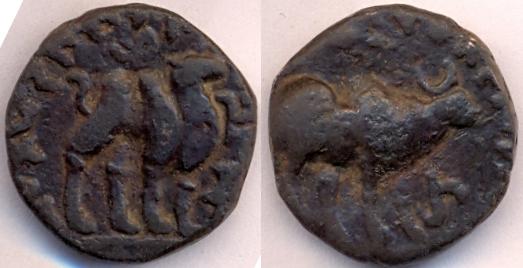 |
AE Tetradrachm.
Dated: 30 - 80 CE.
Weight: 8.92g.
Metal: Copper.
Alignment: Medal. Ruler: Kujula Kadphises
[(Κοζουλου Καδφιζου, also Κοζολα
Καδαφες) Kozola Kadaphes Koshanou Zaoou]. |
|
 |
AE Tetradrachm.
Dated: 80 - 103 CE.
Mint: Taxila.
Weight: 8.29g.
Metal: Copper.
Alignment: Medal.
Ruler: Wemla Taktu
[Basileos Basileon Soter Megas (King of Kings Great Suviour)]. |
|
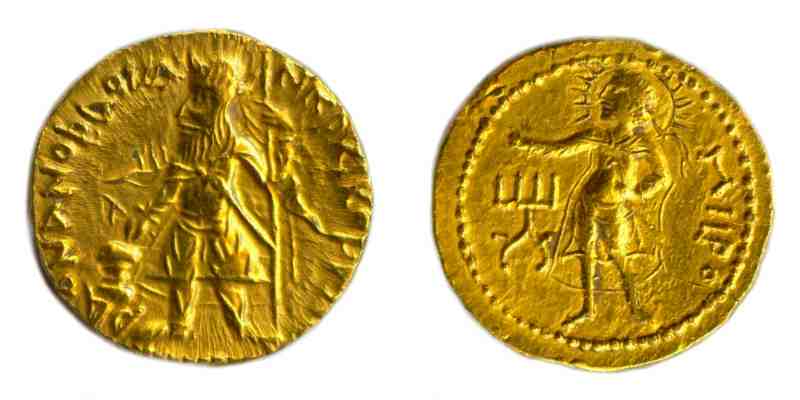 |
Gold starter
Weight: 7.92g. [Goddess Miiro (MIIPO) -
Indo-Iranian solar deity].
Dated: 103-127
CE. Alignment:
Medal. Obverse:
King standing facing, sacrificing at altar at left, holding sceptre
in left hand, elephant goad in right, Bactrian legend around:
ÞAONANOÞAO KA ... NhÞKI KOÞANO (King of kings, Kanishka the Kushan). |
|
Reverse:
Sun god Miiro standing facing,
turned to left, with sun rays on shoulders. Right hand
raised in a gesture of blessing. Tamgha at left side.
Bactrian legend at right: MIIPO.
Ruler:
Kanishka I [Shaonanoshao Kanishki
Koshano]. |
|
|
|
|
|
|
KASHMIR SMAST |
|
The Kashmir Smast (Urdu: کشمیر سمست) caves,
also called Kashmir Smats (کشمیر سمتس), are a series of natural
limestone caves, artificially expanded from the Kushan to the Shahi
periods, situated in the Pirsai Sakrah mountains in the Sudam Valley
Mardan in Northern Pakistan. According to recent scholarship based
on a rare series of bronze coins and artifacts found in the region,
the caves and their adjacent valley probably comprised a sovereign
kingdom in Gandhara which maintained at least partial independence
for almost 500 years, from c. 4th century CE to the 9th century CE.
For most of its history, it was ruled by White Hun (or Hephthalite)
governors or princes. The current research investigations at the
site that have been carrying out by Professor Meritorious Dr. M.
Nasim Khan (TI), a re-known historian and archaeologist, has shown
that the site remained the earliest Hindu university or learning
institution in South Asia. According to Dr. M. Nasim Khan, this area
may have hosted and fed thousands of students and gurus at least
from the 2nd century BCE to 10th century CE. He claims that Kashmir Smast area remained an independent entity with its own monetary
system and cultural and religious environment. |
Scholars contend that the bronze currency
found in the region were issued by local semi-independent governors,
or Tegins, in the Kashmir Smast valley, paying allegiance to the
greater Hunnic Tegins of Gandhara and Bactria. The feudal and tribal
nature of the ancient Central Asian' states allowed for substantial
independence to be exercised by local governors.
It is worth noting that all the new varieties found in this area are
small bronze pieces, varying in weight between 0.5 and 1.1 g.
(referred to as the Kashmir Smast standard). They are occasionally
small versions of more common drachms circulating in the region, or
feature entirely new portraits/images with some or no resemblance to
commonly circulating coins of the period.
Given the fact that these pieces have not been found elsewhere in
Hunnic domains, we can infer that they were not considered
acceptable currency outside of the Kashmir Smast region. However,
imitating the coins of the contemporary rulers of Gandhara, and
employing certain of their dynastic symbols and portraits, alongside
a totally new set of portraits, names / titles, and symbols, may
indicate that while they were issued independently for use in the
local kingdom, the local rulers must have paid homage to and
acknowledged their Hunnic overlords. The fact that they were allowed
to use some of their own tamghas and titles and that the greater
chiefs gave them the privilege of minting their own currency
strengthens this argument. The minting of coins was a prerogative of
the rulers, and carried with it a certain degree of governing
authority. Numismatically speaking, this can be likened to the
period of Hephthalite and Turk Shahi sovereignty over Sogdiana,
during which civic bronze coinage circulated alongside silver
drachms referencing a Hunnic or Turkic overlord (the Bukharkhoda).
The fact that such independent issues continued throughout five
separate dynasties, until the Hindu Shahi period, means that to a
degree this principality maintained its status for perhaps as long
as three to four hundred years. |
Given the fact that exact find data is not
available for the coins of the Kashmir Smast, and that numerous
symbols, legends, and images on the coins have come to light which
have never before been encountered in 150 years of Hunnic numismatic
study, the attribution and dating of these specimens becomes an
arduous task. In the varieties of coins found in the Kashmir Smast,
it becomes apparent that during the period of the Kidara, the Alxon,
the Nazek, the Turk Shahis, and the Hindu Shahis, a minor kingdom
based in this region maintained some level of autonomy from the
greater Hunnic hordes which ruled Gandhara. This is evidenced by the
use of hithertofore unrecorded images, stylistic peculiarities, and
tamghas (royal symbols).
The bronze coins found in cave and its
adjacent valley can be divided into seven groups:
1) Kushano-Sassanian. The hoard
includes numerous Kushano-Sassanian bronzes of the dumpy fabric,
including mostly known varieties in addition to unpublished
fractionals, and a number of anonymous Hunnic imitations minted in
the dumpy Kushano-Sassanian fabric.
2) Kidara. Kidarite coins in the hoard
comprise the majority of unpublished specimens. The obverse of some
varieties closely resemble, or are crudely rendered versions of,
known Kidarite drachms. The busts portrayed on these coins are
depicted wearing headdresses associated with particular Kidara
princes, often in turn borrowed from contemporary Sassanian /
Kushano-Sassanian monarchs. This group also includes thin AE units
featuring bearded busts occasionally with Brahmi legends. As they
are notably different from other recorded Kushano-Sassanian bronzes,
they may be attributed to Kidarite governors or princes under
Kushano-Sassanian or Sassanian sovereignty.
3) Alxon (or Alchon) Huns. The hoard
includes a number of coins which are stylistically similar to the
Alxon Hunnic series. Some feature the royal Hunnic tamgha, or royal
symbol, most often associated with the first of the Alxon Hunnic
kings in Gandhara, Khingila and his immediate successors.
4) Nezak. Common published Nazek
bronzes abound in the hoard. In addition to these, a number of
unpublished varieties with stylistic similarities to Nezak bronzes
have also been discovered, notably featuring a trident tamgha.
5) Turk Shahi. These include small AE
units imitating larger silver Turk Shahi drachms. They are either
anepigraphic or feature Bactrian Greek legends.
6) The Shahi Kings of Kabul and Gandhara.
This category includes coins stylistically similar to the coins of
Samanta Deva and Spalapati Deva, characterized by linear stylized
anthropomorphic or zoomorphic representations.
7) Anonymous coins which cannot be
stylistically attributed to any particular Hunnic period or clan.
8) Bronze imitations of Bactrian
drachms of Menander I and other dynasts. |
|
|
|
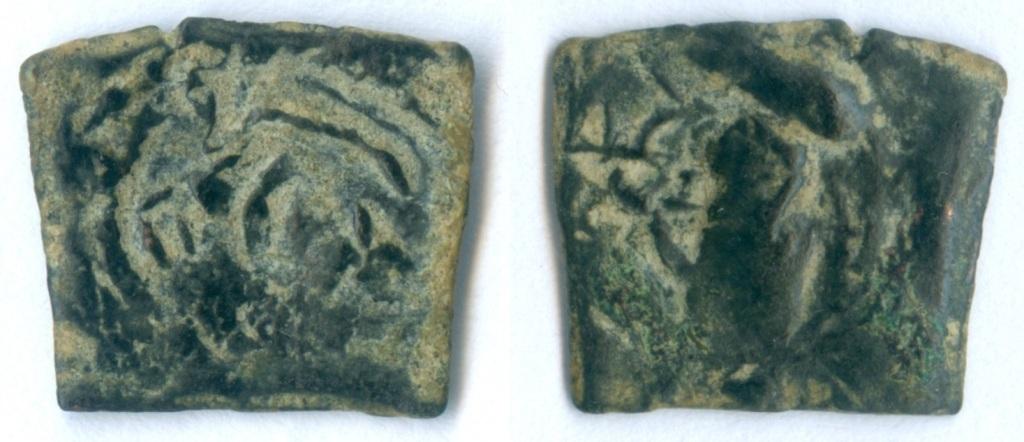 |
Obol.
Year:
c. 2nd century BCE.
Weight: 0.73g.
Metal: Copper.
Diameter:
13.00 mm x 12.00 mm. Mint:
N/A.
Edge:
Plain.
Alignment:
Medal.
Obverse:
unknown
images.
Reverse:
unknown images. Mintage:
N/A. Minted Years:
N/A. Ruler:
N/A. Alxon (or Alchon) Huns
Type. |
|
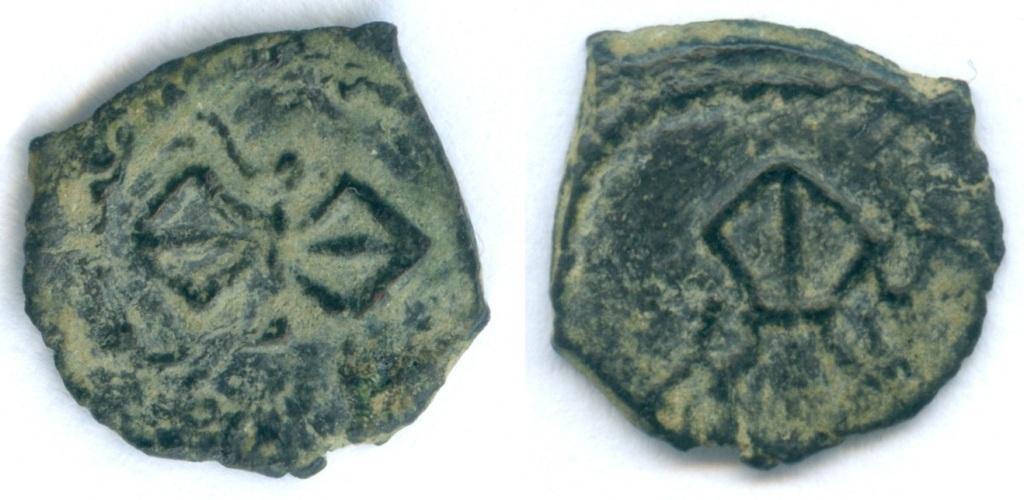 |
Obol.
Year:
c. 2nd century BCE.
Weight: 0.70g.
Metal: Copper.
Diameter:
12.00 mm x 12.00 mm. Mint:
N/A.
Edge:
Plain.
Alignment:
Medal.
Obverse:
Neck bow.
Reverse:
Kite. Mintage:
N/A. Minted Years:
N/A. Ruler:
N/A. Alxon (or Alchon) Huns
Type. |
|
 |
Obol.
Year:
c. 1st century CE.
Weight: 1.40g.
Metal: Copper.
Diameter:
12.00 mm. Mint:
N/A.
Edge:
Plain.
Alignment:
Medal.
Obverse:
Stylized fire altar in the center. One
attendant on each side of the fire altar.
Reverse:
King wearing crown facing right. Mintage:
N/A. Minted Years:
N/A. Ruler:
N/A. |
|
Note: This coin is imitation of
Vima Takto (c. 90 – c. 113) alias Soter Megas (Great Saviour)
of Kushan dynasty. The original coin can be seen at Zeno:
https://www.zeno.ru/showphoto.php?photo=134952 |
|
 |
Obol.
Year:
c. 6th century CE.
Weight: 0.85g.
Metal: Copper.
Diameter:
11.50 mm. Mint:
N/A.
Edge:
Plain.
Alignment:
Rotated (3 o' clock).
Obverse:
Stylized fire altar in the center. One
attendant on each side of the fire altar.
Reverse:
King wearing crown facing right. Mintage:
N/A. Minted Years:
N/A. Ruler:
N/A. Hephthalites
Type. |
|
 |
Obol.
Year: c. 800 - c. 1000.
Weight: 0.92g.
Metal: Copper.
Diameter:
14.50 mm. Mint:
N/A.
Edge:
Plain.
Alignment:
Coin.
Obverse:
Horseman riding
caparisoned horse towards right. |
|
Reverse:
most part of
Kalima written in three lines. Probably "Umar" written at
the bottom. Mintage:
N/A. Minted Years:
N/A. Ruler:
probably Umar. The
coin is stylistically similar to the coins of Samanta Deva and Spalapati Deva
of Hindu Shahi of Kabul and Gandhara. The same coin is also
listed in Zeno, commented by Stephen Album and Robert Tye:
https://www.zeno.ru/showphoto.php?photo=227806
Note: Kashmir Smast Or Kashmir Cave is located in
the Swat Valley in Northern Pakistan in the heartland of
what once was the flourishing ancient Gandhara. This cave
has yielded thousands of coins buried between the 5th and
8th century AD, during the time when this area was ruled by
Hepthalite principalities. Various interesting coins have
been discovered imitating different dynasties that ruled
this area. New discoveries are still being made and the
plethora of varieties of small AE coins still mystifies
numismatists world over.
Further Reading:
01. Images at Zeno:
http://search.zeno.ru/
02.
https://en.wikipedia.org/wiki/Kashmir_Smast
03. Waleed Ziad's "Treasure of Kashmir Smast":
http://www.oocities.org/ziadnumis2/ksintro.htm |
|
|
|
|
|
|
General sequence: |
-
The
Kushanshahs.....................................c. 300 ? - c.
410
-
The
Hephthalites......................................c. 410 - c.
550
- The
Pratiharas........................................c. 550 - 988
- Bokhara..................................................988
- 999
-
The
Ghaznavid Empire.....................................999 - 1148
-
The Ghurid
Empire.......................................1148 - 1213
- Khwarazm................................................1213
- 1220
- The
Mongols.............................................1220 - 1332
-
Herat...................................................1332 -
1389
-
The
Timurid Empire......................................1389 - 1506
-
The Mughal
Empire.......................................1506 - 1740
-
Persia..................................................1740 -
1747
-
Afghanistan.............................................1747 -
1817
-
DURRANI
- Ayyub Shah (in
Kashmir and at Peshawar).................1817
- 1829
- He is also known as a puppet of Dost
Muhammad from 1817 to 1823 and ruled Kashmir from 1818 to 1829.
Peshawar from 1818 briefly then again from 1818 to 1829.
- BARAKZAI
- Dost
Muhammad Khan Mohammadzai..........................1829 - 1831
- Sultan
Muhammad Tilai Barakzai (at
Peshawar)............1831
- 1834
-
Sikh Empire.............................................1833 -
1849
- Great
Britain...........................................1849 - 15 Aug 1947
-
Pakistan.........................................15 Aug 1947 -
date
|
|
|
|
North-West Frontier Province (now Khyber-Pakhtunkhwa) during the British India
period contained five princely states and an important Jagir. Below are their details
shown alphabetically:
|
| |
|
|
| |
| North-West
Frontier Province of British India |
| |
1849
British capture area from Punjab.
1901
North-West Frontier Province
created.
15 Aug 1947
Became province of Pakistan.
15 Apr 2010
Renamed as Khyber-Pakhtunkhwa province of Pakistan. |
| |
- Chief commissioners
-
Lieutenant-Colonel Harold Arthur
Deane............09 Nov 1901 - 07 Jul 1908
-
He was an administrator in
British India. Served as the first Political Agent of the Malakand in 1895.
-
Sir George Olof Roos-Keppel (1st
time)............07 Jul 1908
- 16 Nov 1909
- William
Rudolph Henry Merck (acting)..............16
Nov 1909 - 01 Nov 1910
-
Sir George Olof Roos-Keppel (2nd
time)............01 Nov 1910
- 28 Aug 1913
- Sir John
Stuart Donald (acting)...................28
Aug 1913 - 28 Jan 1915
-
Sir George Olof Roos-Keppel (3rd
time)............28 Jan 1915
- 10 Sep 1919
- Sir Alfred
Hamilton Grant.........................10 Sep 1919 - 08 Mar 1921
-
Sir John Loader Maffey............................08
Mar 1921 - Jul 1923
-
Horatio Norman Bolton (1st
time).....................Jul
1923 - 03 Dec 1925
-
William John Keen (acting)........................03
Dec 1925 - Aug 1926
-
Horatio Norman Bolton (2nd
time).....................Aug
1926 - 10 May 1930
- Sir
Stuart Edmond Pearks..........................10 May 1930 - 09 Sep 1931
-
Sir Ralph Edwin Hotchkin
Griffith.................10 Sep 1931 - 18 Apr 1932
-
Governors
-
Sir Ralph Edwin Hotchkin Griffith (continued).....18
Sep 1932 - 02 Mar 1937
- Sir George Cunningham
(1st time)..................02
Mar 1937 - 11 Aug 1939
- Sir Arthur Edward
Broadbent Parsons...............11 Aug 1939 - 10 Dec 1939
-
Sir George Cunningham (2nd
time)..................10 Dec 1939 - 03 Mar
1946
- Sir Olaf Kirkpatrick Kruuse Caroe.................03
Mar 1946 - 26 Jun 1947
- Sir General Robert
McGregor MacDonald Lockhart....26
Jun 1947 - 13 Aug 1947
Acting Chief commissioner of
NWFP. He also served as Commander in Chief of the Indian Army in 1947 after
Field Marshal Sir Claude John Eyre Auchinleck.
|
| |
- Chief Ministers
- Sir Sahibzada
Abdul Qayyum Khan...................01 Apr 1937 - 07 Sep 1937
- Khan Abdul Jabbar
Khan [Khan Sahib] (1st
time)....07 Sep
1937 - 10 Nov 1939
- Governor's
rule...................................10 Nov 1939 - 25 May 1943
- Sardar Aurangzeb
Khan.............................25 May 1943 - 16 Mar 1945
- Khan Abdul Jabbar
Khan [Khan Sahib] (2nd
time)....16 Mar
1945 - 22 Aug 1947
- Governor Cunningham of
NWFP dismissed the Chief Minister Dr. Khan Sahib and his cabinet as they
refused to salute the Pakistan flag. Khan Abdul Jabbar Khan
(born 1882 - 09 May 1958) popularly known as Dr. Khan Sahib was a
pioneer in the Indian Independence Movement and a Pakistan politician.
He was born in the village of Utmanzai, near Charsadda in the North-West
Frontier Province. His father, Bahram Khan was the chief of the
Mohammedzais ("sons of Mohamed") tribe of the Pashtun (Pathan) people in
the Hashtnagar area. He joined the Central
Cabinet of Muhammad Ali Bogra as Minister for Communications in 1954. In
October 1955, he became the first Chief Minister of West Pakistan
following the amalgamation of the provinces and princely states under
the One Unit scheme. After differences with the ruling Muslim League
over the issue of Joint versus Separate Electorates, he created the
Republican Party.
He was jailed by Abdul Qayyum Khan's government. After Qayyum Khan's
appointment to the Central government and the personal efforts of the
Chief Minister of NWFP at the time Sardar Bahadur Khan he along with his
brother and many other activists were released.
He resigned in March 1957 after the provincial budget was rejected by
the assembly. He was assassinated by a former revenue official in Lahore
on May 12, 1958. After his death, Nawab Akbar Khan Bugti was elected to
fill the vacancy arising in the National Assembly. He was the 1st Chief
Minister of West Pakistan from 14 Oct 1955 to 16 Jul 1957.
It is important to note that Dr. Khan Sahib's
eight years old younger
brother, Khan Abdul Ghaffar Khan (Badshah Khan) and his Red Shirt
movement stayed away from the electoral politics. Ghaffar Khan actively
opposed the One Unit and Dr. Khan Sahib's government. No major Red Shirt
leader or worker ever joined the Republican Party, founded by Dr. Khan
Sahib. The Red Shirts or Khudai Khidmatgar (servants of God) joined
hands with nationalist and progressive workers and leaders from both the
then East Pakistan and West Pakistan to form the National Awami Party
(national Peoples Party) in 1957.
|
| |
|
|
| |
|
|
|
Pakistan or refer to Pakistan's Khyber-Pakhtunkhwa Province
Governors and Chief Ministers. |
|
Countries
/ Territories |
| |
|
Chiefa Coins | |
|