| |
 |
 |
| |
|
Balochistan |
| |
| Baluchistan
(Balochistan) is part of Pakistan surrounded by Iran in the west,
Afghanistan in the north and the Indian Ocean in the south. It was under
British India 1875-1948. In ancient times this was the land of Mokran, a
transit between the Persian Gulf and the Indus Valley civilization.
Mentioned by Herodotus (5th century BCE) as the land of the Ichthyophagi
("Fish-Eaters") - to Ptolemy in the 2nd century CE, it was the land of
Gedrosia. The region is harsh, hilly, and semi-arid; the Baluchi people
themselves, first referred to in Arabic sources of the 10th century, are
nomad herders who migrated into the region from the western Iranian
highlands in the 11th century as a result of the Seljuq conquests. |
|
Balochistan was the site of the earliest known
farming settlements in Indus Valley Civilization, the earliest of
which was Mehrgarh dated at 6500 BCE. Balochistan corresponds to the
ancient Achaemenid province of Gedrosia. Balochistan was sparsely
populated by various tribes, of Dravidian and Indo-Aryan origin, for
centuries following the decline of the nearby Harappa-Mohenjo-daro
civilisation to the east. Over time, Balochistan was invaded by
various Eurasian groups including the Persians, Greeks, Kushans,
Arabs, Turks, Mongols, Mughals, Afghans, and the British. Aryan
invasions appear to have led to the eventual demise of the Elamo-Dravidian
Brahui tribes who were original people of the land where Balochs
arrived later but now have mixed together. Aryan invasions appear to
likely they are an Iranian group who have possibly absorbed Arab
ancestry and cultural traits instead, it is also believed that
Baloch are of Arab blood, it could be they left the Arab world when
Iraq broke from Persia in 652 AD and there is historical evidence
that suggests they lived in (Khuzestan) and (Bushehr) before moving
to Kerman and Hormozgan. The Balochs began to arrive from their
homeland in north-west Iran and appear to be an offshoot of the
Medes, another branch being that of Kurdish tribes that would mainly
populate the western end of the Iranian plateau. The Baloch tribes
eventually became a sizeable group rivalled only by another Iranian
group where Brohis and Pashtuns came under influences of Balochs. |
| |
- Unknown rulers
or conditions.....................c. 2500 BCE - c. 500 BCE
-
Persia................................................c. 520 - 326
-
Macedon..................................................326 - 310
- Seleucid
Empire..........................................310 - 306
-
The
Mauryan Empire (India)...............................306
- c. 250
- Local conditions only, c. 250 BCE - 1st century
CE. Ptolemy mentions the following peoples - the Parsirae in the west,
the Arbitari along the coast, the Musarnaei in the north and northeast,
and the Rhamnae to the east.
|
|
Local Coinage |
|
These coins were discovered at Kalat (Qalat) district region near Dalbandin
in Western Balochistan. There must have been peripheral regions with semi
independent of small areas ruled by unknown local rulers. The smaller round
coins in my option are Persio Sassanide influence. The slightly larger ones
are of Kushano Greek influence. These local rulers, issued such small
denomination for local use to fulfill currency shortages. The cursive Greek
alphabets / language is perhaps indicative of Greek influence. These coins
are believe to be contemporary or maybe even later imitations or forgeries.
Contemporary forgeries were coins made in ancient times to substitute for
currency in circulation at that time. |
|
|
|
 |
Date:
ND (c. 250 BCE - 1st century CE).
Value: AE Unit.
Weight: 0.27 g.
Diameter:
4.75 mm. Alignment:
Medal. Obverse:
Perhaps a two leg bird facing right.
Reverse: Perhaps a person holding an
ancient war spear. |
|
 |
Date:
ND (c. 250 BCE - 1st century CE).
Value: AE Unit.
Weight: 0.33 g.
Diameter: 6.00 mm.
Alignment:
Medal. Obverse: Perhaps two fin fish facing
left.
Reverse: Perhaps a person holding an
ancient war spear. |
|
 |
Date:
ND (c. 250 BCE - 1st century CE).
Value: AE Unit. Weight:
0.36 g. Diameter:
6.00 mm. Alignment:
Medal. Obverse:
Stylish "P" written at the top with other
characters below it.
Reverse:
Unknown details below horizontal line. |
|
 |
Date:
ND (c. 250 BCE - 1st century CE).
Value: AE Unit. Weight:
0.45 g. Diameter:
6.50 mm. Alignment:
Medal. Obverse:
Stylish "AHV" written at the top with other
characters below it.
Reverse:
Unknown details above horizontal line. |
|
 |
Date:
ND (c. 250 BCE - 1st century CE).
Value: AE Unit. Weight:
1.07 g. Diameter:
8.00 mm x 8.00 mm. Alignment:
Medal. Obverse:
unknown details.
Reverse: unknown details. |
|
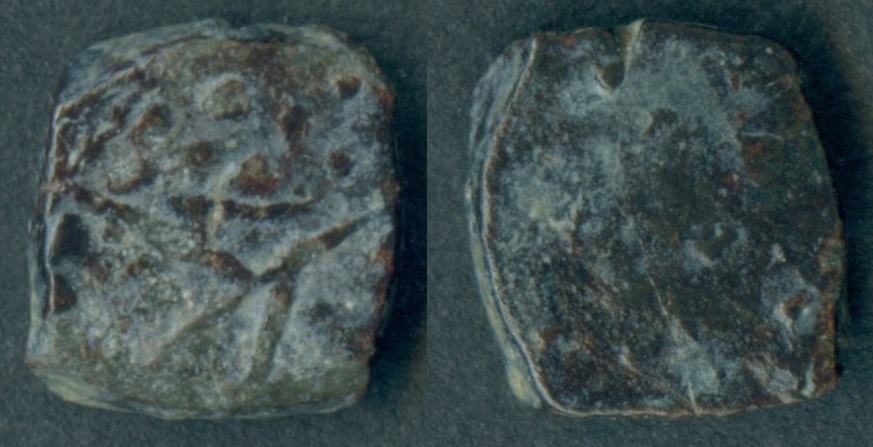 |
Date:
ND (c. 250 BCE - 1st century CE).
Value: AE Unit. Weight:
1.00 g. Diameter:
7.50 mm x 9.00 mm. Alignment:
Medal. Obverse:
unknown details.
Reverse: unknown details. |
|
|
|
- Prata Rajas
- Prata Rajas were Indo-Parthian governors (a local
dynasty in the Loralai district) of Saurashtra in Balochistan. They
probably were later known to be a dynasty of
Indo-Scythian kings who
ruled in the Balochistan region of today's Pakistan and Iran, from the
1st century to the 3rd century CE. They are known through their coins,
which typically exhibit the bust of the ruler on the observe, with long
hair within a headband, and a swastika within a Brahmi legend on the
reverse (usually silver coins) or Kharoshthi (usually copper coins). The
coins can mainly be found in the Loralai area of northeast of
Balochistan, Pakistan. Only a few rulers are known from this dynasty.
Their name betray the Iranian origin of the dynasty.
- Kuvhusuvhume
- Badriyasha
- Nahapana (Kshaharatas
of Saurashtra)..................c. 50
- c. 70
CE
- Bagarvera......................................................fl.
c. 100
- Yolamira S/o
Bagarvera................................c. 125 - c. 150
- Brahmi legend around his coin (starting at 8
o'clock): "Yolamirasa Bagarevaputasa Parataraja" (Of Yolamira, son of
Bagareva, Parata King). The names Yolamira and Bagareva betray the
Iranian origin of this dynasty. The suffix Mira refers to the Iranian
deity Mithra. Yolamira means "Warrior Mithra." Bagareva means "rich
God".
- Bagamira S/o Yolamira..........................................c.
150 CE
- Bagamira was probably Yolamira's oldest son,
as he used his father's obverse die, which was then re-used by his
younger brother Arjuna.
- Arjuna S/o
Yolamira...................................c. 150 - c. 165
- Hvaramira S/o
Yolamira................................c. 165 - c. 175
- Mirahvara S/o
Hvaramira...............................c. 175 - c. 185
- Miratakhma S/o
Hvaramira..............................c. 185 - c. 200
- Miratakhma appears to have been the younger
brother of Mirahvara, since he shares a die of a coin only with his
brother and not with his father.
- Kozana (Spajhana)
S/o Bagavharna......................c. 200
- c. 225
- Kozana was the first Parataraja king to issue
coins with the legends in Kharoshthi. Most authors had presumed that the
Kharoshthi legend coins must have come before the Brahmi legend coins,
as it was Brahmi that replaced Kharoshthi everywhere else in India. But
Kozana's coins came after the Brahmi legend coins. His are the only
Kharoshthi legend coins in silver and he follows the style of
Miratakhma's late coins, with the bust left and the tiara crown on
Obverse side. On reverse side, Swastika in the center with Kharoshthi
legend around "Kozanasa Bagavharnaputrasa Paratarajasa" (Of Kozana son
of Bagavharna, Parata King). Secondly Kozana silver Drachm reduced
weight standard from around 3.50 grams to 2.25 grams. Hemidrachm reduced
weight standard from around 1.80 garms to 1.05 grams. No one knows for
sure who was Kozana's father Bagavharna (pronounced Bagafarna) was, but
Pankaj Tandon have suggested that he was Bagamira's son.
- Bhimarjuna (Bhimajhunasa) S/o
Yolatakhma..............c. 225 - c. 235
- With Bhimarjuna, the debasement of the Parata
currency starts. Some early coins show more silver but later coins seem
to be almost pure copper. The fact that Bhimarjuna's coinage shows the
gradual debasement proves that he followed Kozana. Although we do not
know who was Bhimarjuna's father, Yolatakhma, Pankaj Tandon have argued
that he must have been Arjuna's son.
- Koziya (Spajhama)
S/o Kozana (Spajhana)...............c. 235 - c. 265
- Although Koziya was Kozana's son, it seems
fairly clear that he did not follow his father to the throne but had to
wait until the end of his "uncle" Bhimarjuna's reign. None of Koziya's
coins show any trace of silver, plus his portrait is more different from
Kozana's than Bhimarjuna's was. Finally, Koziya introduced a standing
king copper type of di-drachm (around 3.90 grams) that was then copied
by later rulers. Koziya issued several different types of copper
drachms, some even of very fine style. Koziya's early portrait features
a mustache for the first time facing left on his silver drachms. So
Koziya must have risen to the throne as a teenager and probably had
quite a long reign, given the wide variety of types he issued. His later
copper drachms are having portrait facing right.
- Datarvharna S/o
Datayola..............................c. 265 - c. 285
- Datarvharna (pronounced Datarfarna) may have
been Bhimarjuna's grandson. He issued no drachms as far as we know, only
copper didrachms (around 3.40 grams) with the standing king. His coins
can be distinguished by the fact that the king is facing left (Koziya's
standing king faces right). His coins have both swastika turns right and
turns left types.
- Datayola II S/o
Datarvharna...........................c. 285 - c. 300
- Datayola must have been named for his
grandfather. His coins can be distinguished by the fact that the king is
facing left and the swastika also turns to the left. Datayola's coins
proved crucial to the proper dating of this dynasty. His coins have been
found over struck on coins of the Kushano-Sasanian king Hormizd I, who
is dated to 270-290. Thus Datayola II must have ruled somewhat
contemporaneously or just after Hormizd I. His copper di-drachm reduced
weight standard to around 2.85 grams. Datayola issued an entirely new
denomination - a copper tetradrachm of around 7.75 grams having the Diademed
bust of king facing left. This is the heaviest Parataraja coin known.
|
|
 |
Prata Rajas Date:
ND (c. 225 - c. 235).
Value: AE Unit (billion drachm).
Weight: 2.10 g.
Diameter:
13.00 mm. Obverse:
Diademed, crowned bust facing left. Dotted border. |
|
Reverse: Swastika
facing right in the center. Kharoshthi legend around starting at 12
o'clock counterclockwise: "Bhimarjunasa Yolatakhmaputrasa Parataraja
(no "sa" at the end)" [Of Bhimarjuna son of Yolatakhma, Parata
King]. Ruler:
Bhimarjuna (Bhimajhunasa) S/o
Yolatakhma. |
|
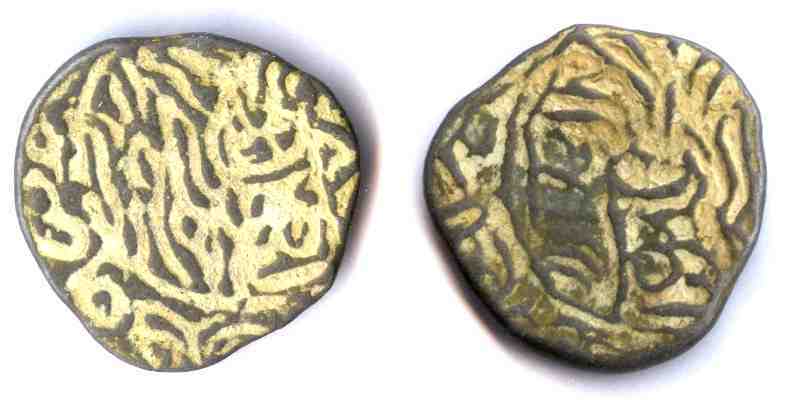 |
Lead Drachm. Fire flames. Weight:
8.12g.
Discovered at Dalbandin Western Balochistan formerly part of Eastern Siestan
and Zaranj.
Probably from 1st century CE. They
are known as Fire Altar/attendants type [Barbaric Sassanide] coins. |
|
|
-
The
Kushanshahs.......................................c. 300 -
c. 410
- The
White Huns (Hephthalites)............................410
- 565
-
Persia...................................................565 -
636
-
Sindh....................................................636
- 644
- Prophet Muhammad's
elected successors....................644 - 661
-
Umayyad
Caliphate........................................661 - 750
-
Abbasid
Caliphate........................................750 - 990's
- In the 7th century the region was divided into two, the south was
part of Kerman Province of the Persian Empire and the north was part
of the Persian province Sistan. In early 644, Caliph Umar sent
Suhail ibn Adi from Busra to conquer the Kerman region of Iran; he
was made governor of Kerman. From Kerman he entered the western
Baluchistan and conquered the region near to Persian frontiers.
South Western Baluchistan was conquered during the campaign in
Sistan the same year. During Caliph Uthman’s reign in 652,
Baluchistan was re-conquered during the campaign against the revolt
in Kerman, under the command of Majasha ibn Masood, it was first
time when western Baluchistan came directly under the Laws of
Caliphate and gave tribute on agriculture. In those days western
Baluchistan was included in the dominion of Kerman. In 654
Abdulrehman ibn Samrah was made governor of Sistan, an Islamic army
was sent under him to crush the revolt in Zarang, which is now in
southern Afghanistan. Conquering Zarang a column moved north ward to
conquer areas up to Kabul and Ghazni in Hindu Kush Mountains, while
another column moved towards North western Baluchistan and conquered
area up to the ancient city of Dawar and Qandabil (Bolan), by 654
the whole of what is now Baluchistan province of Pakistan was under
the rule of Rashidun Caliphate except for the well defended mountain
town of QaiQan (now Kalat), which was conquered during Caliph Ali’s
reign. Abdulrehman ibn Samrah made Zaranj his provincial capital and
remained governor of these conquered areas from 654 to 656, until
Caliph Uthman was murdered. During the Caliphate of Ali, the areas
of Baluchistan, Makran again broke into revolt. Due to civil war in
the Islamic empire Ali was unable to deal with these areas until 660
when he sent a large force under the command of Haris ibn Marah Abdi
towards Makran, Baluchistan and Sind. Haris ibn Marah Abdi arrived
in Makran and conquered it by force then moved north ward to north
eastern Baluchistan and re-conquered Qandabil (Bolan), then again
moving south finally conquered Kalat after a fierce battle.
- Locally
within Kerman and Seistan provinces
-
The
Ghaznavid Empire...................................990's -
1150
-
The Ghurid
Empire....................................c. 1150 - 1215
- Local
conditions........................................1215 - 1223
opposed by...
-
Khwarazm Empire in the western regions..................1218 -
1223
- Mongol
Empire...........................................1223 - 1225
-
Delhi [Shams ud-Din Iltutmish]..........................1225
- 1227
- Mongol
Empire...........................................1227 - 1281
-
Locally within Ilkhanate Persia....................1256 -
1281
-
Herat...................................................1281
- 1389
-
The
Timurid Empire......................................1389
- 1428
- Timurid
of Herat........................................1438 - 1480
opposed by...
-
Qandahar [Dhu’l-Nun Arghun
and later Shah Beg Arghun]...1470
- 1522
- Mir Chakar Khan Rind was the first Baloch
chieftan in the 15th century. He is considered a folk hero of the
Baloch people and an important figure in the Baloch epic Hani and
Sheh Mureed. Mir Chakar lived in Sevi (modern city of Sibi) in
the hills of Balochistan and became the head of Rind tribe at the
age of 18 after the death of his father Mir Shahak Khan. Mir
Chakar's fiefdom was shortlived because of a civil war between the
Lashari and Rind tribes of Balochistan. Mir Chakar and Mir Gwaharam
Khan Lashari, head of the Lashari tribe, went to war that resulted
in thousands dead, including Mir Chakar's brother. The war and the
gallantry of the two tribe leaders continues to be a part of the
Baloch peoples' history. After the "Thirty Years' War" against the
Lashari Tribe, Mir Chakar after his defeat at the hands of Lashari
tribe left Balochistan and settled in the Punjab region in 1518. Mir
Chakar settled in Satghara and gained power and respect in the area.
Afghan King Sher Shah Suri approached Mir Chakar to unite with him
to consolidate his gains. Mir Chakar appreciated the offer but
refused to help Sher Shah Suri and managed to elude Afghan armies.
Under the command of his son, Mir Shahdad Khan, his forces instead
joined the Mughal army of Emperor Humayun in 1555 after a long exile
in Persia. Emperor Humayun came back, recaptured Delhi, and ousted
the Suri dynasty in 1556. As a reward, Emperor Humayun conferred a
vast Jagir, including horses and slaves, to Mir Chakar. He died in
1565. People who accompanied Mir Chakar to Satghara after leaving
Balochistan constructed a tomb for his body. Mir Chakar's tribe
still live in southern Punjab to this day and speak the Seraiki
language. Balochistan subsequently was dominated by empires based in
Iran and Afghanistan as well as the Mughal Empire based in India.
Nadir Shah won the allegiance of the rulers of Baluchistan, and
later the successor of Nadir Shah, Ahmed Shah Durrani also won
allegiance of that areas rulers. The area would eventually revert to
local Baloch control, while parts of the northern regions would
continue to be dominated by Pashtun tribes.
-
The Mughal
Empire.......................................1522 - 1558
-
Persia..................................................1558 -
1595
-
The Mughal
Empire.......................................1595 - 1622
-
Persia..................................................1622 -
1638
- From
1638, mainly to Kalat and later under
British and also some part to Makran.
|
|
|
|
|
|
1839 Eastern Baluchistan
was within British
sphere of influence;
while Western Baluchistan is under Iran.
01 Oct 1887 Baluchistan a British protectorate,
part of British India. |
|
|
|
Baluchistan during the British India period contained
four princely states: Makran, Kharan, Las Bela and Kalat. There was also a Omani port Gwadar (which later became part of
Pakistan on 08 Dec 1958). Las Bela was nominally subject to Kalat, whose ruler
could call on it for an armed force when required and claimed the right of
control over the amount of the dues levied on goods in transit from Sonmiani.
Las Bela chiefs (Jams) have always asserted and maintained a greater or less
degree of independence, their position being strengthened by matrimonial
alliances with the Khans of Kalat. Since the advent of the British, the bond of
connection between the two states has been almost entirely severed.
The political influence of the British Government with Baluchistan commences from the outbreak of the first Afghan War in 1839, when it
was traversed by the Army of the Indus and was afterwards occupied until 1842 to
protect the British lines of communications. The districts of Kachhi, Quetta and
Mastung were handed over to Shah Shuja ul-Mulk and political officers were
appointed to administer the country and organize a system of intelligence.
Continual trouble occurred with the tribes in Kachhi and in 1840 Kahan, in the
Marri hills was occupied by Captain Lewis Brown. Here has was besieged for five
months by the Marris, who were defeated a relieving force under Major Clibborn.
In the meantime the garrison at Quetta was attacked by the neighbouring tribes.
On the retreat of this gathering to Dadhar and its defeat by a British force,
Lieutenant Loveday, the assistant political agent at Kalat was murdered. The
year 1841 opened auspiciously, but closed with the disaster at Kabul. This event
reacted on the Baluchistan tribesmen. Fortunately the country was in charge of a
man of brilliant abilities, Sir James Outram, and all remain quiet while
England's column was pushed up to the Bolan Pass to Quetta at the beginning of
1842, only to be defeated in the unfortunate affairs of Haikalzai in Pishin.
Then began thw withdrawal from Afghanistan; the districts which had been
assigned to Shah Shuja were handed over to the Khan of Kalat and Quetta was
finally evacuated in October.
|
|
|
|
 |
|
|
|
Below are the
ruler details of these princely states with Omani port Gwadar. Click Kalat for
some more brief history of this region.
|
| |
|
|
| |
| Baluchistan -
Province of British India |
| |
19 Jun 1877 British India Baluchistan Province and Tribal Areas.
1896 Province
of British India.
15 Aug 1947 Baluchistan
becames province of Pakistan.
15 Aug 1947 - 1948 Ruler of Kalat declares Baluchistan independent.
03 Oct 1952 - 14 Oct 1955 The four Baluchistan states form the Baluchistan States
Union, with the Wali of Kalat as Khan-e A`zam of the Union.
20 Jun 1958 - 1958 Ruler of Kalat again declares Baluchistan independent.
|
| |
|
On 19 Jun 1877, British occupies Quetta.
Baluchistan becomes British India's province on 01 Oct 1877. From 01 Nov
1877 incorporated into British India. |
| |
- Chief commissioners
-
Major Robert Groves Sandeman in 1866 was appointed
district officer of Dera Ghazi Khan, and there he first showed his capacity
in dealing with the Baluch tribes, Marris and Bugtis. His tact and firmness the Mastung agreement, the Magna
Charta of the Brahui confederacy, was drawn up on July 13, 1875 and read out
formally in Kalat's Darbar. Thus British Government was now accepted the
responsible paramount power for preserving peace in the country and
therefore a fresh treaty was concluded with Mir Khudadad Khan of Kalat in
December 1876 and brought his territories including Kharan, Makran and Las
Bela under British suzerainty. In February 1871, he was given the political control
over the warring Marri, Bugti and Mazari tribes of Sulaiman Hills at the
Mithankot(e) conference between the governments of Punjab and Sindh
provinces. In 1877 he was made agent to the governor-general in Baluchistan,
an office which he held until his death. A new Province under British India, was
created as Baluchistan on June 19, 1877 and Quetta was permanently occupied
as it's capital.
-
Sir Oliver Beauchamp Coventry St. John (1st
time).19 Jun 1877 - 11 Dec 1887
- Acting Chief commissioner.
- Sir Robert Groves Sandeman (1st
time).............11 Dec 1887 - 03 Apr 1889
-
During the Second Afghan War in 1878 his influence
over the tribesmen was of the utmost importance, since it enabled him to
keep intact the line of communications with Kandahar, and to control the
tribes after the British disaster at Maiwand. The Treaty of Gandamak was
concluded in May 1879, the Afghan Emir ceded the districts of Quetta, Pishin,
Sibi, Harnai, and Thal Chotiali to the British. For these services he was made K.C.S.I. in 1879.
In 1883 the British leased the Bolan Pass, southeast of Quetta, from the
Khan of Kalat on a permanent basis. In 1887 some areas of Balochistan
were declared British territory. In 1889 he occupied the Zhob valley, a strategic advantage
which opened the Gomal Pass through the Waziri country to caravan traffic.
Sandeman's system was not so well suited to the Pashtun as to his Baluch
neighbour. But in Baluchistan he was a pioneer, a pacificator and a
successful administrator, who converted that country from a state of
complete anarchy into a province as orderly as any in British India. He died
at Bela, the capital of Las Bela state, on the January 29, 1892. He was
universally mourned and buried under a handsome tomb.
- Sir Harry North Dalrymple Prendergast
(acting)....03
Apr 1889 - 08 Oct 1889
- Sir Robert Groves Sandeman (2nd
time).............08 Oct 1889 - 23 Apr 1891
-
Sir Hugh Shakespear Barnes (1st
time, acting).....23 Apr 1891 - 08 May
1891
-
Sir Oliver Beauchamp Coventry St. John (2nd
time).09 May 1891 - 04 Jun 1891
- Sir Hugh Shakespear Barnes (2nd
time, acting).....05 Jun 1891 - 09 Jul
1891
- John Biddulph (acting)............................10
Jul 1891 - 16 Nov 1891
- Sir Robert Groves Sandeman (3rd
time).............16 Nov 1891 - 29 Jan 1892
-
Sir Hugh Shakespear Barnes (3rd
time, acting).....29 Jan 1892 - 21 Mar
1892
- Sir James Browne..................................22
Mar 1892 - 13 Jun 1896
- A large earthquake crack
has been traced for no less than 120 miles along the Khwaja Amran and
Sarlath ranges, and near this range of hills a disastrous earthquake
occurred on December 20, 1892.
In 1893, Sir Mortimer Durand negotiated an agreement
with Amir Abdur Rahman Khan of Afghanistan to fix the Durand Line running
from Chitral to Balochistan to as the boundary between the Afghans and the
British.- James Adair Crawford (acting).....................14
Jun 1896 - 14 Nov 1896
- Sir Hugh Shakespear Barnes (4th
time).............15 Nov 1896 - 12 Apr
1899
- In 1897 the wave of unrest, which passed down the
frontier, made itself felt in Baluchistan, where a movement among the
Sarawan chiefs, which might have had serious consequences, was averted by
the arrest and imprisonment of two of the ringleaders. In the same year an
outbreak occurred in Makran, and British troops engaged the Makran rebels at
Gokprosh in January 1898 and the ringleader with many of his followers were
slain.
- Henry Wylie (acting)..............................12
Apr 1899 - 21 Dec 1899
- Sir Hugh Shakespear Barnes (5th
time).............21 Dec 1899 - 20 Nov
1900
- Charles Edward Yate...............................20
Nov 1900 - 04 Nov 1904
- Another outbreak occurred in Makran in 1901, which
was also put down by British troops by the capture of Nodiz fort. The floods
are generally very sudden and have been known to rise to a great height in
the Nari. The only known cyclone was that which visited Las Bela in June
1902, destroying many cattle..
-
John Ramsay (1st
time, acting)....................04
Nov 1904 - 23 Jan 1905
- Alexander Lauzun Pendock Tucker
(acting)..........23
Jan 1905 - 02 Apr 1907
- Sir Arthur Henry McMahon (1st
time)...............02
Apr 1907 - 03 Jun 1909
- Charles Archer (1st
time, acting).................03
Jun 1909 - 06 Sep 1909
- Sir Arthur Henry McMahon (2nd
time)...............06
Sep 1909 - 25 Apr 1911
- John Ramsay (2nd
time)............................25
Apr 1911 - 21 Oct 1912
- Charles Archer
(2nd time, acting).................21
Oct 1912 - 14 Nov 1912
- John Ramsay (3rd
time)............................14
Nov 1912 - 02 Apr 1914
- Charles Archer (3rd
time, acting).................02 Apr 1914 - 23 May 1914
- John Ramsay
(4th
time)............................23
May 1914 - 15 Jun 1915
- Charles Archer (4th
time, acting).................15 Jun 1915 - 05 Jul 1915
- John Ramsay
(5th
time)............................05
Jul 1915 - 05 Dec 1917
- Sir Henry Robert Conway
Dobbs.....................05 Dec 1917 - 01 Sep 1919
- Armine Brereton
Dew...............................01 Sep 1919 - Jun 1922
- Henry Beauchamp St. John (1st
time, acting)..........Jun 1922 - 15 Sep 1923
- Frederick William
Johnston........................15 Sep 1923 - 07 Jul 1926
- Edmond Henry Salt James (1st
time, acting)........07 Jul 1926 - 04 Nov 1927
- Henry Beauchamp St. John
(2nd time, acting).......04 Nov 1927 - 02 Feb 1929
- Edmond Henry Salt James
(2nd
time, acting)........02 Feb 1929 - 01 Oct 1929
- Charles Edward Bruce
(acting).....................01
Oct 1929 - 17 Dec 1931
- Alexander Norman Ley Cater (1st
time, acting).....17 Dec 1931 - 10 May 1932
- John Aloysius Brett
(acting)......................10
May 1932 - 01 Oct 1932
- Alexander Norman Ley Cater (2nd
time).............01
Oct 1932 - 01 Apr 1936
- There were two devastating
earthquakes in Balochistan during British colonial rule: The 31 May 1935
Balochistan Earthquake of magnitude of 7.7 Mw at 3:02 am devastated Quetta and the
27 Nov 1945 at 21:56 Balochistan
Earthquake, with its epicentre in Makran region, was felt in other regions
of South Asia.
- Ronald Evelyn Leslie Wingate (1st
time, acting)...01 Apr 1936 - 18 Apr 1936
- Arthur Edward Broadbent Parsons (1st
time, acting)18 Apr 1936 - 20 Jun
1937
- Ronald Evelyn Leslie Wingate
(2nd
time, acting)...20 Jun 1937 - 28 Nov 1937
- Olaf Kirkpatrick Caroe
(acting)...................28
Nov 1937 - 14 Mar 1938
- Arthur Edward Broadbent Parsons (2nd
time)........14
Mar 1938 - 11 Aug 1939
- Sir Herbert Aubrey Francis
Metcalfe...............11 Aug 1939 - 24 Nov 1943
- William Rupert
Hay................................24 Nov 1943 - 1946
- Henry Mortimer Poulton............................14
May 1946 - 1946
- Sir Geoffrey
Prior.......................................1946 - 15 Aug 1947
- Continued to be the Chief
Commissioner of Pakistan's Province of Baluchistan till 03
Oct 1947.
|
| |
| |
|
|
|
Pakistan or refer to Pakistan's Balochistan
Governors and Chief Ministers. |
|
Countries
/ Territories |
| |
|
Chiefa Coins | |
|