| |
 |
 |
| |
|
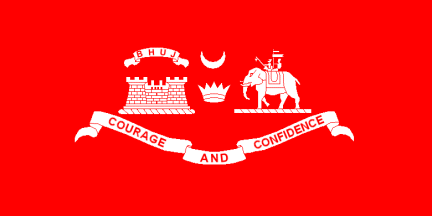
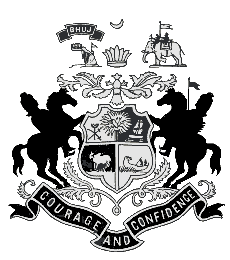
Kutch (Cutch) |
|
|
|
|
 |
|
|
|
Kutch is a district on
the coastal portion of the India/Pakistan frontier, to a large
extent involving an extensive salt-flats (the Great Rann of Kutch)
adjacent to the Gulf of Kutch, an arm of the Arabian Sea extending
toward Gujarat. At the time of Alexander's invasion (4th century
BCE) the Rann was a shallow but navigable lake, but subsequent
centuries of silting have made a mud flat of it, and settlement
within the Rann is limited to what hills are present. The Royal
House of Cutch (or Kutch) belongs to the Jadeja clan of Rajputs. The
founder of the family, prince Lakho, had been adopted by his uncle,
a Samma chieftain named Jada. Leaving Sind, after the birth of a
natural son to this adopted father, Lakho migrated to the marshlands
of western Gujarat. There, with the help of his twin brother Lakhiar,
he established his principality in 1147. Maharao Khengarji, the head
of the Jadeja clan, consolidated his territories in 1549 and
established his capital at Bhuj. Area: 21,365 km2. |
|
|
|
- In Vikram Samvat 683, present day Egypt was
called Misr. One of the states in Misr was Sonitpur, which was ruled by
Jam Devendra Sama. His forefathers were given the title of 'Jam' by the
emperor of Iran. In that year Shonitpur was attacked by Omar Khalifa,
and King Devendra was defeated in that battle of Sonitpur. Omar Khalifa
offered the eldest son Aspat of Devendra the throne of Sonitpur with the
condition that Aspat will have to convert to Islam. Aspat converted to
Islam and became king of Sonitpur, however his three brothers Gajpat,
Narpat and Bhupat refused to convert and they migrated to present day
Afghanistan. They captured Gazni by defeating King Firozshah and Jam
Narpat was made King of Gazni. He ruled a major part of Afaghanistan
from Gazni for 18 years. After that in a war with Badshah of Kabul, he
was defeated and he became a Martyr. His son Samaji migrated to present
day Sindh in Pakistan. They were all called "Sama" Rajputs at that time.
The Kings of Sama Rajputs were called Jam, since then many generations
of Samma Dynasty Rajputs ruled Sindh. Their capital was "Sama Nagar" or
Nagar Thaththa which is about 100 km from Karachi.
- CHAVADA RAJPUT
- Jado
(1st Jam)
- The dominant races in
Kutch previous to the 9th century of Christian era were the Chavda,
Kathees and Waghela, they ruled the western, central and the eastern
parts of Kutch respectively. The reigning Prince of Nagar Thatta in
Sindh towards the end of 8th century AD was Lakho Ghuraro. He had eight
sons by two wives, the eldest son being Unad from the first wife and the
other being Mod by a wife from Chawda tribe. As Unad was the eldest, he
succeeded the throne by virtue of his primogeniture. Shortly afterwards
brothers Mod and Manai started planning against the life of Unad in
order to usurp his throne. However they did not succeed and found it
necessary to go into exile with their followers to Kutch where they had
maternal relations with the Chawda tribe. This was the first
historically noted foray of Samma Rajputs of Sind in Kutch.After arrival
in Kutch, Mod had a dispute with his maternal Uncle Chawda Whagum, The
ruler of Eastern Kutch, and was killed by Mod, thereafter, Mod assumed
the sovereignty of the province. There is no concrete information
available for the period that followed except the names of the rulers up
to five generations. They were Jam Mod, Jam Saad, Jam Phool, Jam Lakho
Phoolani and Jam Pooeronjee. It is important to note here that Lakho
Phoolani is the most revered and cherished warrior in the history of
Kutch and Saurashtra. Jam Pooeronjee was a very cruel ruler and created
despair and apathy among his dominion until he was killed by Jakhs.
During this time the direct descendents of Jam Unad in Nagar Thatta
Sindh was Jam Jada, as he did not have any legitimate heir to the throne
he adopted his brothers son Lakho, however, after adopting Lakho, Jam
Jadas wife gave birth to a child named Ghao, As Jam Jada had already
adopted lakho, he decided to divide his dominion equally among both his
legitimate son Ghao and adopted son Lakho, however after the demise of
Jam Jada, Ghao refused to give any share to Lakho and was forced to
leave Sindh with his twin brother Lakhiar and well wishers. Lakho and
Lakhiar ventured into Kutch and slowly regained the territories in
control of Chavdas, as Lakhiar was childless, Lakho named his territory
after his brother and called it Lakhiarviro. Lakho was adopted by Jam
Jada, the descendants of this Lakho Jadani were called Jadejas. The name
Jadeja means "Belonging to Jada" in the Sindhi and Kutchi language and
is pronounced as "Jaa day jaa.
- Lakho Jadani...............................................1147
- 1175
- Jam Lakho Jadani is attributed to the surname
Jadeja being adopted for all his descendants. Lakho Jadani reigned in
Kutch between AD 1147–1175 and had one heir to the gaddi (throne), Jam
Rato Raydhan.
- Ratto Rayadhan.............................................1175
- 1215
- Ratto means Red in Kutchi and he was so called
because he used to tie a red cloth across his turban to prevent it from
dislodging during battles. Jam Ratto Raydhan had four sons namely, Jam
Othaji, Dedaji, Hothiji and Gajanji and they were given the territories
of Lakhirviro, Kanthkot, Gajod and Bara respectively in Kutch.
- Othoji.....................................................1215
- 1255
- As Othaji was the eldest he ascended to the
throne and the rest became a part of Bhayyat or the Brotherhood. Bhayyat
is the term used for all the descendants of the royal family who own and
control their own domains allocated to them within the state and adhere
to the feudal system.
- Gaoji......................................................1255
- 1285
- Vahenji....................................................1285
- 1321
- SAMMA RAJPUT
- Murvoji....................................................1321
- 1347
- Kaiyaji....................................................1347
- 1386
- Amarji.....................................................1386
- 1429
- Bheemji....................................................1429
- 1472
- Hamirji....................................................1472
- 1510
- Over the years, there were constant skirmishes
due to jealousy that marred within these houses, until they merged in
two groups of Othaji and Gajanji. The first incident among these which
changed the history of Kutch is the murder of Jam Hamirji of Lakhiarviro,
chief of eldest branch of Jadeja and descendant of Othaji, by Jam Rawal
of Bara. It is believed that Jam Rawal attributed the murder of his
father Jam Lakhaji to Hamirji, as he was killed within the territory of
Lakhiarviro, and on the pretense of resolving the dispute between the
two branches, took a fake oath of Ashapura Mataji, the supreme deity of
Jadejas, invited Hamirji for a meal and killed him by deceit. During
this time Alioji and Khengarji, two sons of Hamirji were in Ahmedabad
and escaped the complete destruction of the royal family perpetuated by
Jam Rawal, thereafter Jam Rawal usurped the throne of Kutch and reigned
with supreme authority. Khengarji was 15 years old when his father was
murdered, he enlisted in to the army of Mahmud Begada, during one Royal
Hunting party, Khengar killed a lion and saved the life of Sultan for
which he was asked to name his reward, the prime ambition of Khengar was
to regain Kutch and hence he asked for support to fight Jam Rawal,
whereby, he was given 1000 soldiers and complete access to Morvi and
given a title of Rao by the sultan Mohamad of Ahmedabad. Rao Khengar
with the support of well wishers within Kutch and Morvi fought with Jam
Rawal and slowly started gaining the territories of Rapar and nearby
villages, as Khengar was the rightful heir to the throne he was welcomed
and dissent towards Jam Rawal grew within the state of Kutch. Jam Rawal
was ardent devotee of Maa Ashapura, it is believed that the Goddess
indicated Jam Rawal to leave Kutch and establish himself at Halar (Saurashtra),
and that she will support him in this venture. Jam Rawal set out for
Saurashtra and established himself at Nawanagar. Khengar became the 1st
Rao of Kutch in AD 1549 and established
Bhuj as Capital.
- Khengarji I S/o Hamirji
(1st Rao)..........................1510
- 1586
- Bharmalji
I S/o Khengarji I................................1586 - 1632
- Bhojrajji S/o Bharmalji
I..................................1632
- 1645
- Khengarji
II S/o Meghji Bharmalji..........................1645 - 1654
- Meghji Bharmalji was
Bhojrajji's younger brother. The first four Raos of
Kutch ascended the throne in regular succession according to
primogeniture, however after Rao Khengarji II died, there was a break in
succession, and in order to prevent the throne being given to Khengarjis
illegitimate son, the Bhayyat instated Tamachiji who was the second son
of Rao Khengarjis brother.
- Tamachiji S/o Bhojrajji....................................1655
- 1666
- Rayadhanji
I S/o Tamachiji.................................1666 - 1698
- JADEJA
- Jadeja belong to the
Yaduvanshi rajputs or Chandravanshi (Moon Dynasty) rajputs. They are one
of the 36 royal dynasties of old tracing their origins to Lord Krishna.
They ruled huge parts of Kathiawar peninsula and Kutch until India's
independence in 1947.
- Pragmalji I S/o Rayadhanji
I
(1st Maharao).................1698
- 1715
- Gohodaji
I S/o Pragmalji I.................................1715 - 1719
- Deshalji
I S/o Gohodaji
I..................................1719 - 1741
- Lakhpatji S/o Deshalji
I...................................1741
- 1761
- Gohodaji
II S/o Lakhpatji..................................1761 - 1778
- Rayadhanji II S/o Gohodaji
II (1st
time)...................1778
- 1786
- Prithvirajsinhji
S/o Gohodaji
II...........................1786
- 1801
- Fath Mohammad (regent)................................1786
- 05 Oct 1813
- Rayadhanji II S/o Gohodaji
II (2nd
time)...................1801
- 30 Oct 1813
-
Sindh..................................................Nov
1813 - 1814
- Great
Britain..........................................Nov 1815 - 15 Aug 1947
- Kutch became British
protectorate in Nov 1815.
- Bharmalji
II S/o Rayadhanji II.................06 Nov 1813 - 25 Mar 1819
- Husain Miyan (regent)........................Oct
1813 - 1814
- Deshalji
II S/o Bharmalji
II...................25 Mar 1819 - 26 Jul 1860
- MacMurdo (regent).........................25
Mar 1819 - 08 Jul 1834
- Pragmalji
II S/o Deshalji II (regent)........Jul
1849 - 26 Jul 1960
- Pragmalji
II S/o Deshalji II...................26 Jul 1860 - 19 Dec 1875
- Khengarji
III S/o Pragmalji
II.................19 Dec 1875 - 15 Jan 1942
- Full name:
Maharajadhiraj Mirza Maharao Sri Sir Khengarji
III Sawai Bahadur, GCSI, GCIE,
KIH. During the latter
part of Queen Victoria's reign, Sir Khengarji came to be appointed
as an aide de camp to the Queen-Empress in her declining years,
which excited some jealousy amongst the officials of the Government
of India. He often traveled abroad to Europe, and was noted for his
personal relations with the members of the ruling houses there.
Khengarji III was one of the very few Indian monarchs to attend all
three Delhi Durbars - in 1877, 1903 and 1911. His title became Maharajadhiraj Mirza Maharao Shri from 01 Jan 1918. In 1919, he was
granted a local salute of 19-guns, and represented India at a League
of Nations conference in Geneva in 1921. Khengarji was very
progressive and did lots of reforms and developments in Kutch during
his reign.
- Vijayaraja S/o Khengarji
III...................15
Jan 1942 - 15 Aug 1947
- Vijayaraja S/o Khengarji
III (continued)............15
Aug 1947 - 26 Feb 1948
- In year 1947, upon
advice of Gandhiji, 15,000 acres (61 km2) of land was donated by him for
re-settlement of refugee Hindu Sindhi community, who migrated across the
border into India upon partition. The towns of Gandhidham and Adipur
were developed on this land donated by him. He acceded the Princely
State of Cutch to the Dominion of India on 16th August, 1947. As he was
in London for medical treatment
at the time India gained
independence, he took a decision from there only and the Instrument of
Accession of Kutch was signed on his behalf by the Heir & his son Yuvraj
Meghraji. Upon death of his father on 26
February 1948, Yuvraj Sahib Meghraji under the new name and style of
Madansinghji ruled for a short period, when the administration of
Princely State was completely merged in to Union of India.
- Madan
Singh S/o Vijayaraja..........................26 Feb 1948 - 01 Jun 1948
- Kutch State was formed
out of the territory of the former princely state of Cutch, whose ruler
(Maharao Sri Vijayaraji) had acceded to the Dominion of India with
effect from 15 August 1947. The administration of Kutch after accession
remained in the hands of its former ruler until his death on 26 February
1948, when it then passed to his son, Maharao Shri Meghraji.
Other Princely State
ruled by Jadeja clan of Rajputs are Dhrol: c.1535-1948, Morvi (Morbi):
c.1698-1948, Nawanagar: c.1535-1948 and Rajkot: c.1620-1948.
- Pretenders of Kutch Princely State
- Madan
Singh S/o Vijayaraja (continued)..............01 Jun 1948
- 21 Jun 1991
- As the last ruler of
Kutch, he was very close to Jawaharlal Nehru. He joined Indian Foreign
Service in 1953, served as Hon Minister-Counselor at London 1953-1956,
Ambassador to Norway 1957-1960, and Chile 1960-1961. In 1962 his brother
Himmatsinhji became the member of the Lok Sabha representing the Kutch
community. Madan Singh died on 21 June 1991 in London. He had
three sons and two daughters. His eldest son Pragmulji III was named as
his successor, scion of Jadeja dynasty and Maharaja of Kutch.
- Pragmulji III S/o Madan
Singh.......................21 Jun 1991 - date
- He was installed in the
Tila-medi at Prag Mahal Palace, Bhuj on 17 October 1991 upon demise of
his father.
|
| |
| |
| Bhojrajji S/o Bharmalji
I (1632
- 1645) coinage issue: |
| The first series of coins were
introduced in 1586, and consisted of copper trambiyo and dhinglo coins, and
silver ½ and 1 kori coins. The 1 dokdo coin was introduced in 1632, followed
by the ½ trambiyo and ¼ kori coins in 1645, the 25 kori coin in 1854, 5 kori
in 1863, 50 and 100 kori in 1866, 3 dokda in 1868, 1½ dokda in 1869, 2½ kori
in 1875, and 1 dhabu, 1 payalo, 1 adhio, and 10 kori coins in 1943. Kutch
currency was replaced by the Indian rupee in 1947 at a rate of 1 rupee = 3½
Kori. |
| Currency:
Kori = 2 Adlinao = 4 Payalo = 8 Dhabu = 16
Dhinglo = 24 Dokda = 48 Trambiyo = 96 Babukiya. |
| |
|
.jpg) |
KM#12 Kori.
Year:
ND (1632-1645). Weight:
4.64g [4.50g]. Metal:
0.800 Silver.
Diameter: 15.00 mm. Edge:
Plain. Alignment:
Rotated. Mint:
Bhuj.
Note: A close imitation of the coin of
Gujarat's ruler Muzaffar Shah III with a dagger to bottom right. |
|
Obverse legend in Urdu:
"As-sultan, Muzaffar Shah" with frozen date "٩٧٨"
(AH 978). Rao's name: राव श्री भोजराजजी
(Rao Shree Bhojrajji) in Devnagari at the bottom.
Reverse legend in Urdu:
"Ar-reman betaid al-muwid shams ad-duniya waud-din
abu-Al-nasir" (Son of the world and defender of the Religion by the
help and strength of the merciful). Dagger mint mark at the right
bottom side.
Mintage: N/A.
Minted Years: One
year type with AH 978 frozen date.
Ruler: Bhojrajji. |
|
| |
| |
| Rayadhanji I S/o Tamachiji
(1666
- 1698) coinage issue: |
| Currency:
Kori = 2 Adlinao = 4 Payalo = 8 Dhabu = 16
Dhinglo = 24 Dokda = 48 Trambiyo = 96 Babukiya. |
| |
|
-Type1.jpg) |
KM#36 Kori.
Year:
ND (1666-1698). Weight:
4.46g [4.50g]. Metal:
0.800 Silver.
Diameter: 15.00 mm. Edge:
Plain. Alignment:
Rotated. Mint:
Bhuj.
Note: A close imitation of the coin of
Gujarat's ruler Muzaffar Shah III with a dagger to bottom right. |
|
Obverse legend in Urdu:
"As-sultan, Muzaffar Shah" with frozen date "٩٧٨"
(AH 978). Rao's name: राउ
श्री ऱायधणजी
(Rao Shree Rayadhanji) in Devnagari at the bottom.
Reverse legend in Urdu:
"Ar-reman betaid al-muwid shams ad-duniya waud-din
abu-Al-nasir" (Son of the world and defender of the Religion by the
help and strength of the merciful). Dagger mint mark at the right
bottom side.
Mintage: N/A.
Minted Years: One
year type with AH 978 frozen date.
Ruler: Rayadhanji I. |
|
-Type2.jpg) |
Type2: different
size and position of characters from above coin. Weight:
4.36g [4.50g].
Diameter: 14.50 mm. Alignment:
Rotated. |
|
-Type3.jpg) |
Type3: different
size and position of characters from above coins. Weight:
4.67g [4.50g].
Diameter: 14.00 mm. Alignment:
Coin. |
|
-Type4.jpg) |
Type4: different
size and position of characters from above coins. Weight:
4.63g [4.50g].
Diameter: 13.50 mm. Alignment:
Coin. |
|
| |
| |
| Pragmalji I S/o Rayadhanji
I (1698
- 1715) coinage issue: |
| Currency:
Kori = 2 Adlinao = 4 Payalo = 8 Dhabu = 16
Dhinglo = 24 Dokda = 48 Trambiyo = 96 Babukiya. |
| |
|
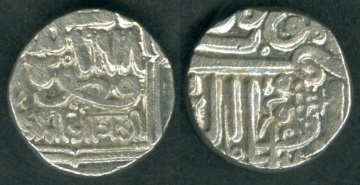 |
KM#43 Kori.
Year:
AH 978 Frozen Year (1698-1715). Weight:
4.53g [4.40g]. Metal:
Silver.
Diameter: 14.00 mm. Edge:
Plain. Alignment:
Rotated.
Mint:
N/A. Note:
Modeled after coin of Mahmud III of Gujarat (ruled: 1537 -
1554). |
|
Obverse legend in Urdu:
"As-sultan, Muzaffar Shah" with frozen date "٩٧٨"
(AH 978) written at the top part. Rao's name: Rao
Shree Pragmal written at the bottom.
Reverse legend in Urdu:
"Ar-reman betaid al-muwid shams ad-duniya waud-din
abu-Al-nasir" (Son of the world and defender of the Religion by the
help and strength of the merciful).
Mintage: N/A.
Minted Years: One
year type. Ruler:
Pragmalji I. |
|
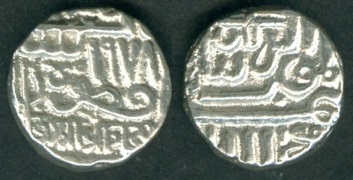 |
Same as above coin, but silver contents rubbed from the edges. Weight:
3.66g.
Diameter: 13.00 mm. Alignment:
Rotated. |
|
| |
| |
| Gohodaji
I S/o Pragmalji I (1715 - 1719) coinage issue: |
| Currency:
Kori = 2 Adlinao = 4 Payalo = 8 Dhabu = 16
Dhinglo = 24 Dokda = 48 Trambiyo = 96 Babukiya. |
| |
|
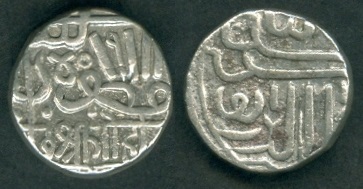 |
KM#45 Kori.
Year:
AH 978 Frozen Year (1715-1719). Weight:
4.31g [4.40g]. Metal:
Silver.
Diameter: 13.50 mm. Edge:
Plain. Alignment:
Rotated.
Mint:
N/A. Note:
Modeled after coin of Mahmud III of Gujarat (ruled: 1537 -
1554). |
|
Obverse legend in Urdu:
"As-sultan, Muzaffar Shah" with frozen date "٩٧٨"
(AH 978) written at the top part. Rao's name: "राउ श्री गोहाधजी" (Rao
Shree Gohodaji) written at the bottom.
Reverse legend in Urdu:
"Ar-reman betaid al-muwid shams ad-duniya waud-din
abu-Al-nasir" (Son of the world and defender of the Religion by the
help and strength of the merciful).
Mintage: N/A.
Minted Years: One
year type. Ruler:
Gohodaji I. |
|
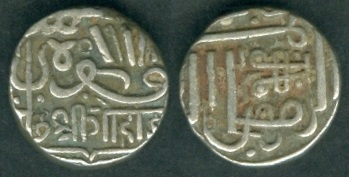 |
Same as above coin, but legend size and position
differs. Weight:
4.61g. |
|
| |
| |
| Deshalji I S/o Gohodaji
I (1719 - 1741) coinage issue: |
| Currency:
Kori = 2 Adlinao = 4 Payalo = 8 Dhabu = 16
Dhinglo = 24 Dokda = 48 Trambiyo = 96 Babukiya. |
| |
|
.jpg) |
KM#51 / Br.#36a Trambiyo (1/48 Kori).
Year:
ND (1719-1741). Weight:
4.32g [4.50g]. Metal:
Copper.
Diameter: 13.00 mm. Edge:
Plain. Alignment:
Rotated.
Mint:
N/A.. Note:
Modeled after coin of Mahmud III of Gujarat. |
|
Obverse:
"As-sultan Mahmud Shah bin Latif Shah" written at the top part. "राउ
श्री धेसलजी" (Rao Shree Desalji) written at the bottom. Reverse:
"Ar-reman betaid al-muwid shams ad-duniya waud-din
abu-Al-nasir" (Son of the world and defender of the Religion by the
help and strength of the merciful).
Mintage: N/A.
Minted Years: One
year type. Ruler:
Deshalji I. |
|
.jpg) |
KM#52 / Br.#37a Dokdo (1/24 Kori).
Year:
ND (1719-1741). Weight:
8.18g [8.70g]. Metal:
debased Copper.
Diameter: 17.00 mm. Edge:
Plain. Alignment:
Rotated.
Mint:
N/A. Note:
Modeled after coin of Mahmud III of Gujarat. KM#49 / Br.#37
is made of Copper metal. |
|
Obverse:
"As-sultan Mahmud Shah bin Latif Shah" written at the top part. "राउ
श्री धेसलजी" (Rao Shree Desalji) written at the bottom. Reverse:
"Ar-reman betaid al-muwid shams ad-duniya waud-din
abu-Al-nasir" (Son of the world and defender of the Religion by the
help and strength of the merciful).
Mintage: N/A.
Minted Years: One
year type. Ruler:
Deshalji I. |
|
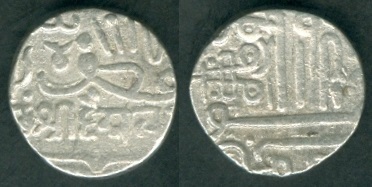 |
KM#56 / Br.#40 Kori.
Year:
AH 978 Frozen Year (1719-1741). Weight:
4.48g [4.40g]. Metal:
Silver.
Diameter: 15.00 mm. Edge:
Plain. Alignment:
Rotated.
Mint:
N/A. Note:
Modeled after coin of Mahmud III of Gujarat. |
|
Obverse legend in Urdu:
"As-sultan Mahmud Shah bin Latif Shah" written at the top part. "राउ
श्री धेसलजी" (Rao Shree Desalji) written at the bottom.
Reverse legend in Urdu:
"Ar-reman betaid al-muwid shams ad-duniya waud-din
abu-Al-nasir" (Son of the world and defender of the Religion by the
help and strength of the merciful). Dagger mint mark at the right
bottom side.
Mintage: N/A.
Minted Years: One
year type. Ruler:
Deshalji I. |
|
| |
| |
| Lakhpatji
S/o Deshalji I (1741-1761) coinage issue: |
| |
|
.jpg) |
C#11 Kori.
Year:
AH 1165 (1752). Weight:
4.61g [5.00g]. Metal:
Silver.
Diameter: 16.00 mm. Edge:
Plain. Alignment:
Medal.
Mint:
N/A. |
|
Obverse:
Trident, debased legend in Urdu: "Shah Sultan Ahmed". Date "۱۱۶٥" (AH
1165) in the center. Ruler's name "महा राव श्री लखपती जी" (Maharao
Sri Lakhpatiji) in Devnagari at the bottom.
Reverse:
Undecipherable Persian legend. Dagger
mint mark at the bottom right side.
Mintage: N/A.
Minted Years: One
year type. Ruler:
Lakhpatji citing Mughal ruler Ahmad Shah (ruled: 1748-1752) or
perhaps old Gujrat Zafarid dynasty ruler with the same name. |
|
| |
| |
| Gohodaji
II S/o Lakhpatji (1761-1778) coinage issue: |
| Currency:
Kori = 2 Adlinao = 4 Payalo = 8 Dhabu = 16
Dhinglo = 24 Dokda = 48 Trambiyo = 96 Babukiya. |
| |
|
-Type1.jpg) |
C#22 Kori.
Year:
AH 978 Frozen Year (1761-1778). Weight:
4.65g [4.40g]. Metal:
Silver.
Diameter: 14.50 mm. Edge:
Plain. Alignment:
Medal; slightly rotated.
Mint:
N/A. Note:
Modeled after coin of Mahmud III of Gujarat (ruled: 1537 -
1554). |
|
Obverse legend in Urdu:
"As-sultan, Muzaffar Shah" with frozen date "٩٧٨"
(AH 978) written at the top part. Rao's name: "राउ श्री गोहाधजी" (Rao
Shree Gohodaji) written at the bottom.
Reverse legend in Urdu:
"Ar-reman betaid al-muwid shams ad-duniya waud-din
abu-Al-nasir" (Son of the world and defender of the Religion by the
help and strength of the merciful).
Mintage: N/A.
Minted Years: One
year type. Ruler:
Gohodaji II. |
|
-Type2.jpg) |
Same as above coin C#22, but having different size and position
of legends.
Weight:
4.62g.
Diameter: 15.00 mm. Alignment:
Rotated. |
|
| |
| |
| Rayadhanji II S/o Gohodaji
II (1801 - 1813) coinage issue: |
| Currency:
Kori = 2 Adlinao = 4 Payalo = 8 Dhabu = 16
Dhinglo = 24 Dokda = 48 Trambiyo = 96 Babukiya. |
| |
|
.jpg) |
C#29 Half Kori.
Year:
ND [1801-1813]. Weight:
2.35g [2.10g]. Metal:
Silver.
Diameter: 11.25 mm. Edge:
Plain. Alignment:
Coin.
Mint:
N/A. Note:
A close imitation of the coin of Muzaffar Shah III of
Gujarat (ruled: 1537 - 1554). |
|
Obverse:
Trident, debased legend in Urdu: "As-sultan, Muzaffar Shah", Frozen
date AH 978 at vthe top right side. Rao's name "राउ श्री ऱायधणजी" (Rao
Shree Raydhanji) in Devnagari at the bottom in larger type.
Reverse:
Debased legend in Urdu: Ar-reman betaid al-muwid
shams ad-duniya waud-din abu-Al-nasir (Son of the world and defender
of the Religion by the help and strength of the merciful). Dagger
mint mark at the bottom right side.
Mintage: N/A.
Minted Years: One
year type. Ruler:
Rayadhanji II. |
|
.jpg) |
C#30 Kori.
Year:
ND [1801-1813]. Weight:
4.60g [4.76g]. Metal:
Silver.
Diameter: 13.00 mm. Edge:
Plain. Alignment:
Rotated.
Mint:
N/A. Note:
A close imitation of the coin of Muzaffar Shah III of
Gujarat (ruled: 1537 - 1554). |
|
Obverse:
Trident, debased legend in Urdu: "As-sultan, Muzaffar Shah", Frozen
date AH 978 at vthe top right side. Rao's name "राउ श्री ऱायधणजी" (Rao
Shree Raydhanji) in Devnagari at the bottom in larger type.
Reverse:
Debased legend in Urdu: Ar-reman betaid al-muwid
shams ad-duniya waud-din abu-Al-nasir (Son of the world and defender
of the Religion by the help and strength of the merciful). Dagger
mint mark at the bottom right side.
Mintage: N/A.
Minted Years: One
year type. Ruler:
Rayadhanji II. |
|
| |
| |
| Bharmalji
II S/o Rayadhanji II (1813 - 1819) coinage issue: |
| Currency:
Kori = 2 Adlinao = 4 Payalo = 8 Dhabu = 16
Dhinglo = 24 Dokda = 48 Trambiyo = 96 Babukiya. |
| |
|
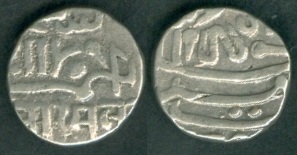 |
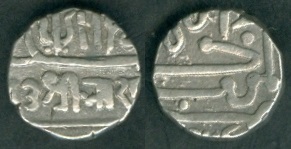
C#35 Half Kori.
Year:
AH 1165 (1752) frozen date [1813-1819]. Weight:
2.37g [2.10g]. Metal:
Silver.
Diameter: 11.50 mm. Edge:
Plain. Alignment:
Coin.
Mint:
N/A. |
|
Obverse:
Undecipherable Persian legend with a dagger to bottom right. Reverse:
Trident with debased legend in Urdu: "Shah
Sultan Ahmed". Rao's name "राउ श्री भारमलजी" (Rao Shree Bharmalji)
at the bottom in Devnagari.
Mintage: N/A.
Minted Years: One
year type. Ruler:
Bharmalji II. |
|
 |
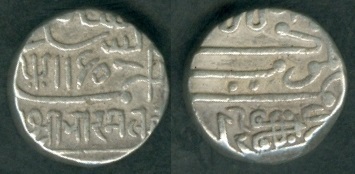
Same as above coin C#35, but different size and position of
legends. Weight:
2.30g [2.10g].
Diameter: 11.25 mm. Alignment:
Rotated. |
|
 |
C#36 Kori.
Year:
AH 1165 (1752) frozen date [1801-1813]. Weight:
4.60g [4.76g]. Metal:
Silver.
Diameter: 13.00 mm. Edge:
Plain. Alignment:
Rotated.
Mint:
N/A. |
|
Obverse:
Undecipherable Persian legend with a dagger to bottom right. Reverse:
Trident with debased legend in Urdu: "Shah
Sultan Ahmed". Rao's name "राउ श्री भारमलजी" (Rao Shree Bharmalji)
at the bottom in Devnagari. Dagger mint mark at the bottom.
Mintage: N/A.
Minted Years: One
year type. Ruler:
Bharmalji II. |
|
| |
| |
| Deshalji
II S/o Bharmalji
II (1819 - 1860)
coinage issue: |
| Currency:
Kori = 2 Adlinao = 4 Payalo = 8 Dhabu = 16
Dhinglo = 24 Dokda = 48 Trambiyo = 96 Babukiya. |
| |
|
.jpg) |
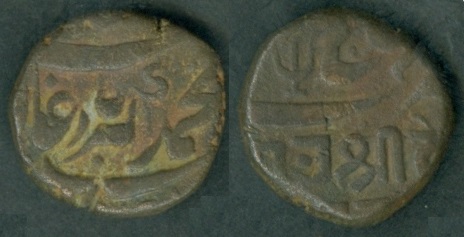
C#45
Trambiyo (1/48 Kori).
Year:
ND (1806-1837). Weight:
4.01g. Metal:
Copper.
Diameter: 15.00 mm. Edge:
Plain. Alignment:
Rotated. Mint:
N/A.
Obverse:
"محمد اکبر بادشاہ غازی" [(Muhammad Akbar Badshah Ghazi);
Muhammad Akbar, The victorious Emperor]. "سنہ"
[(Sanah); Year] with AH Date written at
the bottom.
Reverse:
"ضرب بہوج" (Struck at Bhuj)
written at the top with trident (trishul) on the left. "राउ श्री
धेसलजी" (Rao Shree Desalji) written at the lower part. |
|
Mintage: N/A.
Minted Years: ND (1806-1837), AH1255 (1839),
AH1256 (1840), AH1257 (1841), AH1258 (1842), AH1259 (1843), AH1260 (1844), AH1261 (1845) and AH1262 (1846). Ruler:
Deshalji II citing Mughal Emperor "Muhammad
Akbar II" (ruled: 1806-1837). |
|
 |
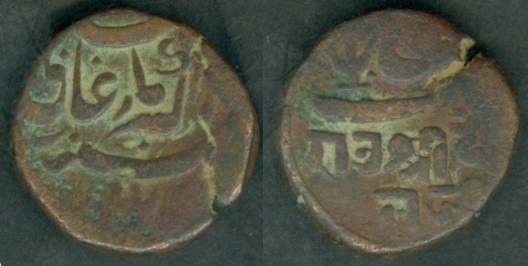
C#46 Dokdo (1/24 Kori).
Year:
ND (AH 1259-1262). Weight:
7.94g. Metal:
Copper.
Diameter: 17.50 mm. Edge:
Plain. Alignment:
Coin. Mint:
N/A.
Obverse:
"محمد اکبر بادشاہ غازی" [(Muhammad Akbar Badshah Ghazi);
Muhammad Akbar, The victorious Emperor]. "سنہ"
[(Sanah); Year] with AH Date written at
the bottom.
Reverse:
"ضرب بہوج" (Struck at Bhuj)
written at the top with trident (trishul) on the left. "राउ श्री
धेसलजी" (Rao Shree Desalji) written at the lower part. |
|
Mintage: N/A.
Minted Years: AH1259 (1843),
AH1261 (1845) and AH1262 (1846). Ruler:
Deshalji II citing Mughal Emperor "Muhammad
Akbar II" (ruled: 1806-1837). |
|
 |
C#47
Dhinglo (1/16 Kori).
Year:
ND (AH 1259-1262). Weight:
12.20g. Metal:
Copper.
Diameter: 21.00 mm. Edge:
Plain. Alignment:
Rotated. Mint:
N/A.
Obverse:
"محمد اکبر بادشاہ غازی" [(Muhammad Akbar Badshah Ghazi);
Muhammad Akbar, The victorious Emperor]. "سنہ"
[(Sanah); Year] with AH Date written at
the bottom.
Reverse:
"ضرب بہوج" (Struck at Bhuj)
written at the top with trident (trishul) on the left. "राउ श्री
धेसलजी" (Rao Shree Desalji) written at the lower part. |
|
Mintage: N/A.
Minted Years: AH1255 (1839), AH1257 (1841),
AH1258 (1842), AH1259 (1843), AH1261 (1845), AH1262 (1846),
AH1263 (1847) and AH1266 (1850). Ruler:
Deshalji II citing Mughal Emperor "Muhammad
Akbar II" (ruled: 1806-1837). |
|
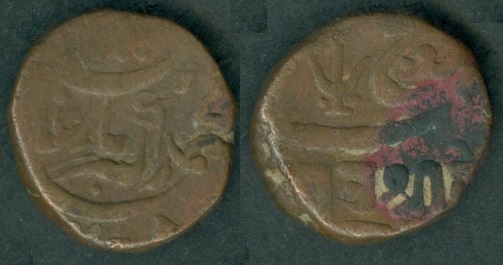 |
Same as above coin, C#47 but having large characters on Reverse
side. Weight:
12.45g. Most probably this coin
looks like dated AH 1258 (1842). |
|
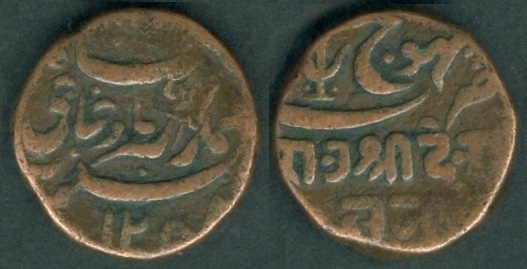 |
Same as above coin, C#47 but having better visible details.
Year:
AH 1258 (1842). Weight:
12.09g.
Diameter: 20.50 mm.
Edge:
Plain. Alignment:
Coin. |
|
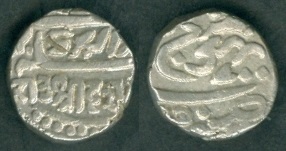 |
C#52 Half Kori.
Year:
Frozen AH 1234 year with VS1877 (1820).
Weight:
2.27g [2.20g].
Metal:
0.610 Silver.
Diameter: 11.25
mm. Edge:
Plain.
Alignment:
Medal. Mint:
Bhuj.
Type1: Decoration below Rao's
name. |
|
Obverse:
Trident, legend in Urdu: "Badshah ghazi Muhammad Akbar sikka". Rao's
name "राउ श्री देशलजी" (Rao Shree Desalji) in Devnagari at the
bottom.
Reverse: Legend in Persian 'Zarb Bhuj
sanah' (Struck at Bhuj in year), VS date below. Dagger pointing left
at bottom left. Mintage: N/A.
Minted Years: One year type. Ruler:
Deshalji II citing Mughal Emperor "Muhammad
Akbar II". |
|
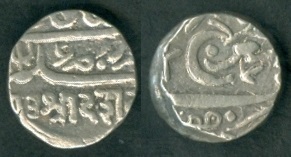 |
Same as above C#52 coin, but having different zize and position
of legends.
Weight:
2.32g Type2:
No Decoration below Rao's name. |
|
.jpg) |
C#53 Kori.
Year:
VS1882 (1825).
Weight:
4.54g [4.60-4.70g].
Metal:
0.610 Silver.
Diameter: 14.50
mm. Edge:
Plain.
Alignment:
Coin. Mint:
Bhuj.
Type1: Katar left side of
Devanagari Date. |
|
Obverse:
Trident, legend in Urdu: "Badshah ghazi Muhammad Akbar sikka". Rao's
name "राउ श्री देशलजी" (Rao Shree Desalji) in Devnagari at the
bottom.
Reverse: Legend in Persian 'Zarb Bhuj
sanah' (Struck at Bhuj in year), VS date below. Dagger pointing left
at bottom left. Mintage: N/A.
Minted Years: AH
(12)34 frozen date on all coins with VS1875-1877, 1879-1882,
1884-1885 and 1887. Ruler:
Deshalji II citing Mughal Emperor "Muhammad
Akbar II".
Note:
All his coins under this KM number have a
frozen date of AH (12)34 [= VS1875 or 1818] on one side, indicating
the the year when Deshalji II became the ruler of Kutch. |
|
.jpg) |
Same as above coin C#53, but...
Year:
VS1887 (1830).
Weight:
4.59g.
Diameter: 14.50
mm.
Alignment:
Medal. |
|
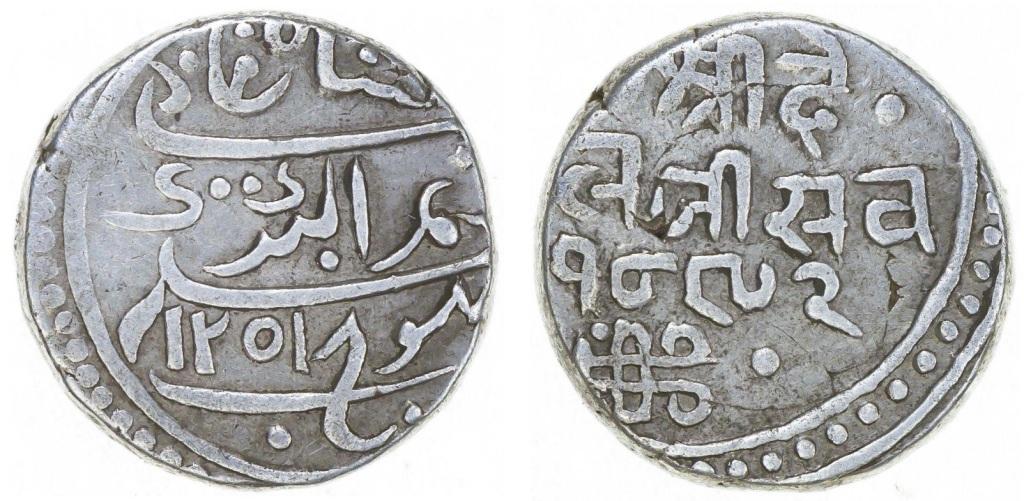 |
C#56 Kori.
Year:
AH 1251 / VS1892 (1835).
Weight:
4.64g [4.60-4.70g].
Metal:
0.610 Silver.
Diameter: 14.50
mm. Edge:
Plain.
Alignment:
Rotated (3 o' Clock). Mint:
Bhuj.
Type2: Katar below
Devanagari Date. |
|
Obverse:
Legend in Urdu: "Badshah ghazi Muhammad Akbar" written in first
two line. "zarb Bhuj" (struck at Bhuj) and Date "1251" written at the
bottom.
Reverse:
Legends written in first two lines. Katar below Devanagari Date. Mintage: N/A.
Minted Years:
AH1250//VS1892 (1835), AH1251//VS1892 (1835)
and AH1252//VS1893 (1836). Ruler:
Deshalji II citing Mughal Emperor "Muhammad
Akbar II". |
|
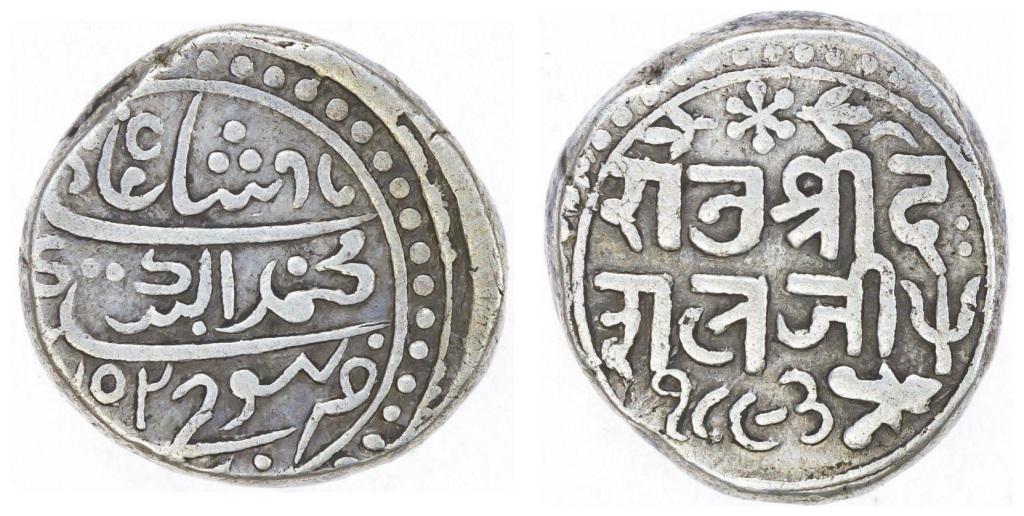 |
C#56a Kori.
Year:
AH 1252 / VS1893 (1836).
Weight:
4.63g [4.60-4.70g].
Metal:
0.610 Silver.
Diameter: 14.50
mm. Edge:
Plain.
Alignment:
Rotated (3 o' Clock). Mint:
Bhuj.
Type3: Katar right side
of Devanagari Date. AH 1252 / VS1893 is unlisted Date in Karuse
publication for this type. |
|
Obverse:
Legend in Urdu: "Badshah ghazi Muhammad Akbar" written in first
two line. "zarb Bhuj" (struck at Bhuj) and Date "1252" written at the
bottom.
Reverse:
Legends written in first two lines. Katar right side of Devanagari
Date. Mintage: N/A.
Minted Years:
AH1252//VS1893 (1836) and AH1252//VS1894
(1837). Ruler:
Deshalji II citing Mughal Emperor "Muhammad
Akbar II". |
|
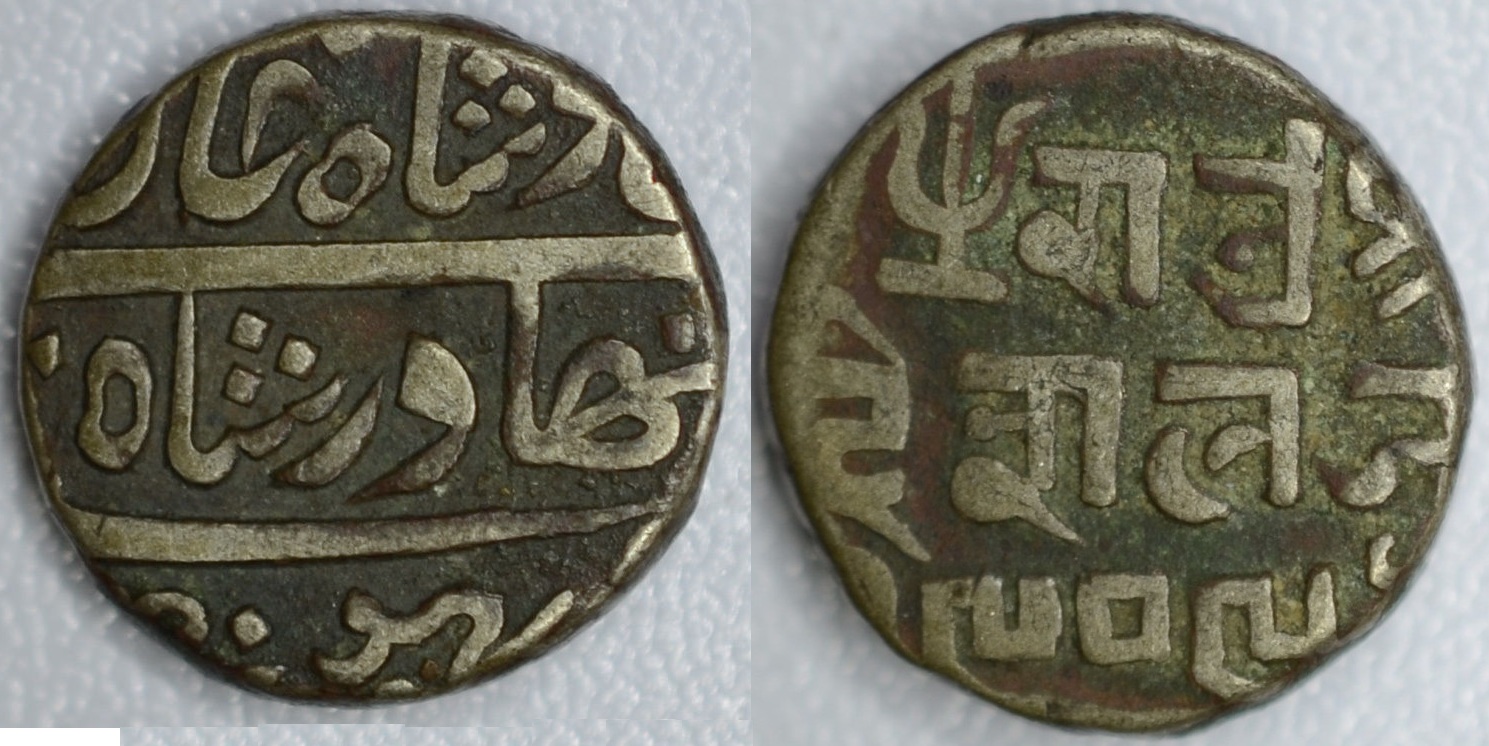 |
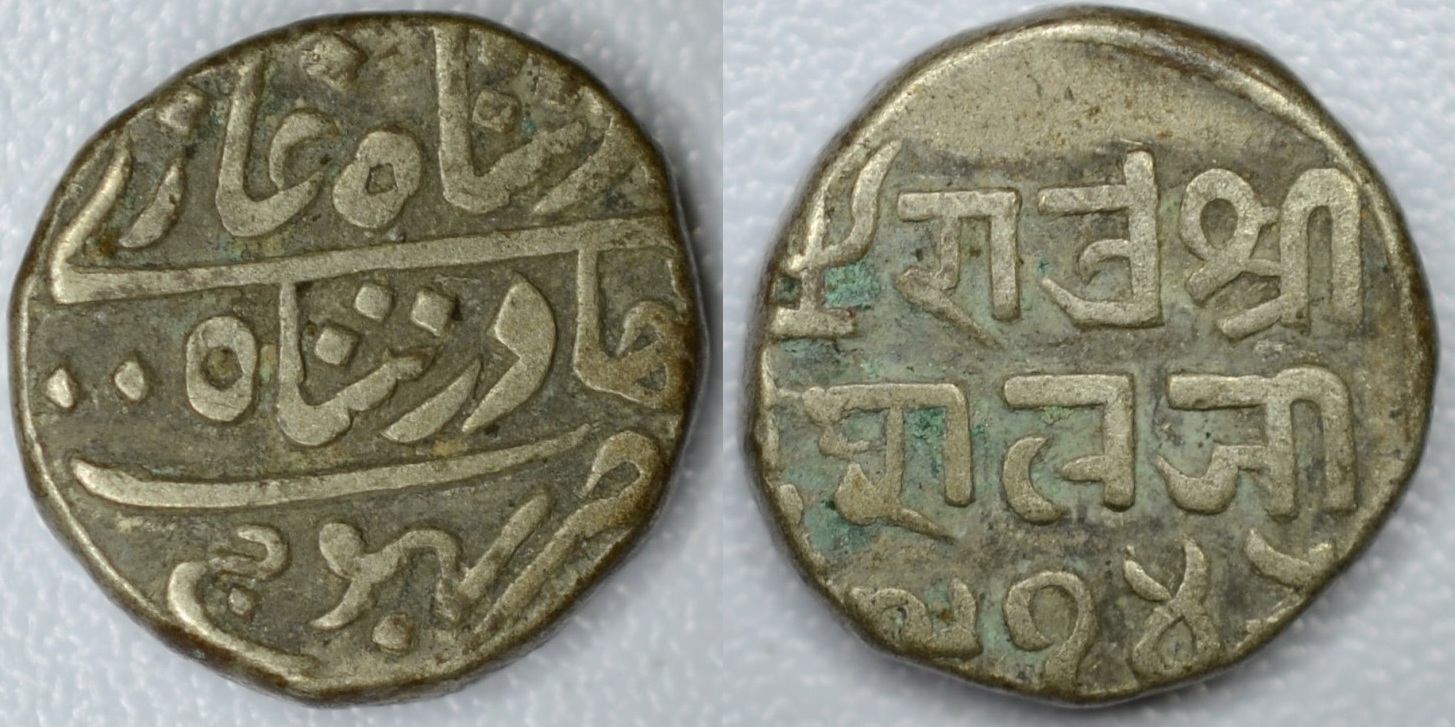
C#66 Kori.
Year:
VS1909 (1852). Weight:
4.63g [4.40-4.50g]. Metal:
0.610 Silver.
Diameter: 14.50 mm. Edge:
Plain. Alignment:
Coin. Mint:
Bhuj.
Mintage: N/A.
Minted Years: AH
(12)34 frozen date on all coins with VS1909-1916. Ruler:
Deshalji II citing Mughal Emperor "Bahadur Shah II". |
|
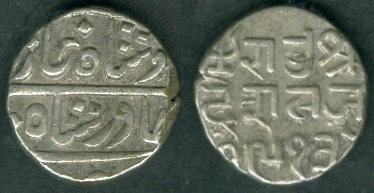 |
Same as above coin, C#66 but... Year:
VS1913 (1856). Weight:
4.58g.
Diameter: 15.00 mm.
Alignment:
Medal. |
|
 |
Same as above coin, C#66 but... Year:
VS1914 (1857). Weight:
4.56g.
Diameter: 15.00 mm.
Alignment:
Rotated. |
|
| |
| |
| Pragmalji
II S/o Deshalji II (1860 - 1875) citing Queen Victoria coinage
issue: |
| Currency:
Kori = 2 Adlinao = 4 Payalo = 8 Dhabu = 16
Dhinglo = 24 Dokda = 48 Trambiyo = 96 Babukiya. |
| |
|
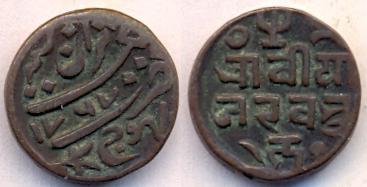 |
Y#5.1 Trambiyo (1/48 Kori).
Year:
1767 error (1867). Weight:
3.34g [3.00-3.40g]. Metal:
Copper.
Diameter: 15.00 mm. Edge:
Plain. Alignment:
Coin, but rotated as shown.
Mint:
Bhuj. |
|
Obverse:
"یک تران بييو" (One Trambiyo) written in Persian at the top. Date in
the center. "ضرب بہوج" (struck at Bhuj) written in Persian at
the bottom. Reverse:
Circle and trident at the top. "त्रांबीयो जरब
भुज" (Trambiyo, struck at Bhuj) written in three lines.
Mintage: N/A.
Minted Years: 1865-1868
and 1767 error (1867). Ruler:
Pragmalji II. |
|
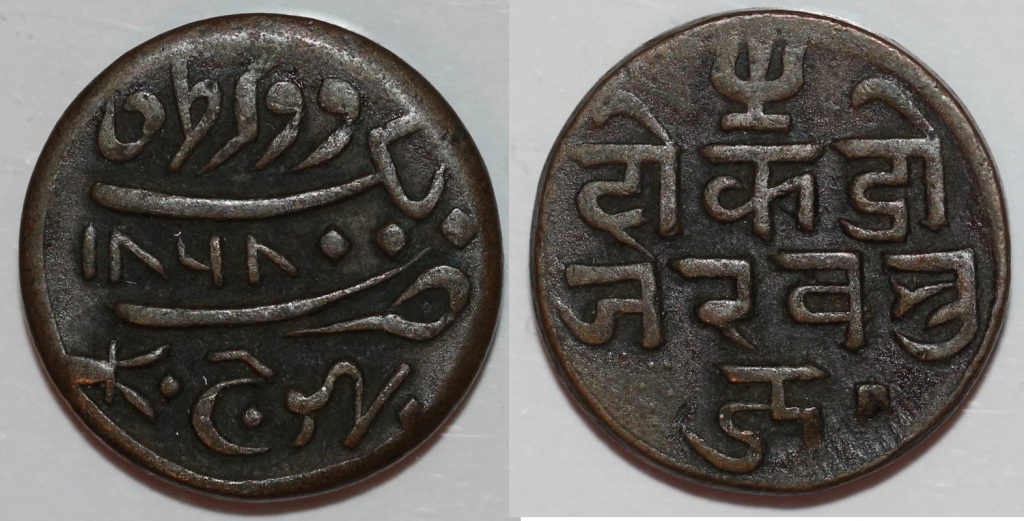 |
Y#6 Dokdo (1/24 Kori).
Year:
1868. Weight:
6.58g [6.30-6.60 g]. Metal:
Copper.
Diameter: 20.00 mm. Edge:
Plain. Alignment:
Medal. Mint:
Bhuj.
Obverse:
Date in CE, dagger and corrupt Urdu legend 'Yek Dokdo, Zarb Bhuj'
(One dokdo, Struck in Bhuj).
Reverse: Trident at the top. "दोकडो जरब
भु ज" (Dokdo, struck in Bhuj) written in three lines.
Mintage: N/A.
Minted Years:
1865, 1866, 1867, 1868, 1869 - Retrograde 9 and 1869. Ruler:
Pragmalji II. |
|
Note: On Reverse side, Dots to the right and left of
trident, right and left of legend and at it's end (varieties with
rosettes and squares, instead of dots also exists). The above coin
has square at the end. |
|
|
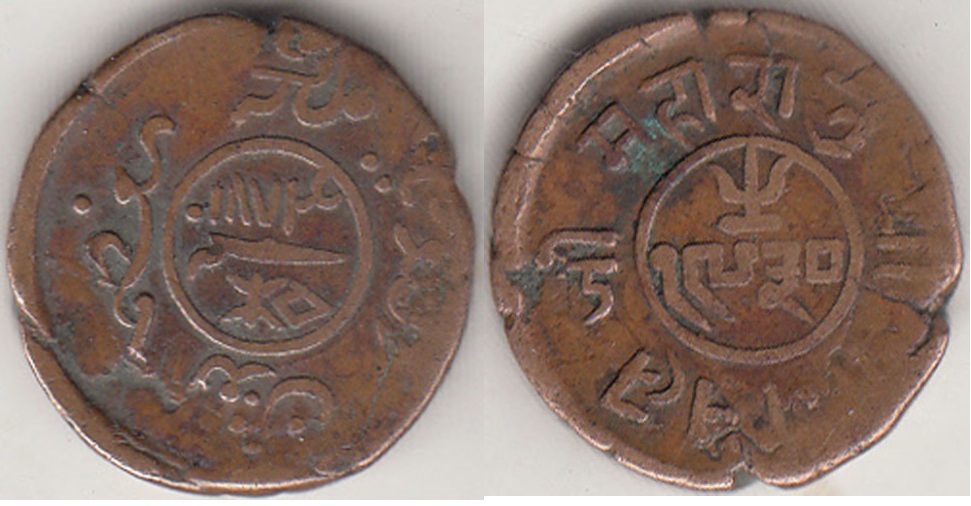 |
Y#10.2 Dokdo (1/24 Kori).
Year:
VS1930 (1873). Weight:
6.18g. Metal:
Copper.
Diameter: 20.50 mm. Edge:
Plain. Alignment:
Coin. Mint:
Bhuj.
Obverse:
"Malika Mu'azzamah Queen Victoria" (Her Majesty Queen Victoria) written
around anti-clockwise. Date with word "سنہ" (Year) and
Dragger mint mark in
the center circle. Type:
"وکٹوریا" (Victoria)
written at the right side. |
|
Reverse: VS Date below trident (trishul)
in center circle. "महाराउ श्री प्रागमल जी" (Maharao Shree
Pragmal ji) written around in Devanagari clockwise from the top.
Mintage: N/A.
Minted Years:
VS1930 (1873) and VS1930 (1874). Ruler:
Pragmalji II. |
|
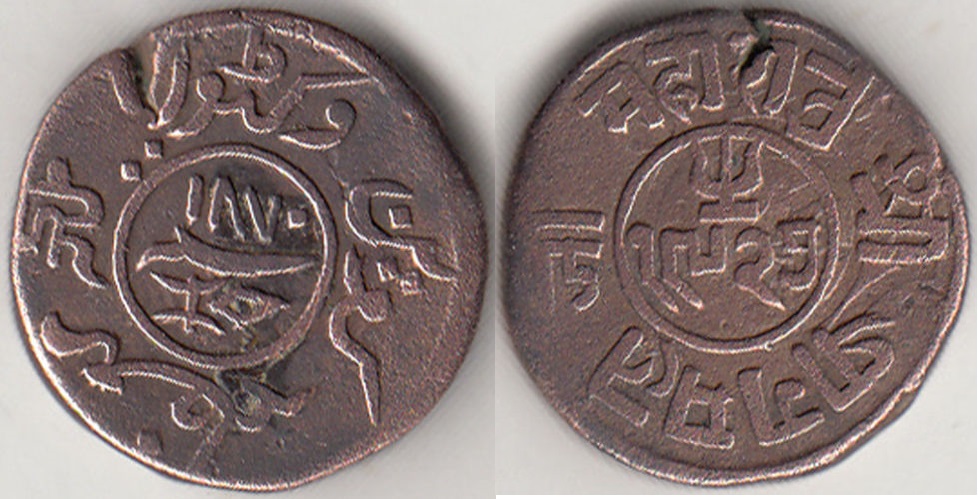 |
Y#11 1½ Dokdo (Dhinglo or 1/16 Kori).
Year:
VS1927 (1870). Weight:
9.53g. Metal:
Copper.
Diameter: 22.50 mm. Edge:
Plain. Alignment:
Rotated. Mint:
Bhuj.
Obverse:
"Malika Mu'azzamah Queen Victoria" (Her Majesty Queen Victoria) written
around anti-clockwise. Date with word "سنہ" (Year) and
Dragger mint mark in
the center circle. Type:
"وکٹوریا" (Victoria)
written at the top. |
|
Reverse: VS Date below trident (trishul)
in center circle. "महाराउ श्री प्रागमल जी" (Maharao Shree
Pragmal ji) written around in Devanagari clockwise from the top.
Mintage: N/A.
Minted Years:
VS1926 (1869), VS1926 Error for 1870 (1780), VS1925 Error for 1870
(1780), VS1927 (1870), VS1928 (1870), VS1928 Error for 1870 (1780)
VS1928 (1871) and VS1928 (1872). Ruler:
Pragmalji II. |
|
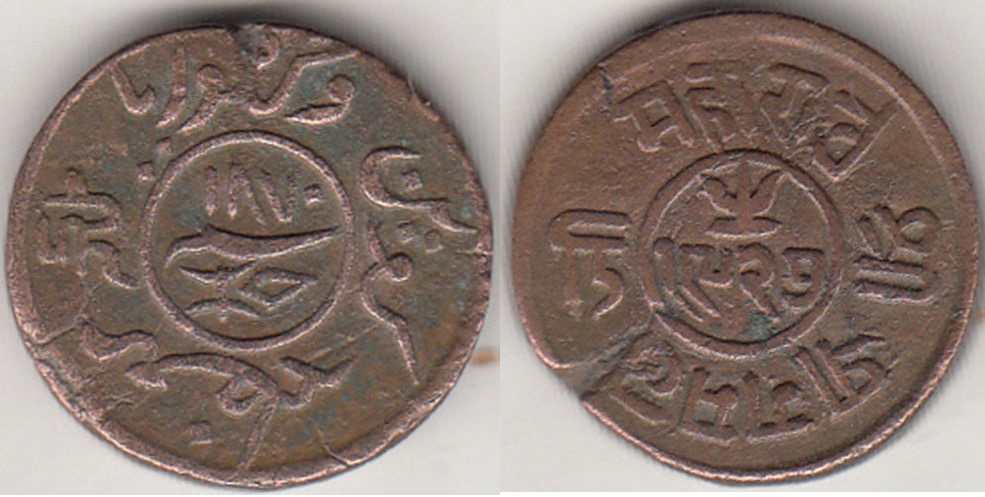 |
Type2: Same as above coin, but having squeezed VS Date
"1927". Weight:
9.36g. Diameter: 23.00 mm. |
|
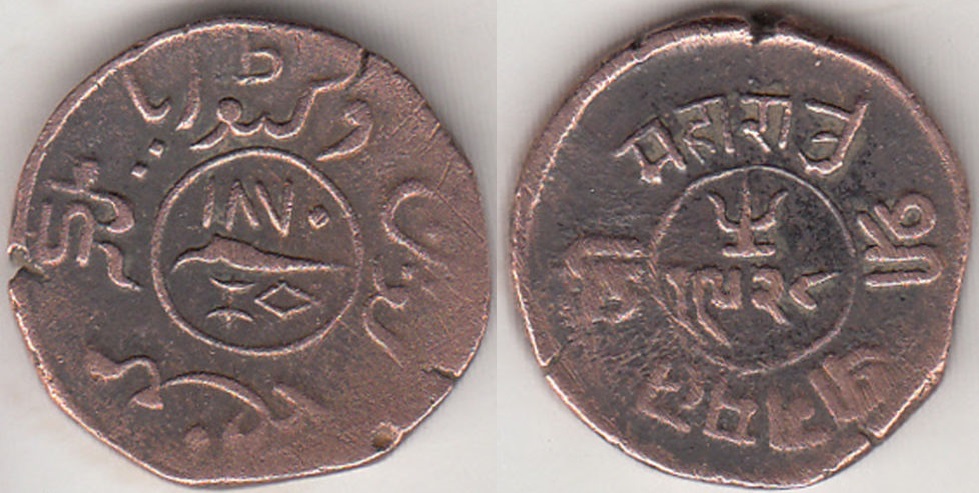 |
Same as above coin, Y#11 but...
Year:
VS1928 (1870). Weight:
9.85g. Diameter: 23.00 mm. Alignment:
Rotated. |
|
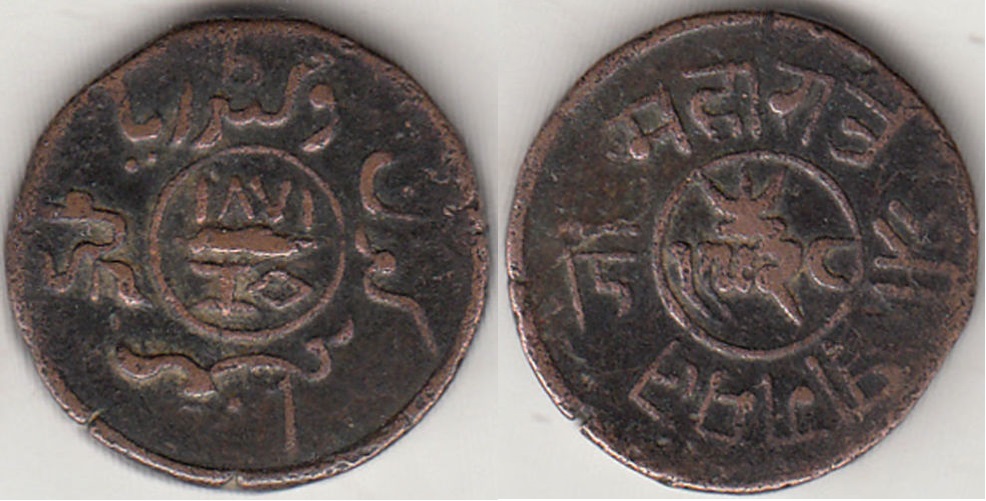 |
Same as above coin, Y#11 but...
Year:
VS1928 (1871). Weight:
9.83g. Diameter: 23.00 mm. Alignment:
Rotated. |
|
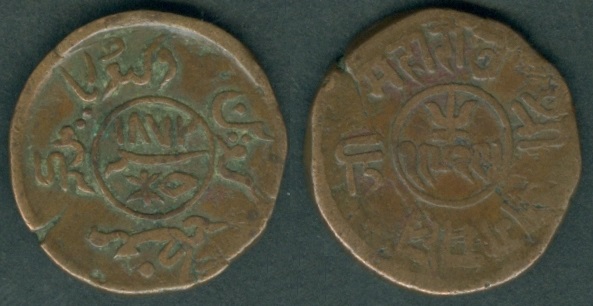 |
Same as above coin, Y#11 but...
Year:
VS1929 (1872). Weight:
9.42g. Diameter: 23.50 mm. Alignment:
Coin. |
|
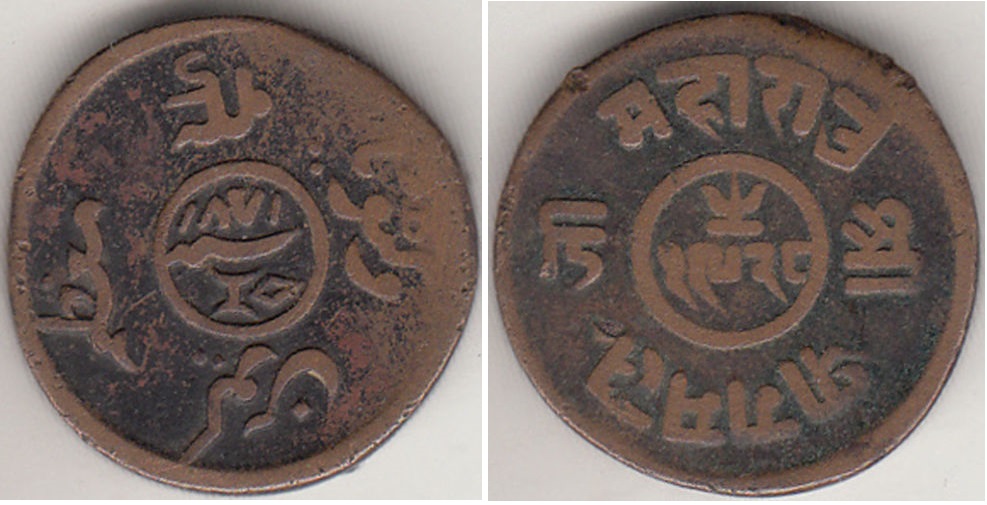 |
Y#11.1 1½ Dokdo (Dhinglo or 1/16 Kori).
Year:
VS1928 (1871). Weight:
9.44g. Metal:
Copper.
Diameter: 23.30 mm. Edge:
Plain. Alignment:
Rotated. Mint:
Bhuj.
Obverse:
"Malika Mu'azzamah Queen Victoria" (Her Majesty Queen Victoria) written
around anti-clockwise. Date with word "سنہ" (Year) and
Dragger mint mark in
the center circle. Type:
"وکٹوریا" (Victoria)
written at the right side, anti-clockwise. |
|
Reverse: VS Date below trident (trishul)
in center circle. "महाराउ श्री प्रागमल जी" (Maharao Shree
Pragmal ji) written around in Devanagari clockwise from the top.
Mintage: N/A.
Minted Years:
VS1928 (1871), VS1928 (1872), VS1929 (1872), VS1929 (1873), VS1930
(1873), VS1930 (1783 sic), VS1930 (1874), VS1931 (1874), VS1932
(1874 sic), VS1931 (1875), VS1932 (1875) and VS1929 (1879 sic). Ruler:
Pragmalji II.
Note:
sic
are error issues, VS year
having mismatch with the Common Era year. |
|
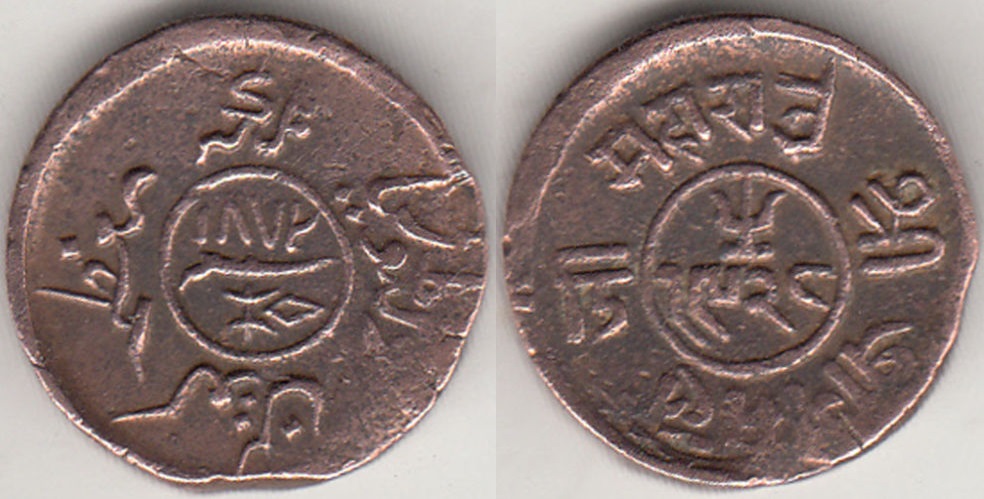 |
Same as above coin, Y#11.1 but...
Year:
VS1928 (1872). Weight:
9.72g. Diameter: 23.00 mm. Alignment:
Rotated. |
|
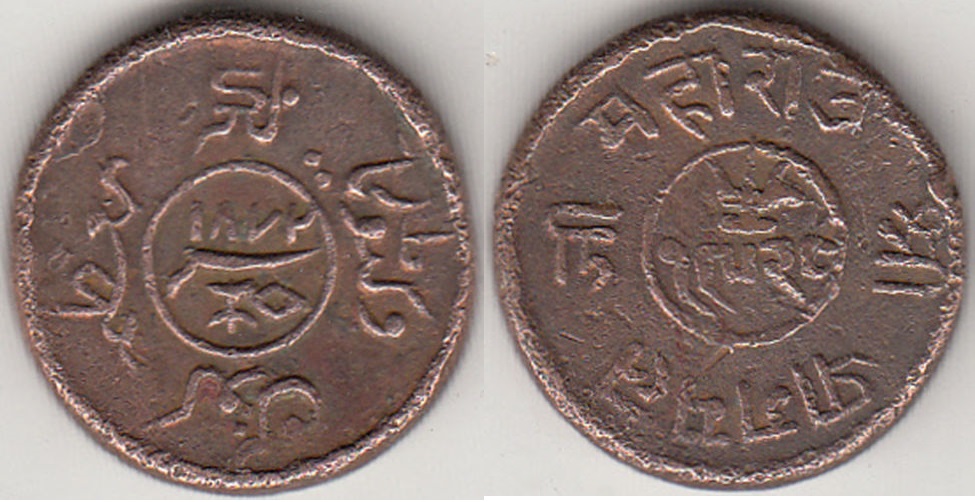 |
Type2: Same as above coin, but having small Dates on both
sides. Weight:
9.26g. Diameter: 22.50 mm. |
|
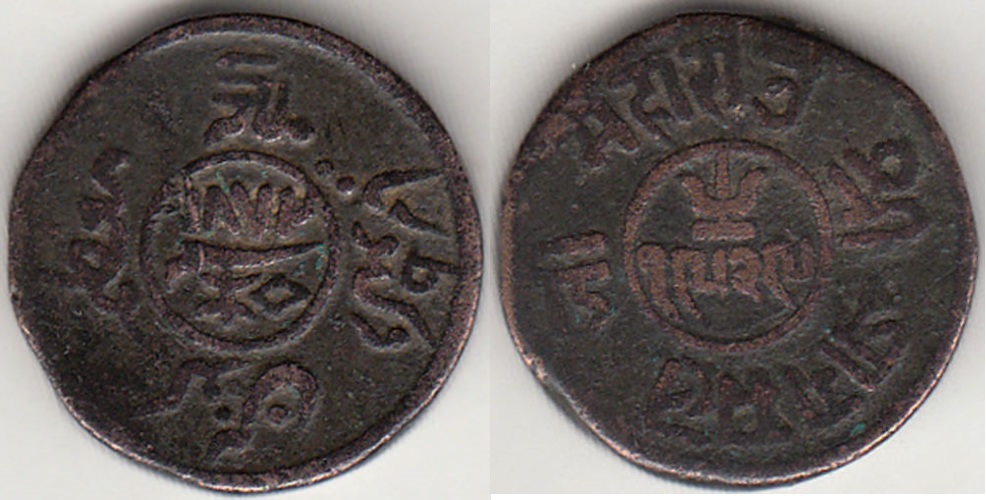 |
Same as above coin, Y#11.1 but...
Year:
VS1929 (1872). Weight:
9.71g. Diameter: 23.00 mm. Alignment:
Rotated. |
|
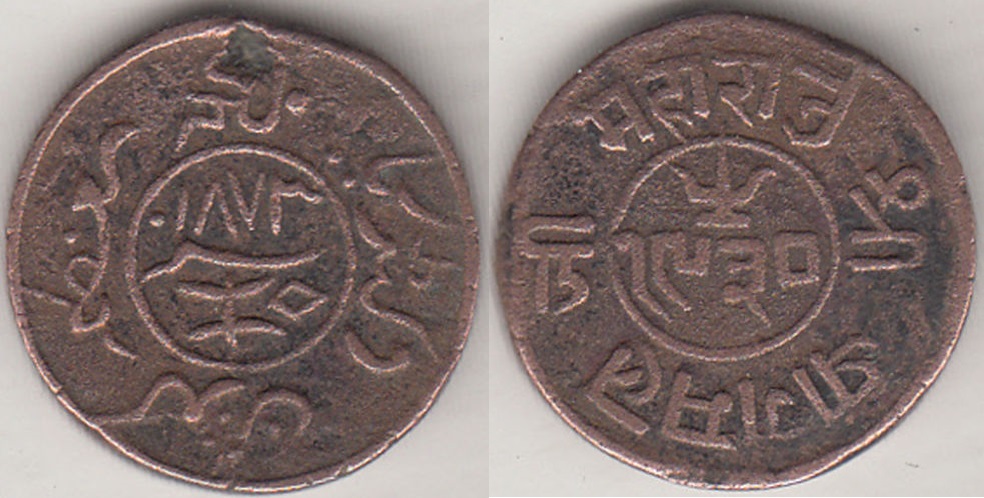 |
Same as above coin, Y#11.1 but...
Year:
VS1930 (1873). Weight:
9.31g. Diameter: 23.50 mm. Alignment:
Medal. |
|
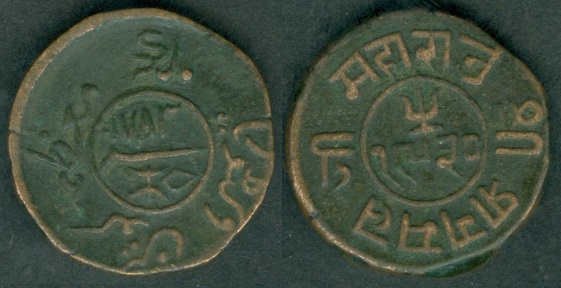 |
Same as above coin, Y#11.1 but...
Year:
VS1930 (1783 sic, should be 1873). Weight:
9.64g. Diameter: 22.50 mm. Alignment:
Rotated. |
|
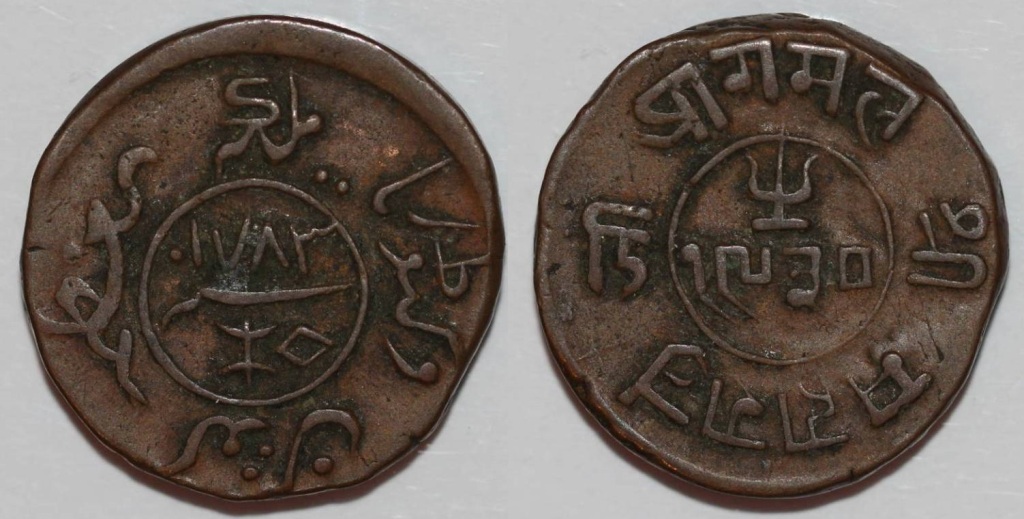 |
Type2: Same as above coin and year, Y#11.1 but...
Different placement and sizes of legends on both sides. Date "1783"
touching inner circle at right side.
Weight:
9.83g.
Diameter: 23.00 mm. Alignment:
Rotated. |
|
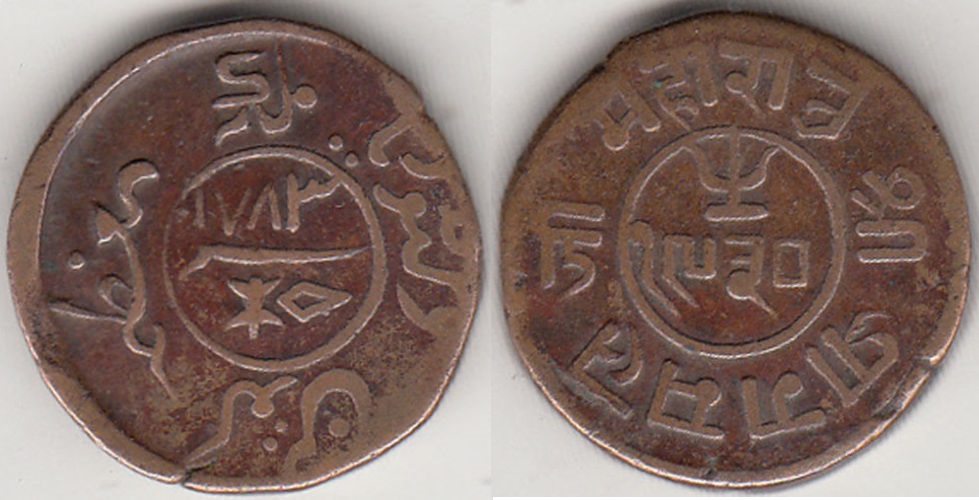 |
Type3: Same as above coin and year, Y#11.1 but...
Thicker and larger dates on both sides. The placement of two dots in
Victoria also differs from above both coins.
Weight:
9.33g.
Diameter: 23.00 mm. Alignment:
Medal. |
|
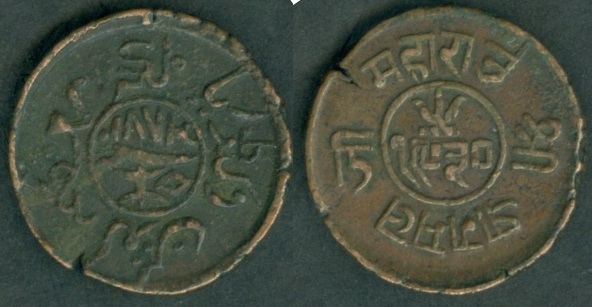 |
Same as above coin, Y#11.1 but...
Year:
VS1930 (1874). Weight:
9.84g.
Diameter: 23.50 mm. Alignment:
Coin. |
|
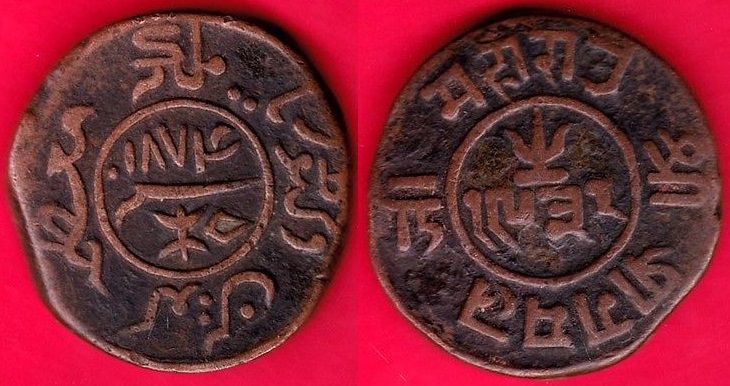 |
Same as above coin, Y#11.1 but...
Year:
VS1931 (1874). Weight:
9.55g.
Diameter: 23.50 mm. Alignment:
Medal. |
|
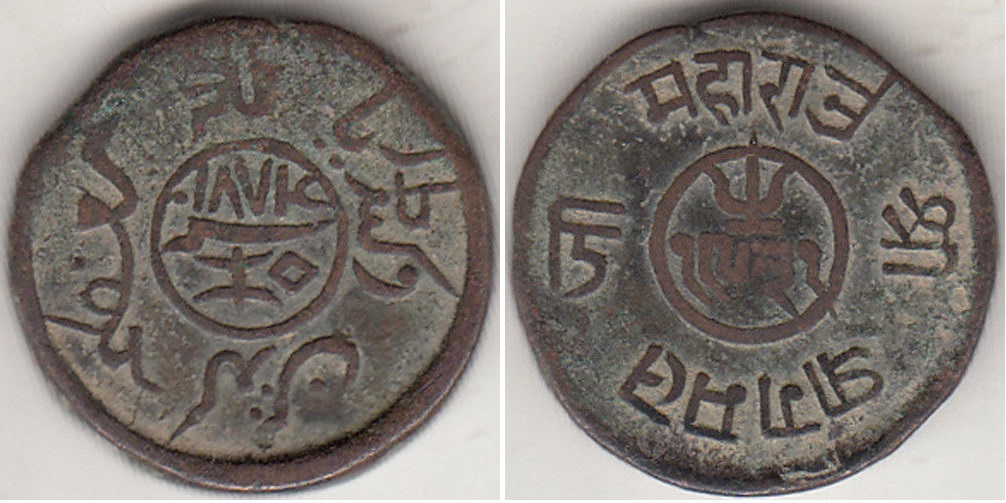 |
Type2: Same as above coin, but having different position of
dots in Victoria on Obverse side and Large VS date on Reverse side.
Year:
VS1931 (1874). Weight:
9.64g.
Diameter: 24.00 mm. Alignment:
Medal. |
|
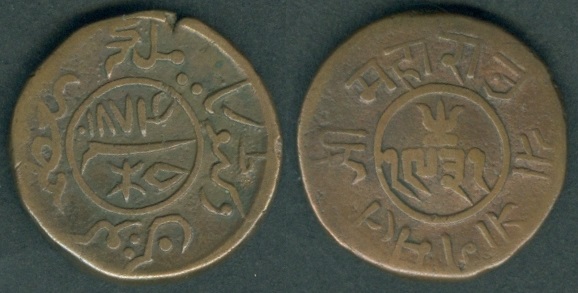 |
Type2: Same as above coin, but having
Date size increasing from left to right on Obverse side and Larger
and thick VS date on Reverse side.
Year:
VS1931 (1874). Weight:
9.46g.
Diameter: 23.00 mm. Alignment:
Rotated. |
|
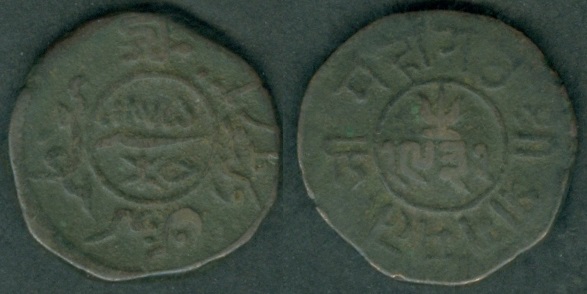 |
Same as above coin, Y#11.1 but...
Year:
VS1931 (1875). Weight:
9.60g.
Diameter: 23.00 mm. Alignment:
Rotated. |
|
|
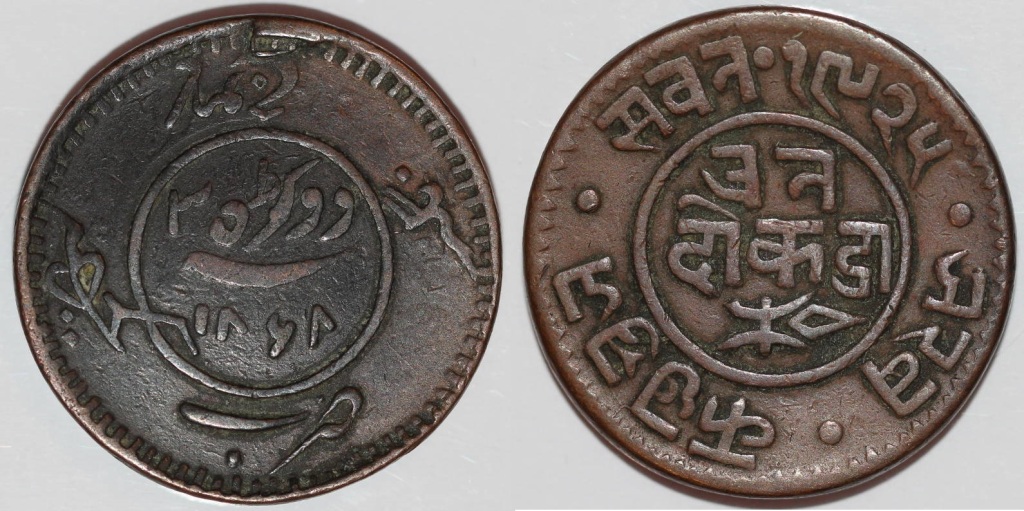 |
Y#8.1 3 Dokda (Dhabu or 1/8 kori).
Year:
VS1925 (1868). Weight:
19.72g [18.80-19.60g]. Metal:
Copper.
Diameter: 32.00 mm. Edge:
Plain. Alignment:
Medal; slightly rotated. Mint:
Bhuj.
Mintage: N/A.
Reverse: Sa(m)vat
and Date at the top.
Minted Years: One
year type. Ruler:
Pragmalji II. |
|
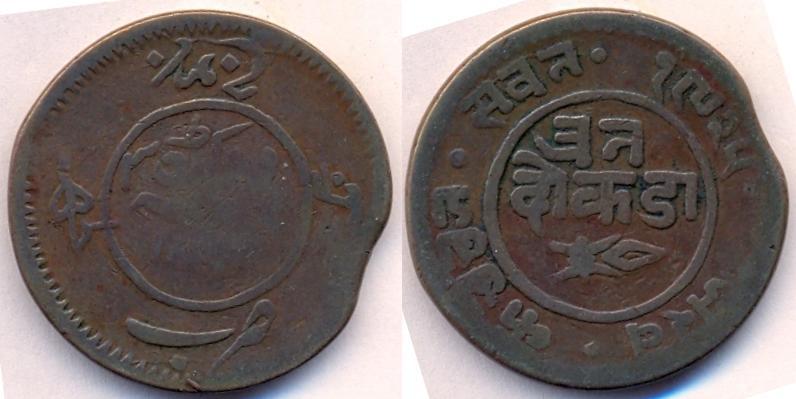 |
Y#8.2 3 Dokda (Dhabu or 1/8 kori).
Year:
VS1925 (1868). Year:
VS1925 (1868). Weight:
18.92g [18.80-19.60g].
Alignment:
Coin. Mint:
Bhuj.
Mintage: N/A.
Reverse: Sa(m)vat
at upper left, Date at upper right.
Minted Years: One
year type. Ruler:
Pragmalji II. Note: This
variety has thick legends on both sides. Also position and size
varies of the legends. |
|
|
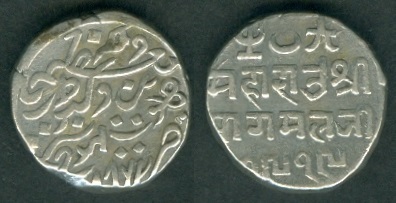 |
Y#14.1 Kori.
Year:
VS1919 (1862). Weight:
4.65g [4.70g]. Metal:
0.610 Silver.
Diameter: 15.50 mm. Edge:
Plain. Alignment:
Rotated.
Mint:
Bhuj. Note:
Closed crescent type. Thin layer joining both the ends of the
crescent. |
|
Reverse:
"Malika Mu'azzamah Queen Victoria" (Her
Majesty Queen Victoria) written in the top lines. "ضرب بہوج" (struck
at Bhuj) written in Persian below it with Date at the bottom.
Reverse: Trident,
crescent, vertical dagger at the top. "महाराउ श्री प्रागमलजी" (Maharao
Shri Pragmalji). VS Date at the bottom.
Mintage: N/A.
Minted Years:
VS1918 (1862) and VS1919 (1862). Ruler:
Pragmalji II. |
|
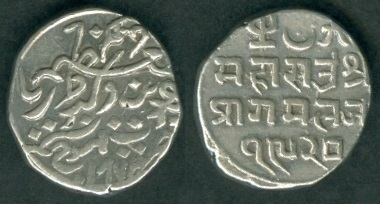 |
Y#14.2 Kori.
Year:
VS1920 (1862). Weight:
4.67g [4.70g]. Metal:
0.610 Silver.
Diameter: 15.50 mm. Edge:
Plain. Alignment:
Medal.
Mint:
Bhuj. Note:
Open crescent type. Square zero in VS date. |
|
Reverse:
"Malika Mu'azzamah Queen Victoria" (Her
Majesty Queen Victoria) written in the top lines. "ضرب بہوج" (struck
at Bhuj) written in Persian below it with Date at the bottom.
Reverse: Trident,
crescent, vertical dagger at the top. "महाराउ श्री प्रागमलजी" (Maharao
Shri Pragmalji). VS Date at the bottom.
Mintage: N/A.
Minted Years: VS1920
(1862), VS1920 (1863) and VS1921 (1863). Ruler:
Pragmalji II. |
|
.jpg) |
Same as above Y#14.2, but...
Year:
VS1920 (xxxx). Weight:
4.66g.
Diameter: 16.00 mm.
Alignment:
Medal, but rotated and off-flan as shown.
Note: Date off-flan; it would be
1862 or 1863. Rounded zero in VS date. |
|
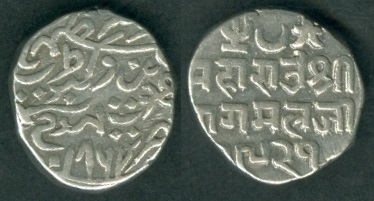 |
Same as above Y#14.2, but...
Year:
VS1921 (1863). Weight:
4.62g.
Diameter: 15.50 mm.
Alignment:
Rotated. |
|
|
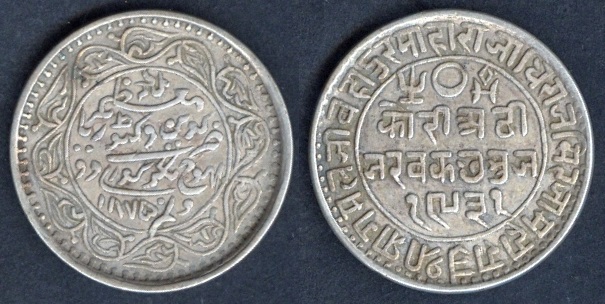 |
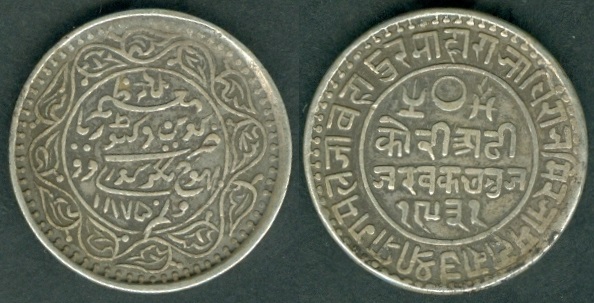
Y#15 2½ Kori.
Year:
VS1931 (1875). Weight:
6.82g [6.94g]. Metal:
0.937 Silver.
Diameter: 24.00 mm. Edge:
Reeded with Lettered: * भुज * Kutch *
कच्छ * Bhuj *. Readable when VS date (Reverse side) is on top. Alignment:
Coin. Mint:
Bhuj.
Obverse:
"Malika / Mu'azzamah, Queen Victoria, Zarb Bhujnagar, Kori do-wa-nasf,
AH date: ١٨٧۵" (Her Majesty Queen Victoria, Struck at Bhujnagar,
Kori Two and Half, AH date: 1875).
Inner circle and
Leaves of wreath around the legend. |
|
Reverse: Trident, closed crescent &
dagger within inner circle, Legend within inner circle in Devanagari:
"कोरी अढी" (Kori Addi), "जरब कच्छ भुज" (Zarb Kutch Bhuj) and VS
date. Outside circle in Devnagari: "महाराजा धिराज मिरजा महाराउ श्री
प्रागमलजी बहादुर" (Maharaja Dhiraj Mirza Maharau Shri Pragmalji
Bahadur).
Mintage: N/A.
Minted Years:
VS1931 (1875), VS1931 (1785) and VS1932 (1875). Ruler:
Pragmalji II. Note: My coin is
pressed deep at the right side of Obverse side. |
|
 |
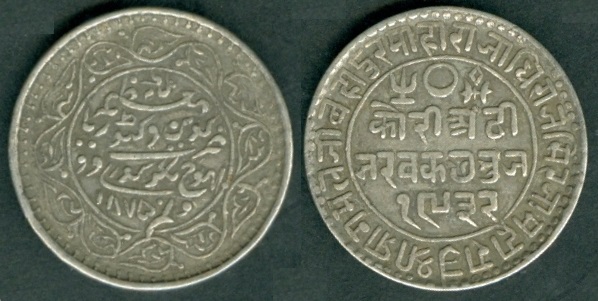
Same as above coin, Y#15 but having small VS date. Weight:
6.86g [6.94g]. Diameter: 23.50 mm.
Alignment:
Coin; Slightly rotated. |
|
 |
Same as above coin, Y#15 but...
Year:
VS1932 (1875). Weight:
6.86g [6.94g]. Alignment:
Coin.
Edge is Reeded with Lettering and readable when CE date (Obverse
side) is on top. |
|
|
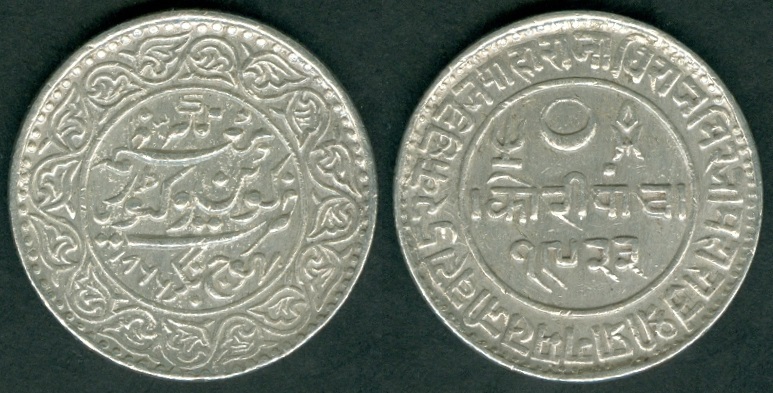 |
Y#16.1 5 Kori.
Year:
VS1923 (1866). Weight:
13.89g [13.87g]. Metal:
0.937 Silver.
Diameter: 31.00 mm. Edge:
Reeded with Lettered: * भुज * Kutch *
कच्छ * Bhuj *. Readable when VS date (Reverse side) is on top. Alignment:
Coin; Slightly roatated. Mint:
Bhuj.
Obverse:
"Malika / Mu'azzamah, Queen Victoria, Zarb Bhujnagar, AH date: ١٨٦٦" (Her Majesty Queen Victoria, Struck at Bhujnagar,
AH date: 1866).
Inner circle and
Leaves of wreath around the legend. |
|
Reverse: Trident, closed crescent &
dagger within inner circle, Legend within inner circle in Devanagari:
"Kori Paanch" (Five Kiri) written within two pillars and VS
date. Outside circle in Devnagari: "महाराजा धिराज मिरजा महाराउ श्री
प्रागमलजी बहादुर" (Maharaja Dhiraj Mirza Maharau Shri Pragmalji
Bahadur) and "कच्छ भुज" (Kutch Bhuj). Mintage:
N/A.
Minted Years:
VS1922 (1865), VS1921 (1865), VS1922 (1866), VS1923 (1866), VS1927
(1870), VS1931 (1874), VS1931 (1875) and VS1932 (1875). Ruler:
Pragmalji II. |
|
| |
| |
| Khengarji
III (1875 - 1942) coinage citing Queen Victoria: |
| Currency:
Kori = 2 Adlinao = 4 Payalo = 8 Dhabu = 16
Dhinglo = 24 Dokda = 48 Trambiyo = 96 Babukiya. |
| Lettering
edge description: * "Bhuj" written in Devanagri
script * "Kutch" written
in English * "Kutch" written in Devanagri script * "Bhuj" written in English
*. |
| |
|
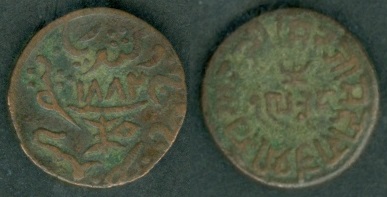 |
Y#30
Trambiyo (1/48 Kori).
Year:
VS1938 (1882). Weight:
3.27g. Metal:
Copper.
Diameter: 15.00 mm. Edge:
Plain. Alignment:
Medal. Mint:
Bhuj.
Obverse:
"وکٹوریا" (Victoria) written at the top. "قیصر
ہند" [(Qaiser-e-Hind), Empress of India] written in Persian
at the bottom left side. "ضرب بہوج" (struck at Bhuj) written in
Persian at bottom right side. Date with word "سنہ" (Year) and
Dragger mint mark in
the center. |
|
Reverse: VS Date below trident (trishul)
in center. "मिरजां महाराउ श्री खेंगारजी" (Mirza Maharao
Shri Khengarji) around in
Devanagari.
Mintage: N/A.
Minted Years:
1881//VS1938, 1882//VS1938, 1883//VS1939 and 1883//VS1940. Ruler:
Khengarji III.
Note: In early coins, there are four dots instead of "ط"
in "Victoria". |
|
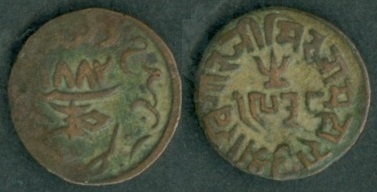 |
Same as above coin, Y#30 but... Weight:
3.03g. Alignment:
Rotated.
Note: The date is large and
both sides legends are shifted left side.
|
|
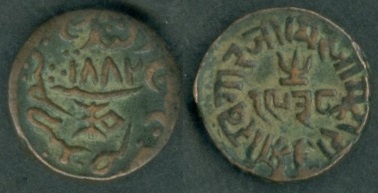 |
Same as above coin, Y#30 but... Weight:
3.37g. Alignment:
Rotated.
Note: The date is large and
both sides legends are shifted right side.
|
|
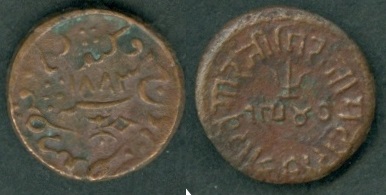 |
Same as above coin, Y#30 but...
Year:
VS1940 (1883). Weight:
2.87g. Alignment:
Rotated.
|
|
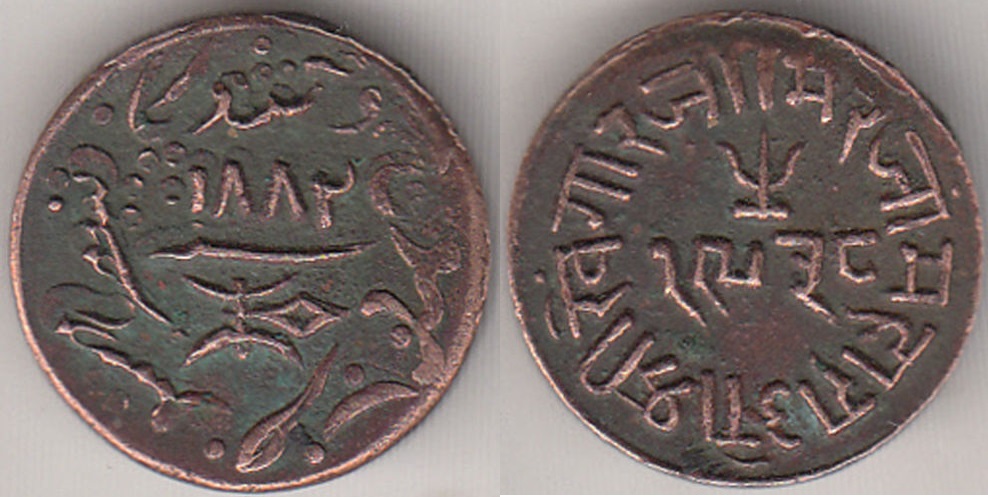 |
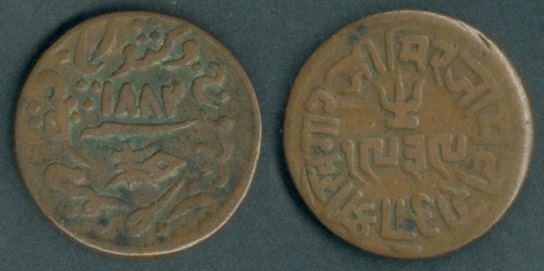
Y#31 Dokdo (1/24 Kori).
Year:
VS1938 (1882). Weight:
6.65g. Metal:
Copper.
Diameter: 21.00 mm. Edge:
Plain. Alignment:
Rotated. Mint:
Bhuj.
Obverse:
"وکٹوریا" (Victoria) written at the top. "قیصر
ہند" [(Qaiser-e-Hind), Empress of India] written in Persian
at the bottom left side. "ضرب بہوج" (struck at Bhuj) written in
Persian at bottom right side. Date with word "سنہ" (Year) and
Dragger mint mark in
the center. |
|
Reverse: VS Date below trident (trishul)
in center. "महाराओ श्री खेंगारजी" (Maharao Shri Khengarji) around in
Devanagari.
Mintage: N/A.
Minted Years:
VS1938
(1882), VS1939 (1882) and VS1939 (1883). Ruler:
Khengarji III. |
|
 |
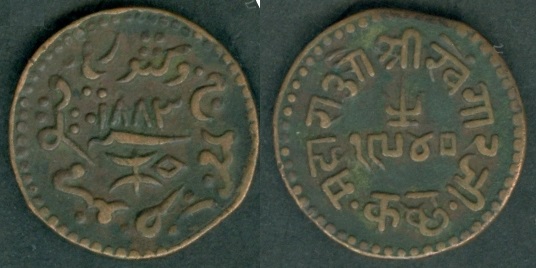
Same as above coin, but... Year:
VS1939 (1882). Weight:
6.42g. Alignment:
Rotated (4 o' clock). |
|
 |
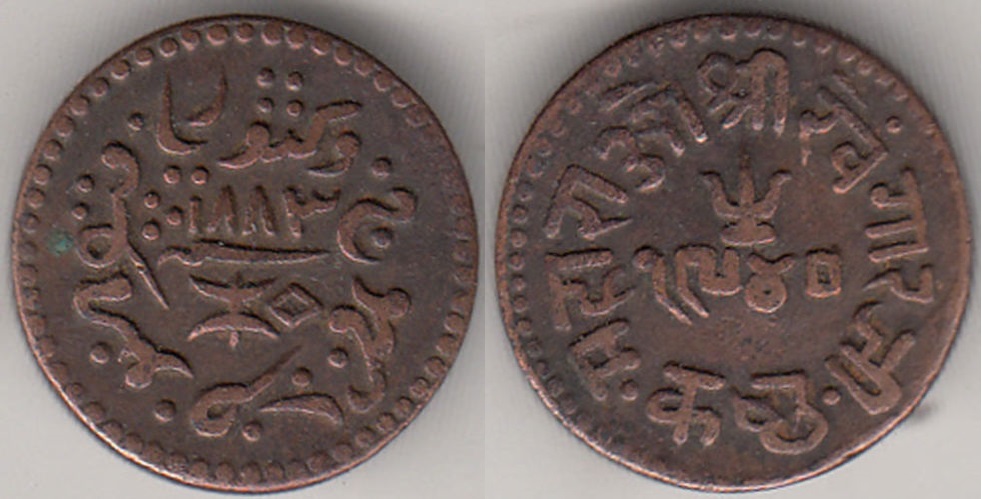
Y#31.1 Dokdo (1/24 Kori).
Year:
VS1940 (1883). Weight:
6.45g. Metal:
Copper.
Diameter: 21.50 mm. Edge:
Plain. Alignment:
Coin, but slightly rotated. Mint:
Bhuj.
Obverse:
"وکٹوریا" (Victoria) written at the top. "قیصر
ہند" [(Qaiser-e-Hind), Empress of India] written in Persian
at the bottom left side. "ضرب بہوج" (struck at Bhuj) written in
Persian at bottom right side. Date with word "سنہ" (Year) and
Dragger mint mark in
the center. |
|
Reverse: VS Date below trident (trishul)
in center. "महाराओ श्री खेंगारजी" (Maharao Shri Khengarji) around in
Devanagari. ".कच्छ." (Kutch) written in Devanagari at the bottom.
Mintage: N/A.
Minted Years:
VS1940
(1883) and VS1940 (1884). Ruler:
Khengarji III. |
|
 |
Same as above coin, but having thicker Dates/legends on both
sides. Weight:
6.51g. Diameter: 21.00 mm. Alignment:
Medal, but slightly rotated. |
|
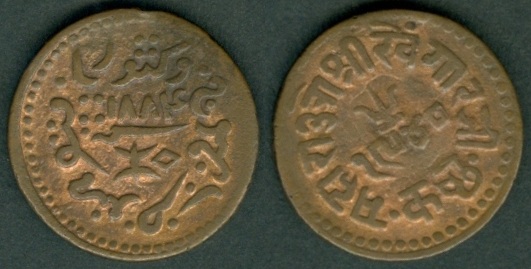 |
Same as above coin, Y#31.1 but... Year:
VS1940 (1884). Weight:
6.30g. Alignment:
Medal, but rotated as shown. |
|
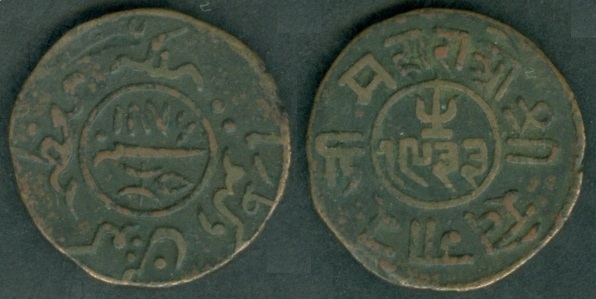 |
Y#23 1½ Dokdo (Dhinglo or 1/16 Kori).
Year:
VS1933 (1876). Weight:
9.64g. Metal:
Copper.
Diameter: 23.00 mm. Edge:
Plain. Alignment:
Coin. Mint:
Bhuj.
Obverse:
"Malika Mu'azzamah Queen Victoria" (Her Majesty Queen Victoria) written
around anti-clockwise. Date with word "سنہ" (Year) and
Dragger mint mark in
the center circle. |
|
Reverse: VS Date below trident (trishul)
in center circle. "महाराओ श्री खेंगारजी" (Maharao Shri
Khengarji) written around in Devanagari clockwise from the top.
Mintage: N/A.
Minted Years:
VS1933 (1876), VS1933 (1877), VS1934 (1877), VS1922 (1877, Error),
VS1934 (1878) and VS1935 (1878). Ruler:
Khengarji III. |
|
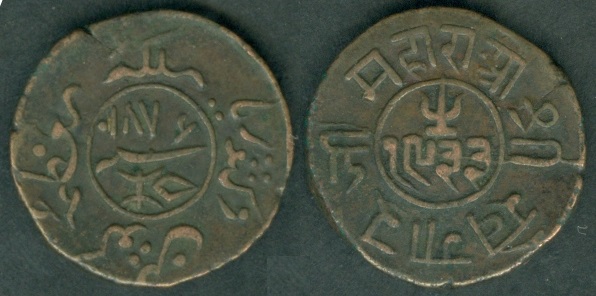 |
Same as above coin, Y#23 but in date, digit "6" is far from the
rest of the digits in date 1876.
Weight:
9.98g. Alignment:
Medal. |
|
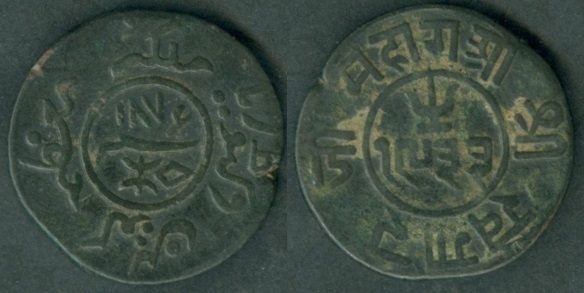 |
Same as above coin, Y#23 but having small "1876" date with small
and thick inner circle
Weight:
9.39g. Alignment:
Medal. |
|
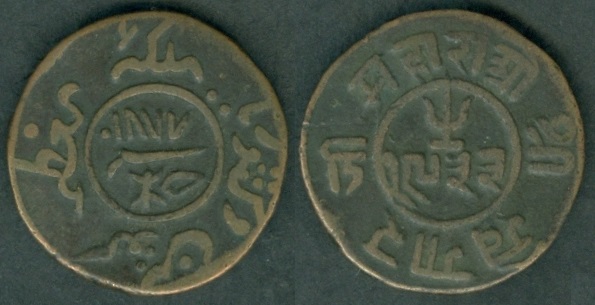 |
Same as above coin, Y#23 but...
Year:
VS1933 (1877). Weight:
9.54g. Diameter: 23.50 mm. Alignment:
Rotated. |
|
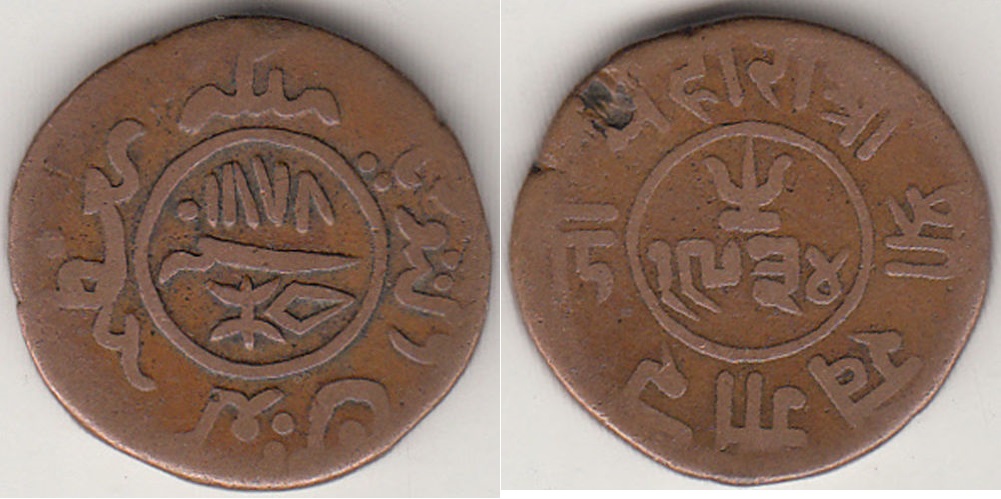 |
Same as above coin, Y#23 but...
Year:
VS1934 (1878). Weight:
9.29g. Diameter: 24.25 mm. Alignment:
Coin. |
|
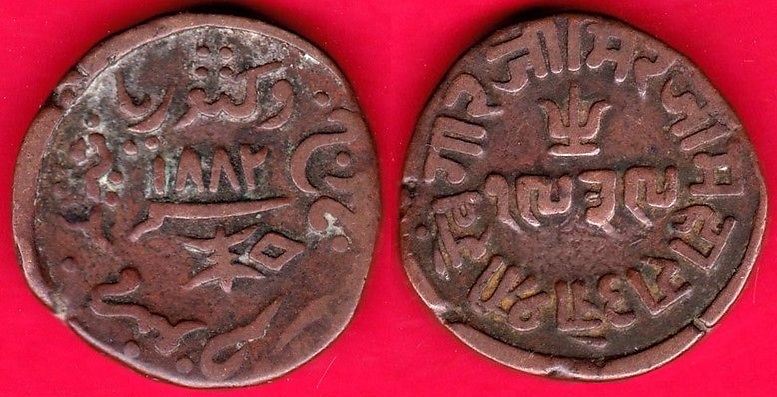 |
Y#32 1½ Dokdo (Dhinglo or 1/16 Kori).
Year:
VS1939 (1882). Weight:
9.55g. Metal:
Copper.
Diameter: 23.50 mm. Edge:
Plain. Alignment:
Coin; slightly rotated. Mint:
Bhuj.
Obverse:
"وکٹوریا" (Victoria)
written at the top. "قیصر
ہند" [(Qaiser-e-Hind), Empress of India] written in Persian
at the bottom left side. "ضرب بہوج" (struck at Bhuj) written in
Persian at bottom right side. Date with word "سنہ" (Year) and
Dragger mint mark in
the center. |
|
Reverse: VS Date below trident (trishul)
in center. "मिरजां महाराओ श्री खेंगारजी" (Mirza Maharao Shree
Khengarji) around in Devanagari.
Mintage: N/A.
Minted Years:
VS1938 (1882), VS1939 (1882), VS1939 (1883) and VS1940 (1883). Ruler:
Khengarji III. Note:
Crude style. |
|
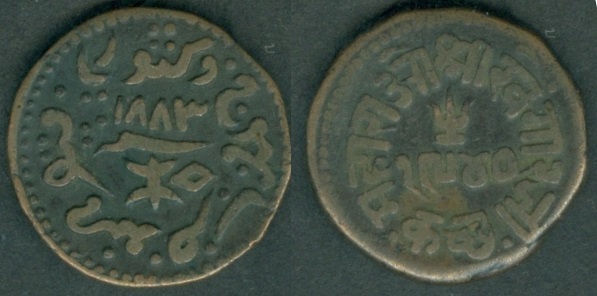 |
Y#32.1 1½ Dokdo (Dhinglo or 1/16 Kori).
Year:
VS1940 (1883). Weight:
9.67g. Metal:
Copper.
Diameter: 23.50 mm. Edge:
Plain. Alignment:
Coin. Mint:
Bhuj.
Obverse:
"وکٹوریا" (Victoria)
written at the top. "قیصر
ہند" [(Qaiser-e-Hind), Empress of India] written in Persian
at the bottom left side. "ضرب بہوج" (struck at Bhuj) written in
Persian at bottom right side. Date with word "سنہ" (Year) and
Dragger mint mark in
the center. |
|
Reverse: VS Date below trident (trishul)
in center. "महाराओ श्री खेंगारजी" (Maharao Shri Khengarji) around in
Devanagari. ".कच्छ." (Kutch) written in Devanagari at the bottom.
Mintage: N/A.
Minted Years:
VS1940 (1883), VS1940 (1884) and VS1941 (1884). Ruler:
Khengarji III. Note:
Crude style. |
|
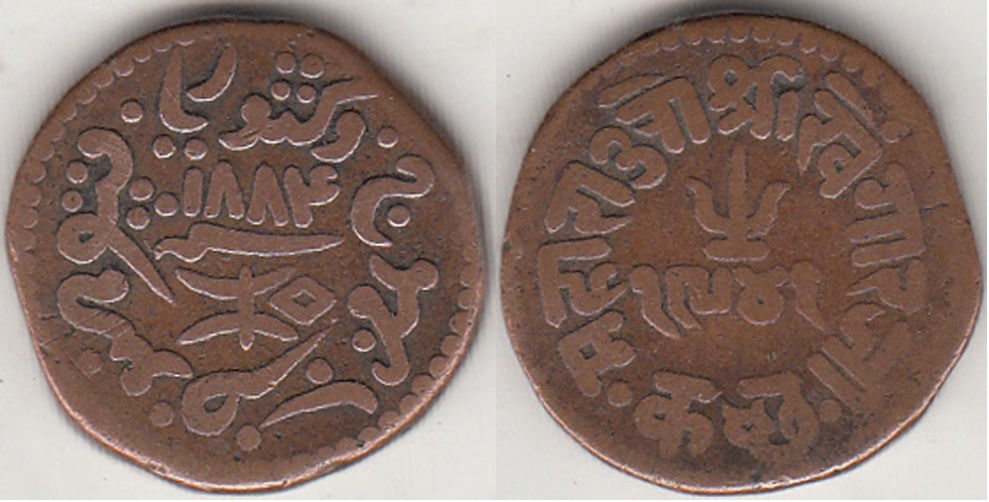 |
Same as above coin, Y#32.1 but...
Year:
VS1941 (1884). Weight:
9.19g. Diameter: 23.00 mm. Alignment:
Rotated. |
|
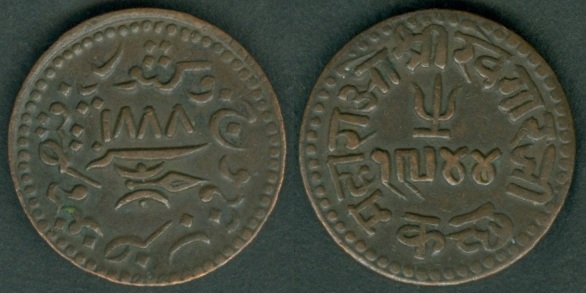 |
Y#32.2 1½ Dokdo (Dhinglo or 1/16 Kori).Year:
VS1944 (1888). Weight:
10.01g. Metal:
Copper.
Diameter: 23.50 mm. Edge:
Plain. Alignment:
Coin. Mint:
Bhuj.
Obverse:
"وکٹوریا" (Victoria)
written at the top. "قیصر
ہند" [(Qaiser-e-Hind), Empress of India] written in Persian
at the bottom left side. "ضرب بہوج" (struck at Bhuj) written in
Persian at bottom right side. Date with word "سنہ" (Year) and
Dragger mint mark in
the center. |
|
Reverse: VS Date below trident (trishul)
in center. "महाराओ श्री खेंगारजी" (Maharao Shri Khengarji) around in
Devanagari. ".कच्छ." (Kutch) written in Devanagari at the bottom.
Mintage: N/A.
Minted Years:
VS1943 (1885), VS1944 (1887) and VS1944 (1888). Ruler:
Khengarji III. Note:
Finer style. |
|
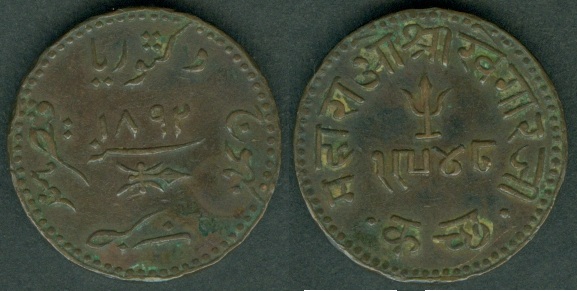 |
Y#32.3 1½ Dokdo (Dhinglo or 1/16 Kori).
Year:
VS1948 (1892). Weight:
9.89g. Metal:
Copper.
Diameter: 23.50 mm. Edge:
Plain. Alignment:
Medal. Mint:
Bhuj.
Obverse:
"وکٹوریا" (Victoria) written at the top. "قیصر
ہند" [(Qaiser-e-Hind), Empress of India] written in Persian
at the bottom left side. "ضرب بہوج" (struck at Bhuj) written in
Persian at bottom right side. Date with word "سنہ" (Year) and
Dragger mint mark in
the center. |
|
Reverse: VS Date below trident (trishul)
in center. "महाराओ श्री खेंगारजी" (Maharao Shri Khengarji) around in
Devanagari. ".कच्छ." (Kutch) written in Devanagari at the bottom.
Mintage: N/A.
Minted Years:
VS1948 (1892) and VS1950 (1894). Ruler:
Khengarji III. |
|
|
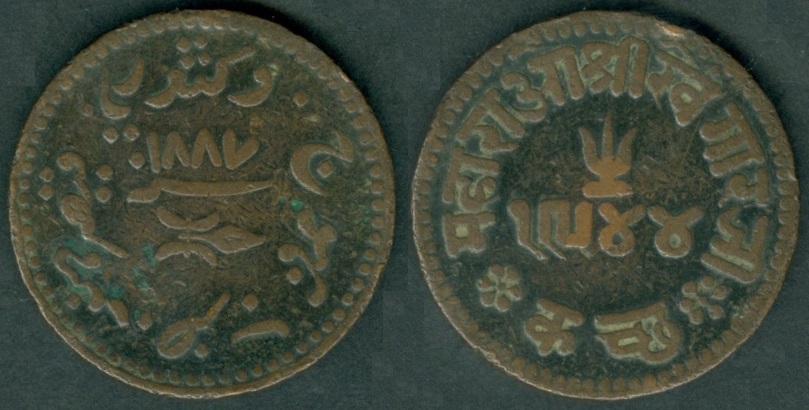 |
Y#33 Dokdo (1/8 Kori).
Year:
VS1944 (1887). Weight:
19.16g [20.00g]. Metal:
Copper.
Diameter: 32.50 mm. Edge:
Plain. Alignment:
Coin; slightly rotated. Mint:
Bhuj. |
|
Obverse:
"وکٹوریا" (Victoria) written at the top. "قیصر
ہند" [(Qaiser-e-Hind), Empress of India] written in Persian
at the bottom left side. "ضرب بہوج" (struck at Bhuj) written in
Persian at bottom right side. Date with word "سنہ" (Year) and
Dragger mint mark in
the center.
Reverse: VS Date below trident (trishul)
in center. "महाराओ श्री खेंगारजी" (Maharao Shri Khengarji) around in
Devanagari. "कच्छ" (Kutch) written in Devanagari at the bottom with
six petal flower on both sides.
Mintage: N/A.
Minted Years:
VS1940
(1883), VS1942 (1885), VS1942 (1886), VS1944 (1887) and VS1944 (1888). Ruler:
Khengarji III. |
|
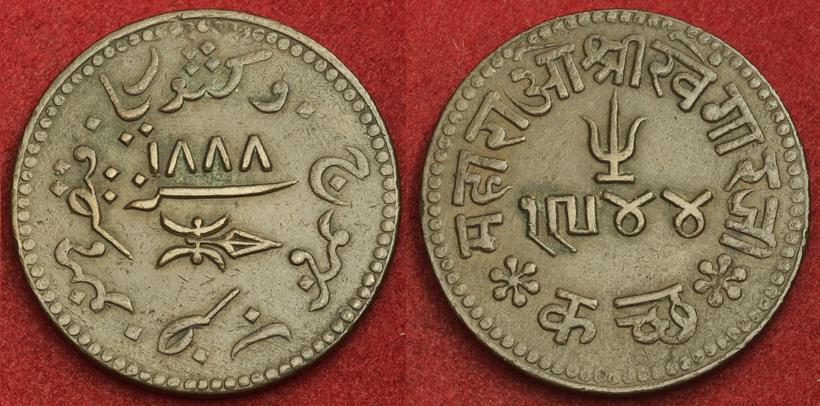 |
Same as above coin, Y#33 but... Year:
VS1944 (1888). Weight:
19.91g [20.00g]. Alignment:
Coin.
This coin has thin legend than the above coin. |
|
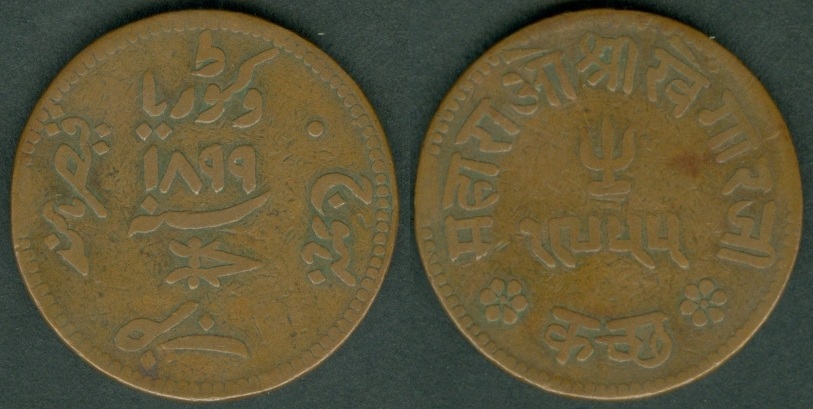 |
Y#33.1 Dokdo (1/8 Kori).
Year:
VS1955 (1899). Weight:
19.41g [20.00g]. Metal:
Copper.
Diameter: 32.50 mm. Edge:
Plain. Alignment:
Medal. Mint:
Bhuj. |
|
Obverse:
"وکٹوریا" (Victoria) written at the top. "قیصر
ہند" [(Qaiser-e-Hind), Empress of India] written in Persian
anti-clockwise at the left side. "ضرب" (struck at) written in
Persian anti-clockwise at bottom. "بہوج" (Bhuj) written in
Persian anti-clockwise at right side. Date with word "سنہ" (Year) and
Dragger mint mark in
the center.
Reverse: Date below trident (trishul)
in center. "महाराओ श्री खेंगारजी" (Maharao Shri Khengarji) around in
Devanagari. "कच्छ" (Kutch) written in Devanagari at the bottom with
six petal flower on both sides.
Mintage: N/A.
Minted Years:
VS1951 (1894) and VS1955 (1899). Ruler:
Khengarji III. |
|
|
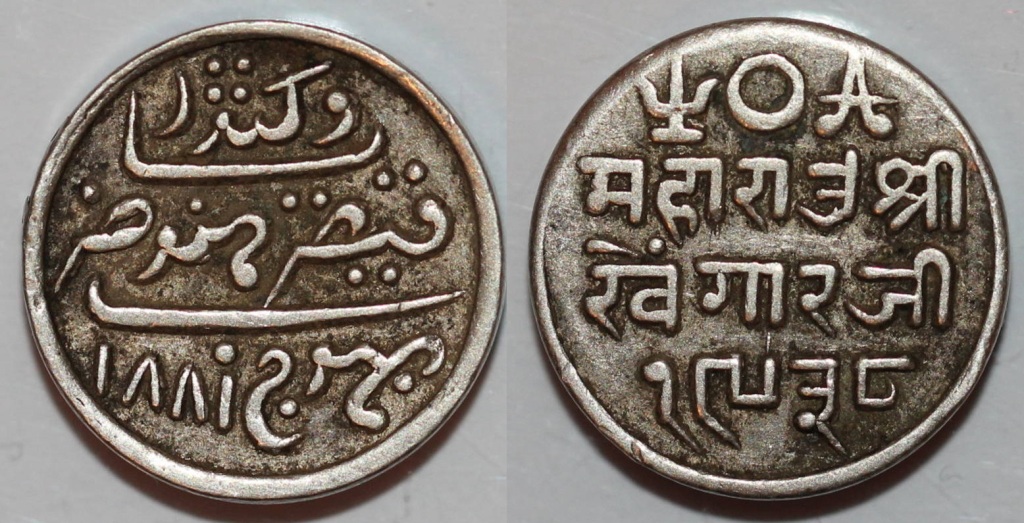 |
Y#35 Kori.
Year:
VS1938 (1881). Weight:
4.64g [4.70g]. Metal:
0.610 Silver.
Diameter: 16.00 mm. Edge:
Plain. Alignment:
Coin; slightly rotated. Mint:
Bhuj.
Obverse:
"Victoria Qaiser-i-Hind" (Victoria, Empress of India), "Zarb Bhuj"
(Mint: Bhuj) with date. |
|
Reverse: Trident, closed Crescent and
Dagger at the top. "महारउ श्रीं खेंगरजी" (Maharau Shree Khengarji )
written in two lines in the center. VS Date at the bottom.
Mintage: N/A.
Minted Years:
1881//VS1938, 1882//VS1938, 1882//VS1939, 1883//VS1939,
1883//VS1940, 1884//VS1941 and 1885//VS1941.. Ruler:
Khengarji III. |
|
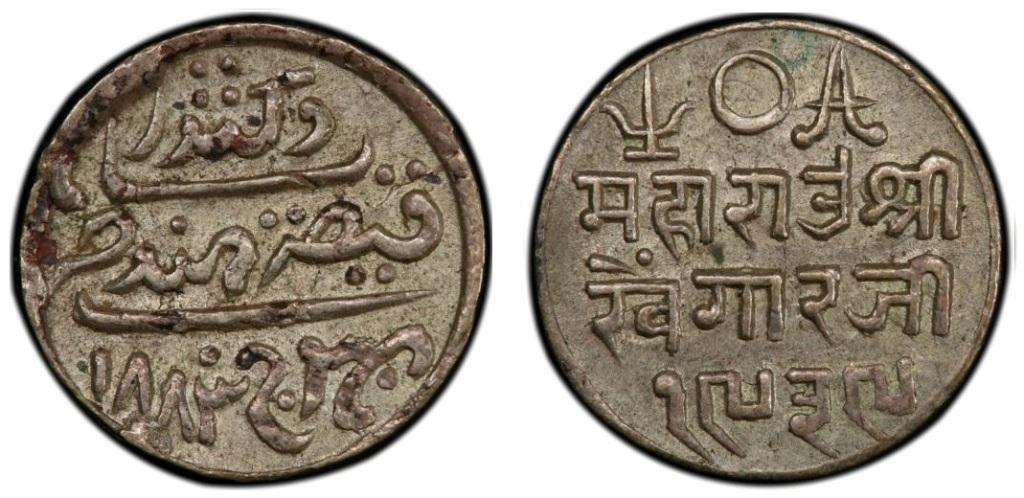 |
Same as above coin, Y#35 Kori but...
Year:
VS1939 (1883). Weight:
4.68g. Diameter:
15.50 mm. Alignment:
Rotated (3 o' clock).
Mintage: N/A.
Note: This coin was part of
Dr. Axel Wahlstedt
collection. |
|
|
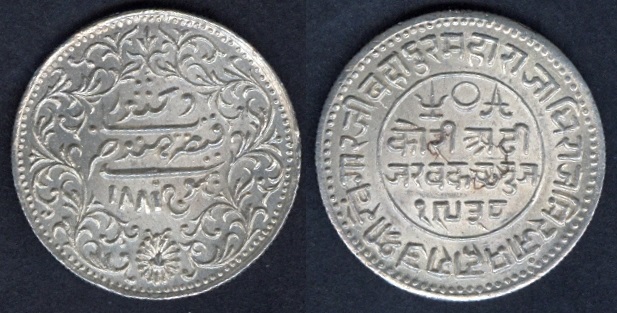 |
Y#36 2½ Kori.
Year:
VS1938 (1881). Weight:
6.92g [6.935g]. Metal:
0.937 Silver.
Diameter: 24.50 mm. Edge:
Reeded. Alignment:
Medal. Mint:
Bhuj.
Obverse:
"Victoria Qaiser-i-Hind" (Victoria, Empress of India), "Zarb Bhuj"
(Mint: Bhuj) with date.
No inner circle. Leaves of wreath design around the legend. |
|
Reverse: Closed crescent within circle.
Mintage: N/A.
Minted Years:
1881//VS1938 and 1882//VS1938. Ruler:
Khengarji III. |
|
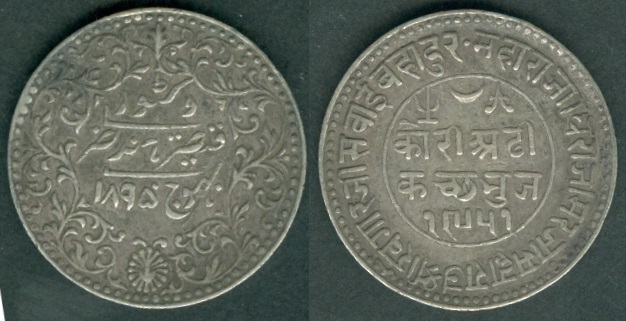 |
Y#36.1 2½ Kori.
Year:
VS1951 (1895). Weight:
6.90g [6.935g]. Metal:
0.937 Silver.
Diameter: 25.00 mm. Edge:
Reeded with Lettered: * भुज * Kutch *
कच्छ * Bhuj *. Readable when VS date (Reverse side) is on top. Alignment:
Medal. Mint:
Bhuj.
Obverse:
"Victoria Qaiser-i-Hind" (Victoria, Empress of India), "Zarb Bhuj"
(Mint: Bhuj) with date.
No inner circle and
Leaves of wreath changed from pervious design around the legend. |
|
Reverse: Open crescent within circle.
Mintage: N/A.
Minted Years:
VS1951 (1894), VS1951 (1895), VS1953 (1897), VS1954 (1897), VS1954
(1898), VS1955 (1898) and VS1955 (1899). Ruler:
Khengarji III. |
|
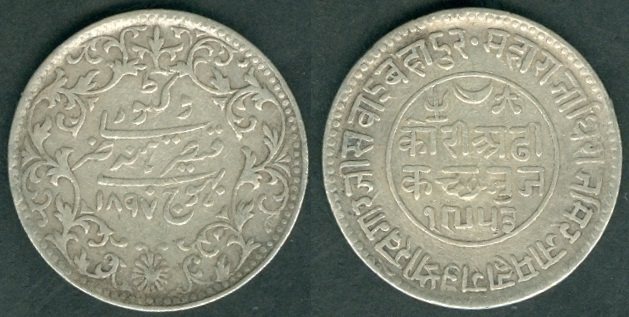 |
Same as above coin, Y#36.1 but...
Year:
VS1953 (1897). Weight:
6.84g [6.935g].
Diameter: 25.50 mm.
Edge is Reeded with Lettering and readable when VS date (Reverse
side) is on top. |
|
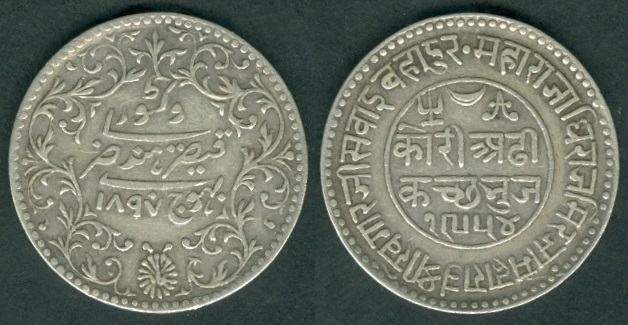 |
Same as above coin, Y#36.1 but...
Year:
VS1954 (1897). Weight:
6.89g [6.935g].
Diameter: 25.00 mm.
Edge is Plain with Lettering and readable when CE date (Obverse
side) is on top. |
|
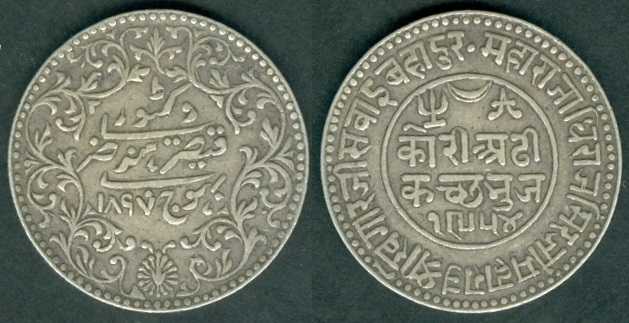 |
Same as above coin, but having minor difference.
The CE date "1897" is thin, having broken
circle of 9 and dot above 7 is more towards right. The VS date
"1954" is having thin layout of 4 at the base.
Edge is Reeded with Lettering and
readable when VS date (Reverse side) is on top. Weight:
6.88g.
Diameter: 25.50 mm. |
|
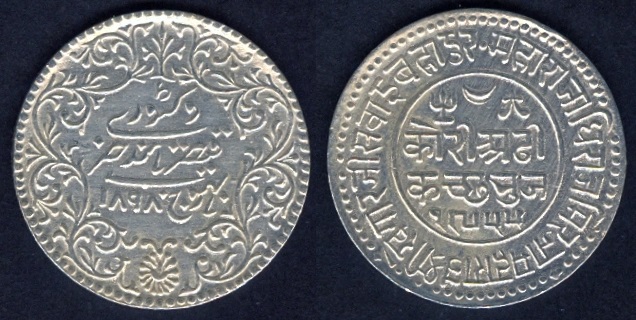 |
Same as above coin, Y#36.1 but...
Year:
VS1955 (1898). Weight:
6.84g [6.935g].
Diameter: 25.00 mm.
Edge is Reeded with Lettering and readable when VS date (Reverse
side) is on top. |
|
|
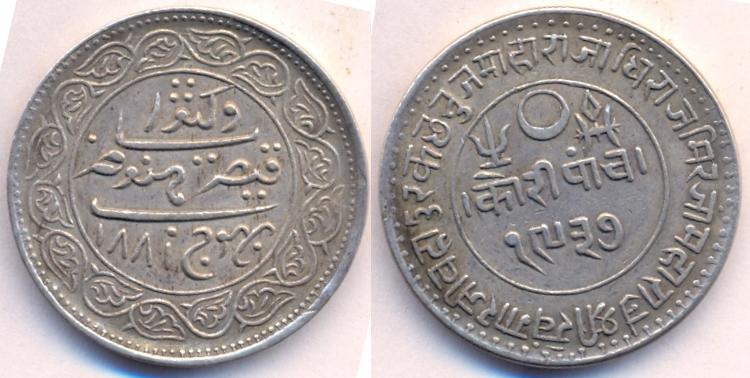 |
Y#37.2 5 Kori.
Year:
VS1937 (1881). Weight:
13.78g [13.87g]. Metal:
0.937 Silver.
Diameter: 30.50 mm. Edge:
Plain with Lettered: * भुज * Kutch *
कच्छ * Bhuj *. Readable when VS date (reverse side) is on top. Alignment:
Medal, but rotated as shown. Mint:
Bhuj.
Obverse:
"Victoria Qaiser-i-Hind" (Victoria, Empress of India), "Zarb Bhuj"
(Mint: Bhuj) with date.
Leaves of wreath pointing counter-clockwise. |
|
Reverse: Close crescent and bars to
left and right of center legend within circle.
Mintage: N/A.
Minted Years: VS1937
(1880) and VS1937 (1881). Ruler:
Khengarji III. |
|
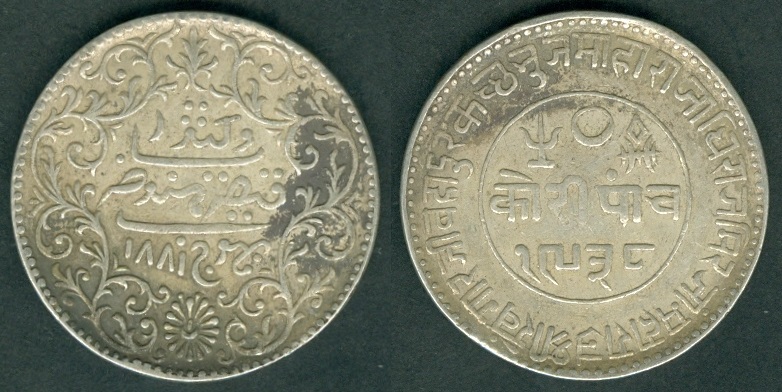 |
Y#37.4 5 Kori.
Year:
VS1938 (1881). Weight:
13.84g [13.87g]. Metal:
0.937 Silver.
Diameter: 31.50 mm. Edge:
Reeded with Lettered: * भुज * Kutch *
कच्छ * Bhuj *. Readable when CE date
(Obverse side) is on top. Alignment:
Medal. Mint:
Bhuj.
Obverse:
"Victoria Qaiser-i-Hind" (Victoria, Empress of India), "Zarb Bhuj"
(Mint: Bhuj) with date.
No inner circle and
Leaves of wreath changed from pervious design around the legend. |
|
Reverse: Close crescent and no bars to
left and right of center legend within circle.
Mintage: N/A.
Minted Years:
VS1938 (1881), VS1938 (1882), VS1939 (1882), VS1939 (1883), VS1940
(1883), VS1939 (1884 sic), VS1940 (1884), VS1941 (1884), VS1941
(1885), VS1942 (1885) and VS1943 (1886). Ruler:
Khengarji III. |
|
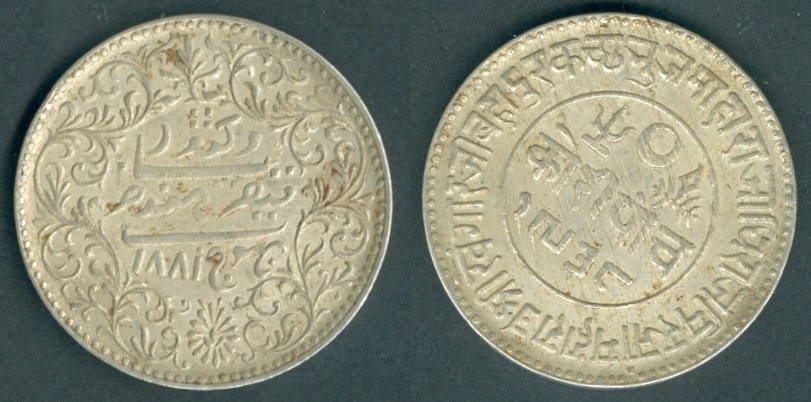 |
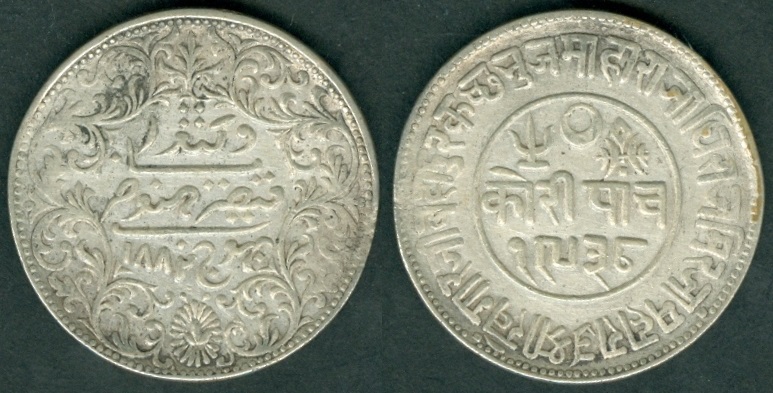
Same as above coin, Y#37.4 but having different size
of characters in the legend
on Obverse side. Even the flower at the top is slightly tilted left.
Rotated on the Reverse side as shown. Edge:
Plain with Lettered. Readable when CE
date (Obverse side) is on top. Weight:
13.91g [13.87g]. |
|
 |
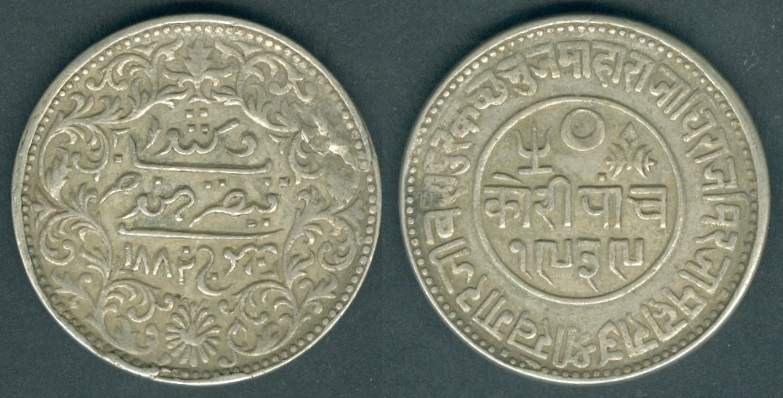
Same as above coin, Y#37.4 but...
Year:
VS1938 (1882). Weight:
13.83g [13.87g].
Edge is Reeded with Lettering and readable when VS date (Reverse
side) is on top. |
|
 |
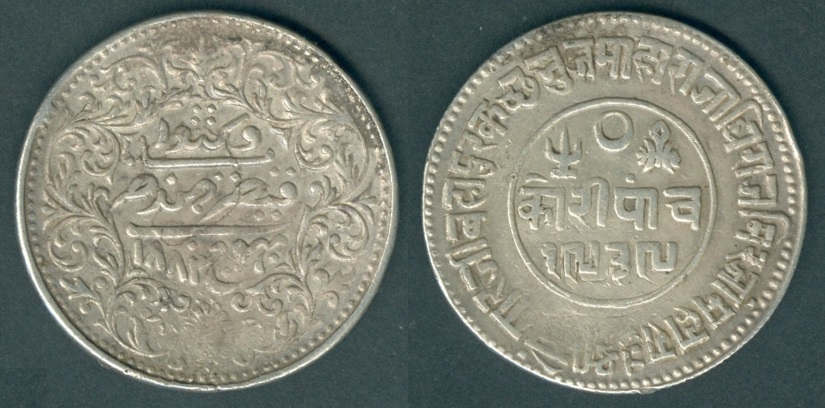
Same as above coin, Y#37.4 but...
Year:
VS1939 (1882). Weight:
13.79g [13.87g].
Diameter: 32.00 mm.
Edge is Reeded with Lettering and readable when CE date (Obverse
side) is on top. |
|
 |
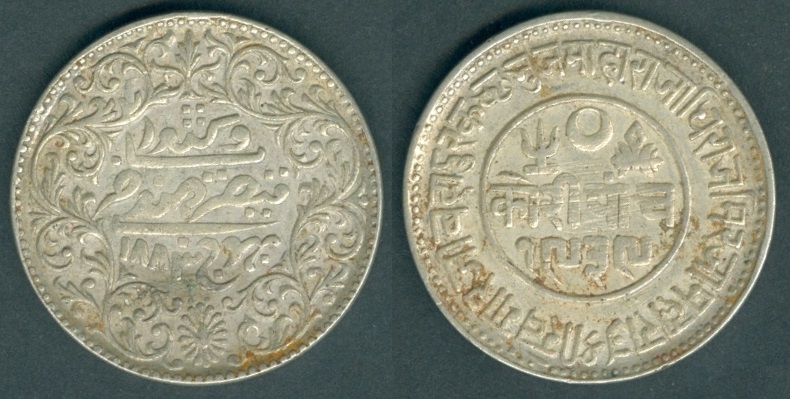
Same as above coin, Y#37.4 but...
Year:
VS1939 (1883). Weight:
13.83g [13.87g].
Diameter: 32.00 mm.
Edge is Reeded only. |
|
 |
Same as above coin, Y#37.4 but having... Weight:
13.85g [13.87g].
Edge is Reeded with Lettering and readable when CE date (Obverse
side) is on top. |
|
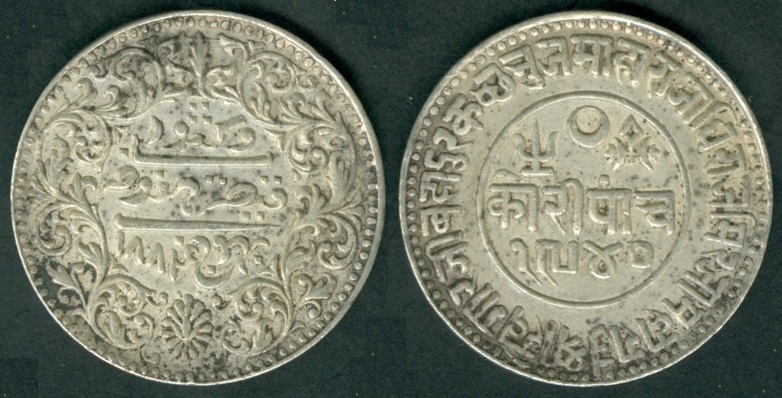 |
Same as above coin, Y#37.4 but...
Year:
VS1940 (1884). Weight:
13.86g [13.87g].
Edge is Reeded with Lettering and readable when CE date (Obverse
side) is on top. |
|
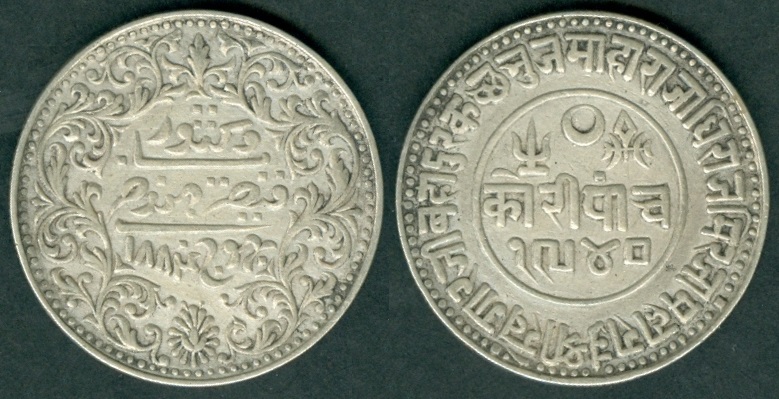 |
Same as above coin, but having minor difference.
Type2: The CE date "1884"
has small "4". Edge is Reeded with Lettering and readable when CE
date (Obverse side) is on top. This coin is 5% slightly rotated. Weight:
13.72g. |
|
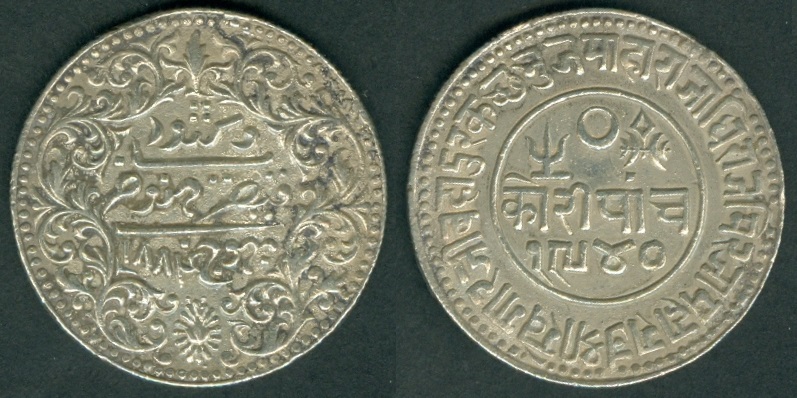 |
Same as above coin, but having minor difference.
Type3: Thin legends on both
sides including CE date "1884". The digit "0" in VS Date is somehow round instead of
square. This coin has Reeded edge only. Weight:
13.69g. |
|
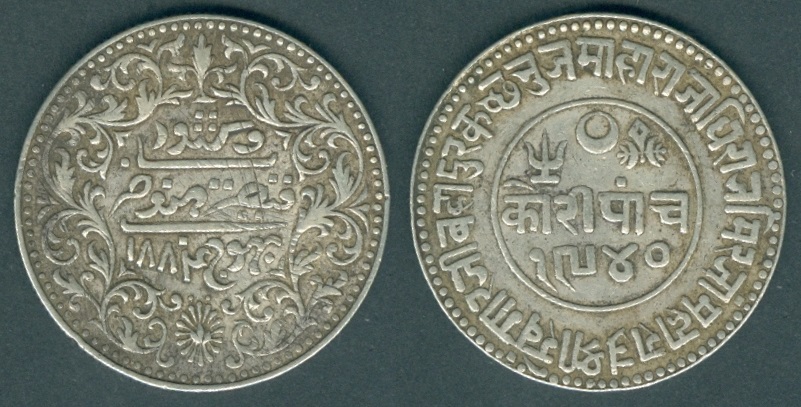 |
Same as above coin (The digit "0" in VS Date is
somehow round instead of square. This coin has Reeded edge only), but having minor difference.
Type4: Larger and Thick Legends
/ Dates on both sides. Dagger on the right right of the crescent is
very close and slightly titled. Weight:
13.87g. |
|
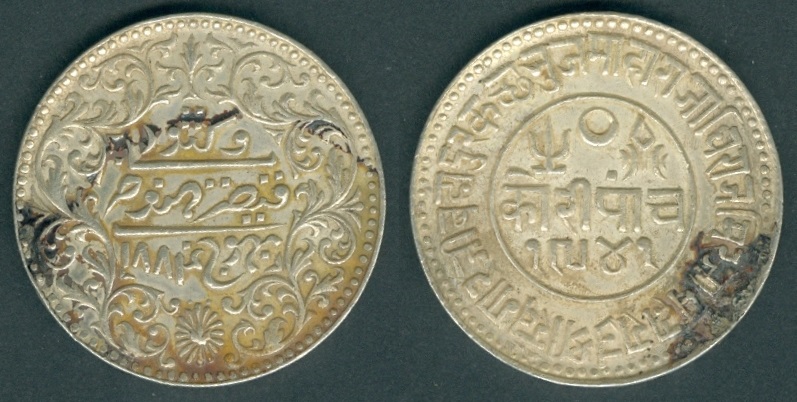 |
Same as above coin, Y#37.4 but...
Year:
VS1941 (1884). Weight:
13.91g [13.87g].
Edge is Reeded with Lettering and readable when VS date (Reverse
side) is on top. |
|
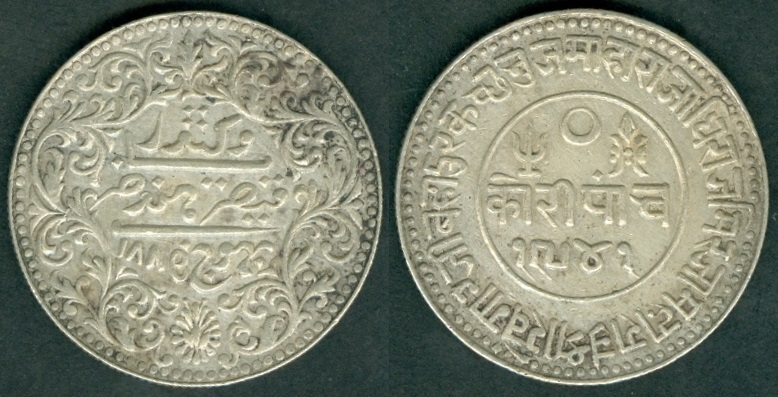 |
Same as above coin, Y#37.4 but...
Year:
VS1941 (1885). Weight:
13.85g [13.87g].
Edge is Plain with Lettering and readable when VS date (Reverse
side) is on top. |
|
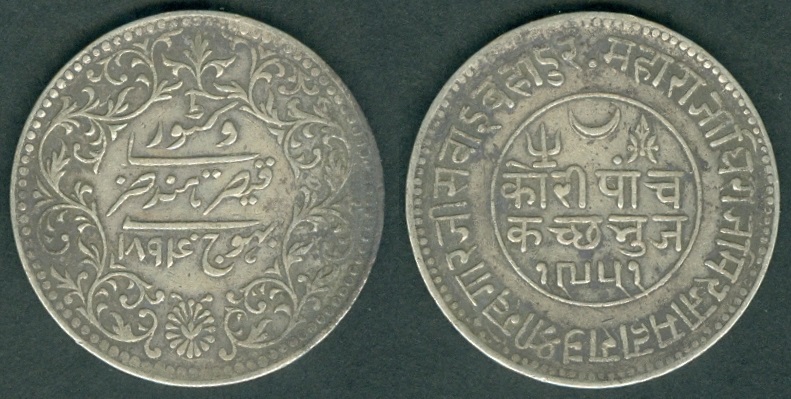 |
Y#37.5 5 Kori.
Year:
VS1951 (1894). Weight:
13.83g [13.87g]. Metal:
0.937 Silver.
Diameter: 31.50 mm. Edge:
Traces of Reeded with Lettered: * भुज * Kutch *
कच्छ * Bhuj *. Readable when VS date
(Reverse side) is on top. Alignment:
Medal. Mint:
Bhuj.
Obverse:
"Victoria Qaiser-i-Hind" (Victoria, Empress of India), "Zarb Bhuj"
(Mint: Bhuj) with date.
Changed wreath. "ط" instead of four dots in "Victoria".
Reverse:
Open crescent within circle.
Type1:
Thin VS date "1851".
|
|
Mintage: N/A.
Minted Years: VS1947
(1890), VS1950 (1893), VS1950 (1894), VS1951 (1894), VS1951 (1895),
VS1952 (1895), VS1952 (1896), VS1953 (1896), VS1954 (1896) error,
VS1951 (1897) error, VS1853 (1897), VS1854 (1897), VS1951 (1898)
error, VS1953 (1898), VS1954 (1898), VS1955 (1898) and VS1955
(1899). Ruler:
Khengarji III. |
|
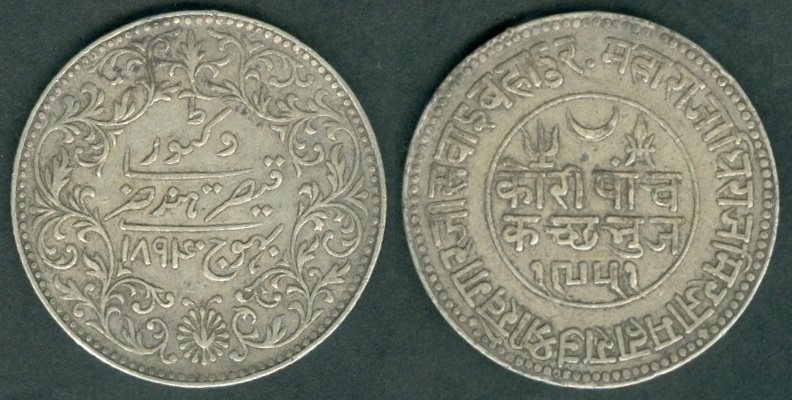 |
Same as above coin, but...
Type2:
Thick VS date "1851". Position of dots in Persian legends
differ from above coin.
Weight:
13.83g.
Proper Reeded Edge with traces of Lettering. Edge readable when
CE date (Obverse
side) is on top. |
|
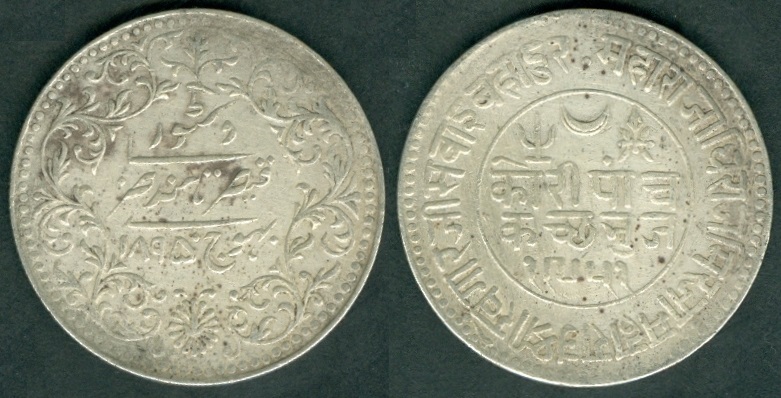 |
Same as above coin, Y#37.5 but...
Year:
VS1951 (1895). Weight:
13.90g.
Diameter: 31.50 mm.
Edge:
Reeded with Lettered: * भुज * Kutch *
कच्छ * Bhuj *. Readable when VS date (Reverse side) is on top.
|
|
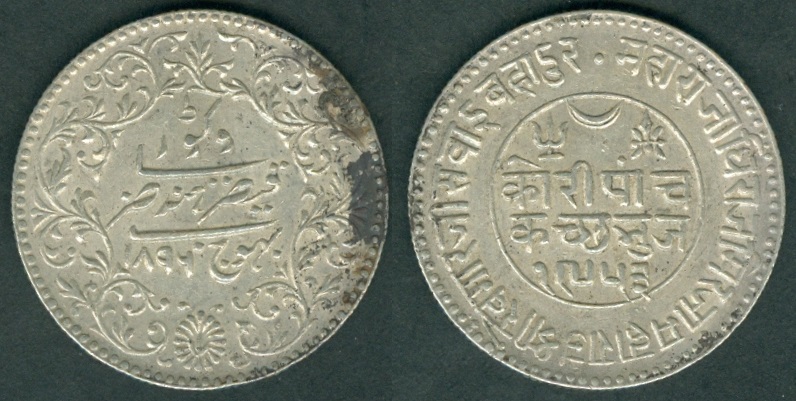 |
Same as above coin, Y#37.5 but...
Year:
VS1953 (1896). Weight:
13.83g.
Diameter: 31.50 mm.
Edge is Reeded only.
|
|
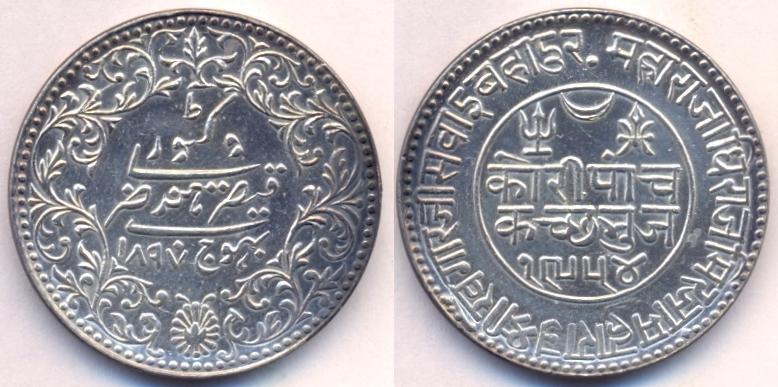 |
Same as above coin, Y#37.5 but...
Year:
VS1954 (1897). Weight:
13.86g.
Diameter: 31.00 mm.
Edge is Plain with Lettering and readable when CE date (Obverse
side) is on top.
|
|
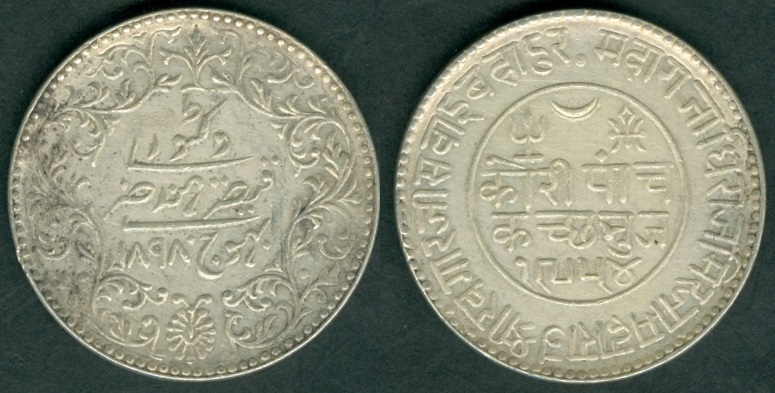 |
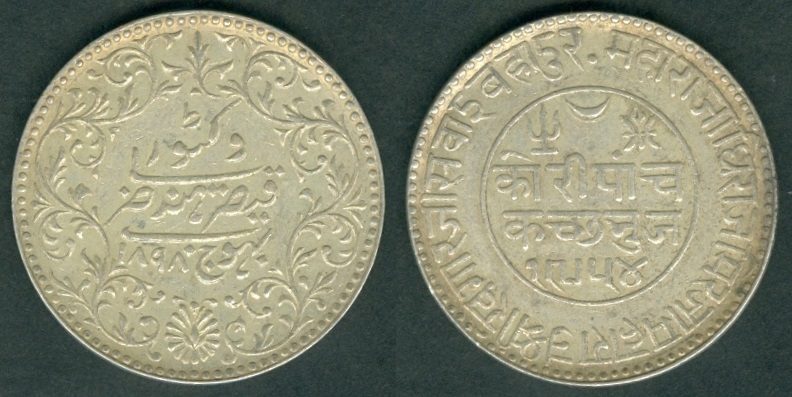
Same as above coin, Y#37.5 but...
Year:
VS1954 (1898). Weight:
13.91g.
Diameter: 31.50 mm.
Type1:
Tilted "8" in Date.
Edge is Reeded with Lettering and readable when VS date (Reverse
side) is on top.
Note:
Small crescent then the above coin.
|
|
 |
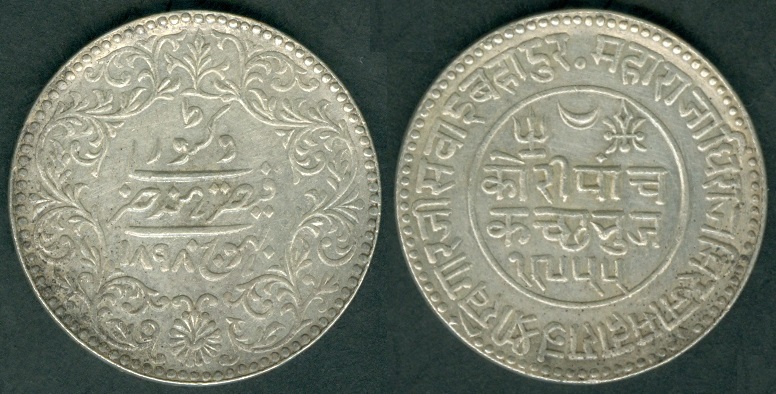
Type2: Same as above coin,
but small date "1898" with straight "8". Weight:
13.82g. Edge is Reeded with Lettering
and readable when CE date (Obverse
side) is on top. |
|
 |
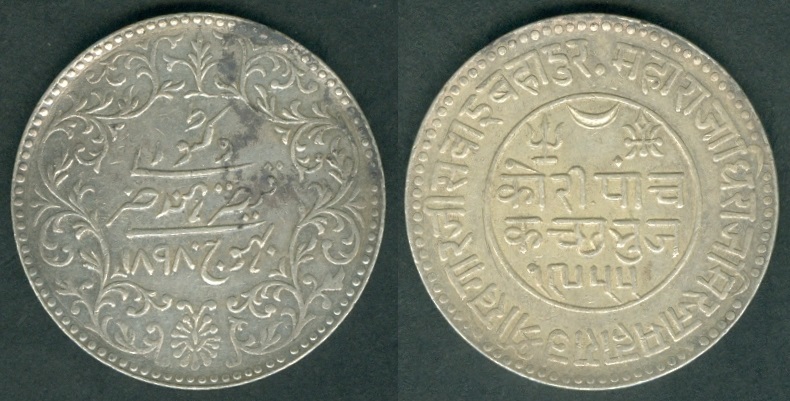
Same as above coin, Y#37.5 but...
Year:
VS1955 (1898). Weight:
13.89g.
Diameter: 31.50 mm.
Type1:
Thick Date "1898".
Edge is Plain with Lettering and readable when CE date (Obverse
side) is on top.
Small crescent then the above coin.
|
|
 |
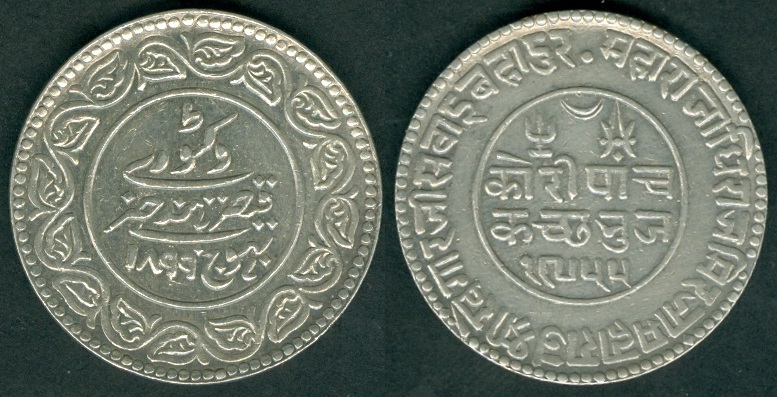
Same as above coin, but...
Type2:
Large, Thin and Tilted Date "1898".
Traces of Reeded
Edge with Lettering. Edge readable when CE date (Obverse
side) is on top. Weight:
13.85g. |
|
 |
Y#37.6 5 Kori.
Year:
VS1955 (1899). Weight:
13.84g [13.87g]. Metal:
0.937 Silver.
Diameter: 31.50 mm. Edge:
Reeded with Lettered: * भुज * Kutch *
कच्छ * Bhuj *. Readable when VS date (Reverse side) is on top. Alignment:
Medal. Mint:
Bhuj.
Obverse:
"Victoria Qaiser-i-Hind" (Victoria, Empress of India), "Zarb Bhuj"
(Mint: Bhuj) with date.
Leaves of wreath pointing clockwise. |
|
Mintage: N/A.
Minted Years: VS1955
(1899) and VS1956 (1899). Ruler:
Khengarji III. |
|
| |
| |
| Khengarji
III (1875 - 1942) coinage citing Edward VII: |
| |
|
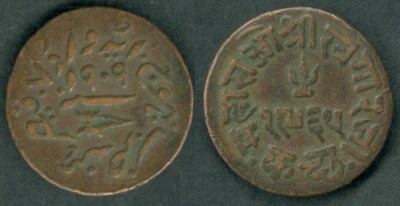 |
Y#38
Trambiyo (1/48 Kori).
Year:
VS1965 (1909). Weight:
3.22g. Metal:
Copper.
Diameter: 16.00 mm. Edge:
Plain. Alignment:
Medal Mint:
Bhuj.
Obverse:
"ایڈورڈ" with numeral (٧) [Edward VII] written at the top. "قیصر
ہند" [(Qaiser-e-Hind), Empress of India] written in Persian
at the bottom left side. "ضرب بہوج" (struck at Bhuj) written in
Persian at bottom right side. Date with word "سنہ" (Year) and
Dragger mint mark in
the center. |
|
Reverse: Date below trident (trishul)
in center and legends "महाराओ श्री खेंगारजी" (Maharao Shri Khengarji) around in
Devanagari. "कच्छ" (Kutch) written in Devanagari at the bottom with
one dot on each sides.
Mintage: N/A.
Minted Years:
1908/VS1965, 1909/VS1965, 1909/VS1966 and 1910/VS1966. Ruler:
Khengarji III. |
|
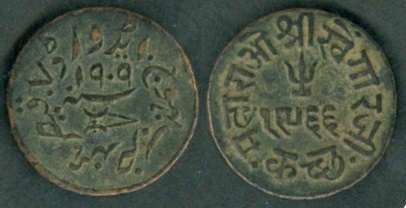 |
Same as above coin, Y#38 but...
Year:
VS1966 (1909). Weight:
3.17g.
|
|
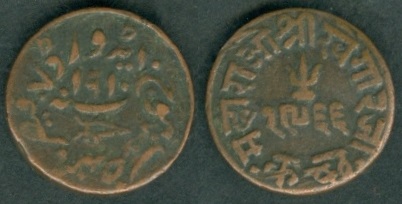 |
Same as above coin, Y#38 but...
Year:
VS1966 (1910). Weight:
3.25g.
|
|
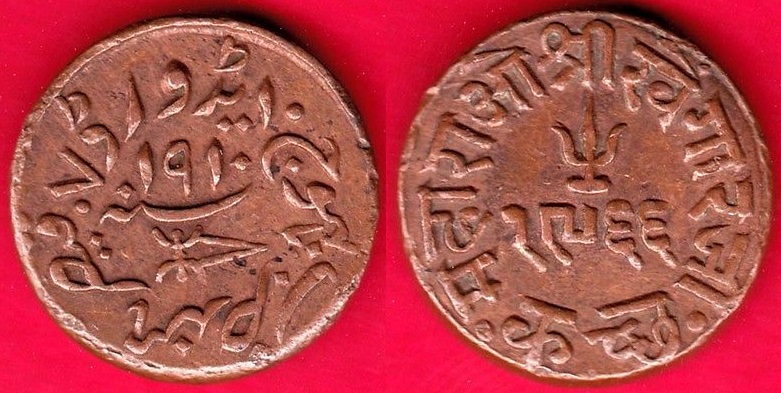 |
Same as above coin with Dates, but having thin legends on
Reverse side. Weight:
3.24g. |
|
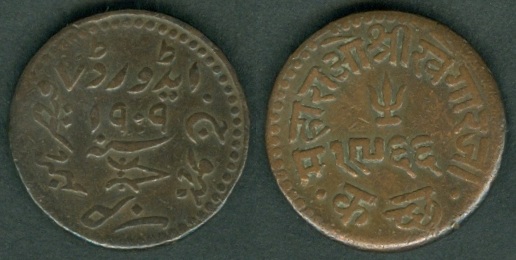 |
Y#39 Dokdo (1/24 Kori).
Year:
VS1966 (1909). Weight:
6.44g. Metal:
Copper.
Diameter: 21.00 mm. Edge:
Plain. Alignment:
Medal. Mint:
Bhuj.
Obverse:
"ایڈورڈ" with numeral (٧) [Edward VII] written at the top. "قیصر
ہند" [(Qaiser-e-Hind), Empress of India] written in Persian
at the bottom left side. "ضرب بہوج" (struck at Bhuj) written in
Persian at bottom right side. Date with word "سنہ" (Year) and
Dragger mint mark in
the center. |
|
Reverse: Date below trident (trishul)
in center and legends "महाराओ श्री खेंगारजी" (Maharao Shri Khengarji) around in
Devanagari. "कच्छ" (Kutch) written in Devanagari at the bottom with
one dot on each sides.
Mintage: N/A.
Minted Years: VS1965
(1909) and VS1966 (1909). Ruler:
Khengarji III. |
|
| |
| Khengarji
III (1875 - 1942) coinage citing George V: |
| |
|
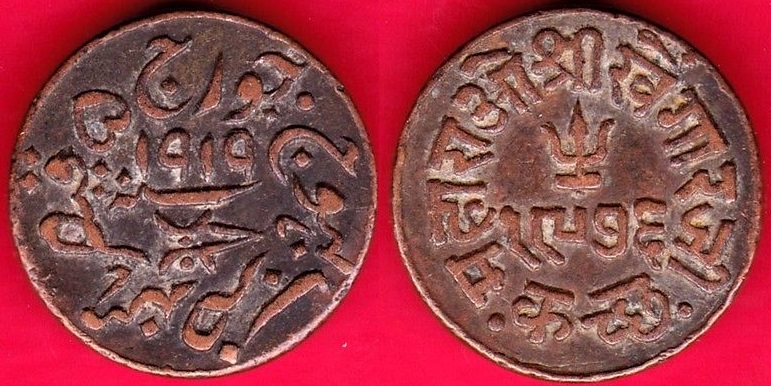 |
Y#46
Trambiyo (1/48 Kori).
Year:
VS1976 (1919). Weight:
3.33g. Metal:
Copper.
Diameter: 16.00 mm. Edge:
Plain. Alignment:
Medal. Mint:
Bhuj.
Obverse:
"George V Qaiser-i-Hind" (George V, Emperor of India), "Zarb Bhuj"
(Mint: Bhuj) with date.
Reverse: Date below trident (trishul)
in center and legends around.
Mintage: N/A.
Minted Years: VS1976
(1919), VS1976
(1920) and VS1977 (1920). Ruler:
Khengarji III. |
|
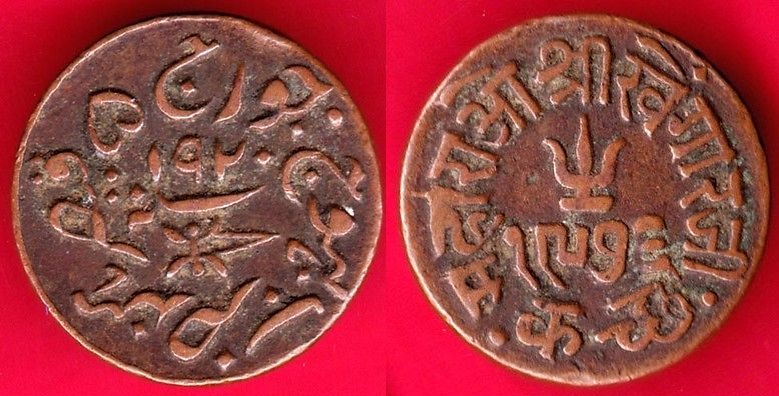 |
Same as above coin, Y#46 but...
Year:
VS1976 (1920). Weight:
3.27g.
Note: Thin Legends on both sides.
|
|
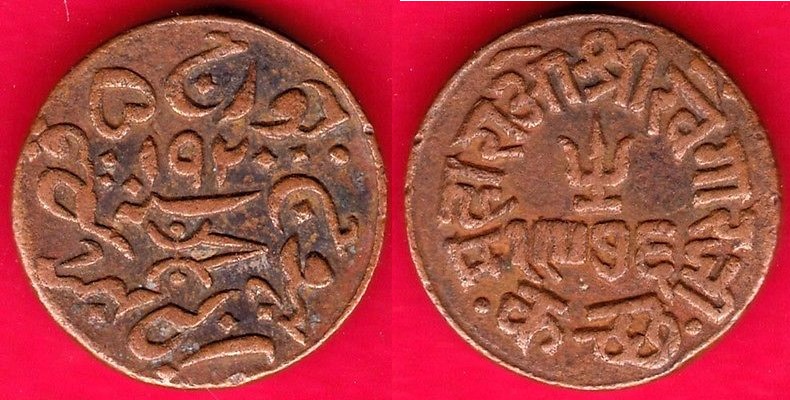 |
Same as above coin and Dates, but... Weight:
3.18g.
Note: Thick Legends on both sides,
especially the Years. |
|
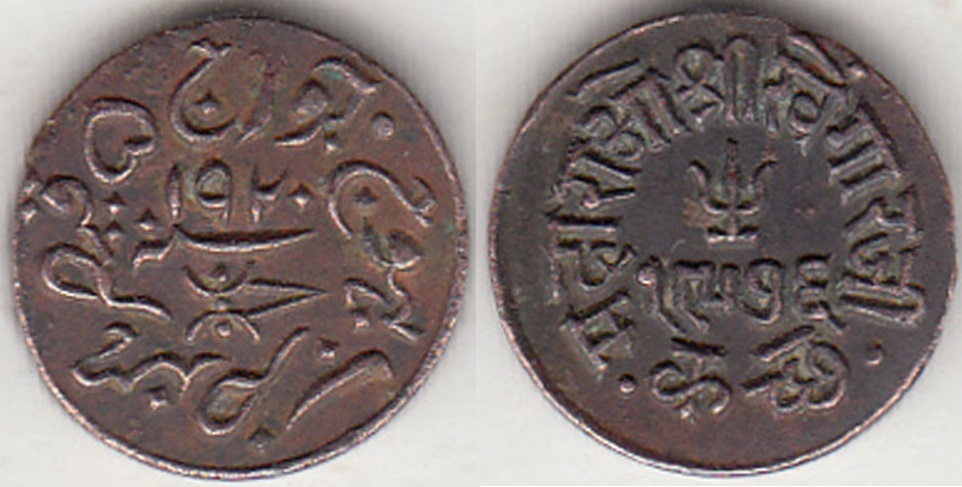 |
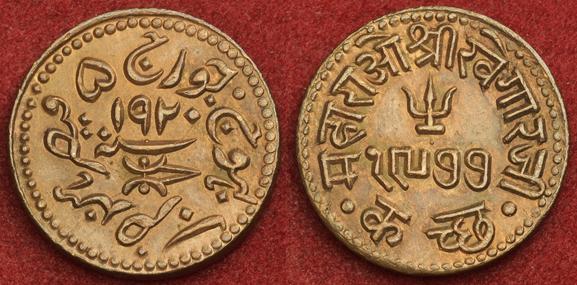
Same as above coin and Dates, but... Weight:
3.24g.
Note: Thinner legends on both sides. |
|
 |
Y#47 Dokdo (1/24 Kori).
Year:
VS1977 (1920). Weight:
6.60g. Metal:
Copper.
Diameter: 21.00 mm. Edge:
Plain. Alignment:
Medal. Mint:
Bhuj.
Obverse:
"George V Qaiser-i-Hind" (George V, Emperor of India), "Zarb Bhuj"
(Mint: Bhuj) with date.
Reverse: Date below trident (trishul)
in center and legends around.
Mintage: N/A.
Minted Years: VS1976
(1920) and VS1977 (1920). Ruler:
Khengarji III. |
|
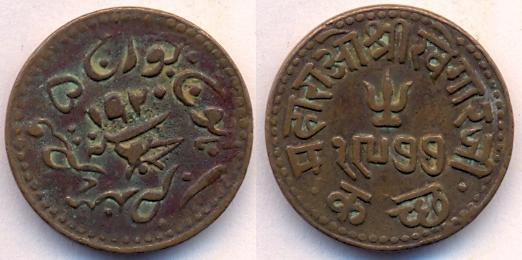 |
Same as above coin, Y#47 but... Weight:
6.44g. Diameter: 20.50 mm. Alignment:
Medal, but rotated as shown.
Note: This coin has smaller size
date "1920" on obverse side and thick legends on reverse side than
the above coin. |
|
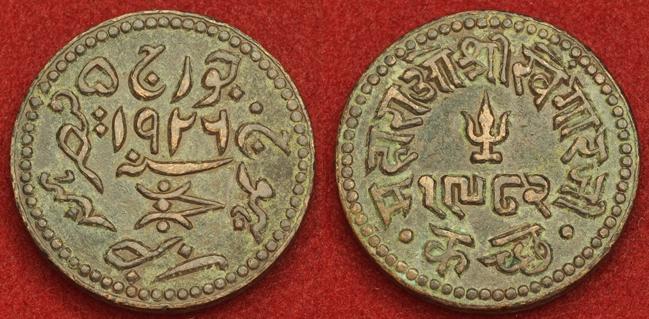 |
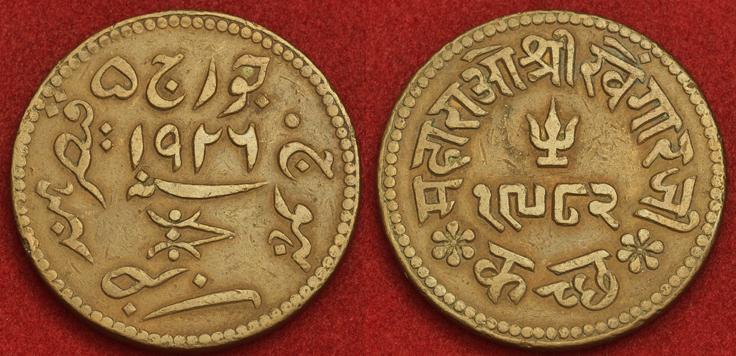
Y#48 1½ Dokdo (Dhinglo or 1/16 Kori).
Year:
VS1982 (1926). Weight:
9.96g. Metal:
Copper.
Diameter: 23.00 mm. Edge:
Plain. Alignment:
Medal. Mint:
Bhuj.
Obverse:
"George V Qaiser-i-Hind" (George V, Emperor of India), "Zarb Bhuj"
(Mint: Bhuj) with date.
Reverse: Date below trident (trishul)
in center and legends around.
Mintage: N/A.
Minted Years:
One year type. Ruler:
Khengarji III. |
|
 |
Y#49 3 Dokdo (1/8 Kori).
Year:
VS1982 (1926). Weight:
19.67g [20.00g]. Metal:
Copper.
Diameter: 33.00 mm. Edge:
Plain. Alignment:
Medal. Mint:
Bhuj.
Obverse:
"George V Qaiser-i-Hind" (George V, Emperor of India), "Zarb Bhuj"
(Mint: Bhuj) with date.
Reverse: Date below trident (trishul)
in center and legends around.
Mintage: N/A.
Minted Years:
One year type. Ruler:
Khengarji III. |
|
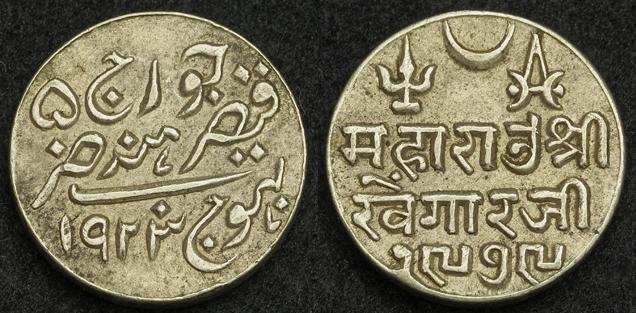 |
Y#51 Kori.
Year:
VS1979 (1923). Weight:
4.67g [4.70g]. Metal:
0.610 Silver.
Diameter: 17.00 mm. Edge:
Plain. Alignment:
Medal, but rotated as shown. Mint:
Bhuj.
Obverse:
"George V Qaiser-i-Hind" (George V, Emperor of India), "Zarb Bhuj"
(Mint: Bhuj) with date.
Reverse: Trident (trishul)
on the left above side below the crescent. Legends in the center.
Date at the bottom. |
|
Mintage: N/A.
Minted Years:
VS1970 (1913 ), VS1979 (1923), VS1980 (1923) and VS1984 (1927). Ruler:
Khengarji III. |
|
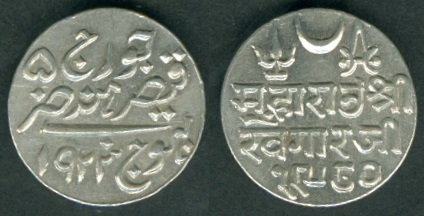 |
Same as above coin, Y#52 but... Year:
VS1980 (1923). Weight:
4.67g. |
|
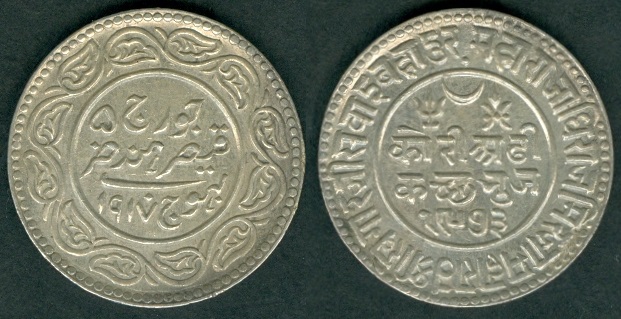 |
Y#52 2½ Kori.
Year:
VS1973 (1917). Weight:
6.88g [6.935g]. Metal:
0.937 Silver.
Diameter: 25.00 mm. Edge:
Reeded with Lettered: * भुज * Kutch *
कच्छ * Bhuj *. Readable when VS date
(Reverse side) is on top. Alignment:
Medal. Mint:
Bhuj. |
|
Obverse:
"George V Qaiser-i-Hind" (George V, Emperor of India), "Zarb Bhuj"
(Mint: Bhuj) with date.
Leaves of wreath pointing clockwise.
Reverse: Large legends than later
issues 1927-1935.
Mintage: N/A.
Minted Years:
VS1973 (1916), VS1973 (1917), VS1974 (1917), VS1974 (1918), VS1975
(1919), VS1978 (1922), VS1979 (1922), VS1981 (1924) and VS1983
(1926). Ruler:
Khengarji III. |
|
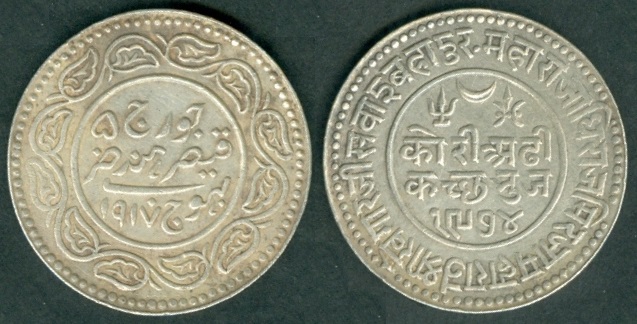 |
Same as above coin, Y#52 but... Year:
VS1974 (1917). Weight:
6.88g. Edge:
Plain with Lettered: * भुज * Kutch *
कच्छ * Bhuj *. Readable when CE date (Obverse side) is on top. Alignment:
Medal; slightly rotated. |
|
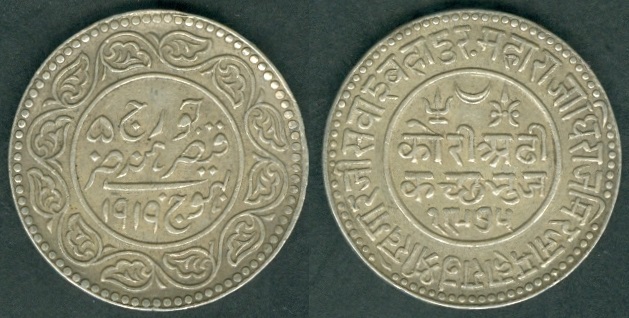 |
Same as above coin, Y#52 but...
Year:
VS1975 (1919). Weight:
6.93g. Edge:
Reeded with Lettered: * भुज * Kutch *
कच्छ * Bhuj *. Readable when CE date (Obverse side) is on top. Alignment:
Medal. |
|
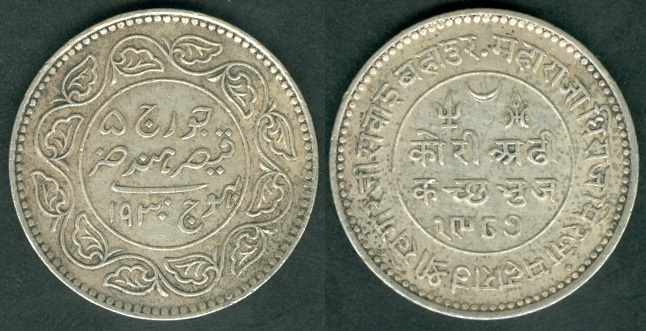 |
Y#52a 2½ Kori.
Year:
VS1987 (1930). Weight:
6.90g [6.935g]. Metal:
0.937 Silver.
Diameter: 26.00 mm. Edge:
Plain with Lettered: * भुज * Kutch *
कच्छ * Bhuj *. Readable when VS date (Reverse side) is on top. Alignment:
Medal. Mint:
Bhuj. |
|
Obverse:
"George V Qaiser-i-Hind" (George V, Emperor of India), "Zarb Bhuj"
(Mint: Bhuj) with date.
Leaves of wreath pointing clockwise.
Reverse: Small legends than earlier
issues 1916-1926.
Mintage: N/A.
Minted Years:
VS1984
(1927), VS1985 (1928), VS1986 (1930), VS1987 (1930), VS1988 (1932), VS1989
(1932), VS1989 (1933), VS1990 (1933), VS1990 (1934), VS1991
(1934), VS1991 (1935) and VS1992 (1935). Ruler:
Khengarji III. |
|
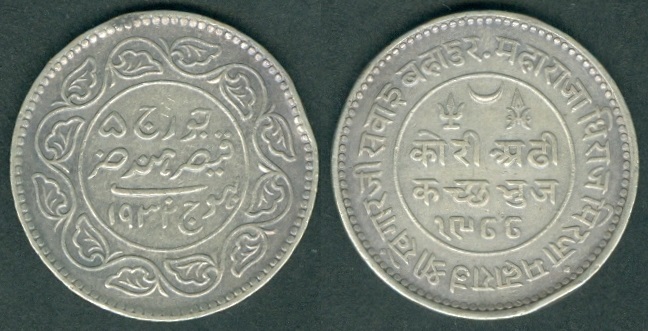 |
Same as above coin, Y#52a but...
Year:
VS1988 (1932). Weight:
6.89g.
Edge is readable when CE date (Obverse
side) is on top. |
|
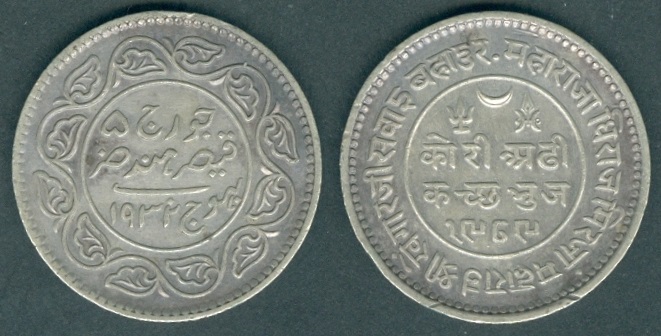 |
Same as above coin, Y#52a but...
Year:
VS1989 (1932). Weight:
6.92g.
Edge is readable when VS date (Reverse
side) is on top. |
|
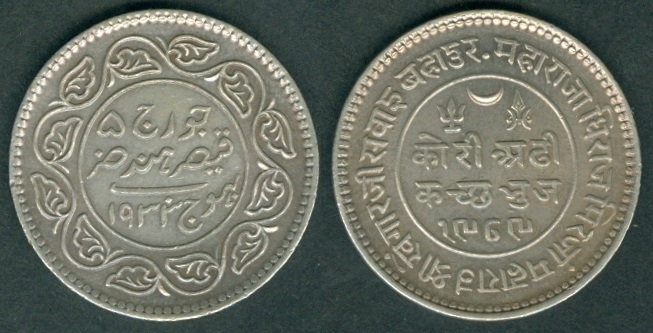 |
Same as above coin, Y#52a but...
Year:
VS1989 (1933). Weight:
6.93g.
Edge is readable when CE date (Obverse
side) is on top. |
|
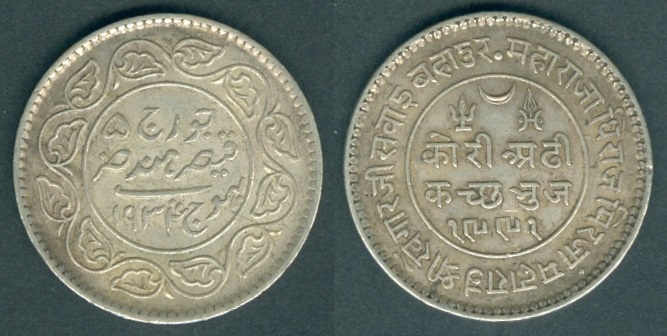 |
Same as above coin, Y#52a but...
Year:
VS1991 (1934). Weight:
6.94g.
Same as above coin, but Edge is readable when CE date (Obverse
side) is on top. |
|
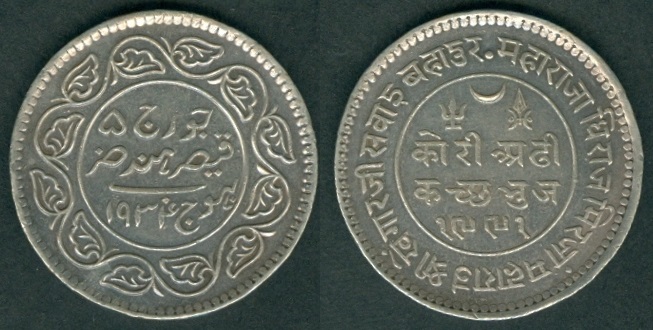 |
Same as above coin, but Edge is readable when VS date (Reverse
side) is on top. Weight:
6.94g. |
|
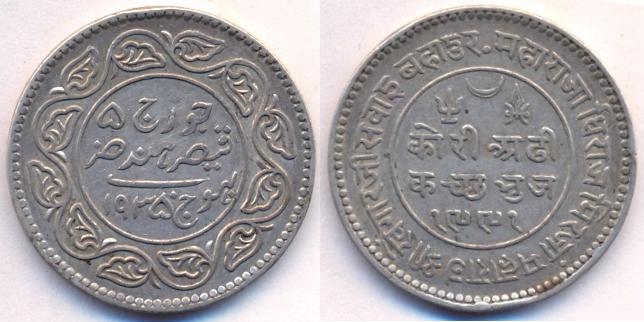 |
Same as above coin, Y#52a but...
Year:
VS1991 (1935). Weight:
6.92g.
Edge is readable when CE date (Obverse
side) is on top. |
|
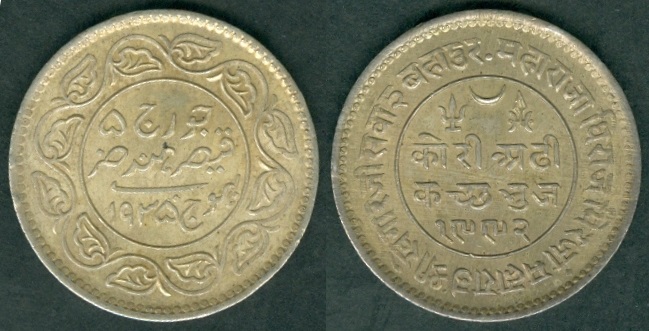 |
Same as above coin, Y#52a but...
Year:
VS1992 (1935). Weight:
6.94g.
Edge is readable when CE date (Obverse
side) is on top. |
|
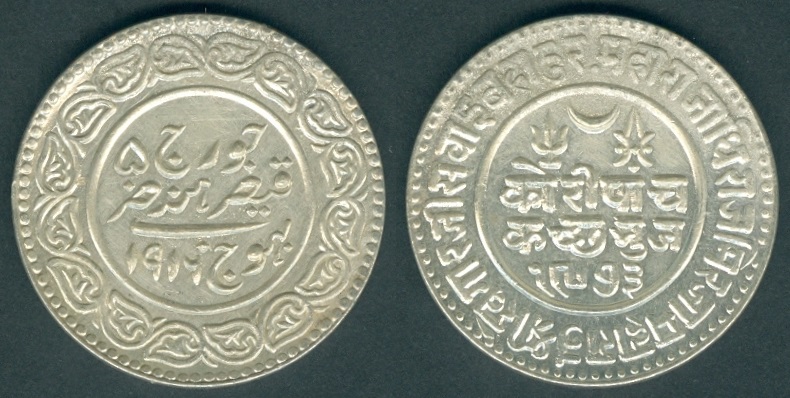 |
Y#53 5 Kori.
Year:
VS1973 (1916). Weight:
13.89g [13.87g]. Metal:
0.937 Silver.
Diameter: 31.00 mm. Edge:
Plain with Lettered: * भुज * Kutch *
कच्छ * Bhuj *. Readable when VS date (Reverse side) is on top. Alignment:
Medal. Mint:
Bhuj.
Obverse:
"George V Qaiser-i-Hind" (George V, Emperor of India), "Zarb Bhuj"
(Mint: Bhuj) with date.
Leaves of wreath pointing clockwise.
Reverse: Large legends than later
issues 1928-1936 .
Mintage: N/A. |
|
Minted Years:
1913/VS1970, 1915/VS1972, 1916/VS1973, 1916/VS1975 (Sic),
1917/VS1973, 1917/VS1974, 1918/VS1974, 1918/VS1975, 1919/VS1975,
1919/VS1976, 1920/VS1977, 1921/VS1977, 1921/VS1978, 1922/VS1974
(Sic), 1922/VS1978, 1922/VS1979, 1922/VS1982 (Sic), 1923/VS1979,
1924/VS1978 (Sic), 1924/VS1980, 1924/VS1981, 1925/VS1982,
1926/VS1978 (Sic), 1926/VS1982, 1926/VS1893, 1927/VS1984 and
1927/VS1984 Proof. Ruler:
Khengarji III. |
|
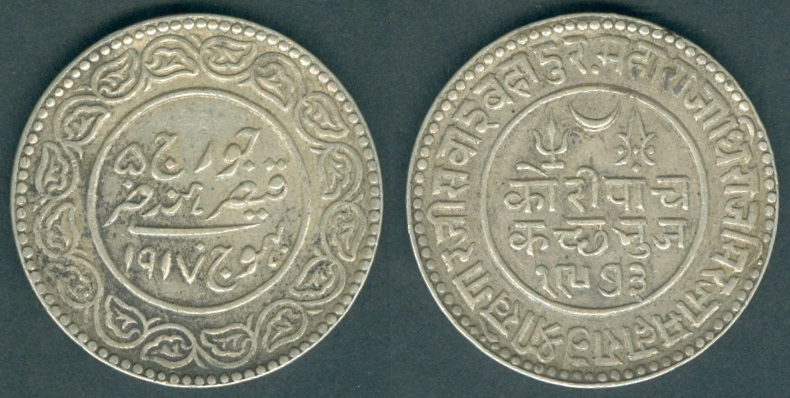 |
Same as above coin, Y#53 but... Year:
VS1973 (1917). Weight:
13.87g. Diameter: 31.25 mm. Edge:
Reeded with Lettered: * भुज * Kutch *
कच्छ * Bhuj *. Readable when VS date (Reverse side) is on top. |
|
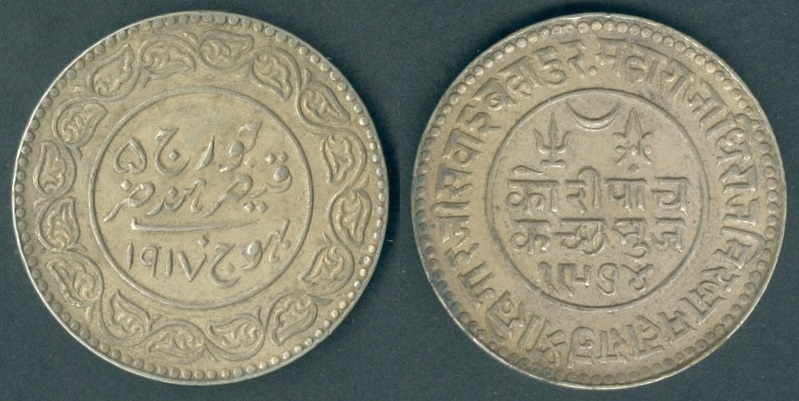 |
Same as above coin, Y#53 but... Year:
VS1974 (1917). Weight:
13.91g. Diameter: 31.25 mm. Edge:
Reeded with Lettered: * भुज * Kutch *
कच्छ * Bhuj *. Readable when VS date (Reverse side) is on top. |
|
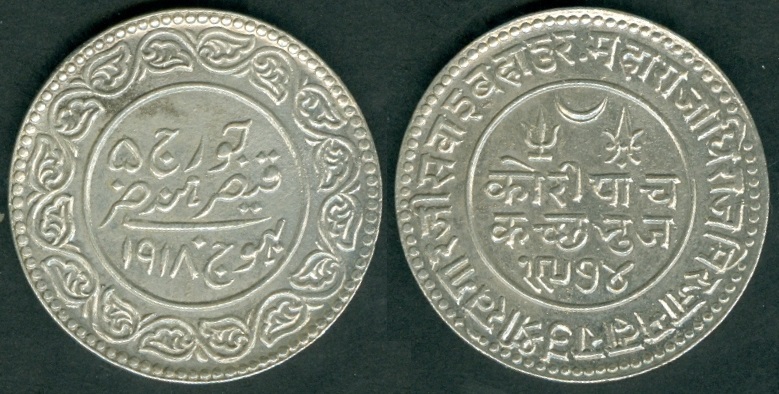 |
Same as above coin, Y#53 but... Year:
VS1974 (1918). Weight:
13.81g. Diameter: 31.00 mm. Edge:
Reeded with Lettered: * भुज * Kutch *
कच्छ * Bhuj *. Readable when VS date (Reverse side) is on top. |
|
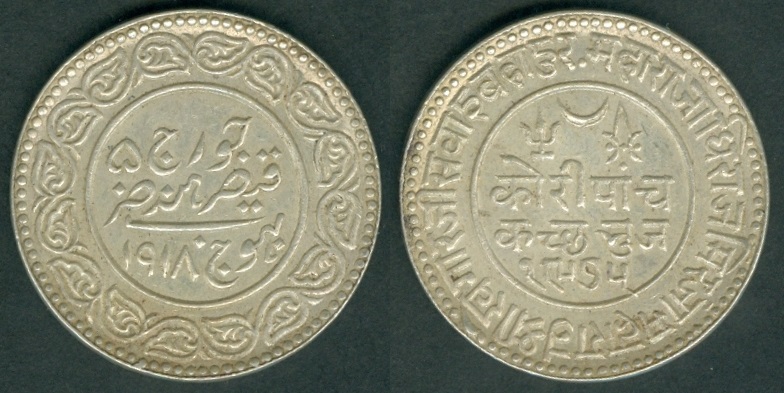 |
Same as above coin, Y#53 but...
Year:
VS1975 (1918). Weight:
13.90g.
Diameter: 31.00 mm. Edge:
Reeded with Lettered: * भुज * Kutch *
कच्छ * Bhuj *. Readable when CE date (Obverse side) is on top. |
|
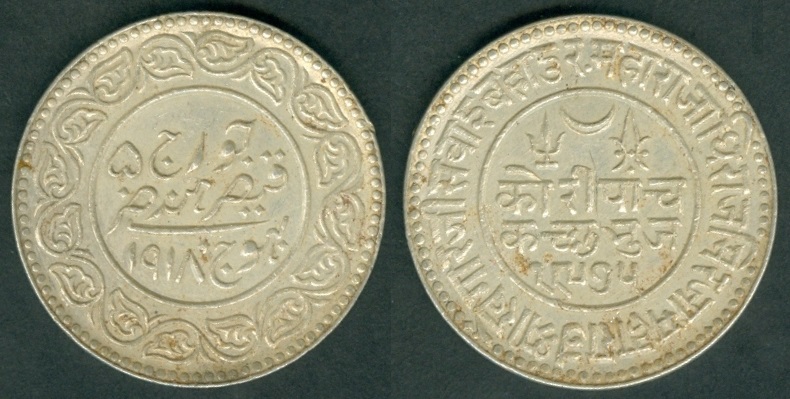 |
Same as above coin, Y#53 but...
Year:
VS1975 (1918). Weight:
13.88g.
Diameter: 31.50 mm. Edge:
Reeded with Lettered: * भुज * Kutch *
कच्छ * Bhuj *. Readable when VS date (Reverse side) is on top. |
|
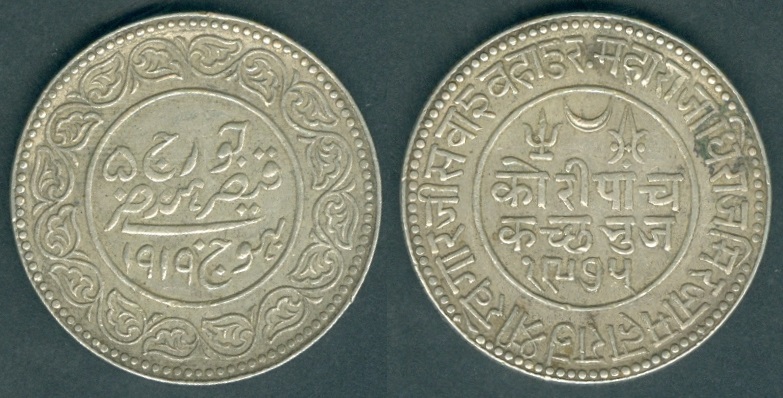 |
Same as above coin, Y#53 but...
Year:
VS1975 (1919). Weight:
13.92g.
Diameter: 31.00 mm. Edge:
Reeded with Lettered: * भुज * Kutch *
कच्छ * Bhuj *. Readable when CE date (Obverse side) is on top. |
|
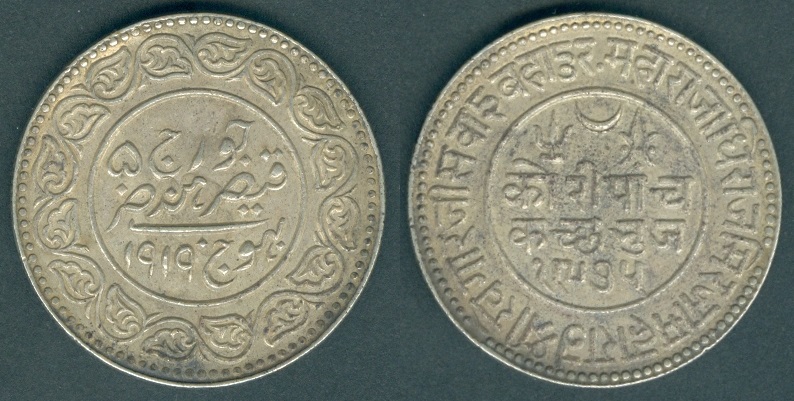 |
Same as above coin, Y#53 but...
Year:
VS1975 (1919). Weight:
13.90g.
Diameter: 31.00 mm. Edge:
traces of Reeded with Lettered: * भुज * Kutch *
कच्छ * Bhuj *. Readable when VS date (Reverse side) is on top. |
|
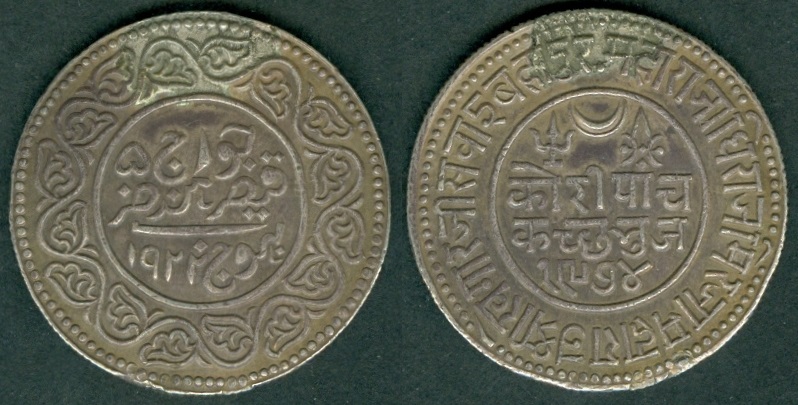 |
FAKE coin of Y#53 5 Kori.
Year:
VS1974 (1922) sic. Weight:
13.95g [13.87g]. Metal:
Copper-Nickel.
Diameter: 32.00 mm. Edge:
Reeded. Alignment:
Medal.
Note: 5 Kori coins were
issued with reeded edges 1913-1927AD, which is when the security
edge was introduced. Due to counterfeiting, the government recalled
pieces and added lettering as a mark of authentication. |
|
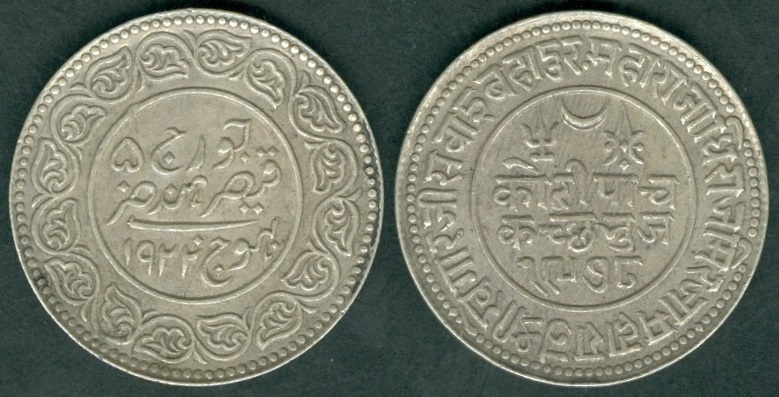 |
Same as above coin, Y#53 but...
Year:
VS1978 (1922). Weight:
13.86g.
Diameter: 31.00 mm. Edge:
Reeded with Lettered: * भुज * Kutch *
कच्छ * Bhuj *. Readable when VS date (Reverse side) is on top. |
|
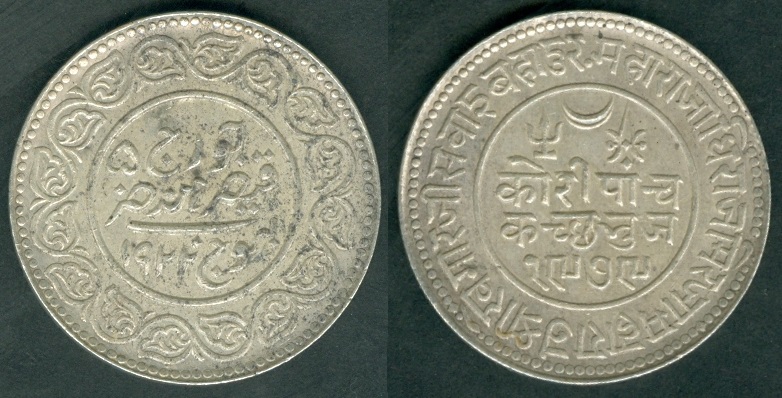 |
Same as above coin, Y#53 but...
Year:
VS1979 (1922). Weight:
13.90g.
Diameter: 31.00 mm. Edge:
Plain with Lettered: * भुज * Kutch *
कच्छ * Bhuj *. Readable when VS date (Reverse side) is on top. |
|
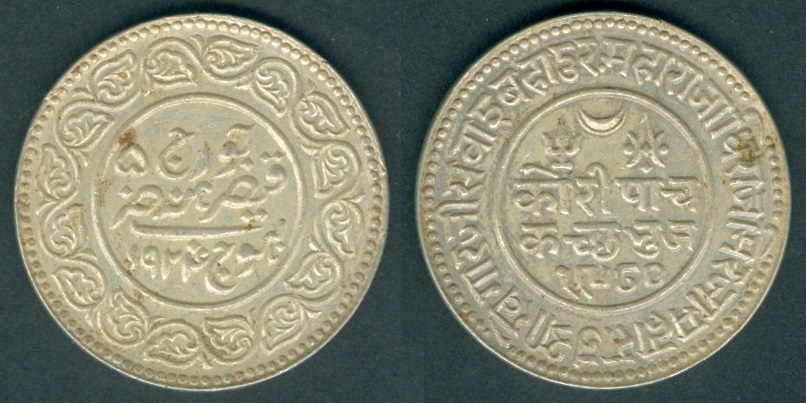 |
Same as above coin, Y#53 but...
Year:
VS1980 (1924). Weight:
13.89g.
Diameter: 31.00 mm. Edge:
Plain with Lettered: * भुज * Kutch *
कच्छ * Bhuj *. Readable when VS date (Reverse side) is on top. |
|
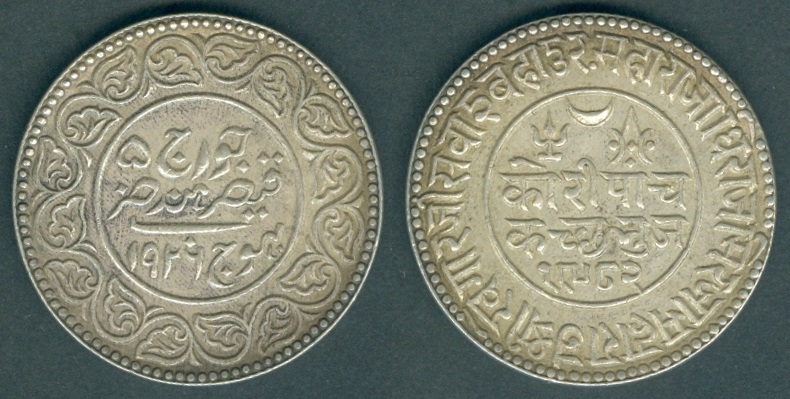 |
Same as above coin, Y#53 but...
Year:
VS1982 (1926). Weight:
13.88g.
Diameter: 31.50 mm. Edge:
Plain with Lettered: * भुज * Kutch *
कच्छ * Bhuj *. Readable when CE date (Obverse side) is on top. |
|
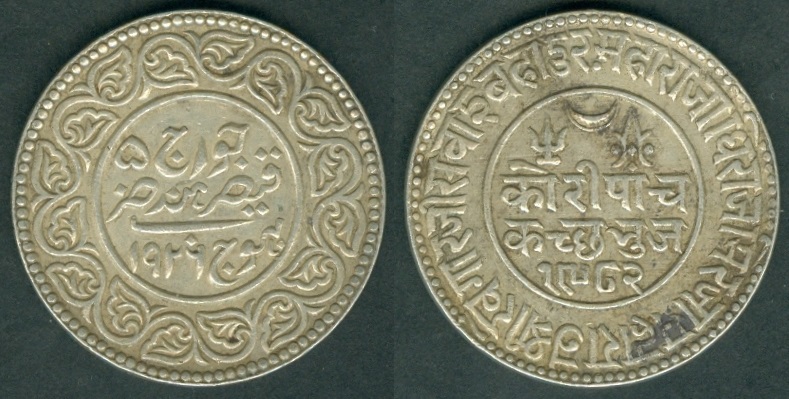 |
Same as above coin, but Edge Readable when VS date (Reverse
side) is on top.
Weight:
13.88g. |
|
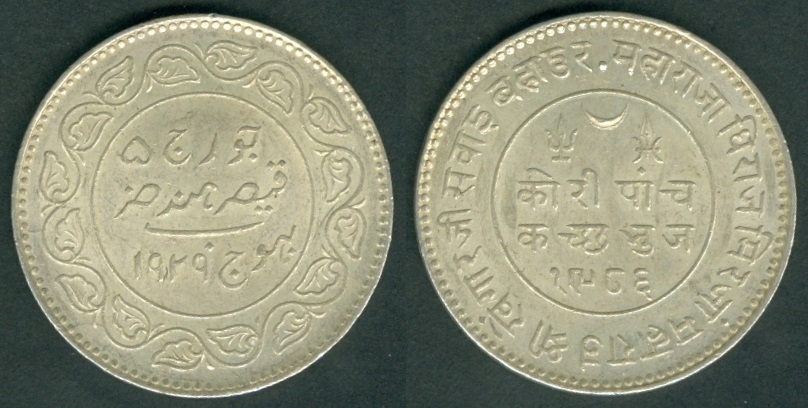 |
Y#53a 5 Kori.
Year:
VS1986 (1929). Weight:
13.91g [13.87g]. Metal:
0.937 Silver.
Diameter: 32.00 mm. Edge:
Plain with Lettered: * भुज * Kutch *
कच्छ * Bhuj *. Readable when VS date (Reverse side) is on top. Alignment:
Medal. Mint:
Bhuj.
Obverse:
"George V Qaiser-i-Hind" (George V, Emperor of India), "Zarb Bhuj"
(Mint: Bhuj) with date.
Leaves of wreath pointing clockwise.
Reverse: Small legends than earlier
issues 1913-1927 .
Mintage: N/A. |
|
Minted Years:
VS1985
(1928), VS1986 (1929), VS1986 (1930), VS1987 (1930), VS1987 (1931), VS1988
(1931), VS1988 (1932), VS1989 (1932), VS1989 (1933), VS1990
(1933), VS1990 (1934), VS1991 (1934), VS1991 (1935), VS1992 (1935)
and VS1992 (1936). Ruler:
Khengarji III. |
|
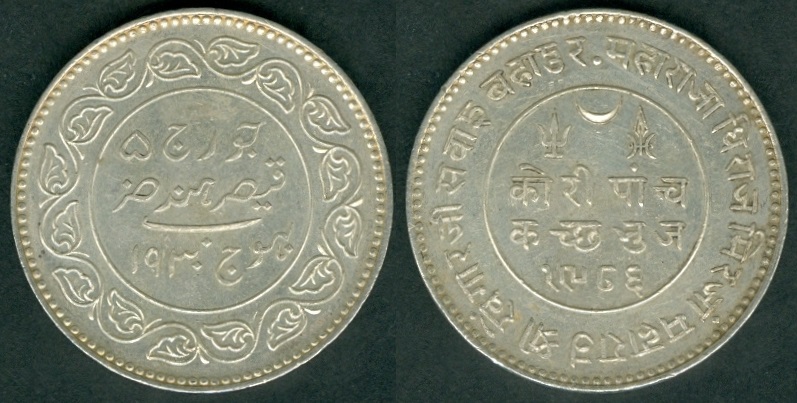 |
Same as above coin, Y#53a but...
Year:
VS1986 (1930). Weight:
13.91g. Edge is readable when VS date (Reverse
side) is on top. |
|
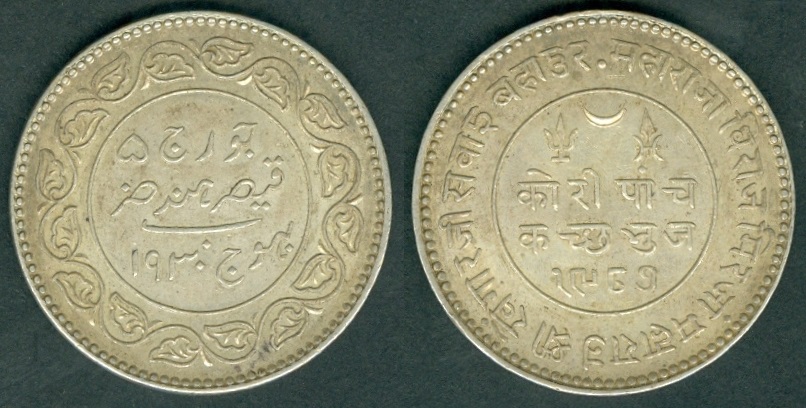 |
Same as above coin, Y#53a but...
Year:
VS1987 (1930). Weight:
13.84g. Edge is readable when CE date (Obverse
side) is on top. |
|
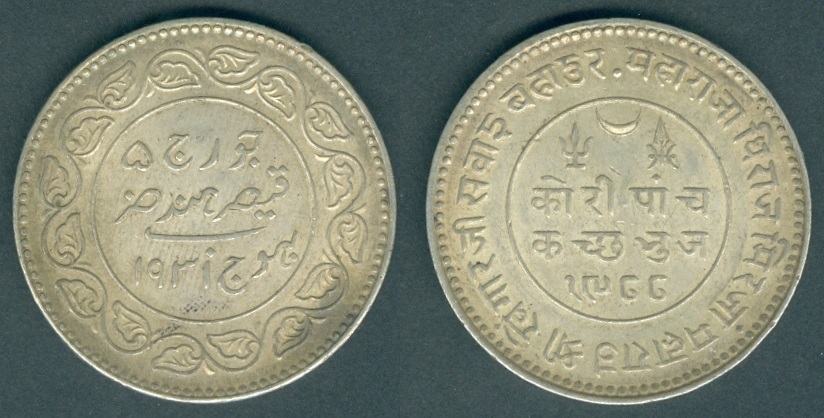 |
Same as above coin, Y#53a but...
Year:
VS1988 (1931). Weight:
13.94g. Edge is readable when CE date (Obverse
side) is on top. |
|
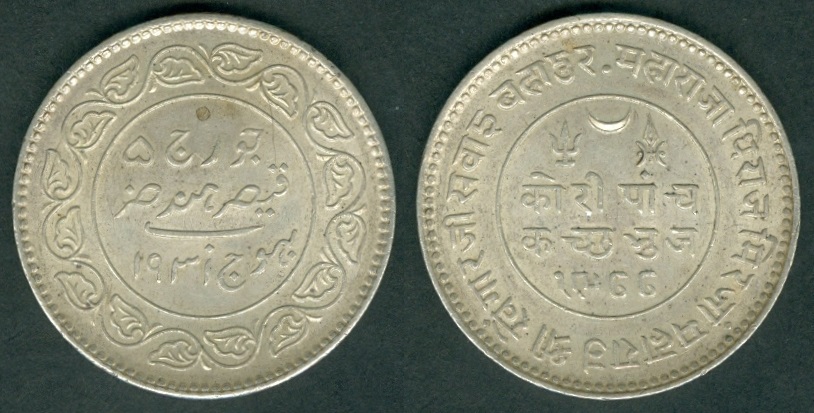 |
Same as above coin, Y#53a but...
Year:
VS1988 (1931). Weight:
13.86g. Edge is readable when VS date (Reverse
side) is on top. |
|
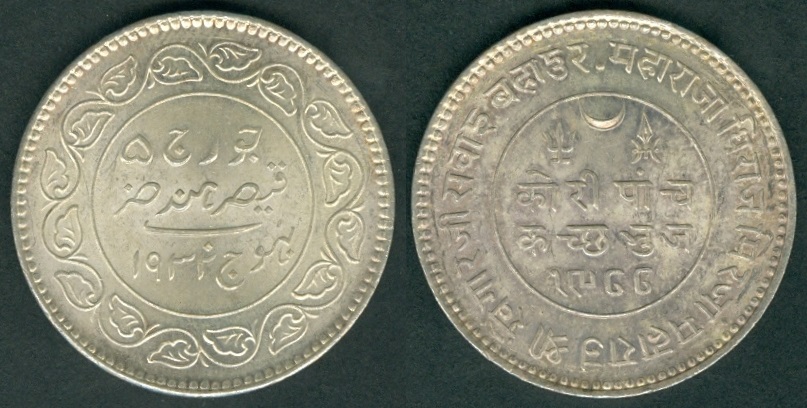 |
Same as above coin, Y#53a but...
Year:
VS1988 (1932). Weight:
13.88g. Edge is readable when CE date (Obverse
side) is on top. |
|
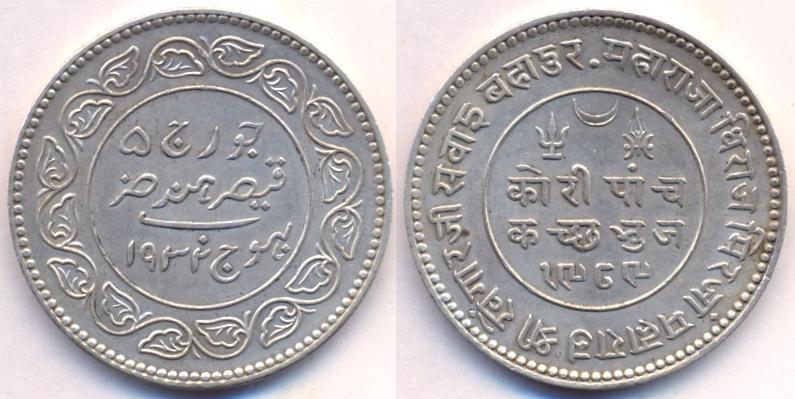 |
Same as above coin, Y#53a but...
Year:
VS1989 (1932). Weight:
13.85g. Edge is readable when CE date (Obverse
side) is on top. |
|
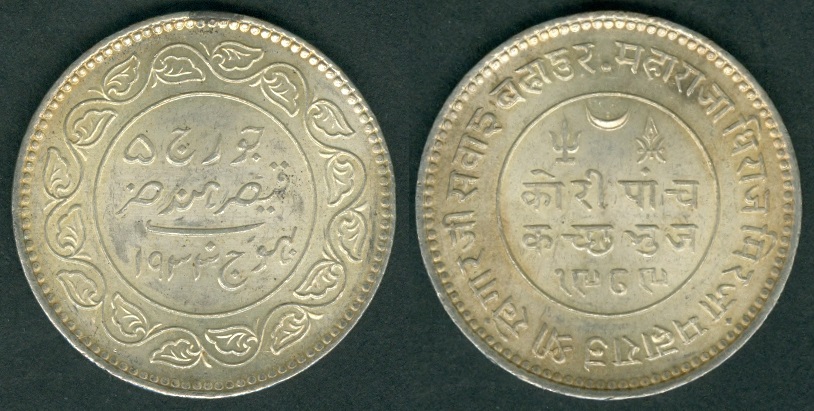 |
Same as above coin, Y#53a but...
Year:
VS1989 (1933). Weight:
13.91g. Edge is readable when CE date (Obverse
side) is on top. |
|
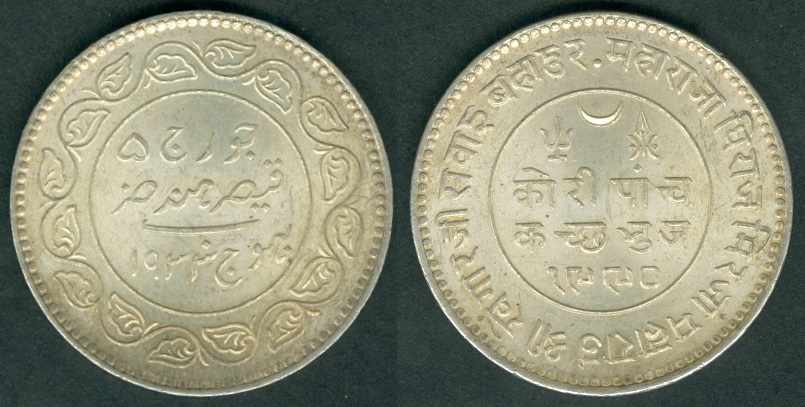 |
Same as above coin, Y#53a but...
Year:
VS1990 (1933). Weight:
13.90g. Edge is readable when CE date (Obverse
side) is on top. |
|
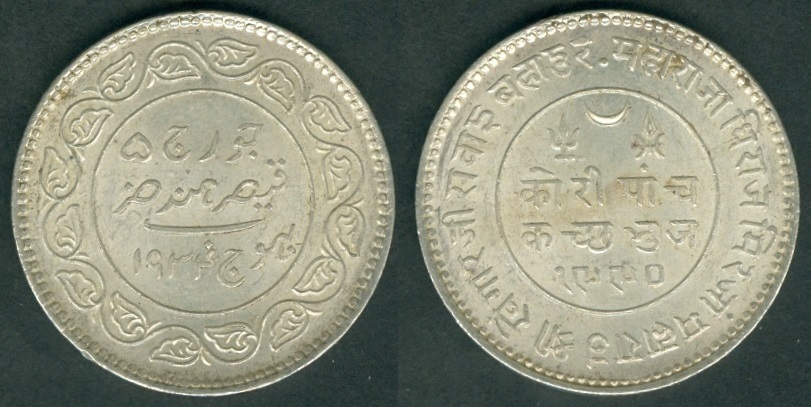 |
Same as above coin, Y#53a but...
Year:
VS1990 (1934). Weight:
13.88g.
Edge is readable when VS date (Reverse
side) is on top. |
|
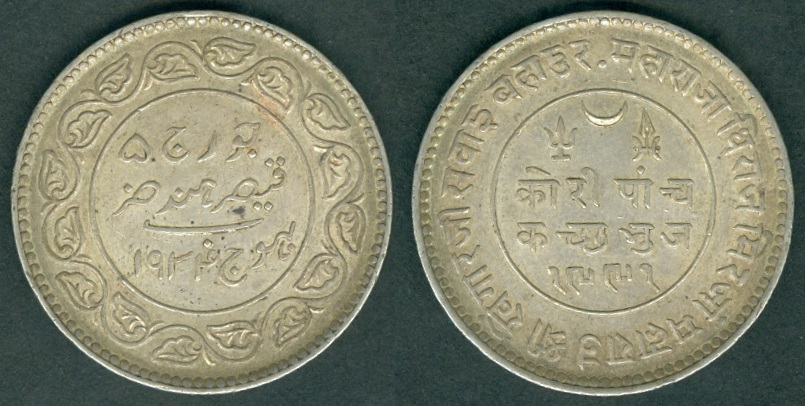 |
Same as above coin, Y#53a but...
Year:
VS1991 (1934). Weight:
13.88g.
Edge is readable when CE date (Obverse
side) is on top. |
|
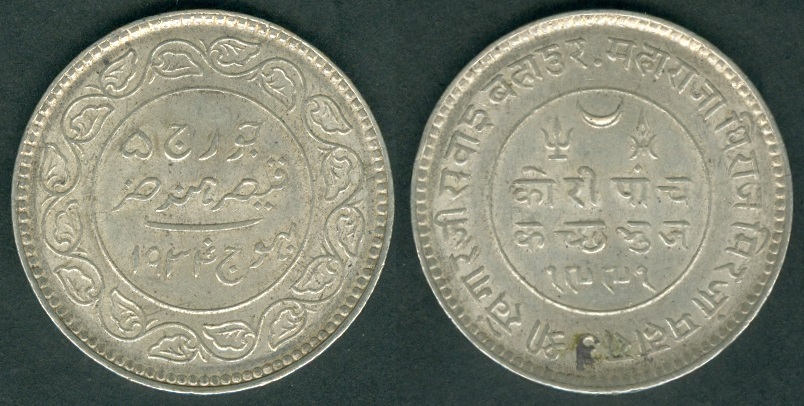 |
Same as above coin, but
Edge is readable when VS date (Reverse
side) is on top.
Weight:
13.88g.
Diameter: 32.25 mm. |
|
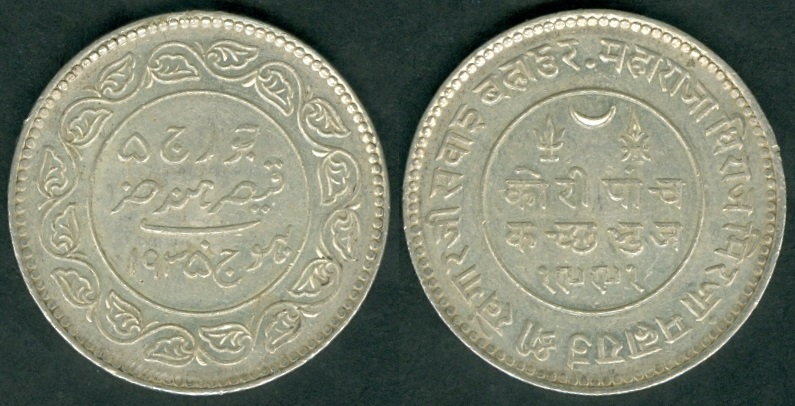 |
Same as above coin, Y#53a but...
Year:
VS1991 (1935). Weight:
13.90g.
Edge is readable when VS date (Reverse side) is on top. |
|
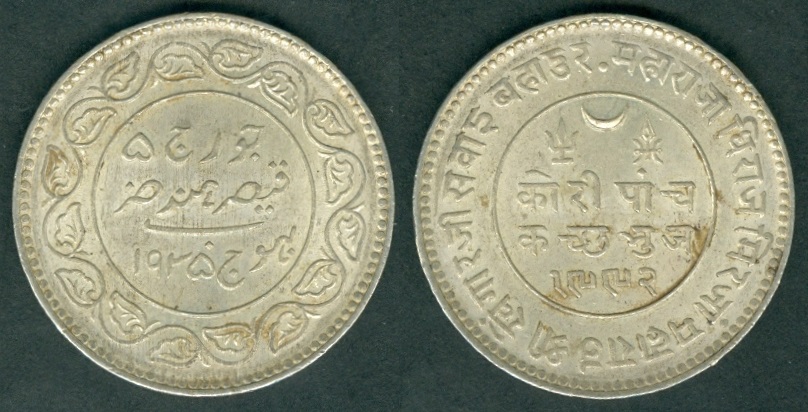 |
Same as above coin, Y#53a but...
Year:
VS1992 (1935). Weight:
13.92g.
Edge is readable when CE date (Obverse
side) is on top. |
|
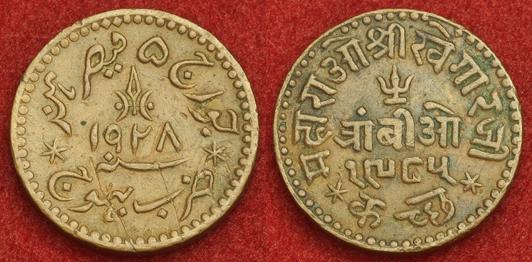 |
Y#54 Trambiyo (1/2 Dokdo or 1/48 Kori).
Year:
VS1985 (1928). Weight:
2.73g. Metal:
Copper.
Diameter: 16.00 mm. Edge:
Plain. Alignment:
Medal. Mint:
Bhuj.
Obverse:
"George V Qaiser-i-Hind" (George V, Emperor of India), "Zarb Bhuj"
(Mint: Bhuj) with date.
Reverse: Date below trident (trishul)
and legend in the center with more legends around.
Mintage: N/A.
Minted Years:
VS1984(1928) and
VS1985
(1928). Ruler:
Khengarji III. |
|
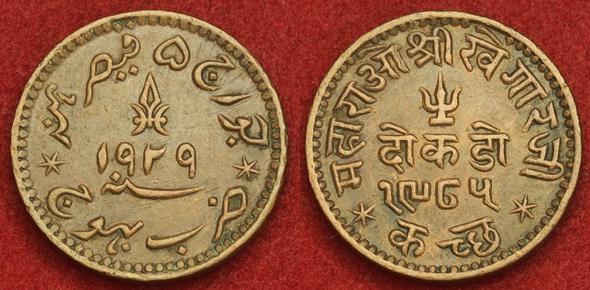 |
Y#55 Dokdo (1/24 Kori).
Year:
VS1985 (1929). Weight:
5.63g. Metal:
Copper.
Diameter: 21.00 mm. Edge:
Plain. Alignment:
Medal. Mint:
Bhuj.
Obverse:
"George V Qaiser-i-Hind" (George V, Emperor of India), "Zarb Bhuj"
(Mint: Bhuj) with date.
Reverse: Date below trident (trishul)
and legend in the center with more legends around.
Mintage: N/A.
Minted Years:
VS1982 (1922 sic), VS1984 (1928) and VS1985 (1929). Ruler:
Khengarji III. |
|
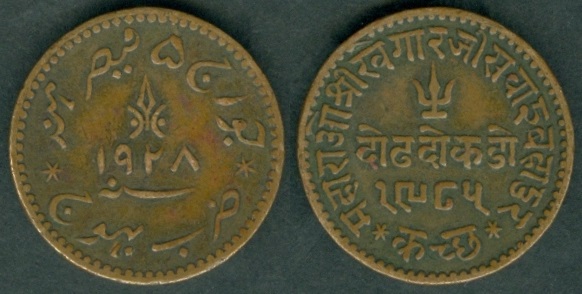 |
Y#56 1½ Dokdo (Dhinglo or 1/16 Kori).
Year:
VS1985 (1928). Weight:
8.15g. Metal:
Copper.
Diameter: 23.00 mm. Edge:
Plain. Alignment:
Medal. Mint:
Bhuj.
Obverse:
"George V Qaiser-i-Hind" (George V, Emperor of India), "Zarb Bhuj"
(Mint: Bhuj) with date. |
|
Reverse: Date below trident (trishul)
and legend in the center with more legends around.
Mintage: N/A.
Minted Years:
VS1985
(1928), VS1985 (1929), VS1986 (1929), VS1987 (1931), VS1988 (1931), VS1988
(1932) and VS1889 (1932). Ruler:
Khengarji III. |
|
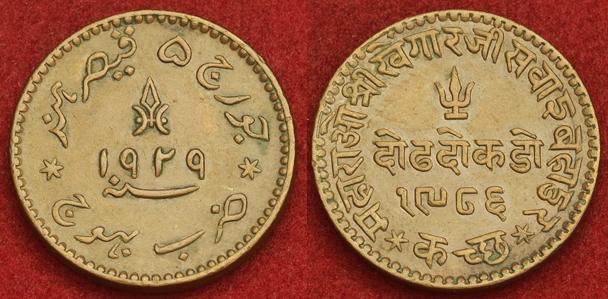 |
Same as above coin, Y#56 but...
Year:
VS1986 (1929). Weight:
8.30g. |
|
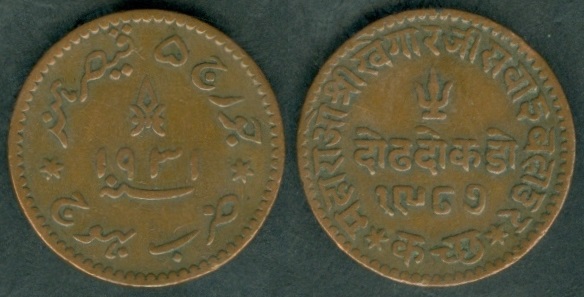 |
Same as above coin, Y#56 but...
Year:
VS1987 (1931). Weight:
8.06g. |
|
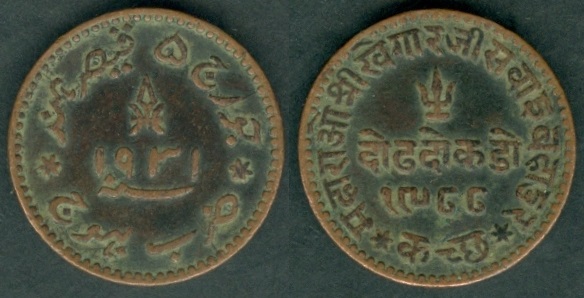 |
Same as above coin, Y#56 but...
Year:
VS1988 (1931). Weight:
8.25g. |
|
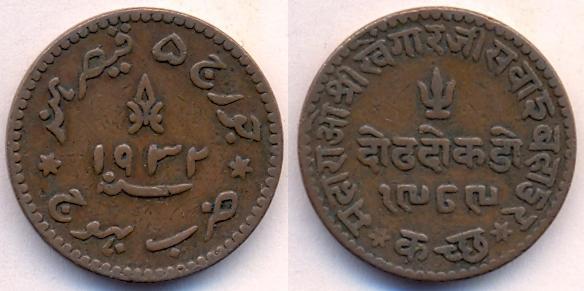 |
Same as above coin, Y#56 but having thick legends on both sides and
...
Year:
VS1989 (1932). Weight:
8.24g. |
|
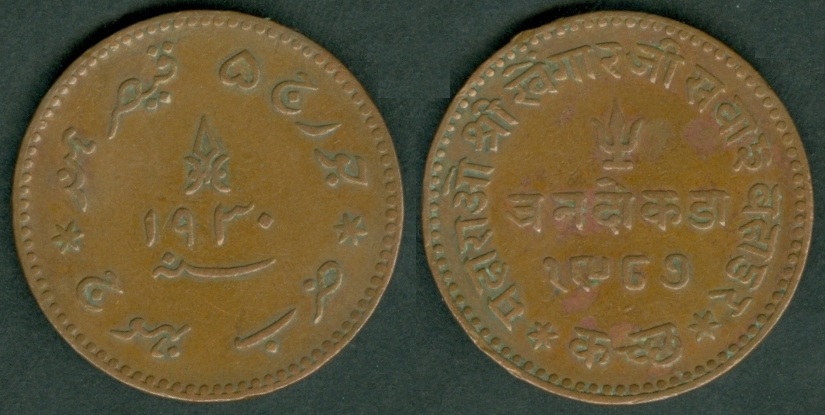 |
Y#57 3 Dokdo (1/8 Kori).
Year:
VS1987 (1930). Weight:
16.23g. Metal:
Copper.
Diameter: 33.00 mm. Edge:
Plain. Alignment:
Medal. Mint:
Bhuj.
Obverse:
"George V Qaiser-i-Hind" (George V, Emperor of India), "Zarb Bhuj"
(Mint: Bhuj) with date.
Reverse: Date below trident (trishul)
and legend in the center with more legends around.
Mintage: N/A.
Minted Years:
VS1985 (1928), VS1985 (1929), VS1986 (1929), VS1987 (1930), VS1987
(1931), VS1990 (1934), VS1991 (1934) and VS1992 (1935). Ruler:
Khengarji III. |
|
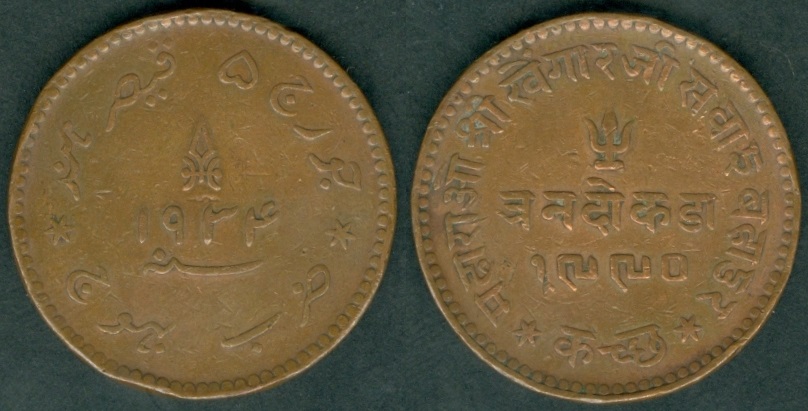 |
Same as above coin, Y#57 but...
Year:
VS1990 (1934). Weight:
16.49g. |
|
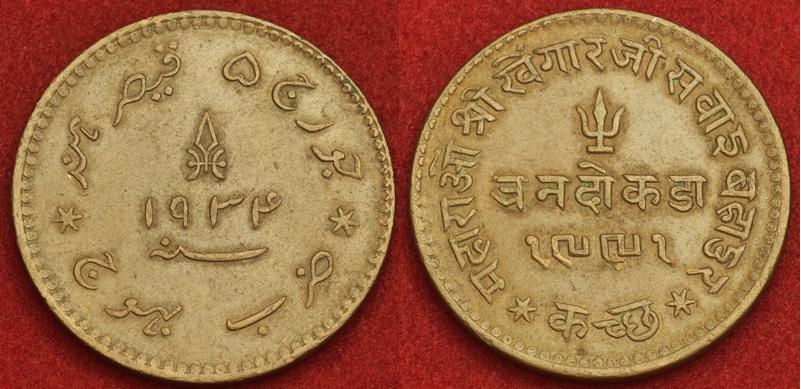 |
Same as above coin, Y#57 but...
Year:
VS1991 (1934). Weight:
16.65g. |
|
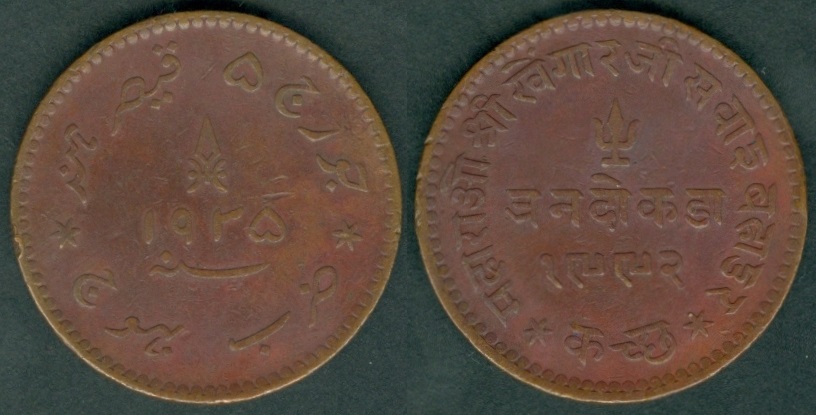 |
Same as above coin, Y#57 but...
Year:
VS1992 (1935). Weight:
16.46g. |
|
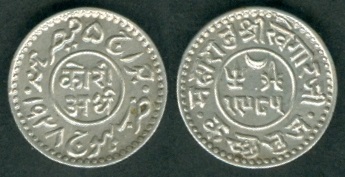 |
Y#58 Half Kori.
Year:
VS1985 (1928). Weight:
2.38g [2.35g]. Metal:
0.610 Silver.
Diameter: 14.00 mm. Edge:
Plain. Alignment:
Medal. Mint:
Bhuj.
Obverse:
"George V Qaiser-i-Hind" (George V, Emperor of India), "Zarb Bhuj"
(Mint: Bhuj) with date. |
|
Reverse: Trident (trishul)
on the left above side below the crescent.
Date at the bottom within the center circle. Legends around the center
circle.
Mintage: N/A.
Minted Years:
One year type. Ruler:
Khengarji III. |
|
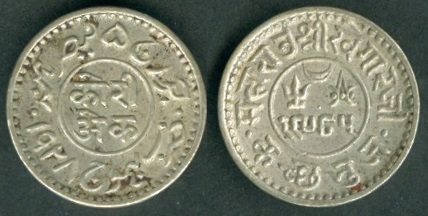 |
Y#59 Kori.
Year:
VS1985 (1928). Weight:
4.67g [4.70g]. Metal:
0.610 Silver.
Diameter: 17.00 mm. Edge:
Plain. Alignment:
Medal. Mint:
Bhuj.
Obverse:
"George V Qaiser-i-Hind" (George V, Emperor of India), "Zarb Bhuj"
(Mint: Bhuj) with date.
|
|
Reverse: Trident (trishul)
on the left above side below the crescent.
Date at the bottom within the center circle. Legends around the center
circle.
Mintage: N/A.
Minted Years:
VS1985 (1928), VS1985 (1929), VS1987 (1931), VS1988 (1931), VS1988
(1932), VS1989 (1932), VS1989 (1933), VS1990 (1933), VS1990 (1934),
VS1991 (1934), VS1991 (1935), VS1992 (1935) and VS1992 (1936). Ruler:
Khengarji III. |
|
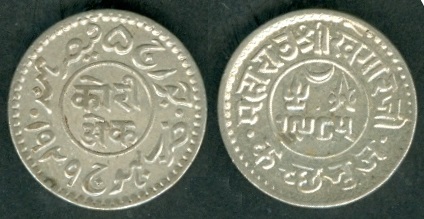 |
Same as above coin, Y#59 but...
Year:
VS1985 (1929). Weight:
4.65g. |
|
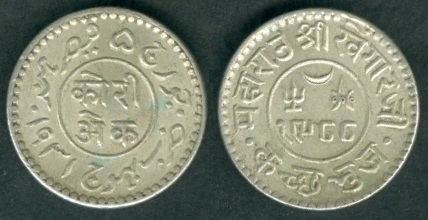 |
Same as above coin, Y#59 but...
Year:
VS1988 (1931). Weight:
4.70g. |
|
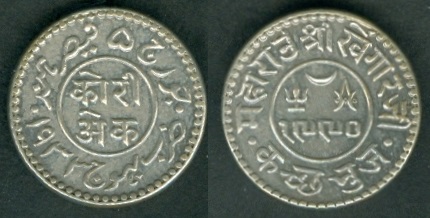 |
Same as above coin, Y#59 but...
Year:
VS1990 (1933). Weight:
4.64g. |
|
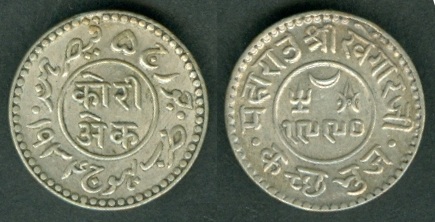 |
Same as above coin, Y#59 but...
Year:
VS1990 (1934). Weight:
4.70g. |
|
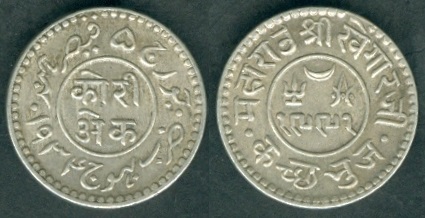 |
Same as above coin, Y#59 but...
Year:
VS1991 (1934). Weight:
4.68g. |
|
| |
| Khengarji
III (1875 - 1942) coinage citing Edward VIII: |
| |
|
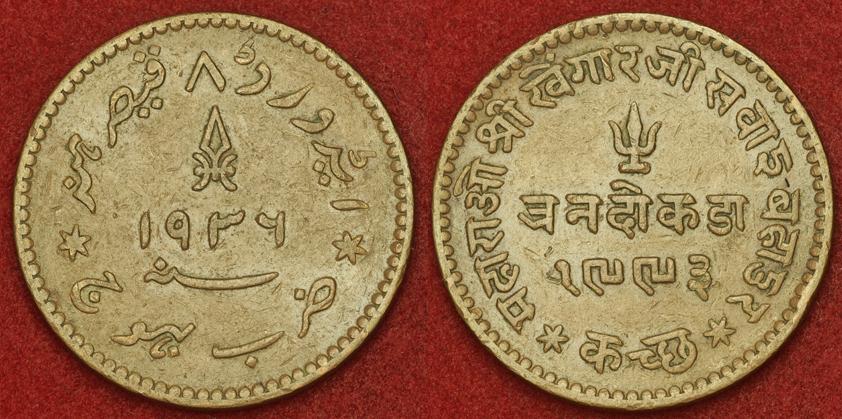 |
Y#63 3 Dokdo (1/8 Kori).
Year:
VS1993 (1936). Weight:
16.59g. Metal:
Copper.
Diameter: 33.00 mm. Edge:
Plain. Alignment:
Medal. Mint:
Bhuj.
Obverse:
"Edward VIII Qaiser-i-Hind" (Edward VIII, Emperor of India), "Zarb Bhuj"
(Mint: Bhuj) with date.
Reverse: Date below trident (trishul)
and legend in the center with more legends around.
Mintage: N/A.
Minted Years:
One year type. Ruler:
Khengarji III. |
|
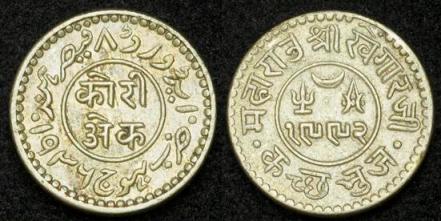 |
Y#65 Kori.
Year:
VS1992 (1936). Weight:
4.67g [4.70g]. Metal:
0.610 Silver.
Diameter: 17.00 mm. Edge:
Plain. Alignment:
Medal. Mint:
Bhuj.
Obverse:
"Edward VIII Qaiser-i-Hind" (Edward VIII, Emperor of India), "Zarb Bhuj"
(Mint: Bhuj) with date.
Reverse: Trident (trishul)
on the left above side below the crescent. Legends in the center.
Date at the bottom.
Mintage: N/A.
Minted Years:
VS1992 (1936) and VS1993 (1936). Ruler:
Khengarji III. |
|
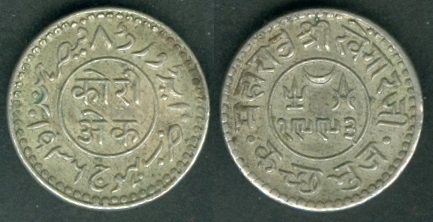 |
Same as above coin, Y#65 but...
Year:
VS1993 (1936). Weight:
4.67g. |
|
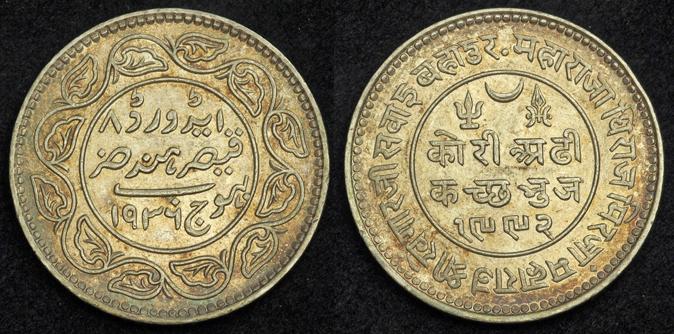 |
Y#66 2½ Kori.
Year:
VS1992 (1936). Weight:
6.96g [6.935g]. Metal:
0.937 Silver.
Diameter: 26.00 mm. Edge:
Plain with Lettered: * भुज * Kutch *
कच्छ * Bhuj *. Readable when CE date (Obverse side) is on top. Alignment:
Medal. Mint:
Bhuj.
Obverse:
"Edward VIII Qaiser-i-Hind" (Edward VIII, Emperor of India), "Zarb Bhuj"
(Mint: Bhuj) with date.
Leaves of wreath pointing clockwise.
Mintage: N/A.
Minted Years:
VS1992 (1936) and VS1993 (1936). Ruler:
Khengarji III. |
|
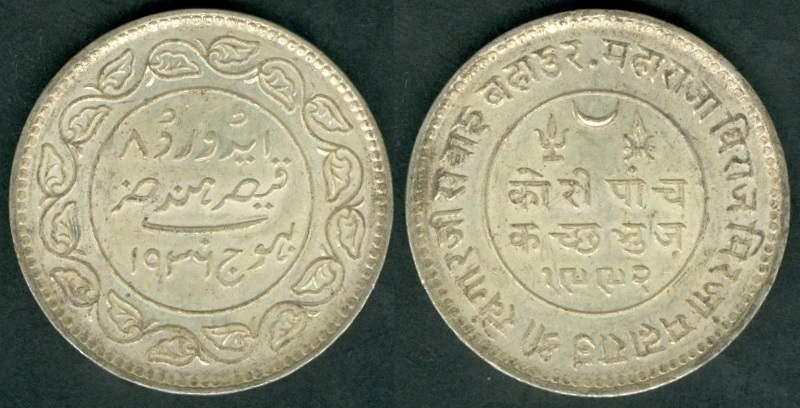 |
Y#67 5 Kori.
Year:
VS1992 (1936). Weight:
13.90g [13.87g]. Metal:
0.937 Silver.
Diameter: 32.00 mm. Edge:
Plain with Lettered: * भुज * Kutch *
कच्छ * Bhuj *. Readable when CE date (Obverse side) is on top. Alignment:
Medal. Mint:
Bhuj.
Obverse:
"Edward VIII Qaiser-i-Hind" (Edward VIII, Emperor of India), "Zarb Bhuj"
(Mint: Bhuj) with date.
Leaves of wreath pointing clockwise.
Mintage: N/A.
Minted Years:
VS1992 (1936) and VS1993 (1936). Ruler:
Khengarji III. |
|
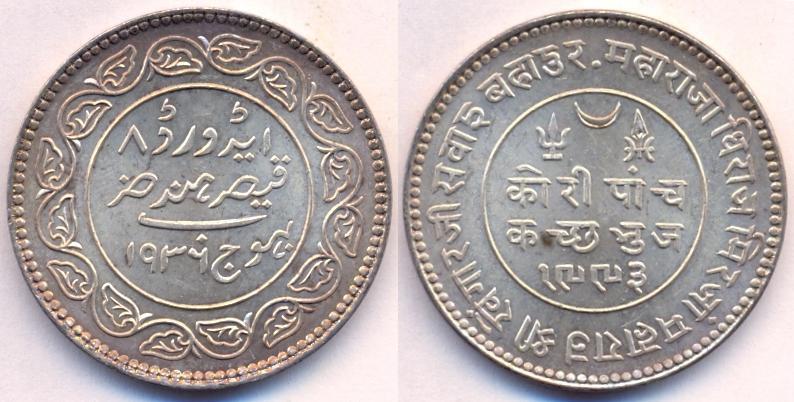 |
Same as above coin, Y#67 but...
Year:
VS1993 (1936). Weight:
13.88g.
Edge is readable when VS date (Reverse side) is on top. |
|
| |
| Khengarji
III (1875 - 1942) coinage citing George VI: |
| |
|
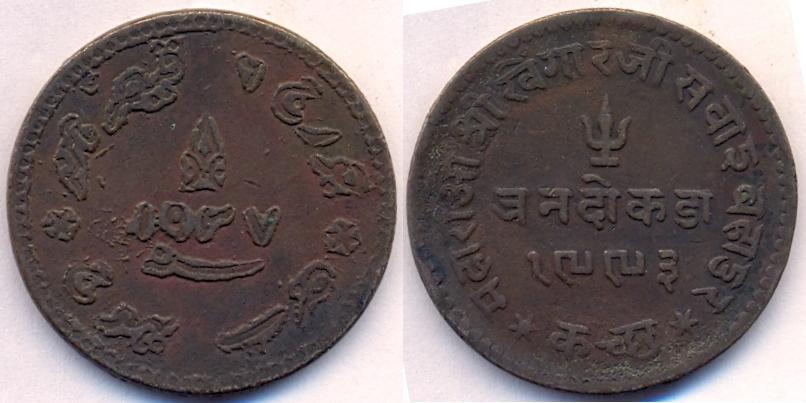 |
Y#71 3 Dokdo (Dhabu or 1/8 kori).
Year:
VS1993 (1937). Weight:
14.80g. Metal:
Copper.
Diameter: 32.25 mm. Edge:
Plain with some sort of decoration. Alignment:
Medal. Mint:
Bhuj.
Obverse:
"George VI Qaiser-i-Hind" (George VI, Emperor of India), "Zarb Bhuj"
(Mint: Bhuj) with date.
Reverse: Date below trident (trishul)
and legend in the center with more legends around.
Mintage: N/A.
Minted Years:
One year type. Ruler:
Khengarji III. |
|
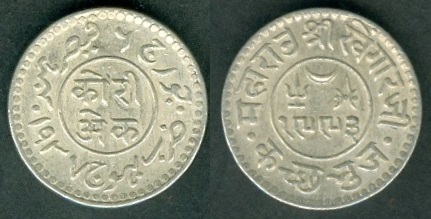 |
Y#73 Kori.
Year:
VS1993 (1937). Weight:
4.68g [4.70g]. Metal:
0.610 Silver.
Diameter: 17.00 mm. Edge:
Plain. Alignment:
Medal. Mint:
Bhuj.
Obverse:
"George VI Qaiser-i-Hind" (George VI, Emperor of India), "Zarb Bhuj"
(Mint: Bhuj) with date.
Reverse: Trident (trishul)
on the left above side below the crescent. Legends in the center.
Date at the bottom within the center circle.
Mintage: N/A. |
|
Minted Years:
VS1993 (1937), VS1994 (1937), VS1995 (1938), VS1995 (1939),
VS1996 (1939) and VS1996 (1940). Ruler:
Khengarji III. |
|
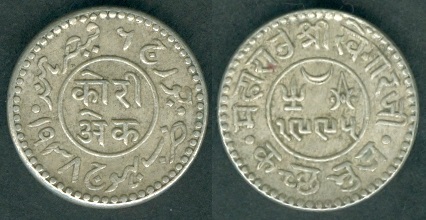 |
Same as above coin, Y#73 but...
Year:
VS1995 (1938). Weight:
4.70g. |
|
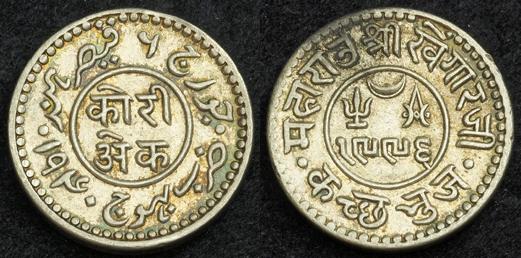 |
Same as above coin, Y#73 but...
Year:
VS1996 (1940). Weight:
4.67g. |
|
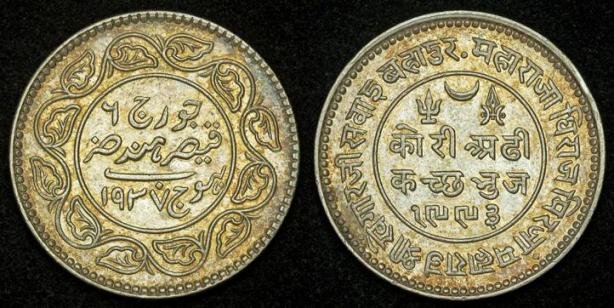 |
Y#74 2½ Kori.
Year:
VS1993 (1937). Weight:
6.96g [6.935g]. Metal:
0.937 Silver.
Diameter: 26.00 mm. Edge:
Plain with Lettered: * भुज * Kutch *
कच्छ * Bhuj *. Readable when VS date (reverse side) is on top. Alignment:
Medal. Mint:
Bhuj.
Obverse:
"George VI Qaiser-i-Hind" (George VI, Emperor of India), "Zarb Bhuj"
(Mint: Bhuj) with date within the center circle.
Leaves of wreath pointing clockwise.
Mintage: N/A.
Minted Years:
One year type. Ruler:
Khengarji III. |
|
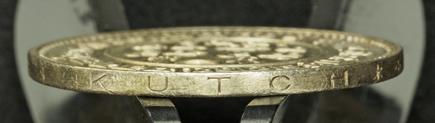 |
Lettering edge of the above coin. |
|
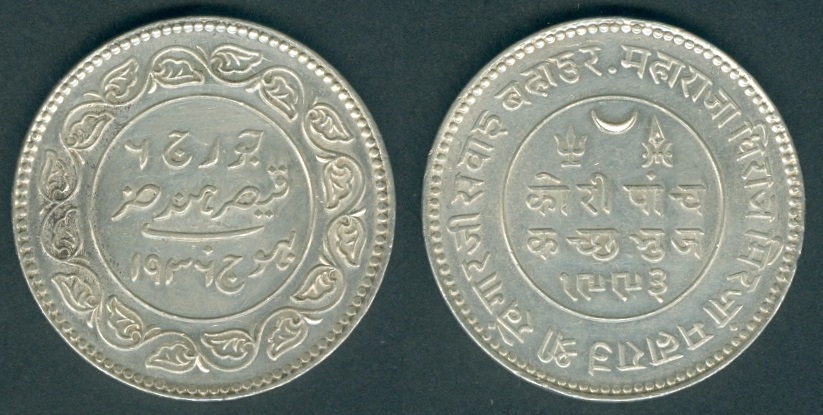 |
Y#75 5 Kori.
Year:
VS1993 (1936). Weight:
13.93g [13.87g]. Metal:
0.937 Silver.
Diameter: 32.00 mm. Edge:
Plain with Lettered: * भुज * Kutch *
कच्छ * Bhuj *. Readable when VS date (Reverse side) is on top. Alignment:
Medal. Mint:
Bhuj.
Obverse:
"George VI Qaiser-i-Hind" (George VI, Emperor of India), "Zarb Bhuj"
(Mint: Bhuj) with date.
Leaves of wreath pointing clockwise.
Reverse:
Crescent flanked by trident and and trisul knife above two lines of
legends and VS date at the bottom (all within the center circle).
Legend clockwise in outer circle.
Mintage: N/A.
|
|
Minted Years:
VS1993 (1936), VS1993 (1937), VS1994 (1937), VS1994 (1938),
VS1995 (1938), VS1997 (1941) and VS1998 (1941).
Ruler:
Khengarji III. |
|
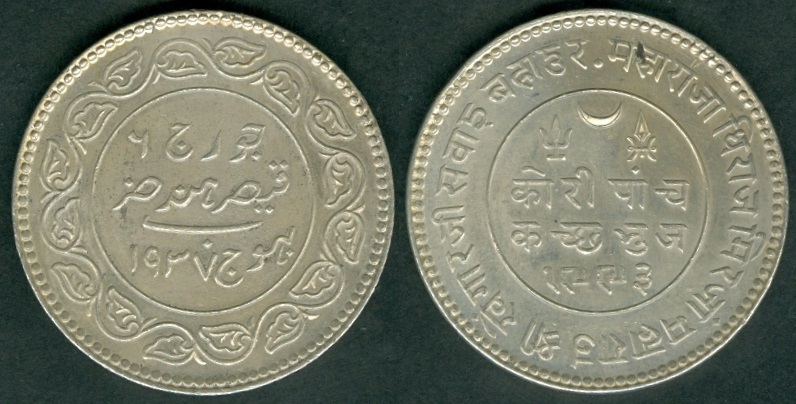 |
Same as above coin, Y#75 but... Year:
VS1993 (1937). Weight:
13.92g [13.87g].
Edge is readable when CE date (Obverse side) is on top. |
|
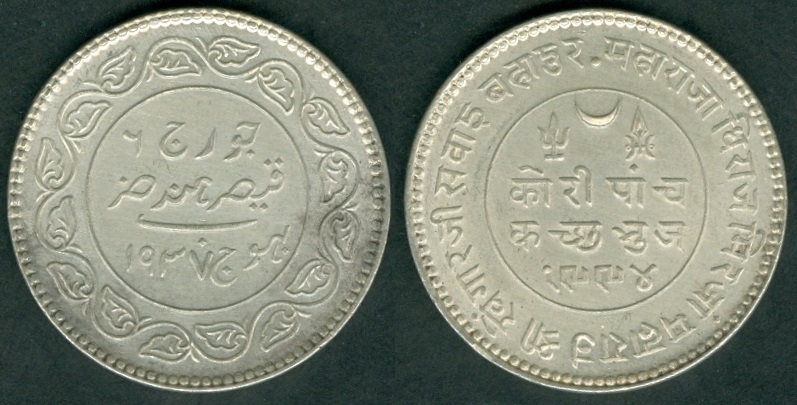 |
Same as above coin, Y#75 but...
Year:
VS1994 (1937). Weight:
13.93g [13.87g].
Edge is readable when VS date (Reverse side) is on top. |
|
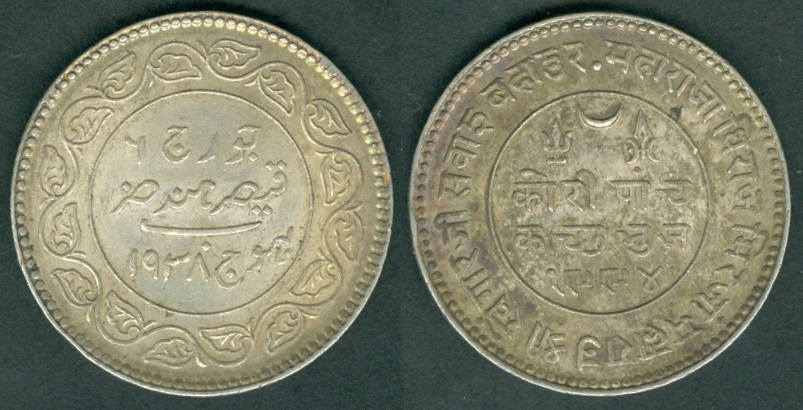 |
Same as above coin, Y#75 but...
Year:
VS1994 (1938). Weight:
13.87g [13.87g].
Edge is readable when CE date (Obverse side) is on top. |
|
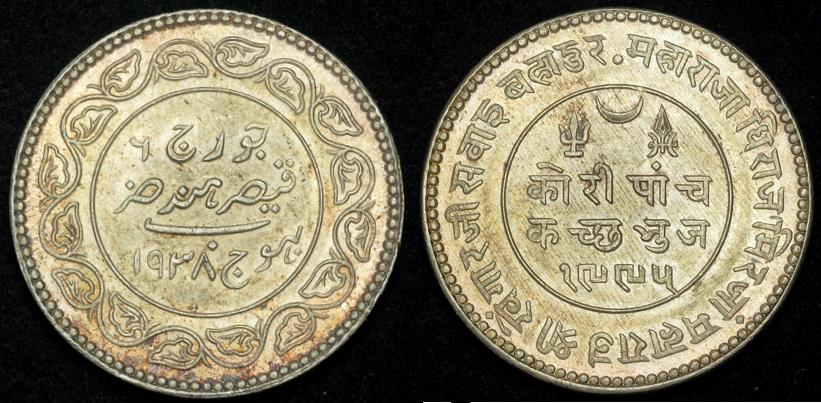 |
Same as above coin, Y#75 but...
Year:
VS1995 (1938). Weight:
13.91g [13.87g].
Edge is readable when CE date (Obverse side) is on top. |
|
|
|
|
|
|
Vijayaraja (1942 - 1948) coinage citing
George VI: |
|
Currency:
Kori = 2 Adlinao = 4 Payalo = 8 Dhabu = 16
Dhinglo = 24 Dokda = 48 Trambiyo = 96 Babukiya. |
|
|
|
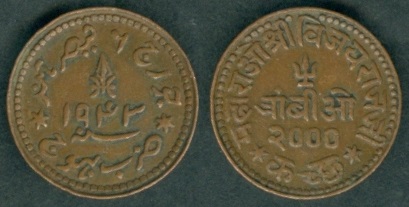 |
Y#76 Trambiyo (1/2 Dokdo or 1/48 Kori).
Year:
VS2000 (1943). Weight:
2.82g. Metal:
Copper.
Diameter: 16.00 mm. Edge:
Plain. Alignment:
Coin. Mint:
Bhuj. |
|
Obverse:
"جورج ٦ قيصر ہند" ["George VI Qaiser-i-Hind" (George VI, Emperor of India)]
written at the top section. Dagger and date in the center. One star
on each side. "ضرب بہوج" ["Zarb Bhuj"
(Mint: Bhuj)] written at the bottom section.
Reverse: "महाराओ श्री विजयराजजी" (Maharao
Shri Vijayaraji) written at the top section. Trident, "त्रांबीओ" (Trambiyo)
and VS (Vikram Samvat) Date written in the center. "*कच्छ*" (*Kutch*)
written at the bottom.
Mintage: N/A.
Minted Years:
VS2000 (1943) and VS2000 (1944). Ruler:
Vijayarajji. |
|
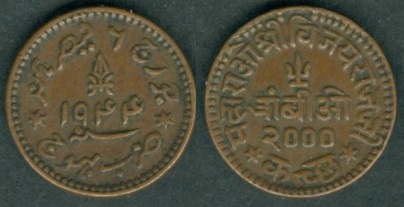 |
Same as above coin, Y#76 but...
Year:
VS2000 (1944). Weight:
2.81g. |
|
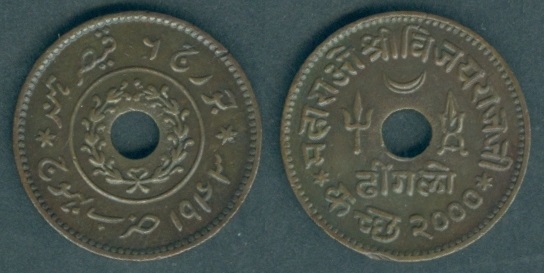 |
Y#77 Dhinglo (1½ Dokdo or 1/16 Kori).
Year:
VS2000 (1943). Weight:
4.18g. Metal:
Copper.
Diameter: 20.50 mm;
hole in center. Edge:
Plain. Alignment:
Medal. Mint:
Bhuj. |
|
Obverse:
"جورج ٦ قيصر ہند" ["George VI Qaiser-i-Hind" (George VI, Emperor of India)]
written at the top section. Wreath in the center circle around hole.
One star on each side. "ضرب بہوج" ["Zarb Bhuj"
(Mint: Bhuj)] written at the bottom left side and Date written at
the bottom right side.
Reverse: "महाराओ श्री विजयराजजी" (Maharao
Shri Vijayaraji) written at the top section. In center around hole:
Crescent moon, trident (left), vertical dagger (right) and value "ढींगलो"
(Dhinglo) below. "*कच्छ*" (*Kutch*) written with VS (Vikram Samvat)
Date at the bottom.
Mintage: N/A.
Minted Years:
VS2000 (1943), VS2000 (1944), VS2004 (1947) and VS2004 (1948). Ruler:
Vijayarajji. |
|
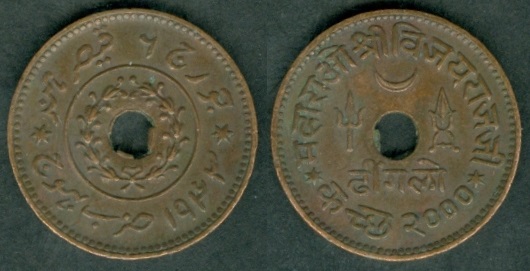 |
Same as above coin, but the center hole is not
properly cut. Weight:
4.10g. |
|
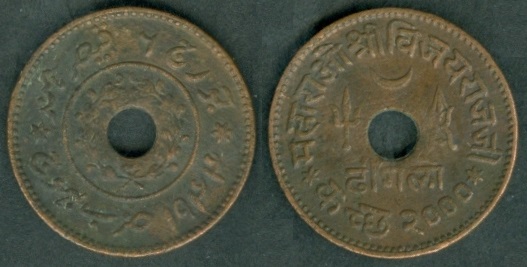 |
Same as above coin, Y#77 but...
Year:
VS2000 (1944). Weight:
4.12g. |
|
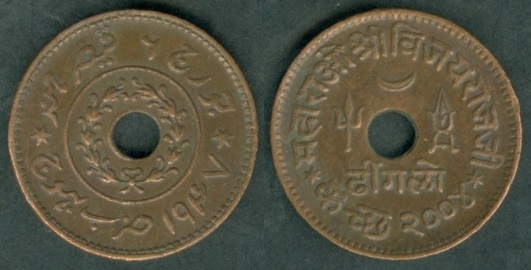 |
Same as above coin, Y#77 but...
Year:
VS2004 (1947). Weight:
4.15g. |
|
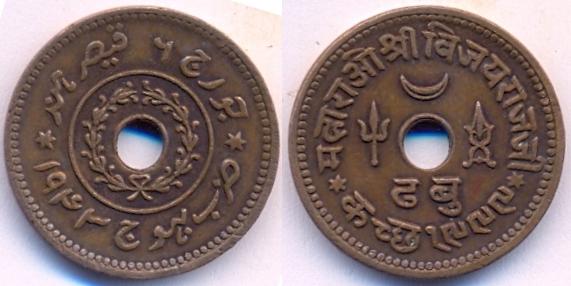 |
Y#78 Dhabu (1/8 kori).
Year:
VS1999 (1943). Weight:
6.69g. Metal:
Copper.
Diameter: 23.50 mm;
hole in center. Edge:
Plain. Alignment:
Medal. Mint:
Bhuj. |
|
Obverse:
"جورج ٦ قيصر ہند" ["George VI Qaiser-i-Hind" (George VI, Emperor of India)]
written at the top section. Wreath in the center circle around hole.
One star on each side. "ضرب بہوج" ["Zarb Bhuj"
(Mint: Bhuj)] written at the bottom right side and Date written at
the bottom left side.
Reverse: "महाराओ श्री विजयराजजी" (Maharao
Shri Vijayaraji) written at the top section. In center around hole:
Crescent moon, trident (left), vertical dagger (right) and value "ढबु"
(Dhabu) below. "*कच्छ*" (*Kutch*) written with VS (Vikram Samvat)
Date at the bottom.
Mintage: N/A.
Minted Years:
VS1999 (1943), VS2000 (1943), VS2000 (1944) and VS2003 (1947). Ruler:
Vijayarajji. |
|
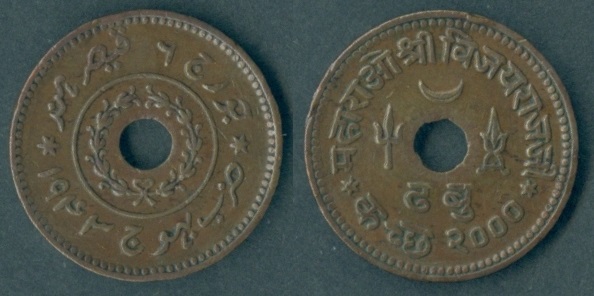 |
Same as above coin, Y#78 but...
Year:
VS2000 (1943). Weight:
6.64g. |
|
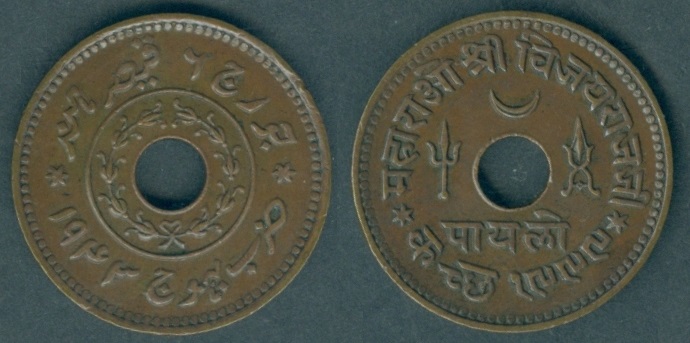 |
Y#79 Payalo (1/4 kori).
Year:
VS1999 (1943). Weight:
8.32g. Metal:
Copper.
Diameter: 26.50 mm;
hole in center. Edge:
Plain. Alignment:
Medal. Mint:
Bhuj. |
|
Obverse:
"جورج ٦ قيصر ہند" ["George VI Qaiser-i-Hind" (George VI, Emperor of India)]
written at the top section. Wreath in the center circle around hole.
One star on each side. "ضرب بہوج" ["Zarb Bhuj"
(Mint: Bhuj)] written at the bottom right side and Date written at
the bottom left side.
Reverse: "महाराओ श्री विजयराजजी" (Maharao
Shri Vijayaraji) written at the top section. In center around hole:
Crescent moon, trident (left), vertical dagger (right) and value "पायलो"
(Payalo) below. "*कच्छ*" (*Kutch*) written with VS (Vikram Samvat)
Date at the bottom.
Mintage: N/A.
Minted Years:
VS1999 (1943), VS2000 (1943), VS2000 (1944), VS2001 (1944), VS2001
(1945), VS2002 (1945), VS2002 (1946), VS2003 (1946) and VS2003
(1947). Ruler:
Vijayarajji. |
|
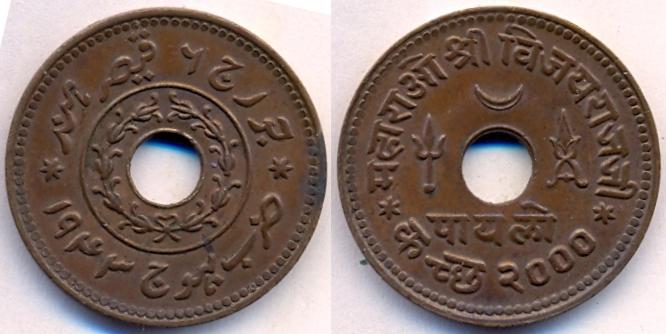 |
Same as above coin, Y#79 but.. Year:
VS2000 (1943). Weight:
8.25g. |
|
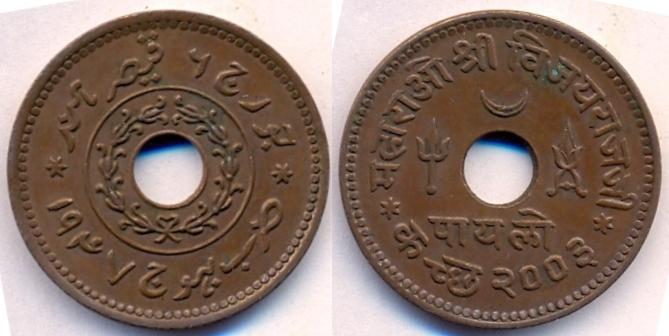 |
Same as above coin, Y#79 but.. Year:
VS2003 (1947). Weight:
8.35g. |
|
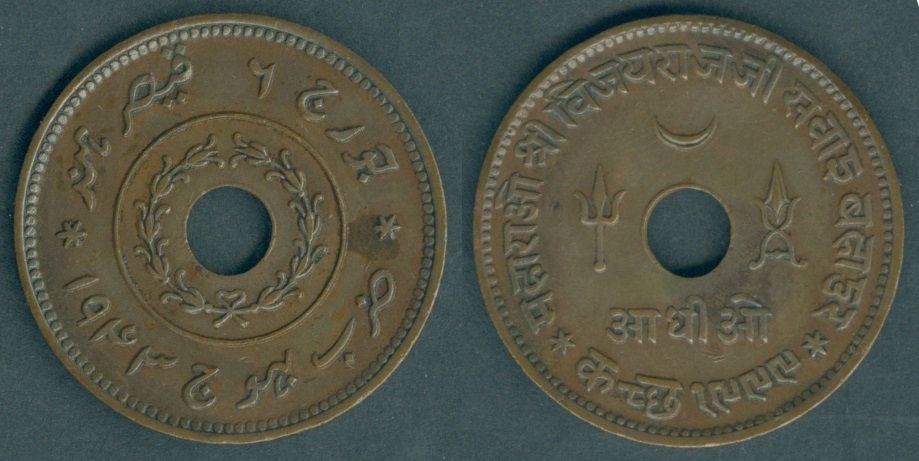 |
|
Y#80 Adhio (1/2 kori).
Year:
VS1999 (1943). Weight:
16.54g. Metal:
Copper.
Diameter: 36.00 mm;
hole in center. Edge:
Plain. Alignment:
Medal. Mint:
Bhuj.
Obverse:
"جورج ٦ قيصر ہند" ["George VI Qaiser-i-Hind" (George VI, Emperor of India)]
written at the top section. Wreath in the center circle around hole.
One star on each side. "ضرب بہوج" ["Zarb Bhuj"
(Mint: Bhuj)] written at the bottom right side and Date written at
the bottom left side.
Reverse: "महाराओ श्री विजयराजजी सवाइ
बहादुरी" (Maharao Shri Vijayarajji Sawai Bahadur) written at the top
section. In center around hole: Crescent moon, trident (left),
vertical dagger (right) and value "आधीओ" (Adhio) below. "*कच्छ*" (*Kutch*)
written with VS (Vikram Samvat) Date at the bottom.
Mintage: N/A.
Minted Years:
VS1999 (1943), VS2000 (1943), VS2001 (1944), VS2001 (1945), VS2002
(1945) and VS2002 (1946). Ruler:
Vijayarajji. |
|
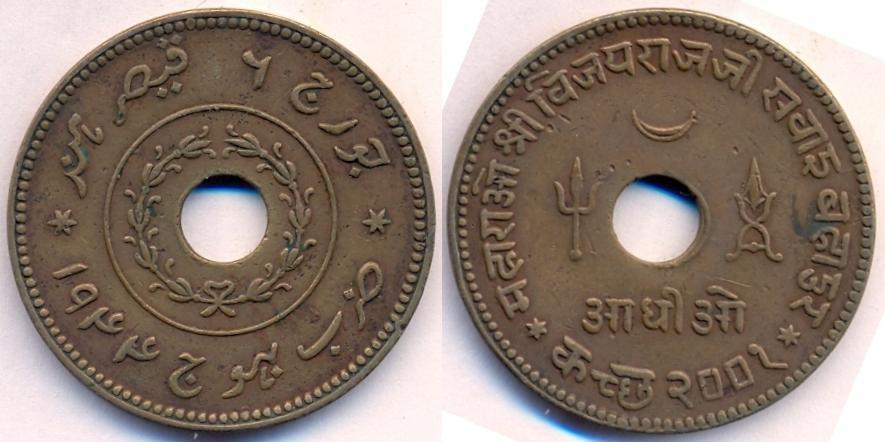 |
| Same as above coin, Y#80 but..
Year:
VS2001 (1944). Weight:
16.49g.
Mintage: N/A. |
|
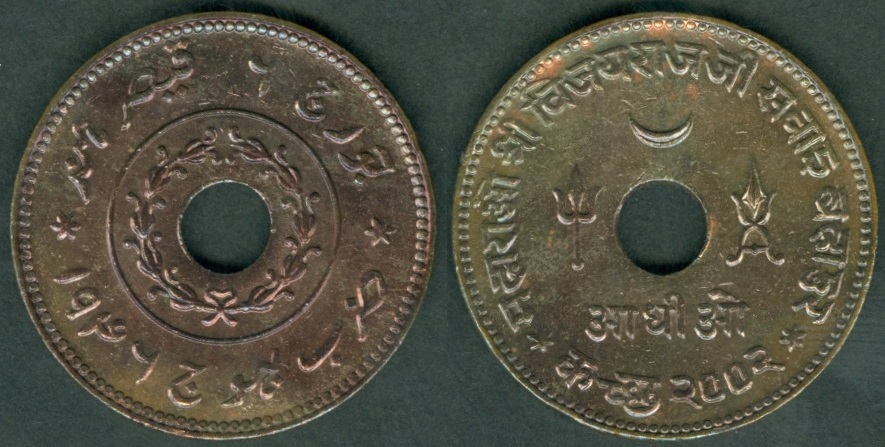 |
| Same as above coin, Y#80 but..
Year:
VS2002 (1946). Weight:
16.35g.
Mintage: N/A. |
|
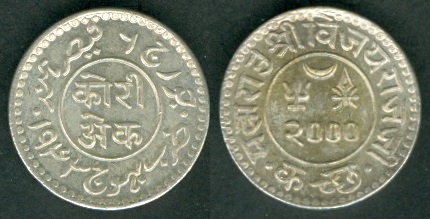 |
Y#81 Kori.
Year:
VS2000 (1943). Weight:
4.70g [4.70g]. Metal:
0.610 Silver.
Diameter: 17.00 mm. Edge:
Plain. Alignment:
Medal. Mint:
Bhuj. |
|
Obverse:
"جورج ٦ قيصر ہند" ["George VI Qaiser-i-Hind" (George VI, Emperor of India)]
written at the top section. "कोरी एक" ["Kori Ek" (Kori One)] written
in the center circle. One dot on each side. "ضرب بہوج" ["Zarb Bhuj"
(Mint: Bhuj)] written at the bottom right side and Date written at
the bottom left side.
Reverse: Crescent moon, trident (left),
vertical dagger (right) and VS (Vikram Samvat) Date within the
center circle. "महाराउ श्री विजयराजजी" (Maharao Shri Vijayrajji)
written at the top section."·कच्छ·"
(·Kutch·)
written at the bottom.
Mintage: N/A.
Minted Years:
VS1999 (1942), VS1999 (1943), VS2000 (1943), VS2000 (1944) and
VS2001 (1944). Ruler:
Vijayarajji. |
|
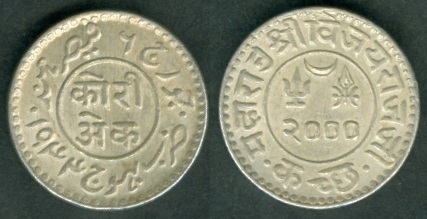 |
Same as above coin, Y#81 but...
Year:
VS2000 (1944). Weight:
4.68g. |
|
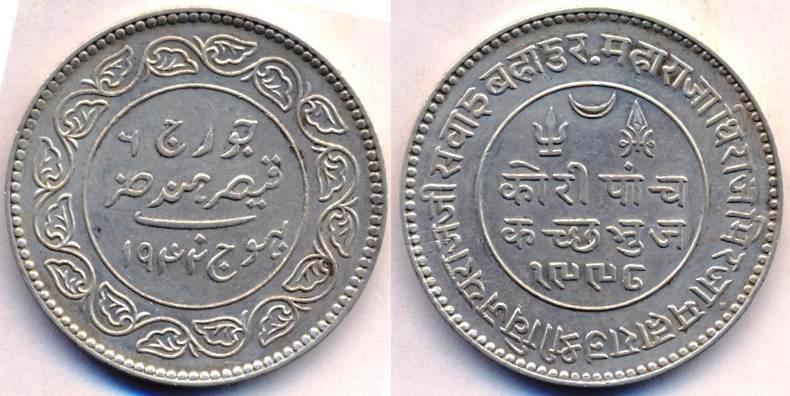 |
Y#82 5 Kori.
Year:
VS1998 (1942). Weight:
13.87g [13.87g]. Metal:
0.937 Silver.
Diameter: 32.00 mm. Edge:
Plain with Lettered: * भुज * Kutch *
कच्छ * Bhuj *. Readable when VS date (reverse side) is on top. Alignment:
Medal. Mint:
Bhuj. |
|
Obverse:
"جورج ٦ قيصر ہند" ["George VI Qaiser-i-Hind" (George VI, Emperor of India)]
written as first two line in the center circle. "ضرب بہوج" ["Zarb Bhuj"
(Mint: Bhuj)] with Date written at the bottom line in the center
circle. Wreath decoration around outside the center circle.
Reverse: Crescent moon, trident (left)
and vertical dagger (right) at the top within the center circle. "कोरी
पांच" [Kori Pannch (Kori Five)] and "कच्छ भुज" (Kutch Bhuj) written
in two lines within the center circle. VS (Vikram Samvat) Date at
the bottom within the center circle. Outside the center circle from
the top dot clockwise legend: "महाराजा धिराज मिरजा महाराउ श्री
विजयराजजी सवाई बहादुरी" (Maharaja Dhiraj Mirza Maharao Shri
Vijayrajji Sawai Bahadur).
Mintage: N/A.
Minted Years:
VS1998 (1942) and VS1999 (1942). VS1998 (1943) also reported but not
confirmed. Ruler:
Vijayarajji. |
|
| |
| |
| Madan
Singhji [Yuvraj
Meghraji] (1947-1948) coinage on celebrating Indian Independence: |
| Currency:
Kori = 2 Adlinao = 4 Payalo = 8 Dhabu = 16
Dhinglo = 24 Dokda = 48 Trambiyo = 96 Babukiya. |
| |
|
.jpg) |
Y#83 Dhabu (1/8 kori).
Year:
VS2004 (1947). Weight:
6.70g. Metal:
Copper.
Diameter: 23.00 mm;
hole in center. Edge:
Plain. Alignment:
Medal. Mint:
Bhuj. |
|
Obverse: "महाराउ श्री मदनसिंहजी" (Maharao Shri Madansinghji)
written at the top section." Crescent moon (top), trident (left),
vertical dagger (right) and design at the bottom; all within the
center around the hole. "*कच्छ २००४*"
(*Kutch 2004*)
written at the bottom section.
Reverse:
"जय हिन्द" ["Jai Hind" (Victory to India)] written at the top.
Wreath with knot around the center hole. Design on left and right
sides. Value "ढबु" (Dhabu) written at the bottom.
Mintage: N/A.
Minted Years:
One year type. Ruler:
Madan Singh. |
|
.jpg) |
Y#84 Kori.
Year:
VS2004 (1947). Weight:
4.66g [4.70g]. Metal:
0.610 Silver.
Diameter: 17.00 mm. Edge:
Plain. Alignment:
Medal. Mint:
Bhuj.
Obverse: Crescent moon, trident (left),
vertical dagger (right) and VS (Vikram Samvat) Date within the
center circle. "महाराउ श्री मदनसिंहजी" (Maharao Shri Madansinghji)
written at the top section."·कच्छ·"
(·Kutch·)
written at the bottom. |
|
Reverse:
"जय हिन्द" ["Jai Hind" (Victory to India)] written at the top.
"कोरी एक" ["Kori Ek" (Kori One)] written in the center line between
decoration curves. "*भुज*" (*Bhuj*) written at the bottom.
Mintage: N/A.
Minted Years:
One year type. Ruler:
Madan Singh. |
|
| |
| |
1948 Kutch province of India.
26 Jan 1950 Part C state.
01 Nov 1956 part of Bombay state.
01 May 1960 part of Gujarat state. |
| |
- Kutch Chief Commissioners
- Chhotalal Khovshaldan
Desai........................01 Jun 1948 - 1952
-
Upon the independence of India in 1947, Kachchh
(Kutch)
acceded unto the dominion of India and was constituted an independent
commissionaire. It was created a province in 1948. Upon the
Constitution of India coming into force on 26 January 1950, Kutch became a
"Class C" state, i.e. its administration was under the direct control of
India's central government with a Chief Commissioner. Its capital was Bhuj.
- Sambhajirao Appasaheb Ghatge..............................1952
- 30 Oct 1956
-
On 01 November 1956, Kachchh State was merged with
Bombay state, under the
States Reorganization Act. On 01 May 1960, it was
divided into the new linguistic states of Gujarat and Maharashtra, with Kachchh becoming a district as part of Gujarat state.
|
| |
|
On the Partition of India in 1947, the province of
Sindh, including the port of Karachi, became part of Pakistan. The Indian
Government constructed a modern port at Kandla in Kutch to serve as a port
for western India in lieu of Karachi. There was a dispute over the Kutch
region with Pakistan on Sir Creek. In 1965, Pakistan claimed
3,500 sq mi (9,100 km2) of the land and an international tribunal was set
up. It awarded 350 sq mi (910 km2) of the claimed land to Pakistan, the rest
remaining with India. |
|
Kutch district (also spelled as Kachchh) is a district
of Gujarat state in western India. Covering an area of 45,652 km², it is the
largest district of India. Kachchh literally means something which
intermittently becomes wet and dry; a large part of this district is known
as Rann of Kachchh which is shallow wetland which submerges in water during
the rainy season and becomes dry during other seasons. The same word is also
used in the languages of Sanskrit origin for a tortoise and garments to be
worn while having a bath. The Rann is famous for its marshy salt flats which
become snow white after the shallow water dries up each season before the
monsoon rains. |
|
|
|
|
|
|
|
Early Indian coins:
British India coins:
Coins of Indian Princely States and other
colonies:
Coins of "Republic of India" sorted under below
Presidential rulers:
Others:
|
|
|
|
|
| |
|
|
| |
| India |
|
Countries
/ Territories |
| |
|
Chiefa Coins | |
|